
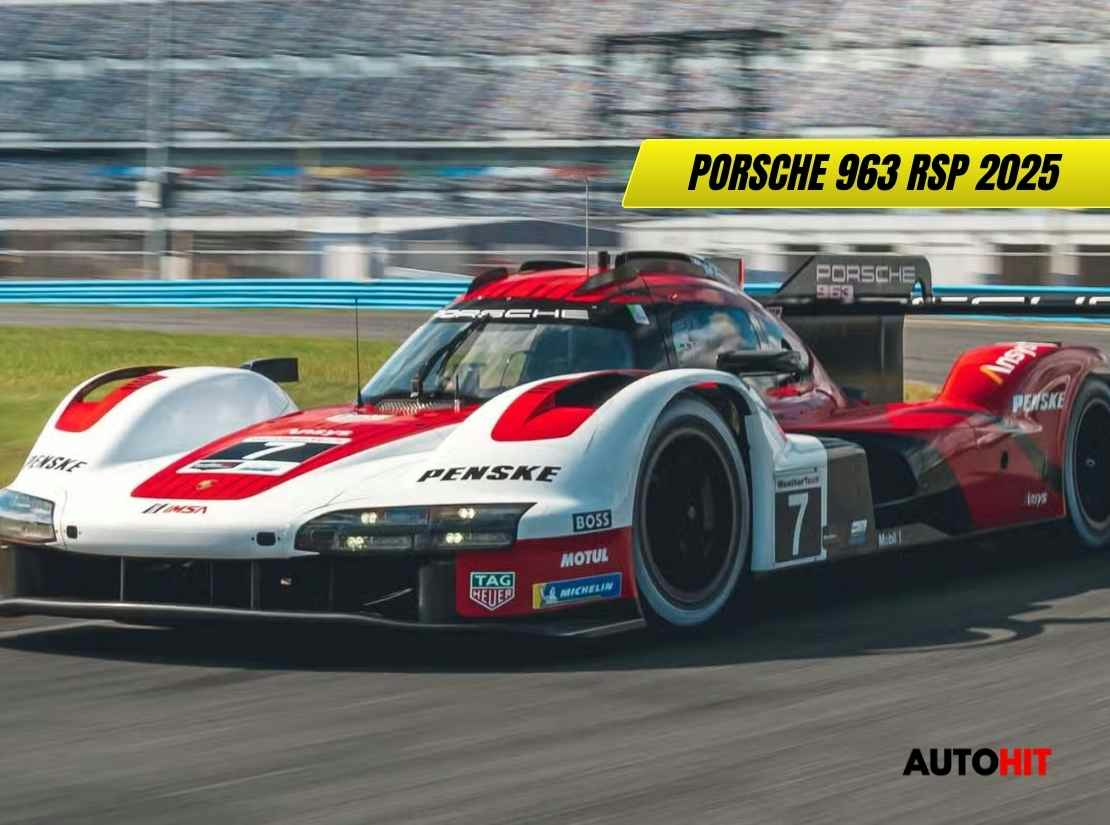
Porsche 963 RSP revealed as one-off road-legal Le Mans hypercar with 670hp hybrid V8, bespoke interior, and potential UK appearance. Full details on specifications, pricing, and motorsport heritage.
In the rarified world of automotive unicorns, few manufacturers possess both the racing pedigree and engineering audacity to transform a Le Mans prototype into a road-legal reality. Porsche has just reminded us why they remain the masters of this dark art with the revelation of the 963 RSP – a one-off road-legal interpretation of their World Endurance Championship-winning race car that promises to redefine what’s possible when motorsport meets luxury craftsmanship.
Our team at AutoHit has been following Porsche’s hints about this project since the mysterious teaser campaign began in April, and the reality exceeds even our most optimistic expectations. The 963 RSP represents more than just another limited-edition hypercar – it’s a statement of intent from a manufacturer that has grown quietly frustrated with the lukewarm reception to their all-electric Mission X concept and sees an opportunity to reconnect with their racing heritage in the most visceral way possible.
The timing couldn’t be more significant. With the 2025 24 Hours of Le Mans approaching in June and Porsche celebrating 50 years since the legendary road-legal 917K was created for Count Gregorio Rossi di Montelera, the 963 RSP serves as both tribute and testament to Porsche’s enduring ability to blur the lines between racetrack and public road. For UK enthusiasts, this represents the most exclusive Porsche road car since the 911 GT1 Straßenversion of the late 1990s.
Key Highlights
• Unique status: Confirmed as a genuine one-off vehicle, making it potentially the most exclusive modern Porsche ever created
• Le Mans pedigree: Based on the 2024 World Endurance Championship-winning 963 LMDh prototype with proven competition success
• Hybrid powerhouse: 4.6-litre twin-turbo V8 from 918 Spyder heritage combined with 67hp hybrid system for approximately 670hp total
• Bespoke luxury: Hand-crafted interior with Alcantara trim, custom upholstery, and premium materials befitting road car status
• June 2025 debut: Expected public unveiling at Le Mans weekend, with potential UK appearances for select collectors
• RSP significance: Name potentially honours Roger S. Penske, whose Team Penske runs Porsche’s factory racing programme
Engineering Marvel: Transforming Prototype Into Road Car
The challenge of making a Le Mans prototype road-legal extends far beyond simply adding indicators and mirrors. The 963 RSP represents one of the most complex automotive engineering exercises undertaken by any manufacturer, requiring fundamental rethinking of systems designed purely for competition use.
Powertrain Adaptation
At the heart of the 963 RSP lies the same 4.6-litre twin-turbocharged V8 that powers the race car, derived from the engine architecture used in the legendary 918 Spyder but extensively modified for competition use. In race trim, this unit produces approximately 680hp and revs to an extraordinary 10,000rpm, creating the distinctive sound that has made the 963 one of the most aurally exciting prototypes in modern endurance racing.
The road car adaptation requires extensive modifications to meet emissions regulations while maintaining the visceral character that defines the racing original. This includes revised ECU mapping, modified exhaust systems with proper silencing, and integration with the hybrid system that provides an additional 67hp of electric assistance.
The hybrid component, derived from Porsche’s extensive experience in Formula E and the 919 Hybrid LMP1 programme, provides instant torque fill and enables limited electric-only operation – crucial for meeting modern urban emission requirements while preserving the dramatic performance that justifies the car’s existence.
Chassis and Safety Integration
Perhaps the most challenging aspect of the 963 RSP project involves adapting the race car’s lightweight chassis for road use while maintaining its fundamental character. The original 963 utilises an extensively modified version of the Multimatic chassis technology, optimised for maximum aerodynamic efficiency and minimum weight.
Road car requirements necessitate comprehensive safety modifications including enhanced crash structures, road-legal lighting systems, and comfort features that would be unthinkable in the racing original. The teaser videos suggest extensive use of carbon fibre bodywork, carefully refinished and modified to accommodate road car necessities like larger mirrors, additional lighting, and practical access requirements.
The suspension system requires fundamental recalibration to provide acceptable ride quality over public roads while retaining the dynamic capability that makes the 963 so effective on track. This likely involves adaptive damping systems and revised spring rates that can transform character depending on driving conditions.
Luxury Craftsmanship: Racing Meets Road Car Refinement
The transformation from spartan race car to luxurious road machine represents perhaps the most visible aspect of the 963 RSP project. Porsche’s teaser campaign has provided tantalising glimpses of the craftsmanship involved in creating what appears to be one of the most luxurious interiors ever fitted to a racing-derived vehicle.
Interior Transformation
The race car’s basic carbon fibre tub provides the foundation for a completely bespoke interior environment. Hand-stitched Alcantara surfaces replace the utilitarian materials of the competition car, while careful attention to ergonomics ensures that the driving position remains pure while providing acceptable comfort for road use.
The seats appear to be custom-designed pieces that maintain the support necessary for dynamic driving while incorporating luxury touches like contrast stitching and premium materials. The dashboard integration suggests extensive redesign to accommodate road car requirements like climate control, entertainment systems, and the numerous switches necessary for legal road operation.
Traditional Porsche luxury cues appear throughout the cabin, including the distinctive crest badge work and material combinations that distinguish road cars from their racing counterparts. The attention to detail visible in the teaser footage suggests craftsmanship levels comparable to the most exclusive Porsche models.
Exterior Refinement
While maintaining the fundamental silhouette that makes the 963 so aerodynamically effective, the RSP receives subtle but significant modifications for road use. The most obvious change involves the addition of a proper Porsche badge to replace the weight-saving stickers used on the race car, symbolising the transformation from competition tool to luxury artifact.
Paint quality appears exceptional, with multiple coats and extensive preparation work visible in the production footage. The carbon fibre elements receive careful finishing that contrasts dramatically with the purely functional approach of the racing original.
Lighting systems require complete redesign to meet road regulations while maintaining the aggressive aesthetic that defines the 963’s character. This likely involves LED technology integrated into modified housings that preserve the car’s distinctive appearance while providing adequate illumination for public road use.
Historical Context: Following Legendary Precedents
The 963 RSP continues a distinguished tradition of Porsche racing cars adapted for road use, though such projects have become increasingly rare as modern safety and emissions regulations have made the conversion process exponentially more complex.
The 917K Legacy
The most famous precedent remains the 1975 917K created for Count Gregorio Rossi di Montelera, which required modifications including exhaust silencers, additional mirrors, side indicators, a horn, and even a spare tyre to achieve road legality in Alabama. That car represented one of the wildest road cars ever created, offering near-uncompromised racing performance in a barely civilised package.
The 963 RSP faces far more stringent regulatory requirements than its 1975 predecessor, necessitating comprehensive modifications to systems that barely existed fifty years ago. Modern crash safety standards, emissions compliance, and consumer protection regulations create challenges that simply didn’t exist when the 917K received its licence plate.
911 GT1 Inspiration
More recent precedent comes from the 911 GT1 Straßenversion of 1996-1998, which represented Porsche’s last serious attempt to create a road-going version of a top-flight racing car. That project required extensive modifications to create 25 road cars that shared fundamental architecture with the Le Mans-winning race car while meeting contemporary safety and emissions standards.
The GT1 Straßenversion demonstrated both the possibilities and limitations of such projects, delivering extraordinary performance and exclusivity while highlighting the compromises necessary to meet road car requirements. The 963 RSP faces similar challenges but with exponentially more complex base technology.
UK Market Implications: Ultimate Collector’s Prize
While Porsche has confirmed the 963 RSP as a one-off creation, the implications for UK collectors and enthusiasts extend far beyond simple ownership considerations. This car represents a statement about Porsche’s commitment to maintaining their racing heritage in an increasingly electrified future.
Exclusivity and Value
As a genuine one-off vehicle, the 963 RSP automatically enters the realm of automotive artifacts rather than conventional supercars. Comparison with similar unique vehicles suggests values that could easily exceed £10 million, placing it among the most expensive modern cars ever created.
The exclusivity extends beyond mere numbers to encompass the engineering achievement and historical significance of successful race-to-road conversion in the modern era. Future values will likely reflect not just the car’s inherent desirability but its status as potentially the last such project Porsche undertakes before full electrification.
Market Context
The 963 RSP arrives at a time when the hypercar market shows increasing appreciation for authenticity and motorsport heritage over pure specification numbers. Recent sales of racing-derived vehicles demonstrate strong demand for cars with genuine competition pedigree, particularly those from manufacturers with established Le Mans success.
UK collectors have historically shown strong appreciation for Porsche motorsport derivatives, with values of 911 GT1 Straßenversions, Carrera GTs, and 918 Spyders continuing to appreciate despite broader market uncertainties. The 963 RSP’s unique status and proven racing heritage position it as the ultimate expression of this collecting trend.
Technical Specifications and Performance Expectations
While Porsche has remained deliberately vague about specific performance figures, the 963 RSP’s racing heritage provides strong indications of its likely capabilities when adapted for road use.
Power and Performance
The hybrid powertrain’s combined output of approximately 670hp should deliver performance comparable to the most extreme road cars, though specific acceleration figures remain speculation until official testing occurs. The race car’s extraordinary power-to-weight ratio suggests sub-3-second 0-60mph capability, though road car modifications will inevitably add weight and complexity.
Top speed becomes academic given the car’s likely limited use, though aerodynamic efficiency suggests capability well beyond UK legal requirements. More relevant will be the car’s ability to deliver the sensory experience that justifies its extraordinary exclusivity and likely pricing.
Handling and Dynamics
The 963’s racing heritage promises handling characteristics that exceed virtually any road car, though public road use will require significant dynamic compromises. Adaptive suspension systems and multiple driving modes will likely provide transformation between track-focused aggression and acceptable road manners.
The aerodynamic efficiency that makes the 963 so effective at Le Mans will translate into exceptional high-speed stability on road, though the massive downforce levels generated at racing speeds may require modification for practical road use.
Future Implications: Porsche’s Commitment to Racing Heritage
The 963 RSP project sends important signals about Porsche’s future direction as the automotive industry transitions toward electrification. While the Mission X concept represents their electric hypercar aspirations, the 963 RSP demonstrates continued commitment to combustion-powered racing heritage.
Brand Strategy
This project suggests recognition that pure electrification may not satisfy all customer demands, particularly among collectors who value the sensory experience of high-performance combustion engines. The 963 RSP provides Porsche with a flagship that celebrates their racing heritage while the broader range transitions toward electric power.
The investment in creating a one-off road car also demonstrates confidence in the 963’s racing programme and provides valuable publicity for their endurance racing efforts. Success at Le Mans translates directly into brand prestige that benefits the entire Porsche range.
Collector Interest
The project’s existence suggests continued demand for extreme, limited-production vehicles that push engineering boundaries while celebrating motorsport achievement. This validates Porsche’s approach to maintaining prestige through carefully managed exclusivity rather than volume production.
Frequently Asked Questions
Will the Porsche 963 RSP ever be available for purchase, and what might it cost?
As a confirmed one-off vehicle, the 963 RSP is not commercially available in any traditional sense. Porsche has described it as “a one-of-one vehicle crafted with precision, purpose and detail,” suggesting it may be destined for their museum collection or a specific collector. If it were to become available, comparable unique vehicles suggest pricing would easily exceed £10 million, potentially reaching £15-20 million given its unprecedented nature and racing heritage.
Why did Porsche choose to create only one 963 RSP instead of a limited production run?
The complexity of converting a modern Le Mans prototype for road use is exponentially greater than historical precedents like the 917K. Modern safety, emissions, and homologation requirements make such conversions extraordinarily expensive and time-consuming. Creating a single showcase vehicle allows Porsche to demonstrate their engineering capabilities while avoiding the massive investment required for series production, however limited.
How does the 963 RSP compare to Porsche’s planned Mission X electric hypercar?
The two projects represent different aspects of Porsche’s future strategy. The Mission X targets ultimate electric performance with Nürburgring record ambitions, while the 963 RSP celebrates combustion-powered racing heritage. The RSP’s one-off status makes it more exclusive, while the Mission X aims for limited production around 2027. Both serve to maintain Porsche’s hypercar credentials during the transition to electrification.
Could the 963 RSP actually be driven on UK roads legally?
While designed as a road-legal vehicle, the 963 RSP’s extreme nature would make regular road use impractical and potentially problematic. The car would require Individual Vehicle Approval (IVA) testing for UK registration, a complex process for such a unique vehicle. More likely, it would receive limited use for promotional events, museum displays, or very special occasions rather than genuine road driving.
What makes the 963 RSP different from other racing-derived road cars?
The 963 RSP is unique as the first road-legal version of a modern LMDh prototype – a far more complex proposition than previous generations of racing cars. Unlike GT cars or older prototypes, modern LMDh vehicles feature sophisticated hybrid systems, advanced aerodynamics, and complex electronics that make road conversion extraordinarily challenging. The engineering achievement of making such a car road-legal represents a new benchmark in automotive engineering.
Is there any connection between the RSP name and Team Penske?
Strong speculation suggests “RSP” honors Roger S. Penske, whose Team Penske runs Porsche’s factory racing programme with remarkable success. Penske’s organisation secured multiple championship wins in 2024 across WEC and IMSA, making this a fitting tribute to their partnership. However, Porsche hasn’t officially confirmed this interpretation of the name.
Why is this significant for Porsche’s future hypercar strategy?
The 963 RSP demonstrates Porsche’s commitment to maintaining combustion-powered heritage vehicles alongside their electric future. While the Mission X concept received mixed reactions, the 963 RSP celebrates proven racing success and traditional engineering excellence. This suggests Porsche recognises that complete electrification may not satisfy all enthusiast demands, particularly among collectors who value the sensory experience of high-performance combustion engines.
Conclusion: A Singular Symphony of Heritage, Power, and Purpose
In an age where the automotive world increasingly hums to the sound of electrons, the Porsche 963 RSP roars defiantly with a hybrid V8 heartbeat and a mission rooted in legacy. This is not just a car—it’s a rolling monument to everything Porsche has achieved on the world’s greatest circuits, distilled into a one-off masterpiece that bridges the exhilarating chaos of Le Mans with the restrained elegance of the open road.
The 963 RSP isn’t meant to populate garages; it’s meant to provoke dreams. It embodies a vanishing breed of automobiles where performance isn’t just measured in numbers, but in goosebumps, engine symphonies, and the sheer audacity of making the impossible real. In crafting a road-legal Le Mans prototype, Porsche hasn’t just pushed engineering boundaries—they’ve reasserted their identity at a time when many brands are losing theirs to uniformity and compromise.
Whether it ends up in a collector’s climate-controlled sanctuary, a museum spotlight, or—against all odds—on a stretch of public tarmac, the 963 RSP will remain a tantalising ‘what if’ brought to life. A tribute, a challenge, a love letter to motorsport, and perhaps most crucially, a reminder that when Porsche wants to make a point, they do it at full throttle.
As the 2025 Le Mans approaches and Porsche marks the half-century since the road-going 917K, the RSP doesn’t just nod to history—it writes a new chapter. And in that chapter, speed, beauty, and legacy still have a place, even if just one very special one.





