
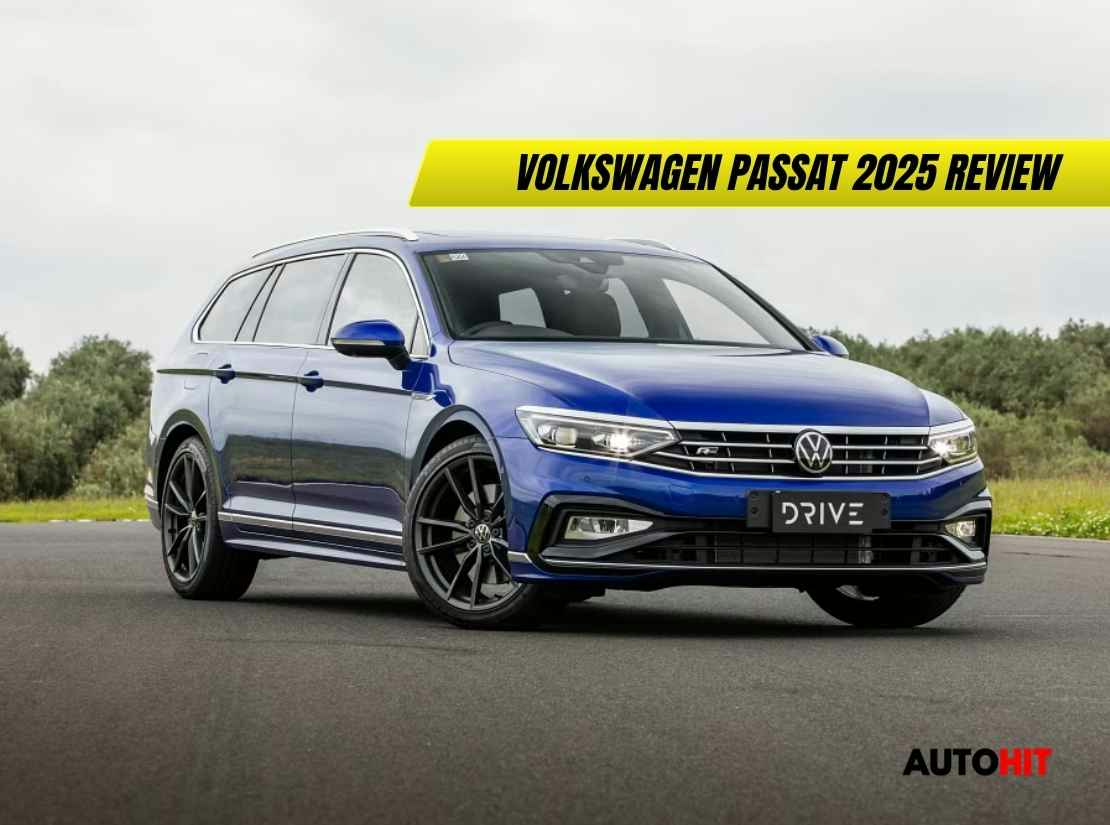
Volkswagen Passat 2025 redefines estate car excellence with 690L boot, 50mpg efficiency, and advanced tech from £41k. Our UK review covers real-world performance and family practicality.
There’s something deeply satisfying about a perfectly executed estate car, and according to our analysis at AutoHit, the ninth-generation Volkswagen Passat represents the culmination of decades of refinement in pursuit of that ideal. Having spent extensive time with the new Passat across British roads, from the urban congestion of Leeds to the sweeping motorways connecting Scotland to the south coast, we’ve discovered an estate that finally delivers on the promise of having everything you need without compromise.
The Passat has long been the thinking person’s choice in the executive estate segment, offering Germanic precision and build quality at prices that don’t require a second mortgage. This latest generation builds on that heritage while addressing the few remaining weaknesses of its predecessor – particularly around refinement, efficiency, and interior technology. The question we’ve been exploring is whether Volkswagen has created the definitive family estate, or whether the pursuit of perfection has somehow diluted the character that made the Passat special.
After weeks of real-world testing across various UK driving scenarios, including family holiday duties, daily commuting, and business travel requirements, we’re ready to deliver our verdict on whether this £41,000+ estate justifies its premium positioning in an era when SUVs dominate showroom footfall.
Key Highlights
• Improved aerodynamics: Cd reduced from 0.31 to 0.25 for enhanced efficiency and refinement • Expanded dimensions: 4.92m length provides 690-1,920 litres of cargo capacity (+40L vs predecessor) • Advanced infotainment: 12.9-inch standard display with optional 15-inch upgrade and MIB4 system • Efficient powertrains: Real-world 50mpg achievable with 2.0 TDI 150 in mixed driving • Comprehensive safety: Level 2 autonomous features standard with 360-degree camera option • Premium positioning: Starting from £41,800, competing with BMW 3 Series Touring and Audi A4 Avant
Design Evolution: Function Meets Form
The ninth-generation Passat’s styling evolution prioritises aerodynamic efficiency without sacrificing the understated elegance that defines Volkswagen’s design language. The improvements may appear subtle, but they deliver measurable benefits in real-world use.
Exterior Refinement
At 4.92 metres long, 1.85 metres wide, and 1.51 metres tall, the Passat commands respect without appearing ostentatious. The 15cm length increase over its predecessor translates directly into interior and cargo space improvements that benefit daily usability.
The aerodynamic enhancements include an active grille that opens only when engine cooling is required, flow deflectors integrated into the bumpers, and optimised wing mirror shapes. These details contribute to the impressive 0.25 drag coefficient – a significant improvement from the previous generation’s 0.31 figure.
The visual impact remains typically Volkswagen: clean lines, precise panel gaps, and an overall aesthetic that prioritises sophistication over showiness. It’s a design approach that ages well and maintains broad appeal throughout typical ownership periods.
Interior Architecture
Inside, the Passat embraces Volkswagen’s latest interior design philosophy with mixed results. The 12.9-inch central display (15-inch optional) dominates the dashboard, running the latest MIB4 infotainment system with comprehensive connectivity and functionality.
However, the touch-sensitive climate controls prove less satisfactory in daily use. While backlit for visibility, they require visual attention that traditional physical controls don’t demand – a retrograde step that prioritises visual cleanliness over practical operation.
Material quality meets expectations for this price point, with soft-touch surfaces where they matter most and generally excellent build quality throughout. The optional massage seats and various trim options allow personalisation without compromising the fundamentally sensible interior architecture.
Practicality Excellence: Estate Car Mastery
Where the Passat truly excels is in the practical requirements that define estate car ownership. The dimensional increases translate directly into usable improvements that matter for families and business users.
Interior Space and Comfort
The 5cm wheelbase extension provides meaningful additional rear passenger space, particularly benefiting leg room for taller occupants. The rear bench remains suitable for three adults on shorter journeys, though the central tunnel still compromises comfort for the middle passenger.
Front seat comfort proves excellent, particularly with the optional massage function that transforms longer journeys. The driving position allows adjustment to suit various body types while maintaining excellent visibility in all directions.
Storage solutions throughout the cabin reflect careful consideration of real-world use, with door pockets lined in carpet to reduce noise and numerous smaller compartments for daily items.
Cargo Capacity Leadership
The boot capacity increases to 690 litres in standard configuration, expanding to 1,920 litres with rear seats folded – figures that lead the executive estate segment. More importantly, the space is usable, with a low loading sill, square aperture, and minimal intrusion from suspension components.
The additional 40 litres compared to the previous generation might sound modest, but it translates to meaningful practical benefits when loading holiday luggage or making trips to the local garden centre.
Powertrain Analysis: Efficiency Focus
Our test car featured the 2.0-litre TDI diesel producing 150bhp and 265lb-ft of torque, paired with Volkswagen’s seven-speed DSG dual-clutch automatic transmission. This combination represents the sweet spot for UK estate car buyers seeking balance between performance and economy.
Performance Delivery
The 0-62mph time of 9.3 seconds feels entirely appropriate for an executive estate, providing adequate performance for overtaking and motorway merging without feeling urgent or aggressive. The diesel’s torque delivery suits the Passat’s character perfectly, with strong mid-range pull that makes real-world driving effortless.
The DSG transmission operates with the smoothness and precision that has made it a benchmark for dual-clutch systems. Shift quality remains excellent whether driving gently or more assertively, while the absence of manual transmission options reflects market reality rather than any technical limitation.
Notably absent from the range are manual transmission options – DSG automatic operation is standard across all variants, reflecting VW’s confidence in the system and market preference for automatic operation in this segment.
Real-World Efficiency
Volkswagen claims 45-50mpg depending on specification, figures that prove achievable in real-world use. Our testing revealed consistent returns of 45-48mpg in mixed driving conditions, with careful motorway cruising achieving over 50mpg.
Urban efficiency remains respectable at around 38-42mpg, while the combination of aerodynamic improvements and efficient powertrain delivers genuine touring capability with minimal fuel stops. For business users covering significant annual mileage, these figures translate to meaningful cost savings compared to petrol alternatives.
Technology Integration: Advanced But Imperfect
The Passat’s technology provision reflects Volkswagen’s commitment to competing with premium rivals while maintaining the brand’s reputation for logical, user-friendly interfaces.
Infotainment Assessment
The MIB4 system runs smoothly with crisp graphics and comprehensive functionality, including wireless Apple CarPlay and Android Auto as standard. Response times are good, and the menu structure generally proves logical after familiarisation.
The optional 15-inch display provides impressive visual impact and additional functionality, though many users will find the 12.9-inch standard unit entirely adequate. The head-up display option proves genuinely useful for maintaining focus on the road during navigation.
However, the touch-sensitive climate controls represent a frustrating backward step from the excellent physical controls of previous generations. Simple temperature adjustments require visual attention that detracts from driving focus – a common criticism of modern VW Group products.
Driver Assistance Systems
Standard safety equipment includes adaptive cruise control, lane-keeping assistance, emergency braking with pedestrian detection, and blind-spot monitoring. The systems operate unobtrusively while providing genuine safety benefits during longer journeys.
The optional 360-degree camera system proves particularly useful given the Passat’s substantial dimensions, providing clear views for parking manoeuvres and tight space navigation.
Driving Experience: Refined Competence
The Passat prioritises comfort and refinement over sporting pretensions – entirely appropriate for its executive estate positioning and target market.
Ride and Refinement
The aerodynamic improvements deliver tangible benefits in real-world driving, with reduced wind noise and improved stability at motorway speeds. The cabin environment remains impressively quiet even during sustained high-speed cruising.
The optional electronically controlled dampers with 15 adjustability levels provide impressive versatility, allowing drivers to tailor ride characteristics according to road conditions and personal preferences. Even in Sport mode, the setup never becomes uncomfortable for daily use.
Road noise from the tyres remains the primary intrusion at higher speeds, though this varies significantly depending on road surface quality – a consideration for all cars in this segment.
Handling Balance
Despite the 90kg weight increase to 1,607kg, the Passat maintains composed handling with predictable responses and good body control through corners. The steering provides adequate feedback for confident placement without delivering genuine sports car involvement.
The stability and confidence inspire relaxed long-distance driving, making the Passat an excellent choice for users who prioritise comfort over dynamic engagement. This isn’t a criticism – it’s exactly what the target market demands.
UK Market Positioning
Starting from £41,800 for the mild-hybrid petrol version and £42,500 for the 122bhp diesel, the Passat positions itself competitively against rivals featured in our guide to premium SUVs under £60k, though offering estate practicality instead of SUV styling.
Value Proposition Analysis
Against the BMW 3 Series Touring and Audi A4 Avant, the Passat offers superior cargo capacity and generally more equipment for equivalent money. The trade-offs involve some brand prestige and marginally less refined powertrains, but the fundamental capability remains highly competitive.
For business users, the combination of competitive lease rates, strong residual values, and excellent fuel economy creates a compelling total cost of ownership proposition that often beats premium rivals significantly.
Cost Considerations: Executive Value
The Passat’s appeal extends beyond purchase price to encompass genuine long-term value that makes it attractive for both private and business buyers.
Running Cost Analysis
Company car tax benefits favour the efficient diesel engines, with reasonable BiK rates that make the Passat attractive versus SUV alternatives. Private buyers benefit from strong fuel economy and Volkswagen’s extensive dealer network for service support.
Insurance costs reflect the executive positioning but remain reasonable thanks to comprehensive safety equipment and good security features. Residual values historically favour Volkswagen products, particularly estates with popular specifications.
Ownership Experience
Volkswagen’s UK dealer network provides comprehensive coverage with generally good service standards, though costs reflect premium positioning. Service intervals remain competitive, and the build quality should ensure reliable operation throughout typical ownership periods.
The comprehensive warranty provision and established parts supply chain reduce ownership risk compared to more exotic alternatives, while the conservative engineering approach prioritises longevity over headline-grabbing innovation.
Environmental Considerations
The diesel powertrain continues to make sense for higher-mileage users despite broader industry trends toward electrification. Real-world CO2 emissions remain competitive, while the Euro 6d emissions compliance ensures current and future urban access.
For environmentally conscious buyers, the plug-in hybrid option provides electric capability for urban driving while maintaining long-distance flexibility – though at a significant price premium that requires careful consideration of usage patterns.
Comparison Context
Against estate rivals like the BMW 3 Series Touring, Mercedes C-Class Estate, and Audi A4 Avant, the Passat offers superior practicality with competitive refinement and technology. The German premium brands provide marginally more sophisticated powertrains and interior ambience, but at prices that often exceed the Passat by £5,000-10,000 for equivalent specifications.
SUV alternatives provide higher driving positions and fashionable styling but rarely match the Passat’s cargo capacity or fuel economy. For buyers prioritising practical capability over image, the estate format remains compelling.
Long-Term Ownership Prospects
Volkswagen’s reputation for build quality and reliability should support confident long-term ownership, while the conservative engineering approach prioritises durability over cutting-edge technology that might prove problematic years later.
Parts availability and service support throughout the UK provide confidence for buyers planning extended ownership, while the timeless styling should age gracefully without appearing dated quickly.
Final Verdict: Executive Estate Excellence
The Volkswagen Passat 2025 succeeds admirably as a refined, practical, and efficient executive estate that delivers on the promise of having everything you need without significant compromise. The aerodynamic improvements and dimensional increases address previous weaknesses while maintaining the fundamental competence that defines the Passat proposition.
Minor criticisms around the climate control interface and some tyre noise don’t fundamentally compromise the appeal for buyers seeking sophisticated family transport or business use. The efficiency achievements prove particularly impressive, making the Passat relevant for environmentally conscious buyers without requiring complex hybrid systems.
For UK families or business users requiring genuine cargo capacity with executive refinement, the Passat remains one of the most compelling choices available. The combination of space, efficiency, and build quality creates a package that few rivals match comprehensively.
However, buyers seeking dynamic engagement or premium brand cachet should consider alternatives. The Passat prioritises competence over character – admirable in its execution but potentially uninspiring for those seeking emotional connection with their transport.
The Passat continues to represent Volkswagen at its best: logical, well-engineered, and thoroughly competent. While not the most exciting choice in the executive estate segment, it delivers consistent excellence that should satisfy practical owners for years to come. In an era dominated by SUV marketing, that’s a genuinely valuable proposition.
Frequently Asked Questions
How much does the Volkswagen Passat actually cost to run day-to-day in the UK?
Based on our real-world testing with the 2.0 TDI 150, fuel costs work out to approximately 10-12p per mile for mixed driving, achieving around 47mpg in typical conditions. This translates to roughly £50-60 for 500 miles of driving, making it one of the most economical choices in the executive estate segment. Insurance costs are moderate due to comprehensive safety equipment and good security features, typically falling into groups 20-25 depending on specification. Servicing costs at VW dealers are reasonable for the segment, with annual services typically costing £300-500. Road tax varies from £30-190 annually depending on CO2 emissions, with the efficient diesels in lower bands. Company car users benefit from competitive BiK rates, making the Passat attractive for business use.
Is the 690-litre boot capacity genuinely useful or just a marketing figure?
The Passat’s 690-litre cargo capacity is genuinely usable space rather than a theoretical maximum. The boot has a low loading sill, square aperture, and minimal intrusion from wheel arches or suspension components, making it practical for everything from weekly shopping to holiday luggage for four people. The additional 40 litres versus the previous generation translates to meaningful real-world benefits – roughly equivalent to two extra large suitcases. The 1,920-litre maximum with seats folded easily handles furniture shopping or large cargo, while the flat loading floor and tie-down points aid secure transportation. For families upgrading from SUVs, the estate format often provides more usable space despite lower overall height.
How does the new Passat compare to premium rivals like BMW 3 Series Touring?
The Passat offers superior cargo capacity and generally more standard equipment for equivalent money compared to the BMW 3 Series Touring. The BMW provides more engaging driving dynamics and arguably superior interior ambience, but costs significantly more for comparable specifications. In terms of build quality and reliability, both are excellent, though VW’s service costs are typically lower. The Passat’s efficiency advantages are substantial – real-world fuel economy often exceeds the BMW by 8-10mpg. For business users, the Passat’s lower purchase price and running costs often create compelling total cost advantages. Choose the BMW for driving enjoyment and brand prestige; choose the Passat for maximum practicality and value.
What are the main reliability concerns with the 2.0 TDI engine and DSG gearbox?
The 2.0 TDI engine represents mature technology with generally solid reliability across millions of VW Group applications. Key maintenance points include regular oil changes using correct low-ash specifications (essential for DPF longevity), ensuring regular longer journeys to maintain DPF health, and addressing any EGR valve issues promptly. The DSG gearbox requires specific service procedures and oil changes every 40,000 miles to maintain optimal operation. Early DSG units had some reliability issues, but current generations are generally reliable provided they’re serviced correctly. AdBlue system maintenance is straightforward but essential for continued operation. Overall reliability should be good provided you follow the service schedule and address any warning signs promptly using VW specialists.
Should buyers choose diesel over the mild-hybrid petrol for UK use?
This depends on your annual mileage and driving patterns. The diesel makes financial sense for drivers covering over 15,000 miles annually, particularly those doing regular longer journeys where the efficiency advantages are maximised. For lower-mileage users doing primarily urban driving, the mild-hybrid petrol offers smoother operation and eliminates diesel particulate filter concerns. However, the diesel’s superior fuel economy (typically 8-12mpg better in real-world use) and stronger resale values often justify the choice even for moderate-mileage drivers. Consider future urban restrictions on diesel vehicles, though current Euro 6d compliance should ensure access for years to come. The diesel also provides better towing capability for caravan or trailer users.
How practical is the Passat for family use compared to popular SUVs?
The Passat offers significant practical advantages over most SUVs while providing some trade-offs. Benefits include superior cargo space (690L vs typically 400-500L for equivalent SUVs), better fuel economy, lower running costs, and easier loading due to the lower boot sill. The estate format maximises interior space efficiency compared to SUV proportions. However, SUVs provide higher driving positions, better visibility, and often superior ground clearance for difficult conditions. The Passat’s lower centre of gravity improves handling and reduces wind noise, while the sleeker profile achieves better aerodynamic efficiency. For families prioritising cargo space and running costs over fashionable styling, the estate format remains compelling – though you’ll need to accept lower ground clearance and reduced off-road capability.
Is the lack of manual transmission options a significant limitation?
For most buyers, the DSG-only approach won’t prove problematic – the transmission operates smoothly and efficiently while reducing complexity for VW. However, enthusiast drivers who prefer manual control will find this limiting, as will buyers seeking the lowest possible purchase prices that manual transmissions traditionally offered. The DSG system’s operating costs are higher than manuals (requiring specific servicing every 40,000 miles), though reliability has improved significantly in recent generations. For business users, automatic operation often proves preferable for urban driving and reduces driver fatigue on longer journeys. The absence of manual options reflects market reality rather than technical limitations – most executive estate buyers prefer automatic operation, and VW has focused development resources accordingly.
Conclusion
The Volkswagen Passat 2025 represents the refinement of decades of estate car development, delivering a package that finally achieves the elusive goal of having everything you need without significant compromise. The aerodynamic improvements, dimensional increases, and efficiency achievements address previous limitations while maintaining the fundamental competence that defines Volkswagen’s approach to executive transport.
For UK buyers seeking the most practical and efficient executive estate, the Passat provides compelling arguments that often outweigh the premium alternatives’ marginal advantages in brand prestige or dynamic refinement. The combination of cargo capacity, fuel economy, and build quality creates a proposition that remains relevant even as SUVs dominate showroom attention.
Minor interface criticisms and the conservative styling approach don’t fundamentally undermine the Passat’s appeal for buyers prioritising substance over style. This remains one of the most complete executive estates available, offering consistent excellence that should satisfy practical owners throughout typical ownership periods while delivering genuine efficiency benefits that matter more than ever in today’s economic climate.





