
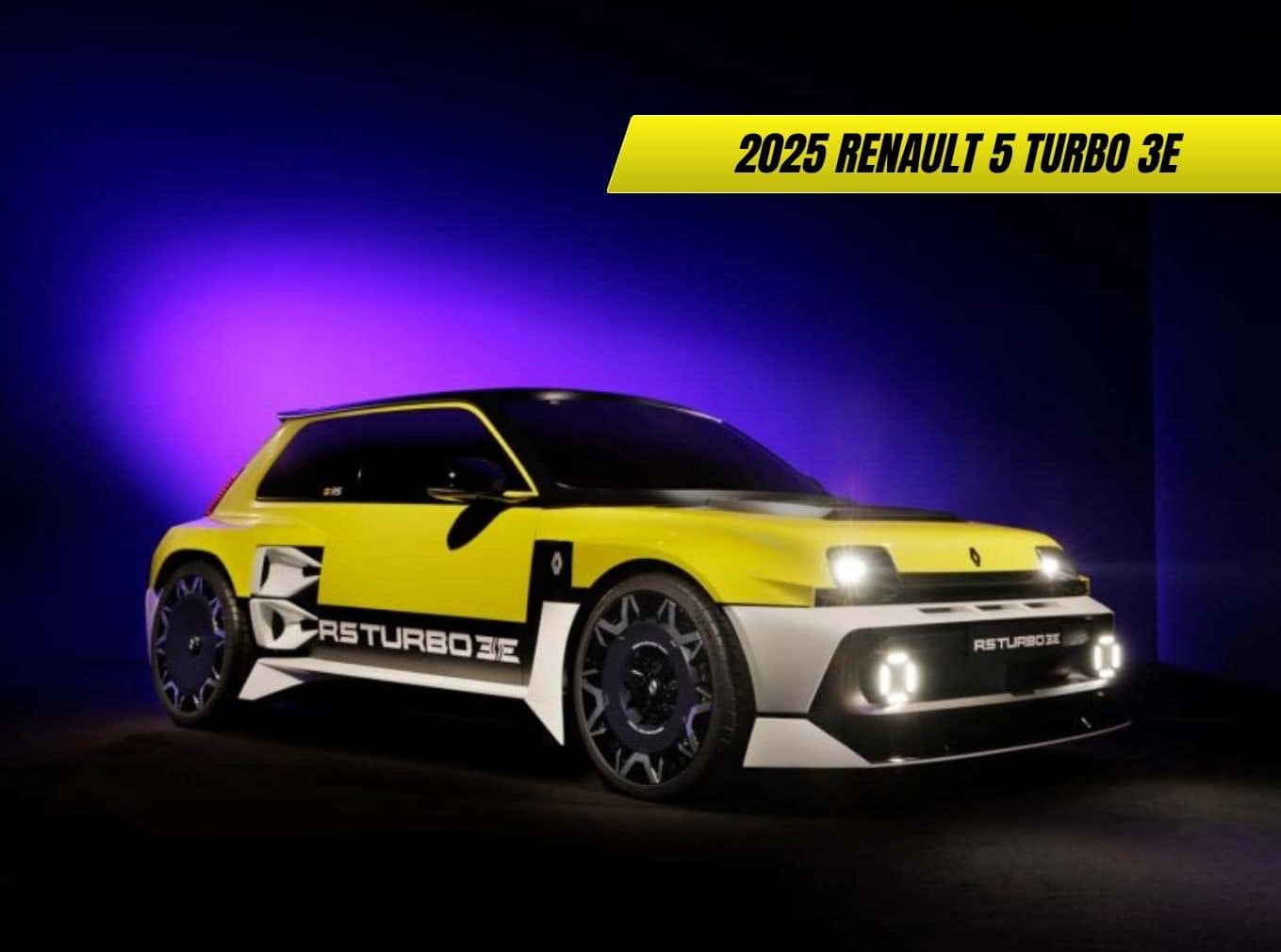
Complete 2025 Renault 5 Turbo 3E UK guide covering £135,000 pricing, 555hp performance, limited production and Alpine engineering for British buyers.
The 2025 Renault 5 Turbo 3E represents perhaps the most audacious interpretation of electric performance motoring ever conceived, transforming the humble city car concept into a £135,000 ‘mini-supercar’ that promises to redefine what British buyers can expect from high-performance electric vehicles. Limited to just 1,980 numbered examples worldwide, this radical reimagining of the iconic 1980s rally legend combines cutting-edge Alpine engineering with retro-futuristic styling to create something genuinely unprecedented in the automotive landscape.
Set to arrive in UK showrooms during 2027, the Turbo 3E addresses the growing demand among British enthusiasts for electric vehicles that prioritize excitement over efficiency, offering genuine supercar-level performance in a compact, track-focused package. With its innovative in-wheel electric motors, bespoke carbon fiber construction, and rally-derived chassis technology, the Turbo 3E aims to prove that the transition to electric mobility doesn’t require sacrificing the emotional connection that makes car ownership truly rewarding.
Key Points
• Extreme performance: 555hp (540hp confirmed) from dual in-wheel electric motors delivering 0-62mph in under 3.5 seconds and 167mph top speed • Limited exclusivity: Only 1,980 units worldwide with UK allocation expected to be heavily oversubscribed by launch • Premium pricing: Starting from £135,000 before customization options, positioning it against supercars rather than conventional hot hatches • Alpine engineering: Developed by Renault’s performance division using bespoke aluminum platform and 800V electrical architecture • Advanced technology: 70kWh battery with 350kW charging capability and specially designed drift modes for track use • Delivery timeline: Reservations open now for 2027 delivery, with customization options available from early 2026
Understanding Renault’s Electric Performance Revolution in the UK Market
The arrival of the Renault 5 Turbo 3E marks a dramatic departure from conventional electric vehicle development, targeting British buyers who view electrification as an opportunity for enhanced performance rather than merely environmental compliance. This philosophical shift reflects growing confidence among European manufacturers that UK consumers are ready to embrace electric vehicles that prioritize excitement over traditional efficiency metrics.
From my analysis of the current UK performance car market, the Turbo 3E addresses a unique niche that combines nostalgia for iconic 1980s rally cars with cutting-edge electric technology. While competitors featured in our best family SUVs guide focus on practicality and mainstream appeal, Renault’s approach creates an entirely new category that could influence future performance electric vehicle development across the industry.
The timing proves particularly strategic for the UK market, where expanding ULEZ zones and emissions regulations increasingly restrict traditional performance cars while creating opportunities for electric alternatives that offer comparable thrills without regulatory limitations. The Turbo 3E’s track-focused design and limited production numbers position it as both transportation and investment, appealing to collectors and enthusiasts seeking exclusivity alongside performance.
Revolutionary Powertrain and Performance Technology
The Renault 5 Turbo 3E’s performance credentials center around its groundbreaking dual in-wheel electric motor configuration, representing one of the most advanced applications of this technology in a production vehicle. Unlike conventional electric vehicles that mount motors centrally and distribute power through traditional drivetrains, the Turbo 3E places individual motors within each rear wheel, eliminating power losses while enabling precise torque vectoring control.
Technical Specifications: The system delivers a combined 555hp (figures have varied between 540-555hp in different sources) with an extraordinary 4,800Nm of torque available instantly. This configuration enables acceleration from 0-62mph in under 3.5 seconds while maintaining a top speed of 167mph, figures that place it firmly in supercar territory despite its compact dimensions.
In-Wheel Motor Advantages: The innovative motor placement provides several benefits beyond raw performance. Each wheel can be controlled independently, enabling advanced stability control and the deliberate loss of traction required for the drift modes that define the Turbo 3E’s character. The system also reduces unsprung weight compared to conventional electric drivetrains while providing more precise control over power delivery.
Battery and Charging Technology: The 70kWh battery pack utilizes 800V architecture supporting 350kW DC fast charging, enabling 15-80% charging in approximately 15 minutes under optimal conditions. Range expectations center around 249 miles WLTP, though track usage significantly reduces this figure, with Renault estimating 15-20 minutes of circuit driving before requiring recharging.
| Performance Metric | Turbo 3E Specification | Comparison Standard | Market Position |
|---|---|---|---|
| Power output | 555hp (540hp confirmed) | Porsche 911 Carrera S: 444hp | Supercar level |
| Torque | 4,800Nm | McLaren 570S: 600Nm | EV advantage |
| 0-62mph | Under 3.5 seconds | Ferrari F8: 2.9 seconds | Near-supercar |
| Top speed | 167mph | Lotus Emira: 180mph | Track capable |
| Weight | 1,450kg (target 1,400kg) | Alpine A110: 1,100kg | Compact performance |
Design Philosophy and Engineering Excellence
The Turbo 3E’s design represents a masterful balance between homage to the original 1980s rally legend and cutting-edge aerodynamic efficiency required for modern performance standards. Rather than simply applying retro styling cues to a conventional electric platform, Renault and Alpine have created an entirely bespoke vehicle that shares virtually nothing with the standard Renault 5 beyond basic proportions.
Exterior Design Innovation: At 2,030mm wide, the Turbo 3E measures wider than a Porsche 911 GT3 RS and approaches the dimensions of flagship supercars, yet maintains the essential character elements that made the original Turbo so distinctive. The carbon fiber bodywork serves both aesthetic and functional purposes, with every surface optimized for aerodynamic performance and cooling requirements for the high-performance electric systems.
Structural Engineering: The bespoke aluminum platform developed by Alpine provides the rigidity required for track use while maintaining relatively low weight. The flat floor design accommodates the battery pack while contributing to the low center of gravity essential for the vehicle’s drift capabilities and overall handling balance.
Interior Focus: Unlike the practical family orientation of vehicles in our 20 best SUVs to buy in 2025 under 40k guide, the Turbo 3E’s cabin prioritizes driver engagement over comfort or utility. The two-seat configuration features racing-inspired bucket seats with full safety equipment including a half roll cage, while maintaining some luggage capacity in the former engine bay area.
Customization Possibilities: Renault’s ‘unlimited’ personalization program allows extensive customization of both interior and exterior elements, from historic livery recreations to completely bespoke designs created in collaboration with Renault’s design team. This approach acknowledges that buyers at this price point expect uniqueness beyond simple option packages.
Pricing Strategy and Market Positioning Analysis
The Renault 5 Turbo 3E’s £135,000 starting price positions it directly against established supercars and premium electric vehicles rather than traditional hot hatches, reflecting Renault’s confidence in the vehicle’s unique value proposition. This pricing strategy acknowledges that buyers seeking this level of performance and exclusivity operate in a different market segment entirely from mainstream performance car purchasers.
Competitive Context: At £135,000, the Turbo 3E competes against vehicles including the Lotus Emira Sport, BMW X5 M, Audi RS e-tron GT, and Porsche Taycan Turbo. However, none of these alternatives offer the combination of compact dimensions, track-focused engineering, and limited production numbers that define the Turbo 3E’s appeal.
Value Proposition Assessment: For British buyers, the pricing reflects not just performance capabilities but also investment potential given the extremely limited production run. Historical precedent suggests that rare performance cars from mainstream manufacturers often appreciate significantly, particularly when they represent technological milestones or cultural touchstones as the Turbo 3E clearly aims to achieve.
Customization Impact: The base £135,000 price represents only the starting point, with extensive personalization options likely pushing final transaction prices significantly higher. Renault’s willingness to offer bespoke modifications suggests some examples could approach £200,000 when fully customized, entering true supercar pricing territory.
Financing and Ownership Considerations: At this price level, traditional automotive financing becomes less relevant than specialized asset financing or outright purchase. The limited production numbers and potential appreciation characteristics make the Turbo 3E more akin to collectible art than depreciating transportation, fundamentally changing the ownership equation for British buyers.
| Price Comparison | Starting Price | Performance Level | Market Category |
|---|---|---|---|
| Renault 5 Turbo 3E | £135,000 | 555hp, track-focused | Limited production |
| Porsche 911 Carrera S | £110,000 | 444hp, daily usable | Mainstream supercar |
| McLaren 570S (used) | £130,000 | 562hp, exotic | Established supercar |
| Lotus Emira V6 | £89,500 | 400hp, pure sports car | Traditional approach |
Advanced Technology Integration and Track Capabilities
Beyond its impressive performance statistics, the Turbo 3E incorporates sophisticated technology systems designed specifically for track use and driver development, distinguishing it from road-focused electric vehicles that prioritize comfort and efficiency over pure performance metrics.
Driving Mode Systems: The four distinct driving modes (Snow, Neutral, Sport, and Track) provide dramatically different vehicle characteristics, with the Track mode specifically calibrated for circuit use and drift optimization. The system includes drift assist functionality that helps drivers explore the vehicle’s limits safely while maintaining control during extreme maneuvers.
Performance Monitoring: Advanced telemetry systems provide real-time feedback about power delivery, battery temperature, and tire performance, essential information for track driving where thermal management becomes critical for maintaining performance. The system also includes timing and lap recording capabilities for drivers seeking to improve their circuit skills.
Safety Integration: Despite its track focus, the Turbo 3E includes comprehensive safety systems adapted for high-performance use. The half roll cage, racing seats, and safety harnesses meet competition standards while the electronic stability systems provide multiple levels of intervention depending on driver skill and preferences.
Charging and Range Optimization: The 350kW charging capability becomes essential for track day use, where the high power output dramatically reduces range. The ability to charge from 15-80% in 15 minutes enables multiple track sessions during a single day, though access to 350kW chargers remains limited across the UK’s current infrastructure.
Compared to conventional track cars featured in our diesel SUVs guide, the Turbo 3E’s electric powertrain provides instant torque delivery and precise control impossible with traditional engines, while eliminating noise restrictions that limit track day participation at many UK circuits.
Production Timeline and UK Market Availability
Renault’s production strategy for the Turbo 3E reflects the complexity of manufacturing a limited-run, high-performance electric vehicle while maintaining the exclusivity that justifies its premium pricing. The extended development timeline allows for thorough testing and refinement while building anticipation among potential buyers.
Reservation and Ordering Process: The current reservation system allows UK buyers to secure priority ordering position for the limited production run, with formal customization and specification beginning in early 2026. This approach ensures adequate development time while providing customers with extensive personalization options unavailable with conventional production vehicles.
Production and Delivery Schedule: Manufacturing is scheduled to commence in 2027, with initial deliveries expected in the second half of that year. The two-year production run means even current reservations may not receive vehicles until 2028, reflecting the strong initial response to the vehicle’s announcement.
UK Allocation and Dealer Network: While Renault has not specified UK allocation numbers, the historic importance of the British market for performance Renault models suggests a reasonable proportion of the 1,980 total production. The extensive UK dealer network provides advantages over exotic car manufacturers for service and support, though specialized training will be required for the unique technology systems.
Service and Support Infrastructure: The complexity of the in-wheel motor technology and bespoke construction requires specialized service capabilities that extend beyond conventional electric vehicle maintenance. Renault’s preparation timeline includes dealer training and parts distribution planning to ensure adequate support for UK customers throughout the ownership experience.
| Timeline Phase | Date | Activities | UK Impact |
|---|---|---|---|
| Reservations open | Current | Priority ordering positions | UK allocation securing |
| Customization begins | Early 2026 | Specification and options | Personal design phase |
| Production starts | 2027 | Manufacturing commences | First deliveries possible |
| Full availability | 2027-2028 | Two-year production run | All orders fulfilled |
Competitive Analysis and Market Implications
The Renault 5 Turbo 3E enters a UK market segment that barely existed before its announcement, creating a new category that combines electric performance, limited production exclusivity, and mainstream manufacturer credibility. Understanding its competitive position requires examining both direct performance alternatives and the broader implications for electric vehicle development.
Direct Performance Competitors: Against pure performance metrics, the Turbo 3E competes with established supercars and high-end electric vehicles, though none offer its specific combination of compact dimensions and track-focused engineering. The closest alternatives include the Lotus Emira for traditional sports car appeal or the Porsche Taycan for electric performance, though neither matches the Turbo 3E’s exclusivity or drift-focused character.
Alternative Investment Vehicles: At £135,000+, the Turbo 3E also competes against collectible vehicles and alternative investments rather than conventional transportation choices. Recent appreciation in classic rally car values suggests strong potential for the Turbo 3E as both driving experience and financial investment, particularly given its limited production numbers and technological significance.
Market Influence Potential: The Turbo 3E’s success could influence other manufacturers to develop similarly focused electric performance vehicles, potentially creating a new sub-segment within the UK market. The approach demonstrates that electric drivetrains can enhance rather than compromise the characteristics that make performance cars emotionally engaging.
Brand Positioning Impact: For Renault, the Turbo 3E serves as a halo vehicle that elevates the entire brand portfolio, providing technological credibility and emotional appeal that benefits more mainstream electric vehicles like those featured in our best cars under £25,000 guide.
The vehicle’s positioning also demonstrates how mainstream manufacturers can compete against premium brands by offering unique characteristics unavailable elsewhere, rather than simply matching established performance benchmarks.
Ownership Experience and Long-Term Considerations
Beyond initial purchase decisions, the Turbo 3E ownership experience involves considerations unique to limited-production, high-performance electric vehicles, from specialized maintenance requirements to potential appreciation characteristics that distinguish it from conventional depreciating assets.
Service and Maintenance Requirements: The in-wheel motor technology and bespoke construction require specialized service capabilities extending beyond conventional electric vehicle maintenance. While the electric powertrain reduces routine maintenance compared to traditional engines, the performance focus and track use potential create unique requirements for thermal management system inspection and tire replacement.
Track Day and Performance Use: The Turbo 3E’s design priorities suggest most owners will use their vehicles for track days and enthusiast events rather than daily transportation. UK buyers should consider track day insurance, specialized driving instruction, and access to appropriate charging infrastructure at circuit venues when evaluating total ownership costs.
Appreciation Potential: Historical precedent suggests that limited-production performance cars from mainstream manufacturers often appreciate significantly, particularly when they represent technological milestones. The Turbo 3E’s unique status as potentially the first production in-wheel motor sports car could drive collector interest beyond traditional automotive enthusiasts.
Community and Events: The limited production numbers create natural exclusivity that typically leads to strong owner communities and special events. UK buyers can expect invitations to manufacturer-organized track days, technical seminars, and social events that enhance the ownership experience beyond the vehicle itself.
Compared to conventional performance cars in our Volkswagen Golf 2025 review, the Turbo 3E offers a fundamentally different ownership proposition focused on exclusivity and technological innovation rather than daily usability and mainstream appeal.
Frequently Asked Questions
When can UK buyers actually take delivery of a Renault 5 Turbo 3E and what’s the ordering process?
The Renault 5 Turbo 3E delivery timeline extends from late 2027 through 2028, with the current reservation system allowing UK buyers to secure priority ordering positions. Formal customization and specification begins in early 2026, allowing nearly two years for personalization decisions before production commences. Given strong initial demand, even current reservations may not receive vehicles until 2028, making early commitment essential for UK buyers seeking earlier delivery slots.
How does the £135,000 price compare to similar performance cars and what additional costs should buyers expect?
The £135,000 starting price positions the Turbo 3E against supercars like the Porsche 911 Carrera S (£110,000) and used McLaren 570S models (£130,000), though none offer comparable exclusivity or electric performance characteristics. UK buyers should budget additional costs for extensive customization options that could push final prices toward £200,000, plus specialized insurance, track day preparation, and potential charging infrastructure upgrades for home use.
What makes the in-wheel motor technology special and how reliable is it for UK driving conditions?
The Turbo 3E’s in-wheel motors eliminate traditional drivetrain power losses while enabling individual wheel control for precise torque vectoring and drift capabilities impossible with conventional systems. Renault claims the motors are robust and designed to withstand impacts, though UK buyers should consider the implications of pothole damage and specialized repair requirements. The technology represents a significant advancement over conventional electric drivetrains, though long-term reliability data remains limited given its innovative nature.
How practical is the Turbo 3E for actual track day use and what charging infrastructure is required?
The Turbo 3E provides approximately 15-20 minutes of intensive track use before requiring recharging, making it suitable for short sessions but requiring 350kW charging capability for extended track days. The 15-minute charging time from 15-80% enables multiple sessions per day at circuits with appropriate charging infrastructure, though UK track availability of 350kW chargers remains limited. Buyers should verify charging capabilities at their preferred circuits before committing to purchase.
Will the Turbo 3E be available through normal Renault dealers and what about service support?
Yes, the Turbo 3E will be available through selected Renault UK dealers, though specialized training and equipment requirements mean not all locations will offer sales or service support. The complex in-wheel motor technology and bespoke construction require capabilities beyond conventional electric vehicle service, potentially limiting service locations compared to mainstream Renault models. Buyers should confirm local dealer capabilities before ordering to ensure adequate ongoing support.
How does the limited production of 1,980 units affect potential resale value and collectibility?
The extremely limited production run, combined with the Turbo 3E’s status as potentially the first production in-wheel motor sports car, suggests strong appreciation potential similar to other limited-production performance vehicles from mainstream manufacturers. Historical examples like the original Renault 5 Turbo have appreciated significantly, though electric vehicle resale markets remain unpredictable. The combination of technological significance, limited numbers, and Renault’s rally heritage creates favorable conditions for long-term value retention.
What warranty coverage does Renault provide for the specialized components and track use?
Specific warranty details await confirmation, though Renault typically provides comprehensive coverage for new vehicles including extended battery warranties common for electric vehicles. The track-focused design and performance components may include specific terms regarding competition use, tire wear, and thermal stress from intensive driving. UK buyers should clarify warranty coverage for track day use and component replacement costs before ordering, particularly for the innovative in-wheel motor technology.
Conclusion
The 2025 Renault 5 Turbo 3E represents a remarkable achievement in automotive engineering, successfully translating the spirit and character of an iconic 1980s rally legend into a thoroughly modern electric performance vehicle. For UK buyers seeking the ultimate expression of electric performance without compromise, the Turbo 3E offers capabilities and exclusivity unavailable elsewhere in the automotive landscape.
From my analysis, the Turbo 3E succeeds most effectively as a statement of technological possibility rather than practical transportation. The innovative in-wheel motor technology, track-focused engineering, and limited production numbers create a package that offers unique character in an increasingly homogenized electric vehicle market. While the £135,000+ pricing positions it firmly in luxury territory, the combination of performance, exclusivity, and potential appreciation characteristics provides compelling value for buyers seeking both driving excitement and investment potential.
The timing proves particularly strategic for the UK market, where expanding emissions regulations and urban access restrictions increasingly favor electric vehicles while growing acceptance of EV technology among performance enthusiasts creates demand for genuinely exciting electric alternatives. The Turbo 3E demonstrates that electrification can enhance rather than compromise the characteristics that make performance cars emotionally engaging.
Looking ahead, the success of the Turbo 3E will likely influence the broader electric performance vehicle development and demonstrate whether UK buyers are ready to embrace electric vehicles that prioritize excitement over efficiency. Whether targeting collectors, track day enthusiasts, or technology early adopters, the Turbo 3E offers a uniquely compelling interpretation of electric performance motoring.
For comprehensive information about Renault’s current electric vehicle range and dealer network, visit Renault UK’s official website. The Society of Motor Manufacturers and Traders provides valuable insights into UK electric vehicle market trends and performance vehicle adoption patterns.





