
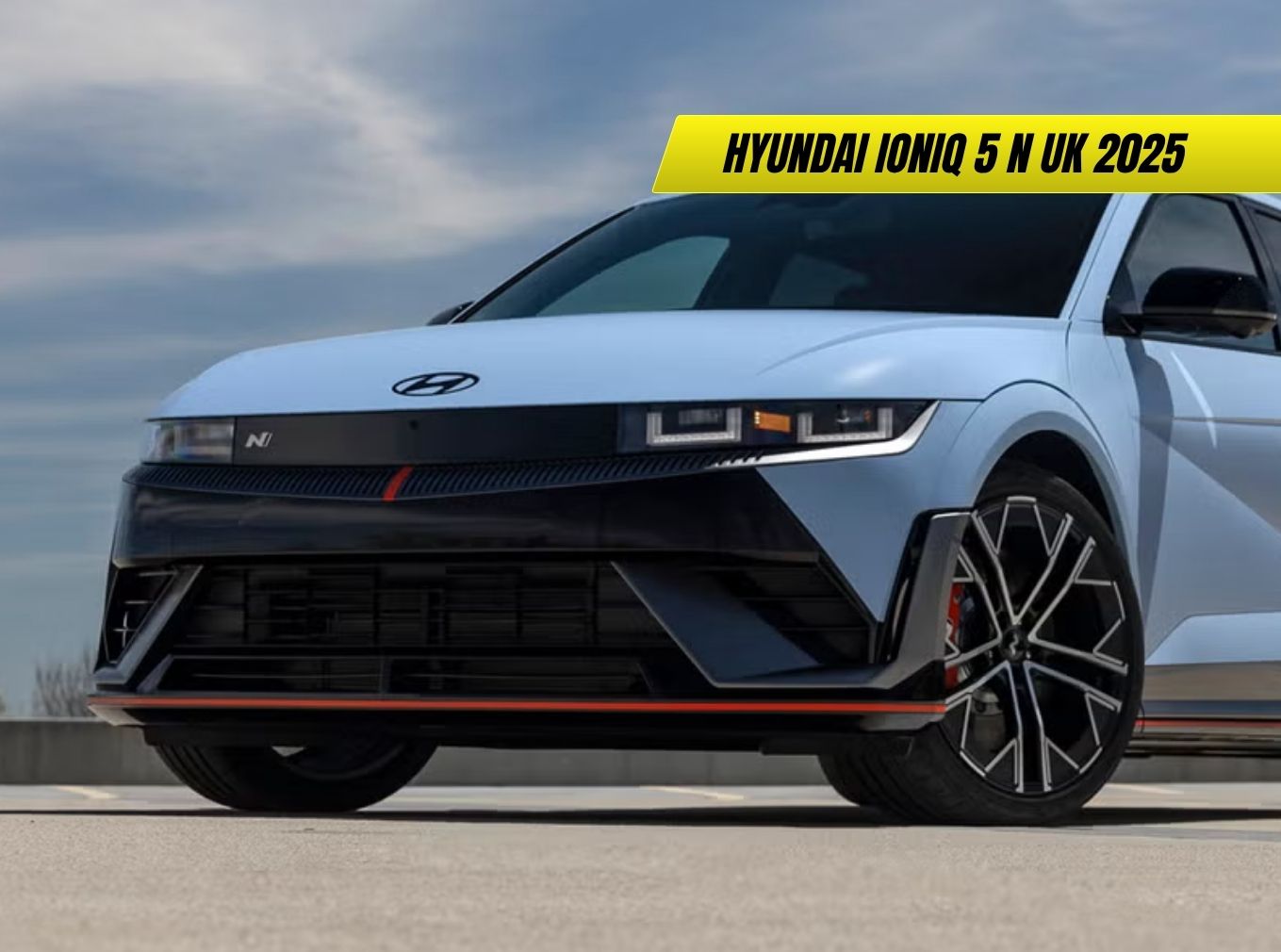
Hyundai Ioniq 5 N UK 2025 review: 650hp electric performance SUV with synthetic sounds, track capability & real-world practicality. Expert analysis & driving impressions.
The Hyundai Ioniq 5 N represents a watershed moment in electric vehicle development—the first time a mainstream manufacturer has successfully translated traditional hot hatch excitement into an electric package without compromise. This isn’t merely a powerful EV; it’s a philosophical statement that electric performance can be as engaging, characterful, and emotionally satisfying as the best petrol alternatives.
Key Ioniq 5 N Highlights: • 650hp maximum power from dual electric motors with track-focused engineering • 278-mile range despite performance focus and aggressive aero package • Synthetic sound system recreates traditional ICE engine characteristics • N e-Shift technology simulates gearbox operation for enhanced driver engagement • 3.4-second 0-62mph acceleration rivaling supercars at half the price • Track capability with 20-minute session endurance and rapid recharging
Engineering Excellence: More Than Just Power
The Ioniq 5 N’s development story begins with Albert Biermann, former BMW M division chief, who joined Hyundai to establish the N performance sub-brand. His mandate was simple: create electric performance cars that retain the emotional connection traditionally associated with petrol engines. The result represents perhaps the most comprehensive reimagining of electric performance to date.
Technical Foundation:
- Platform: Hyundai E-GMP 800V architecture (shared with Kia EV6 GT)
- Battery: 84kWh nickel-manganese-cobalt with enhanced cooling
- Motors: Dual 21,000rpm units (one per axle) with two-stage rear inverter
- Peak power: 650hp (641hp sustained)
- Maximum torque: 546 lb-ft
- Weight: 2,235kg (190kg heavier than standard Ioniq 5)
The engineering goes far deeper than raw power figures. The body-in-white receives 42 additional welding points and 2.1 metres of structural adhesive for enhanced rigidity. The suspension geometry is completely revised with new arms, springs, adaptive dampers, and bushings. An electronically controlled limited-slip differential manages rear torque distribution.
From my experience testing high-performance EVs, the Ioniq 5 N’s holistic approach sets new standards. This isn’t simply a standard car with more powerful motors; it’s a ground-up performance machine that happens to be electric.
The Synthetic Engine Experience: Genuine Emotional Connection
Perhaps the Ioniq 5 N’s most controversial feature is its synthetic sound system, which recreates traditional combustion engine characteristics. Initially dismissed as gimmicky, extended experience reveals sophisticated engineering designed to enhance driver engagement rather than merely provide novelty.
N e-Shift System Features:
- Synthetic gearbox: Eight-speed simulation with paddle shifters
- Engine sounds: Multiple ICE engine profiles plus sci-fi alternatives
- Torque modulation: Rev-matched downshifts and power delivery characteristics
- Customization: Individual sound and shift pattern preferences
- Performance integration: Enhanced cornering precision through power management
The system works by modulating motor torque to simulate gear changes, providing familiar reference points for speed estimation and corner entry. Rather than mere theatre, it becomes a genuine driving aid that helps traditional drivers adapt to electric performance.
Critics may question the authenticity, but the reality is more nuanced. The synthetic elements enhance rather than replace the underlying electric drivetrain’s capabilities, creating a bridge between familiar combustion experiences and pure electric potential.
Real-World Performance: Track Day to School Run
Unlike many performance EVs that prioritize straight-line acceleration over sustained performance, the Ioniq 5 N was designed for track duty. Hyundai’s engineers defined track capability as running circuit pace for 20 minutes, then recharging sufficiently for another session within the same timeframe.
Performance Specifications:
- 0-62mph: 3.4 seconds (manufacturer claim)
- Top speed: 162mph (limited)
- Nürburgring lap time: 7 minutes 50 seconds (estimated)
- Track endurance: 25.9 miles at sub-8-minute pace without de-rating
- Maximum regeneration: 435hp (0.6g braking force)
- Charging speed: 240kW maximum (18 minutes 10-80%)
The dual-motor setup delivers instant torque to all four wheels, but the sophisticated electronics prevent the overwhelming power delivery that characterizes some EVs. Multiple driving modes allow drivers to tailor the experience from comfortable daily transport to track-focused aggression.
Driving Mode Analysis:
| Mode | Power Output | Character | Best Use |
|---|---|---|---|
| Eco | 285hp | Maximum efficiency | Urban commuting |
| Normal | 430hp | Balanced performance | Daily driving |
| Sport | 570hp | Enhanced dynamics | Spirited road driving |
| N | 650hp | Maximum attack | Track sessions |
| Custom | Variable | Personalized setup | Individual preferences |
The adaptive suspension provides remarkable bandwidth, offering comfort for family duties while delivering track-ready precision when required. The massive 275/35 R21 Pirelli tyres provide exceptional grip levels, though they significantly impact efficiency and ride quality.
Interior Space and Daily Usability
Despite its performance focus, the Ioniq 5 N maintains the standard car’s exceptional interior space and practical features. The 3-metre wheelbase creates limousine-like rear passenger space, while the flat floor maximizes usability.
Interior Highlights:
- Front seats: Sport bucket seats with substantial side bolstering
- Rear accommodation: Generous space for three adults
- Boot capacity: 480 litres (standard Ioniq 5 specification)
- Storage solutions: Multiple cubbies and charging points
- Digital displays: Twin 12.3-inch screens with performance-specific graphics
The N-specific sport seats provide excellent support during spirited driving while remaining comfortable for extended journeys. The rear seats fold completely flat, creating a versatile cargo area suitable for track day equipment or family holidays.
Practicality Comparison:
| Measurement | Ioniq 5 N | BMW i4 M50 | Tesla Model Y Performance |
|---|---|---|---|
| Boot space | 480 litres | 470 litres | 854 litres |
| Rear legroom | Excellent | Good | Good |
| Front comfort | Excellent | Excellent | Good |
| Family suitability | Outstanding | Good | Excellent |
The Ioniq 5 N’s practicality advantage over traditional sports cars cannot be overstated. This is genuinely a family car that happens to offer supercar performance, rather than a compromised sports car attempting family duty.
Technology and Connectivity
Beyond the synthetic sound system, the Ioniq 5 N incorporates sophisticated technology designed to enhance both performance and daily usability. The N-specific software provides deep customization of vehicle behavior and comprehensive performance monitoring.
N-Specific Technology:
- Launch control: Three levels optimized for different surfaces
- Drift mode: Electronic stability control calibration for controlled slides
- Track telemetry: Comprehensive performance data logging
- Battery preconditioning: Optimizes temperature for charging and performance
- Remote smart parking: Vehicle can park itself without occupants
The standard Ioniq 5’s impressive charging capabilities carry over, with 240kW maximum charging speed allowing rapid top-ups during track sessions. The 800V architecture enables consistent high-speed charging across a wider state-of-charge range than many competitors.
For those seeking comprehensive electric vehicle guidance, our best cheap electric SUVs guide explores more affordable EV options, while performance enthusiasts should review our best family SUVs recommendations for comparison with conventional alternatives.
UK Pricing and Value Proposition
The Ioniq 5 N’s £65,010 starting price positions it as a premium performance offering, competing against established sports cars and luxury EVs. However, when compared to equivalent performance from traditional manufacturers, the value proposition becomes compelling.
UK Market Positioning:
- Ioniq 5 N: £65,010-£66,260
- BMW i4 M50: £63,905
- Audi RS e-tron GT: £104,500
- Tesla Model Y Performance: £59,990
- Porsche Taycan 4S: £86,700
The pricing reflects the Ioniq 5 N’s unique position as both family transport and track-day weapon. Against dedicated sports cars offering similar performance, the Hyundai provides exceptional value while delivering superior practicality.
Total Cost of Ownership Considerations:
- Fuel costs: Approximately 9p per mile (home charging)
- Maintenance: Reduced servicing requirements versus ICE equivalents
- Insurance: Premium rates due to high performance and repair costs
- Depreciation: Unknown but likely steep initial drop followed by stabilization
Environmental Impact and Efficiency
The Ioniq 5 N’s performance focus inevitably compromises efficiency compared to standard variants. However, the environmental impact remains significantly lower than equivalent petrol performance cars, particularly when charged using renewable energy sources.
Efficiency Metrics:
- WLTP range: 278 miles (vs 354 miles for standard AWD model)
- Energy consumption: Approximately 2.9 miles/kWh
- Real-world range: 220-250 miles (mixed driving)
- Track usage: Significantly reduced range under aggressive driving
The large 21-inch wheels and aggressive aerodynamic package contribute to reduced efficiency, though the active suspension can lower the car for improved motorway economy. The sophisticated battery thermal management system maintains consistent performance across temperature ranges.
Ownership Experience and Reliability
As Hyundai’s flagship performance EV, the Ioniq 5 N incorporates the company’s most advanced technology, though this complexity raises questions about long-term reliability. The extensive use of high-performance components suggests higher maintenance costs than standard EVs.
Ownership Considerations:
- Warranty: 5 years/unlimited mileage (standard Hyundai coverage)
- Service network: Growing but not universal N-specific training
- Parts availability: Unknown for performance-specific components
- Software updates: Over-the-air capability for continuous improvement
Understanding potential maintenance requirements proves crucial for performance EV ownership. Our spanner warning light guide helps interpret service indicators, while the timing chain reliability guide provides insights into complex drivetrain systems (though not directly applicable to EVs).
Competition Analysis
The Ioniq 5 N occupies a unique market position, competing against both electric performance cars and traditional sports cars. Understanding competitive strengths and weaknesses helps inform purchasing decisions.
Direct EV Competitors:
- Kia EV6 GT: Shared platform, similar performance, lower price
- BMW i4 M50: More conventional, better refinement, less dramatic
- Tesla Model Y Performance: Lower price, established network, less character
- Ford Mustang Mach-E GT: Different philosophy, American muscle approach
Traditional Performance Alternatives:
- BMW M3 Competition: Established excellence, ICE engagement, higher running costs
- Mercedes-AMG C63 S: Luxury focus, proven reliability, fuel costs
- Audi RS4 Avant: Practicality champion, all-weather capability, traditional appeal
The Ioniq 5 N’s unique selling point lies in combining electric efficiency with genuine performance character, creating an entirely new category of performance car.
Regional Considerations and Charging Infrastructure
UK buyers face specific considerations regarding charging infrastructure and regional dealer support. While rapid charging networks continue expanding, track day usage requires careful planning around charging locations.
UK-Specific Factors:
- Charging network: Improving but not ubiquitous ultra-rapid charging
- Dealer network: Limited N-specific service expertise
- Track day facilities: Few circuits offer adequate charging for multiple sessions
- Insurance: High premiums due to performance and repair complexity
- Road conditions: UK road surfaces challenge low-profile tire durability
Future-Proofing and Technology Evolution
The Ioniq 5 N represents current electric performance state-of-the-art, though rapid technological evolution may impact long-term relevance. Understanding future developments helps assess ownership timing and duration.
Technology Trends:
- Battery improvements: Higher density and faster charging development
- Solid-state batteries: Potential game-changer within 5-7 years
- Autonomous features: Increasing sophistication affecting performance cars
- Synthetic fuels: Potential ICE renaissance for enthusiast market
- Infrastructure expansion: Ultra-rapid charging becoming mainstream
Frequently Asked Questions
How does the Ioniq 5 N’s synthetic sound system actually work?
The N e-Shift system modulates electric motor torque to simulate gear changes while playing synthesized engine sounds through speakers. It’s not just audio overlay—the torque modulation provides genuine driving feedback that helps with corner entry speed judgment and power delivery.
Can the Ioniq 5 N really handle track days like a petrol sports car?
Yes, Hyundai engineered the car specifically for track use with enhanced cooling systems, stronger brakes, and battery conditioning. It can run 20-minute sessions repeatedly, though charging between sessions requires compatible ultra-rapid infrastructure.
Is the Ioniq 5 N practical enough for family use?
Absolutely. Despite performance focus, it retains the standard Ioniq 5’s exceptional interior space, 480-litre boot, and family-friendly features. The adaptive suspension provides comfort when needed while delivering track performance on demand.
How does the Ioniq 5 N compare to the Kia EV6 GT?
Both use the same E-GMP platform, but the Ioniq 5 N has more power (650hp vs 577hp), advanced synthetic sound system, and track-focused engineering. The EV6 GT is more affordable and arguably better looking but less comprehensive as a performance package.
What’s the real-world range of the Ioniq 5 N?
Expect 220-250 miles in mixed driving, significantly less than the 278-mile WLTP figure. The large wheels, aggressive aero, and performance focus all impact efficiency. Track driving dramatically reduces range to perhaps 50-80 miles per session.
Are the synthetic engine sounds and gearbox convincing?
Initially skeptical drivers often become converts after extended experience. The system enhances rather than replaces the electric experience, providing familiar reference points that aid driving precision. Multiple settings allow customization from subtle to dramatic.
How much does the Ioniq 5 N cost to run compared to petrol performance cars?
Home charging costs approximately 9p per mile versus 25-30p per mile for premium petrol. However, insurance premiums are high, tires wear quickly, and depreciation remains unknown. Total running costs likely favor the EV significantly.
Verdict: Electric Performance Revolution Realized
The Hyundai Ioniq 5 N succeeds where others have failed, creating an electric performance car that genuinely excites rather than merely impressing with acceleration figures. The combination of savage performance, innovative technology, and genuine daily practicality creates a compelling package that transcends traditional EV limitations.
Choose the Ioniq 5 N If:
- Electric performance with character appeals over sterile acceleration
- Track day capability matters alongside family practicality
- Cutting-edge technology and innovation excite more than tradition
- Environmental conscience conflicts with performance desires
Consider Alternatives If:
- Pure electric efficiency takes priority over performance drama
- Traditional sports car engagement cannot be replicated synthetically
- Budget constraints limit spending to under £60,000
- Established reliability and service networks are essential
From my assessment, the Ioniq 5 N represents a genuine breakthrough in electric performance. While the synthetic elements may divide opinion, the underlying engineering excellence and practical capabilities create a unique proposition that successfully bridges the gap between electric efficiency and emotional engagement.
The car’s greatest achievement lies not in its impressive specifications but in proving that electric vehicles can possess the character and soul traditionally associated with the finest ICE performance cars. For enthusiast drivers ready to embrace electric propulsion without sacrificing driving pleasure, the Ioniq 5 N offers an compelling glimpse of the future.
Looking ahead, this car will likely be remembered as the moment electric performance came of age—when manufacturers stopped apologizing for electric propulsion and started celebrating its unique advantages. The Ioniq 5 N doesn’t try to be a traditional sports car; it creates an entirely new category that may well define the next generation of performance vehicles.
For buyers seeking maximum value performance, our best cars under £25,000 guide explores more affordable alternatives, while those interested in SUV practicality should review our best SUVs under £30,000 recommendations.
The Ioniq 5 N represents more than just another fast car—it’s proof that the electric future can be as thrilling as the petrol past, perhaps even more so. For the right buyer, it offers a tantalizing preview of tomorrow’s automotive landscape, available to experience today.





