
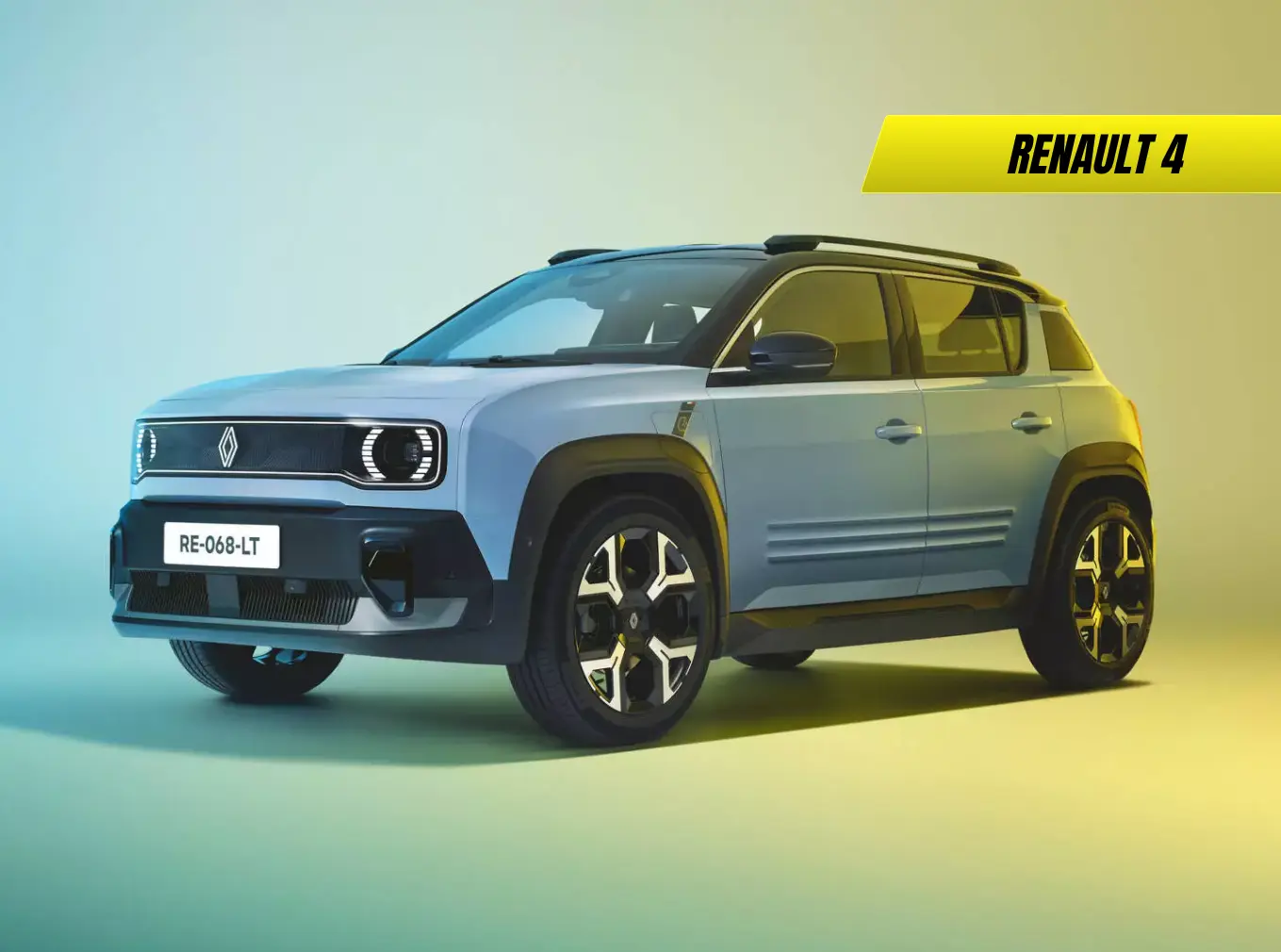
The Renault 4 and Renault 5 E-Tech 2027 represent the future of Renault’s electric revolution — two small cars that bring back the brand’s most beloved names, now reimagined for the modern EV era. Building on the upcoming 2025–2026 launches, the 2027 updates are expected to push performance and range even further, targeting 500 km (310 miles) WLTP on a single charge.
Both models are based on the new AmpR Small platform (formerly CMF-BEV) and are being developed to combine retro-inspired design with cutting-edge technology, offering British drivers affordable, efficient, and fun-to-drive electric cars. From my point of view, these models could be the most significant small EVs to hit the UK market since the original Renault Zoe.
Key Highlights
- Next-generation AmpR Small EV platform
- Target range of 500 km (310 miles) WLTP
- Upgraded 52–60 kWh battery packs
- Rapid DC charging up to 150 kW
- Production in France with full European sourcing
- Expected UK arrival in 2027, prices from £22,000 (R5) and £26,000 (R4)
Design and Identity
The Renault 4 and 5 E-Tech take inspiration from two iconic models of the past — the practical Renault 4L and the playful Renault 5. Each will have a distinct character while sharing similar mechanical foundations.
- Renault 4 E-Tech: Small SUV crossover design with a raised body, chunky wheel arches, and roof rails.
- Renault 5 E-Tech: Compact hatchback with sporty proportions and retro LED lighting.
Both feature LED matrix headlights, flush door handles, and aerodynamic detailing to reduce drag and improve efficiency.
“We’re not just bringing back old names — we’re reinventing icons for a new generation,” said Renault Design Director Gilles Vidal.
From my perspective, this strategy gives Renault a powerful mix of nostalgia and innovation, appealing to both young EV buyers and those who remember the originals.
Platform and Powertrain
Both cars are underpinned by the new AmpR Small platform, engineered specifically for electric city cars with enhanced battery density and lightweight construction.
| Model | Battery | Power | Range (WLTP) | Charging |
|---|---|---|---|---|
| Renault 5 E-Tech | 52 kWh / 60 kWh | 120–150 hp | 450–500 km | 150 kW DC / 22 kW AC |
| Renault 4 E-Tech | 60 kWh | 130–160 hp | 480–500 km | 150 kW DC / 22 kW AC |
Performance will focus on efficiency and agility, not outright speed. The R5 will offer lively acceleration (0–60 mph in around 7.5 seconds), while the R4 will emphasise comfort and practicality with optional e-4WD capability.
The next-generation motor — developed in partnership with Valeo and Valeo Siemens eAutomotive — will reduce weight and improve efficiency by up to 25% over current E-Tech systems.
Battery and Range
Renault’s ambition for 2027 is clear: to make 500 km range the new benchmark for affordable EVs.
- New nickel-manganese-cobalt (NMC) chemistry for higher energy density
- Improved battery management system (BMS) for temperature stability
- 10–80% DC fast charge in under 25 minutes
- Home AC charging (22 kW) for full charge in under 3 hours
From my experience, Renault’s recent advancements in battery management — seen in the Megane E-Tech — give credibility to these figures. If achieved, they would put the Renault 5 and 4 ahead of many larger EVs currently on sale.
Interior and Technology
Both interiors follow Renault’s new design philosophy: digital simplicity with sustainable materials.
- 10.25-inch digital cockpit and 9.3-inch infotainment display
- OpenR Link OS with Google integration and over-the-air updates
- Optional retro-style colour themes inspired by 1980s Renaults
- Fully flat floor and generous rear space (especially in the R4 SUV)
- 100% recycled fabrics and trim components
The R4’s boot will measure about 380 litres, while the R5 offers 325 litres, competitive for their respective sizes.
Comfort and connectivity are prioritised — features like AR head-up display, wireless phone mirroring, and voice-activated climate control will be available even on mid-range trims.
Driving Experience
The Renault 5 E-Tech is being engineered as the more dynamic of the two, with shorter suspension travel and sportier handling. The Renault 4 E-Tech, meanwhile, will prioritise comfort, featuring a softer ride and a higher seating position.
- Lightweight chassis ensures agile handling
- Low centre of gravity for stability on UK roads
- Optional multi-link rear suspension on high-end models
- Advanced regenerative braking with adjustable intensity
From my point of view, Renault’s experience in electric drivetrains gives both models a natural advantage — smooth torque delivery, quiet operation, and excellent city manoeuvrability.
UK Pricing and Availability
| Model | Estimated UK Price | Range (WLTP) | Highlights |
|---|---|---|---|
| Renault 5 E-Tech | £22,000–£25,000 | 450–500 km | Compact hatchback with retro design |
| Renault 4 E-Tech | £26,000–£29,000 | 480–500 km | Electric SUV with family practicality |
Both models will launch in mainland Europe in early 2027, reaching UK showrooms by summer 2027. Orders will open via renault.co.uk.
Competitors and Market Comparison
| Model | Starting Price | Range | Segment |
|---|---|---|---|
| Renault 5 E-Tech | £22,000 | 500 km | Urban hatchback |
| Fiat 500e | £29,000 | 320 km | Style and city size |
| MINI Cooper SE 2026 | £31,000 | 400 km | Premium small EV |
| Peugeot e-208 | £28,000 | 410 km | Comfort and tech |
| Citroën ë-C3 | £23,000 | 320 km | Budget electric option |
| Renault 4 E-Tech | £26,000 | 500 km | Compact SUV |
| Jeep Avenger | £27,000 | 400 km | Off-road charm |
| Hyundai Kona Electric | £30,000 | 480 km | Range and practicality |
The Renault pair will likely dominate for value and range, targeting both individual and fleet buyers seeking affordable long-range EVs.
Running Costs
| Item | Estimated Annual Cost (UK) |
|---|---|
| Electricity | £300–£500 |
| Insurance | £400–£600 |
| Maintenance | £200–£350 |
| Tyres | £250–£400 |
| Total | £1,200–£1,850 |
Their low energy use and affordable insurance make both cars ideal for UK city and suburban driving, with minimal ongoing expenses.
Sustainability
Renault’s ElectriCity hub in northern France will produce both models using renewable energy and recycled materials.
- Over 70% European-sourced components
- 95% recyclability rate by weight
- Battery recycling partnership with Veolia and Solvay
- Carbon-neutral manufacturing by 2030
This aligns with Renault’s broader sustainability goal: offering a European-built alternative to Chinese small EVs while maintaining competitive pricing.
FAQ
When will the Renault 4 and 5 E-Tech 2027 be available in the UK?
Both models will arrive by summer 2027.
How much will they cost?
Around £22,000 for the Renault 5 and £26,000 for the Renault 4.
What is their range?
Up to 500 km (310 miles) WLTP.
Are they built in Europe?
Yes, both are manufactured in northern France using renewable energy.
Will they support fast charging?
Yes, both support 150 kW DC and 22 kW AC charging.
Are they ULEZ compliant?
Yes, both are zero-emission vehicles exempt from UK low-emission charges.
Who are their main rivals?
Fiat 500e, MINI Cooper SE, and Peugeot e-208 for the R5; Jeep Avenger and Hyundai Kona Electric for the R4.
Conclusion
The Renault 4 and 5 E-Tech 2027 signal the next phase of Renault’s electric transformation — longer range, smarter design, and accessible pricing. From my point of view, these models embody everything that’s working in the European EV industry: efficiency, sustainability, and charm.
I would recommend the Renault 5 E-Tech for urban commuters seeking retro appeal and compact practicality, while the Renault 4 E-Tech suits families and adventure-focused drivers.
With up to 500 km of range, rapid charging, and European-built quality, the Renault 4 and 5 E-Tech 2027 are poised to redefine affordable electric mobility in the UK — timeless names reborn for a clean, connected future.





