
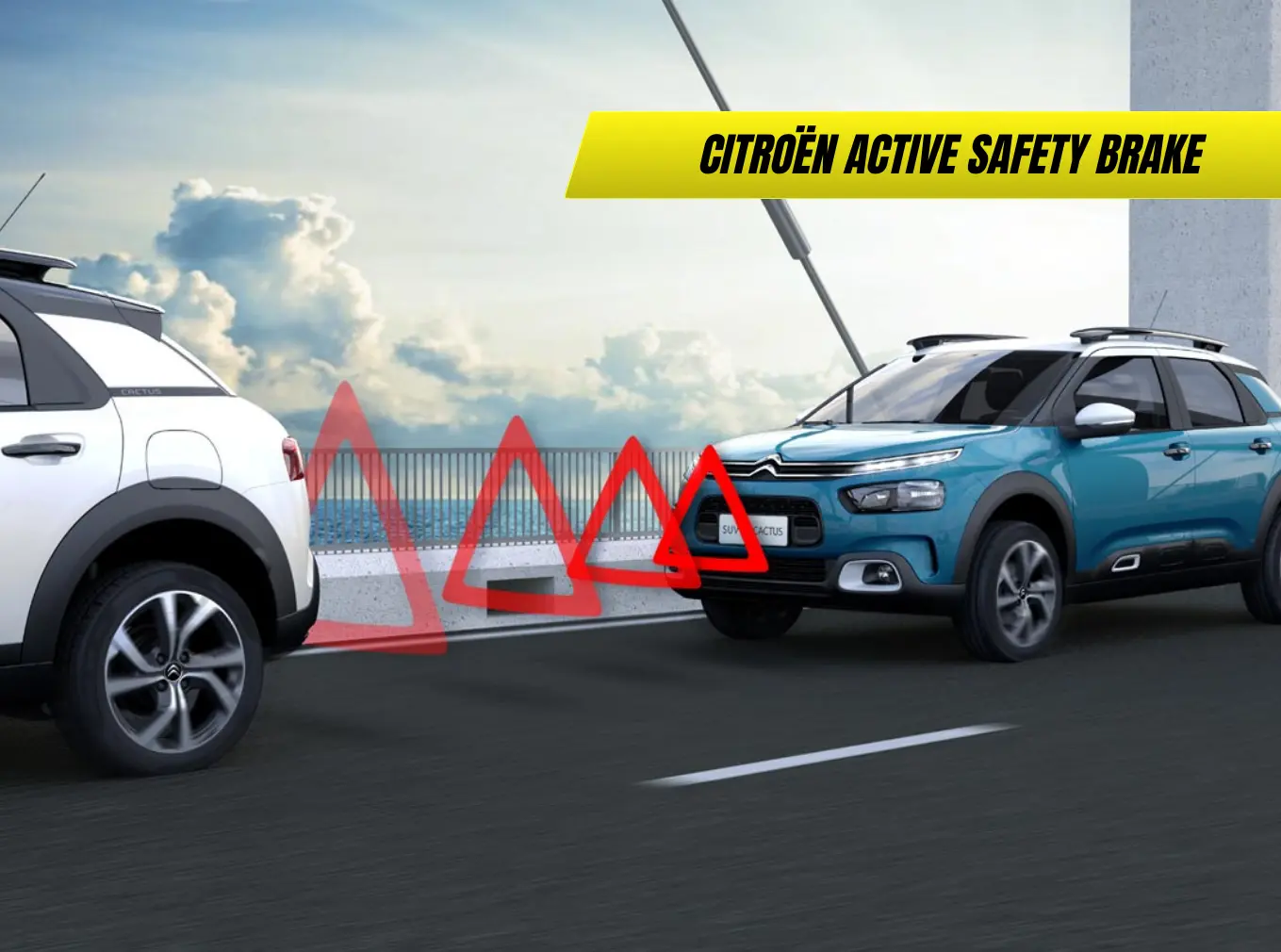
Active Safety Brake is Citroën’s autonomous emergency braking system designed to reduce or prevent collisions when the driver does not react quickly enough. With stop-start traffic, busy roundabouts and sudden motorway braking, UK drivers face constant risk of front-end crashes. This 2025 guide explains how the system works, its strengths, limitations and best practices.
Key Points
- Automatically brakes to avoid or reduce collision impact.
- Detects vehicles, pedestrians and cyclists (model dependent).
- Works day and night, subject to visibility.
- Functions across a wide speed range from city to motorway.
- Integrates with Distance Alert for layered protection.
How Active Safety Brake Works
The system uses a forward-facing camera and millimetre-wave radar to scan the road. It continuously measures:
- Distance to the object ahead
- Its relative speed
- Driver reactions (brake pedal, steering inputs)
If the system determines a collision is likely and the driver doesn’t respond, it automatically:
- Issues a warning
- Prepares the brake system
- Applies partial or full braking
This intervention can prevent many low-speed collisions and reduce the severity of high-speed impacts.
What the System Can Detect
Depending on model year and sensor package, Active Safety Brake detects:
- Vehicles (moving or stationary)
- Pedestrians
- Cyclists
- Large obstacles
Earlier generations may detect only vehicles.
Speed Range
- Urban (5–30 mph): Effective at avoiding pedestrian and cyclist collisions.
- A-roads (30–60 mph): Prevents common nose-to-tail collisions.
- Motorways (60+ mph): Most effective at reducing injury severity.
The system works at night, but camera visibility remains essential.
Active Safety Brake vs Distance Alert
| Feature | Active Safety Brake | Distance Alert |
|---|---|---|
| Applies the brakes | Yes | No |
| Warns about collision | Yes | Yes |
| Detects pedestrians | Yes (most) | No |
| Prevents accidents | Often | Indirectly |
| Works at low speed | Yes | Limited |
Together, they provide layered safety intervention.
When the System Activates
Active Safety Brake intervenes when:
- A vehicle ahead brakes suddenly
- A pedestrian steps into the road
- A cyclist crosses unexpectedly
- The driver is distracted or fatigued
- Traffic compresses rapidly on motorways
It will not intervene if the driver makes a clear evasive manoeuvre (steering away).
Benefits for UK Drivers
- Reduces rear-end collisions
- Improves pedestrian safety in towns and cities
- Helps in poor visibility
- Supports motorway safety during sudden slow-downs
- Prevents common “I didn’t see the car stopping” incidents
Cities like London, Manchester, Birmingham and Bristol see the greatest benefits because of dense traffic and high pedestrian activity.
Limitations
AEB performance declines when:
- Heavy rain or fog obstructs the camera
- Snow or mud covers the radar
- The windscreen is cracked or dirty
- The object ahead is very small or poorly reflective
- Road signs or reflective barriers cause false readings
The driver remains responsible for vehicle control.
Maintenance Requirements
To keep AEB accurate:
- Clean windscreen and radar areas regularly
- Replace worn wipers
- Avoid stickers near the camera
- Recalibrate sensors after windscreen or bumper repairs
- Keep tyres inflated for predictable braking response
AEB accuracy is heavily dependent on clean, unobstructed sensors.
Troubleshooting
| Issue | Cause | Fix |
|---|---|---|
| AEB unavailable | Dirty or blocked sensors | Clean camera/radar |
| Frequent false alerts | Reflective objects nearby | Adjust following distance |
| System does not brake | Driver steering intervention | Check for messages |
| Warning light on | Sensor fault | Dealer calibration |
For general dashboard alerts and diagnostics, see:
Tips for Best Use
- Maintain safe distance—AEB is not a substitute for good habits.
- Avoid tailgating; AEB should act as backup, not plan A.
- Use Adaptive Cruise Control when available for smoother traffic flow.
- Slow down early in bad weather even if the system is active.
My Point of View
From my point of view, Active Safety Brake is a game-changing feature for UK roads. It reacts faster than human reflexes in emergencies and provides crucial support during fatigue, distraction or sudden traffic compression. It’s the system you rarely notice—until the moment it saves you.
FAQs
Can AEB avoid every collision?
No, but it can prevent many and significantly reduce severity in others.
Does AEB work when reversing?
No, it operates only in forward motion.
Will it brake if a car cuts in sharply?
Yes, if a collision is detected as imminent.
Does it work at night?
Yes, though camera visibility influences performance.
Can I disable AEB?
Most models allow deactivation, but leaving it on is strongly recommended.
Conclusion
Citroën’s Active Safety Brake system is a vital safety tool that helps UK drivers avoid or mitigate collisions through rapid automatic braking. In my experience, it provides invaluable backup—especially on motorways, in urban areas and during moments when human attention is naturally reduced.





