
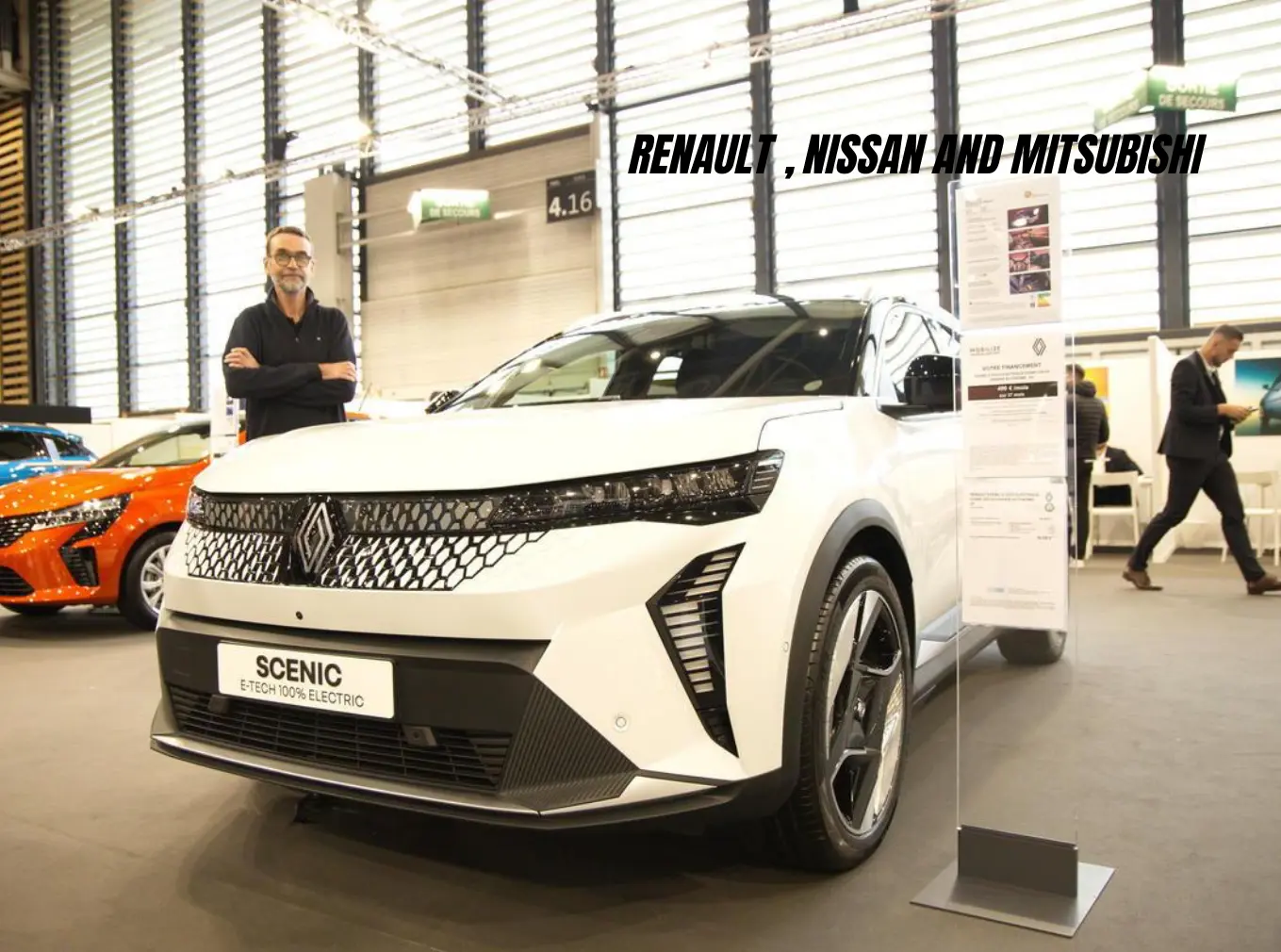
Three electric SUVs, one shared technical backbone — and what it means for UK buyers.
The Renault Scenic E-Tech, Nissan Leaf (next generation) and Mitsubishi Eclipse Cross EV may look like three very different vehicles aimed at distinct audiences, but under the skin they share far more than most buyers realise. All three models are built around the same Alliance EV architecture, developed jointly by Renault, Nissan and Mitsubishi, with shared batteries, motors, software and production strategies.
For UK drivers navigating the fast-moving EV market, understanding these shared foundations helps explain pricing, range figures and real-world performance — and also why these models are arriving on similar timelines.
Key Points
- Scenic E-Tech, Leaf and Eclipse Cross share the Alliance CMF-EV platform
- Common battery technology and electric motors
- Different body styles and brand positioning
- UK launches staggered between 2025 and 2026
- Ranges expected between 300 and 375 miles WLTP
- Shared software and charging technology
- Built in Europe for European markets
Introduction
The Renault–Nissan–Mitsubishi Alliance has quietly become one of the most important players in Europe’s electric transition. Rather than developing standalone EVs for each brand, the group has opted for a shared modular approach, allowing faster development and better cost control.
From my point of view, this strategy is one of the reasons why these three EVs remain competitively priced compared with rivals from Volkswagen and Stellantis — without sacrificing range or technology.
All three vehicles sit on the CMF-EV architecture, designed specifically for medium-size electric vehicles.
- Flat battery pack integrated into the floor
- Front and rear electric motors depending on version
- 400-volt electrical system
- Heat-pump compatibility
- Over-the-air software architecture
- Advanced driver-assistance systems
This platform also underpins models like the Renault Megane E-Tech and Nissan Ariya.
Renault Scenic E-Tech
Release Date and UK Positioning
The Renault Scenic E-Tech is already on sale in the UK and represents the most family-oriented interpretation of the platform.
Key Specs (UK)
| Battery | Range | Power |
|---|---|---|
| 60 kWh | ~260 miles | 170 hp |
| 87 kWh | ~375 miles | 220 hp |
Strengths
- Spacious interior
- Large boot
- Strong efficiency on long journeys
- Google-based infotainment
From my point of view, the long-range Scenic is currently the most balanced EV in this trio for UK families.
Official specifications are published via Renault UK, with type approval managed through GOV.UK vehicle approval.
Nissan Leaf (Next Generation)
Reinventing an EV Icon
The next-generation Nissan Leaf abandons its traditional hatchback shape and moves closer to a compact SUV profile — bringing it directly into Scenic territory.
Expected UK Specs
| Battery | Range | Power |
|---|---|---|
| ~60 kWh | ~300 miles | ~215 hp |
| ~87 kWh | ~360–370 miles | ~230 hp |
What Changes
- Taller body
- More interior space
- Improved aerodynamics
- More premium interior materials
Unlike the current Leaf, this version finally feels competitive against modern European EVs.
UK launch details will be confirmed on Nissan UK.
Mitsubishi Eclipse Cross EV
The Alliance Outsider
Mitsubishi’s Eclipse Cross EV is effectively the same technical package, but tuned for a different audience.
Expected Characteristics
- Slightly sportier suspension tuning
- More rugged exterior design
- Simplified trim structure
- Competitive pricing
Target Buyer
Drivers who want EV practicality but prefer a more SUV-like image than the Scenic or Leaf.
The Eclipse Cross EV will be Mitsubishi’s main electric model in Europe, replacing earlier PHEV-focused strategies.
Charging and Efficiency
All three models share identical charging hardware.
Charging Performance
- DC fast charging up to 130–150 kW
- 10–80% in approx. 30 minutes
- AC charging up to 22 kW (market-dependent)
In real UK conditions, winter range stability is improved by optional heat-pump systems.
Driving Experience
Although the hardware is shared, tuning differs noticeably.
Driving Feel Comparison
| Model | Driving Character |
|---|---|
| Scenic E-Tech | Comfort-focused |
| Nissan Leaf | Balanced, refined |
| Eclipse Cross EV | Slightly firmer, SUV-like |
From my experience, Renault prioritises ride comfort, Nissan aims for neutrality, while Mitsubishi adds a hint of ruggedness.
Practicality
Interior Space
- Scenic offers the most rear legroom
- Leaf balances space and compactness
- Eclipse Cross prioritises upright seating
Boot Capacity (approx.)
| Model | Boot |
|---|---|
| Scenic | ~545 L |
| Leaf | ~470 L |
| Eclipse Cross | ~460 L |
Safety and Regulations (UK)
All three vehicles meet current UK safety requirements and include:
- Adaptive cruise control
- Lane-keeping assistance
- Traffic-sign recognition
- Autonomous emergency braking
UK registration is handled through the DVLA, and drivers should remain aware of updated speed camera regulations and licence-point rules when switching to high-performance EVs.
Which One Makes Sense for UK Buyers?
- Choose the Scenic E-Tech if you prioritise space and long-distance efficiency
- Choose the Leaf if you want familiarity with a modern EV upgrade
- Choose the Eclipse Cross EV if you prefer SUV styling and simplicity
FAQ
Do these cars really share the same platform?
Yes, all are built on the CMF-EV architecture.
Is range the same across models?
Battery options are similar, but aerodynamics and tuning cause small differences.
Are they built in the same factory?
No, production is split across different European plants.
Which is cheapest in the UK?
The Leaf is expected to undercut the Scenic slightly at launch.
Are they ULEZ-compliant?
Yes, all are fully electric.
Conclusion
The Renault Scenic E-Tech, Nissan Leaf and Mitsubishi Eclipse Cross EV prove how shared engineering can deliver very different products. From my point of view, the Alliance’s CMF-EV strategy gives UK buyers more choice without unnecessary duplication — and ultimately results in better value, better range and faster development.





