
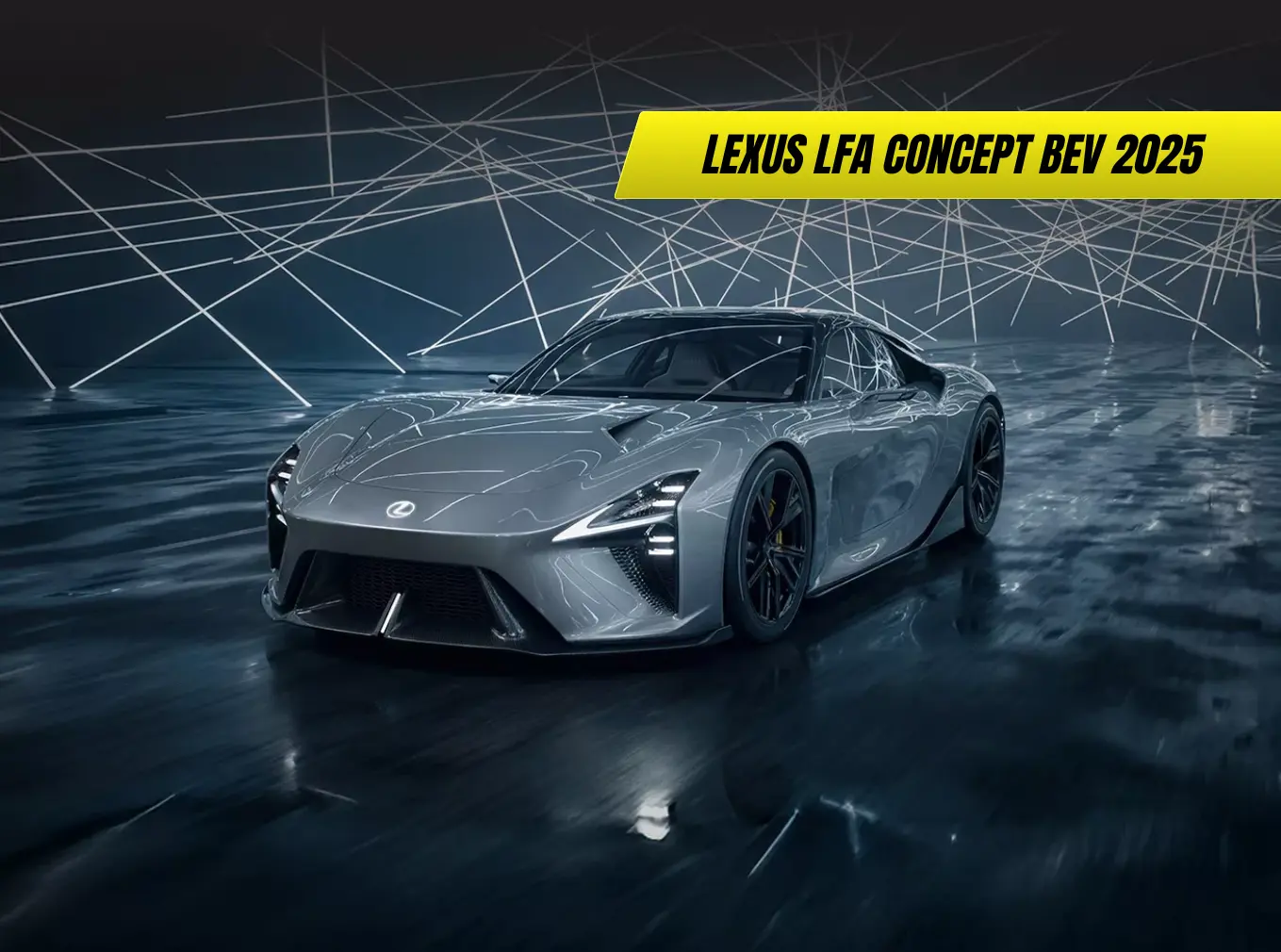
The Lexus LFA Concept BEV 2025 represents one of the most ambitious statements yet from Toyota’s luxury brand. Conceived as a fully electric spiritual successor to the legendary LFA, this concept previews a future Lexus supercar built around extreme performance, advanced aerodynamics and next-generation battery technology. While still a concept, it offers strong clues about where Lexus intends to position itself in the high-performance EV landscape later this decade.
Key Points
- Fully electric supercar concept inspired by the original Lexus LFA
- Expected power output well above 1,000 hp
- Advanced battery and thermal-management technology
- Focus on driving engagement, not just straight-line speed
- Production version expected later in the decade
- Likely halo model for Lexus’ electric performance strategy
Introduction
When Lexus launched the original LFA, it did so with a naturally aspirated V10 that prioritised emotion, sound and driver involvement over outright sales volume. The LFA Concept BEV applies the same philosophy to the electric era. Rather than chasing novelty, Lexus is signalling that electric performance can still be visceral, precise and engaging.
From my point of view, this concept is less about nostalgia and more about credibility: Lexus wants to prove it can build an electric supercar that appeals to purists as well as technophiles.
Concept Status and Expected Release Date
At present, the LFA Concept BEV is not a production-confirmed model, but Lexus has strongly hinted that it previews a real car.
Expected Timeline
| Stage | Timing |
|---|---|
| Concept reveal | 2024–2025 |
| Development prototypes | 2026–2027 |
| Production reveal (expected) | 2027–2028 |
| UK availability (estimated) | 2028–2029 |
This places the car in the same future window as other ultra-high-performance electric supercars.
Estimated Price and Positioning
If approved for production, the LFA BEV would sit at the very top of the Lexus range.
Estimated UK Pricing
| Version | Estimated Price |
|---|---|
| Base production model | £180,000–£220,000 |
| Limited or track-focused versions | £250,000+ |
Pricing would reflect exclusivity rather than volume, echoing the original LFA’s approach.
Exterior Design and Aerodynamics
The concept’s design is aggressively functional.
Design Highlights
- Extremely low and wide stance
- Sculpted bodywork with active aerodynamic elements
- Large rear diffuser and fixed rear wing
- Pronounced wheel arches housing large performance wheels
- Sharp lighting signatures inspired by Lexus’ motorsport designs
Every surface appears engineered to manage airflow and cooling, not just visual drama.
Interior and Driver Focus
While full interior details remain limited, Lexus has indicated a driver-centric cockpit.
Expected Interior Philosophy
- Low seating position
- Minimalist dashboard focused on driving data
- High-quality performance materials
- Digital interfaces tailored for track and road use
- Emphasis on steering feel and pedal response
From my point of view, Lexus seems determined to avoid the “silent appliance” feel that affects some electric performance cars.
Powertrain and Performance
Although Lexus has not confirmed figures, expectations are extremely high.
Expected Technical Highlights
| Aspect | Estimated Specification |
|---|---|
| Power output | 1,000–1,200+ hp |
| Drivetrain | Dual or quad-motor AWD |
| 0–62 mph | ~2.0 seconds |
| Top speed | 200 mph+ (electronically limited) |
| Battery | Next-generation high-density pack |
The focus appears to be sustained performance, not just short bursts.
Battery and Thermal Management
A major challenge for electric supercars is heat management.
Lexus’ Approach
- Advanced liquid cooling systems
- Battery designed for repeated high-load use
- Stable performance during track driving
- Reduced power fade compared with current EVs
This is where Lexus aims to differentiate itself from rivals that prioritise peak numbers over consistency.
Driving Experience Philosophy
Unlike many electric hypercars, the LFA Concept BEV is engineered around driver engagement.
Expected Driving Characteristics
- Highly responsive throttle mapping
- Sophisticated torque vectoring
- Emphasis on steering feedback
- Balanced chassis tuning
- Predictable handling at the limit
From my point of view, this philosophy aligns closely with what made the original LFA so respected among enthusiasts.
Practicality and Usability
Practicality is not the priority, but Lexus has hinted at limited road usability.
Usability Expectations
- Two-seat layout
- Small luggage compartment
- Road-legal configuration
- Track-focused driving modes
- Advanced driver aids that can be fully disabled
This is a car designed to be driven, not displayed.
Safety and Regulations (UK Context)
Any production version would need to comply with UK safety and approval standards.
- Full compliance with UK type approval
- Advanced braking and stability systems
- High-voltage battery safety protocols
- Registration through standard UK processes
Electric performance does not exempt it from regulatory scrutiny.
Rivals and Market Context
| Model | Powertrain | Positioning |
|---|---|---|
| Lexus LFA BEV (expected) | Electric | Driver-focused supercar |
| Rimac Nevera | Electric | Extreme performance |
| Porsche Mission X (future) | Electric | Precision engineering |
| Ferrari EV (future) | Electric | Brand-led performance |
Lexus’ challenge will be standing out emotionally, not just technically.
FAQ
Is the Lexus LFA Concept BEV going into production?
Lexus has not officially confirmed production, but strong signals suggest a real model will follow.
Will it replace the original LFA?
No, it is a spiritual successor rather than a direct replacement.
Is it fully electric?
Yes, it is designed as a pure battery-electric supercar.
Will it be sold in the UK?
If produced, the UK is expected to be one of the key European markets.
Is this a limited-edition model?
Most likely, production numbers would be very limited.
Conclusion
The Lexus LFA Concept BEV 2025 is a clear declaration of intent: Lexus does not want to merely participate in the electric performance era — it wants to lead it on its own terms. By prioritising engagement, balance and repeatable performance, this concept honours the spirit of the original LFA while embracing a radically different powertrain. From my point of view, if Lexus delivers on these promises, the production version could become one of the most compelling electric supercars of the next decade.





