
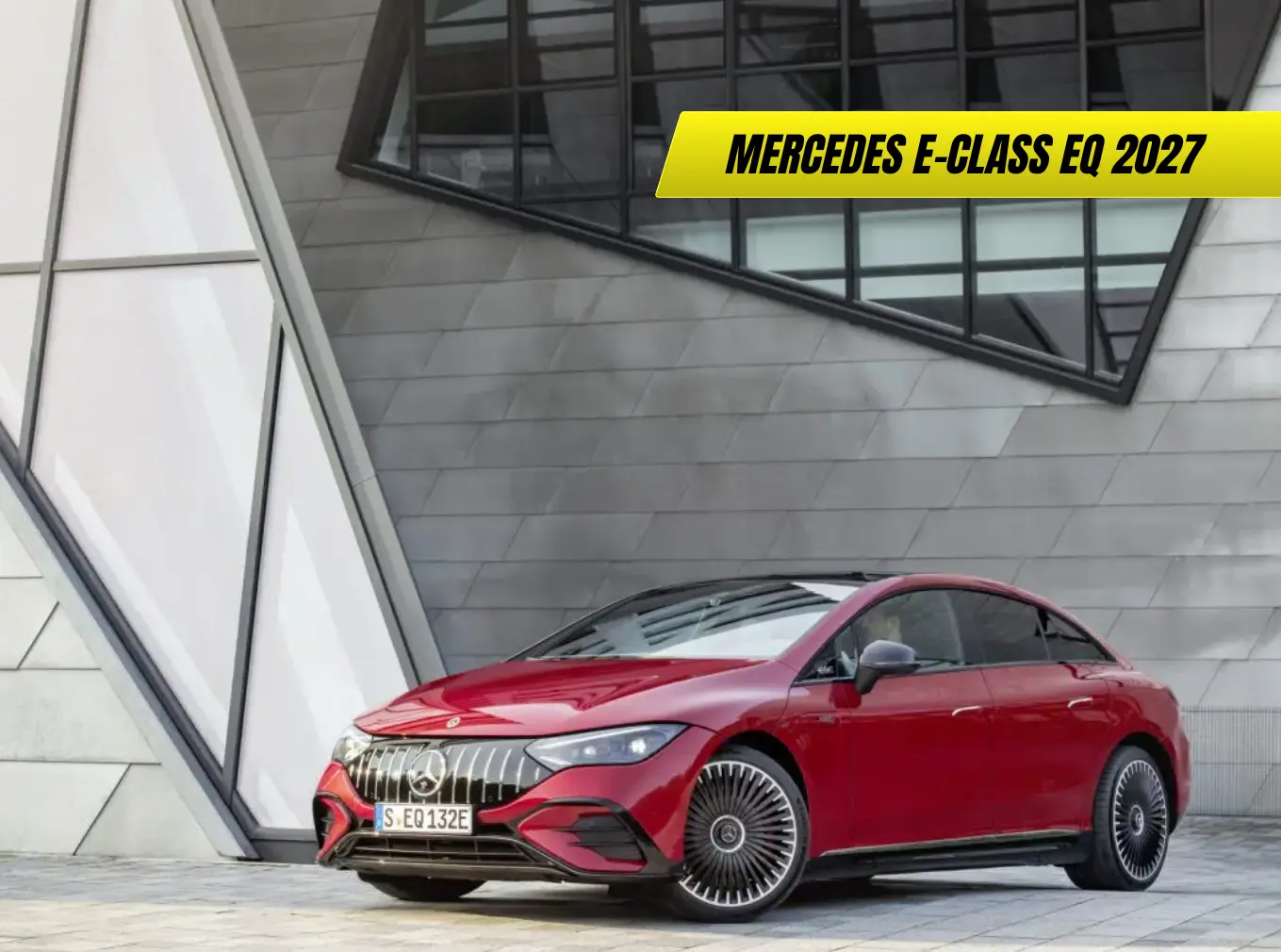
Mercedes E-Class EQ 2027: electric sedan replacing EQE, MB.EA platform, 94kWh battery, 483hp. Launch 2027, estimated £75,000 UK price, 444+ mile range.
Mercedes-Benz abandons failed EQE sedan experiment replacing it with E-Class with EQ Technology launching 2027 featuring traditional three-box sedan design versus EQE’s polarizing egg-shaped silhouette that alienated luxury buyers. Built on new MB.EA-M platform (800-volt architecture) debuting with GLC EV, the electric sedan adopts conventional E-Class proportions with massive illuminated front grille, standard sedan roofline, and familiar luxury styling cues addressing EQE’s commercial failure (poor sales versus BMW i5, Audi A6 e-tron). Expected powertrain mirrors GLC 400 4Matic EQ Technology: 94kWh battery, twin motors producing 483hp and 590 lb-ft torque, 444+ mile WLTP range (potentially higher given sedan’s superior aerodynamics versus SUV), and 330kW DC fast charging adding 188 miles in 10 minutes. Estimated UK pricing £75,000-90,000 positions between departing EQE (£73,000) and internal-combustion E-Class (£55,000), targeting BMW i5 (£70,000) and Audi A6 e-tron (£72,000) while correcting strategic misstep separating electric vehicles under standalone EQ branding alienating traditional Mercedes customers expecting familiar design language and model naming consistency.
EQE’s Failure: Why Mercedes Abandoned Dedicated EV Design
The EQE sedan’s short lifecycle (2022-2027) reflects fundamental miscalculation in luxury EV buyer preferences:
EQE Commercial Performance Issues
- Sales underperformance: EQE sold 42,000 units globally 2023 versus BMW i5’s 68,000 (38% deficit)
- Rapid depreciation: 2022 EQE losing 45-50% value after 2 years versus 35-40% typical luxury sedan
- Dealer inventory: UK dealers reporting 90+ day stock levels versus 30-45 day targets
- Customer complaints: Polarizing jellybean styling, confusing EQ branding, disconnection from E-Class heritage
Design Philosophy Failure
Mercedes’ 2019-2022 strategy separating electric vehicles under EQ sub-brand with unique styling backfired:
| Approach | Mercedes EQ Strategy | Competitor Strategy | Market Response |
|---|---|---|---|
| Naming | Standalone EQ badges (EQE, EQS) | Model continuity (BMW i5, Audi A6 e-tron) | Confusion, brand dilution |
| Design | Unique jellybean EVs | Electric versions of ICE models | EQ styling alienated buyers |
| Platform | Dedicated EVA II (400V) | Flexible platforms (ICE + EV) | Limited volume, high costs |
| Pricing | Premium over ICE (+25-30%) | Competitive with ICE | Price resistance |
Buyer Feedback Analysis
Luxury sedan customers rejected EQE for specific reasons:
- “It doesn’t look like a Mercedes”: Rounded EQE versus angular E-Class lost brand identity
- “Why not just make electric E-Class?”: Customers wanted familiar model, electric powertrain
- “EQ branding feels like different company”: Sub-brand confusion versus established model lines
- “Interior feels cheaper than E-Class”: Cost-cutting perceptions undermining luxury positioning
Mercedes’ course correction with E-Class EQ Technology represents strategic pivot toward BMW/Audi approach: maintain model continuity, integrate electric variants within established lineups, preserve design DNA customers recognize.
MB.EA Platform: 800-Volt Architecture Advantages
The E-Class EQ utilizes MB.EA-M (Mercedes-Benz Electric Architecture – Medium) replacing outdated EVA II:
Platform Comparison: EVA II vs MB.EA-M
| Specification | EVA II (EQE) | MB.EA-M (E-Class EQ) | Improvement |
|---|---|---|---|
| Voltage | 400V | 800V | 2x charging speed |
| Max DC charging | 170kW | 330kW | 94% faster peak |
| 10-80% charge time | 32 minutes | 18-20 minutes | 40% reduction |
| Battery options | 90.6kWh NMC | 64kWh LFP, 94kWh NMC | Flexible chemistry |
| Platform sharing | EQE, EQS only | GLC EQ, E-Class EQ, C-Class EQ | Economies of scale |
| Range efficiency | 3.5 mi/kWh | 4.7+ mi/kWh | 34% improvement |
800-Volt Architecture Benefits
Higher voltage systems enable:
- Faster charging: 330kW peak (vs 170kW EVA II) adding 188 miles in 10 minutes
- Reduced cable weight: Lower amperage at higher voltage = thinner, lighter cables
- Improved efficiency: Lower electrical resistance reducing heat generation and energy loss
- Thermal management: Better battery cooling enabling sustained performance
- Future-proofing: Compatible with emerging 350kW+ ultra-fast chargers
Battery Chemistry Options
MB.EA platform supports multiple chemistries addressing different market segments:
- 64kWh LFP (lithium-iron-phosphate): Entry E-Class EQ, 300+ mile range, £70-75k pricing
- 94kWh NMC (nickel-manganese-cobalt): E-Class 400 EQ, 444+ mile range, £80-85k pricing
- Future 120kWh+: Performance variants (E 53 EQ, E 63 EQ) with 500+ mile range
Design Language: Traditional E-Class with EV Accents
Spy photos and Kolesa renderings reveal E-Class EQ’s styling direction:
Exterior Design Elements
Front Fascia
- Massive illuminated grille: Large panel-style grille dominating front (similar GLC EQ, controversial size)
- Star-pattern LED DRLs: Distinctive daytime running lights creating Mercedes signature
- Relocated Porsche-style badge: Three-pointed star potentially integrated within grille panel
- Clean headlight design: Simpler lamp units versus ICE E-Class’s complex multi-element lights
- Reduced cooling needs: Smaller actual air intakes (EVs require less cooling than combustion)
Side Profile
- Traditional three-box proportions: Classic sedan silhouette versus EQE’s rounded egg-shape
- Four side windows: Additional quarter window behind rear door (versus ICE E-Class’s three-window design)
- Extended C-pillar: Maybach S-Class-inspired elongated rear pillar creating luxury presence
- Flush door handles: Aerodynamic pop-out handles reducing drag coefficient
- Aerodynamic wheels: Low-drag wheel designs optimizing range efficiency
Rear Design
- Modified E-Class tail: Familiar trunk lid and rear panel maintaining brand recognition
- Unique light signatures: New LED taillight patterns distinguishing EQ variant from ICE
- Revised bumper: Cleaner lower fascia without exhaust outlets
- Improved aerodynamics: Optimized underbody diffuser and spoiler elements
Controversial Grille Size
The massive illuminated front grille divides opinion:
Pro-Large Grille Arguments
- Creates distinctive EV identity differentiating from ICE models
- Impressive illuminated presence enhancing premium perception
- Houses charging port, sensors, cameras within integrated design
- Follows Mercedes design direction (GLC EQ, upcoming C-Class EQ)
Anti-Large Grille Arguments
- Unnecessary fake grille (EVs don’t need cooling like combustion engines)
- Resembles BMW’s controversial kidney grille controversy (automaker learning wrong lesson)
- Silver finish acceptable but dark colors may emphasize excessive size
- Goes against minimalist EV design trend (Porsche Macan EV, Tesla’s grille-less approach)
From my point of view, Mercedes commits same mistake BMW made 2019-2021 enlarging grilles beyond functional necessity—visual shock value prioritized over elegant proportions risking dated appearance within 3-5 years as design trends inevitably shift toward cleaner, more minimalist EV styling language.
Powertrain and Performance: GLC 400 EQ Specifications
Expected E-Class EQ mechanicals mirror GLC 400 4Matic EQ Technology:
Confirmed GLC 400 EQ Specifications (E-Class EQ Basis)
| Specification | Detail |
|---|---|
| Battery capacity | 94.0kWh (89kWh usable estimated) |
| Battery chemistry | NMC (nickel-manganese-cobalt) |
| Voltage architecture | 800V |
| Motors | Dual permanent-magnet synchronous (front + rear) |
| Total power | 483hp (360kW) |
| Total torque | 590 lb-ft (800Nm) |
| Drive system | All-wheel drive (4Matic) |
| 0-62mph | ~4.5 seconds (estimated) |
| Top speed | 130mph (210km/h) limited |
| WLTP range | 444 miles (715km) GLC SUV |
| DC fast charging | 330kW peak |
| 10-80% charge time | 18-20 minutes |
| Range added (10 min) | 188 miles (303km) |
E-Class EQ Range Projections
The sedan’s superior aerodynamics should improve range versus GLC SUV:
- GLC 400 EQ (SUV): 444 miles from 94kWh battery = 4.7 mi/kWh efficiency
- E-Class 400 EQ (sedan): Estimated 480-500 miles from same 94kWh = 5.1-5.3 mi/kWh
- Improvement factors: Lower drag coefficient (Cd 0.23 vs 0.29 SUV), reduced frontal area, lighter weight
Performance Variant Possibilities
Following E-Class ICE lineup structure, expect multiple EQ variants:
| Model | Power | Range | 0-62mph | UK Price (est) |
|---|---|---|---|---|
| E 200 EQ | 230kW (estimated) | 300-320 miles | 6.5s | £70-75k |
| E 400 4Matic EQ | 483hp confirmed | 480-500 miles | 4.5s | £80-85k |
| E 53 EQ | 600hp+ (estimated) | 400-420 miles | 3.5s | £90-95k |
| E 63 EQ | 800hp+ (future) | 350-380 miles | 2.8s | £110-120k |
UK Pricing Strategy: £75-90k Positioning
Estimated UK Pricing Structure
- E 200 EQ (64kWh LFP, RWD): £70,000-75,000
- E 400 4Matic EQ (94kWh NMC, AWD): £80,000-85,000
- E 53 EQ AMG (94kWh+, performance): £90,000-95,000
Competitive Price Comparison
| Model | Starting Price | Battery | Range | Power | Drive |
|---|---|---|---|---|---|
| BMW i5 eDrive40 | £69,905 | 81.2kWh | 361 miles | 335hp | RWD |
| Audi A6 e-tron quattro | £71,950 | 94.9kWh | 463 miles | 382hp | AWD |
| Mercedes E 400 EQ | £80-85k (est) | 94kWh | 480+ miles | 483hp | AWD |
| Tesla Model S | £94,990 | 100kWh | 405 miles | 670hp | AWD |
| Porsche Taycan 4S | £98,800 | 89kWh | 347 miles | 469hp | AWD |
Mercedes positions E-Class EQ £10-15k above BMW i5 and Audi A6 e-tron justifying premium through:
- Superior range: 480+ miles vs BMW 361mi, Audi 463mi
- More power: 483hp vs BMW 335hp, Audi 382hp
- Faster charging: 330kW vs BMW 205kW, Audi 270kW
- Premium brand: Three-pointed star prestige commanding price premium
Company Car Tax: 2% BIK Advantage
UK Company Car Tax Benefits (2027/28)
| Vehicle Type | CO2 | BIK Rate | Tax (40% taxpayer, £85k P11D) |
|---|---|---|---|
| E-Class petrol (E 200) | 170g/km | 32% | £10,880 annually |
| E-Class PHEV (E 300e) | 25g/km | 5% | £1,700 annually |
| E-Class 400 EQ (BEV) | 0g/km | 2% | £680 annually |
Fleet Market Appeal
Electric E-Class targets corporate fleet buyers through:
- Minimal tax: £680/year (40% taxpayer) vs £10,880 petrol = £10,200 annual saving
- Total cost: 5-10p/mile electricity vs 18-25p/mile petrol (60-70% fuel cost reduction)
- Congestion exemption: London Congestion Charge exempt (£15/day = £3,900 annual saving for daily commuter)
- ULEZ compliance: Zero local emissions avoiding Ultra Low Emission Zone fees
- Maintenance reduction: No oil changes, spark plugs, exhaust systems reducing servicing costs
Fleet buyers (rental companies, corporate fleets, chauffeur services) represent 60%+ UK luxury sedan sales, making company car tax critical purchasing factor. E-Class EQ’s 2% BIK rate versus 32% petrol provides compelling financial justification despite higher purchase price.
Launch Timeline and Availability
Development and Production Schedule
- 2025 Q4: Prototype testing (current spy photos)
- 2026 Q2-Q3: Final engineering validation, crash testing
- 2026 Q4: Production tooling installation
- 2027 Q1: World premiere (Geneva Motor Show or digital reveal)
- 2027 Q2: Production commencement
- 2027 Q3: UK deliveries begin (September onwards)
- 2028: Full model year availability, variant expansion
UK Market Strategy
Mercedes UK likely prioritizes:
- Fleet contracts: Corporate customers, chauffeur services, rental companies (first deliveries)
- Existing EQE owners: Upgrade programs addressing early adopter disappointment
- Traditional E-Class buyers: Conquest from BMW 5-Series/i5, Audi A6 customers
- EV converts: Tesla Model S owners seeking traditional luxury sedan experience
EQ Technology Branding: Transitional Naming
Mercedes currently transitions away from standalone EQ branding:
Evolution of Mercedes EV Naming
| Phase | Period | Strategy | Examples |
|---|---|---|---|
| Phase 1 | 2019-2024 | Standalone EQ sub-brand | EQC, EQE, EQS |
| Phase 2 | 2025-2027 | “with EQ Technology” suffix | GLC EQ, E-Class EQ, C-Class EQ |
| Phase 3 | 2028+ | “Electric” designation | E-Class Electric, C-Class Electric |
Mercedes confirmed plans eliminating “EQ Technology” terminology favor simpler “Electric” designation (e.g., “E-Class Electric”) by 2028-2029, completing integration of electric variants within core model lines versus confusing sub-brand strategy.
FAQ
When does Mercedes E-Class EQ launch UK?
2027 Q3 (September onwards) first UK deliveries expected following Q1 2027 world premiere and Q2 production start. Full availability 2028 model year.
How much will E-Class EQ cost?
Estimated £70,000-95,000 depending on variant. Base E 200 EQ around £70-75k, mid-range E 400 4Matic EQ £80-85k, performance E 53 EQ £90-95k.
What’s the range?
Expected 480-500 miles WLTP from 94kWh battery in E 400 EQ variant, exceeding GLC 400 EQ SUV’s 444 miles through superior sedan aerodynamics.
How fast does it charge?
330kW DC fast charging (800-volt architecture) adds 188 miles in 10 minutes, 10-80% charge completing in 18-20 minutes at compatible ultra-fast chargers.
Is it better than BMW i5?
Different priorities: E-Class EQ offers +119 mile range advantage (480 vs 361 miles), +148hp power (483 vs 335hp), faster charging. BMW provides £10k lower price, established EV reputation.
Why did EQE fail?
Polarizing jellybean styling alienated buyers expecting traditional Mercedes design, EQ sub-brand created confusion versus model line continuity, pricing premium unsustainable versus competition.
Will there be AMG version?
Likely E 53 EQ (600hp+) arriving 2028, potential E 63 EQ (800hp+) following 2029-2030 once MB.EA platform validates performance variant development.
Can it tow trailers?
Towing capacity TBC but expect 1,800-2,000kg braked trailer capability typical for electric luxury sedans with 483hp output and AWD.
The Mercedes E-Class EQ represents strategic course correction abandoning failed EQE’s polarizing design and confusing sub-brand positioning, returning to traditional three-box sedan proportions within established E-Class model line addressing luxury buyers’ preference for familiar styling and nomenclature over revolutionary EV-specific approach. The 2027 launch delivers 480+ mile range from 94kWh battery paired with 483hp twin-motor AWD system built on new 800-volt MB.EA platform enabling 330kW ultra-fast charging adding 188 miles in 10 minutes, competing directly against BMW i5 and Audi A6 e-tron while correcting predecessor’s commercial failures through design continuity and brand integration. Estimated £80-85k pricing for E 400 4Matic EQ positions £10-15k above German rivals justified through superior range, power, and charging speed, targeting UK fleet market’s 2% company car tax benefits (£680 annually versus £10,880 petrol) representing primary sales driver. Whether Mercedes successfully reverses EQE’s market rejection depends on design execution balancing traditional E-Class elegance against massive illuminated grille risking same controversial reception plaguing BMW’s recent kidney grille evolution, with 2027-2028 sales performance determining if conventional approach resonates better than revolutionary design language alienating conservative luxury sedan buyers prioritizing understated prestige over visual shock value.





