
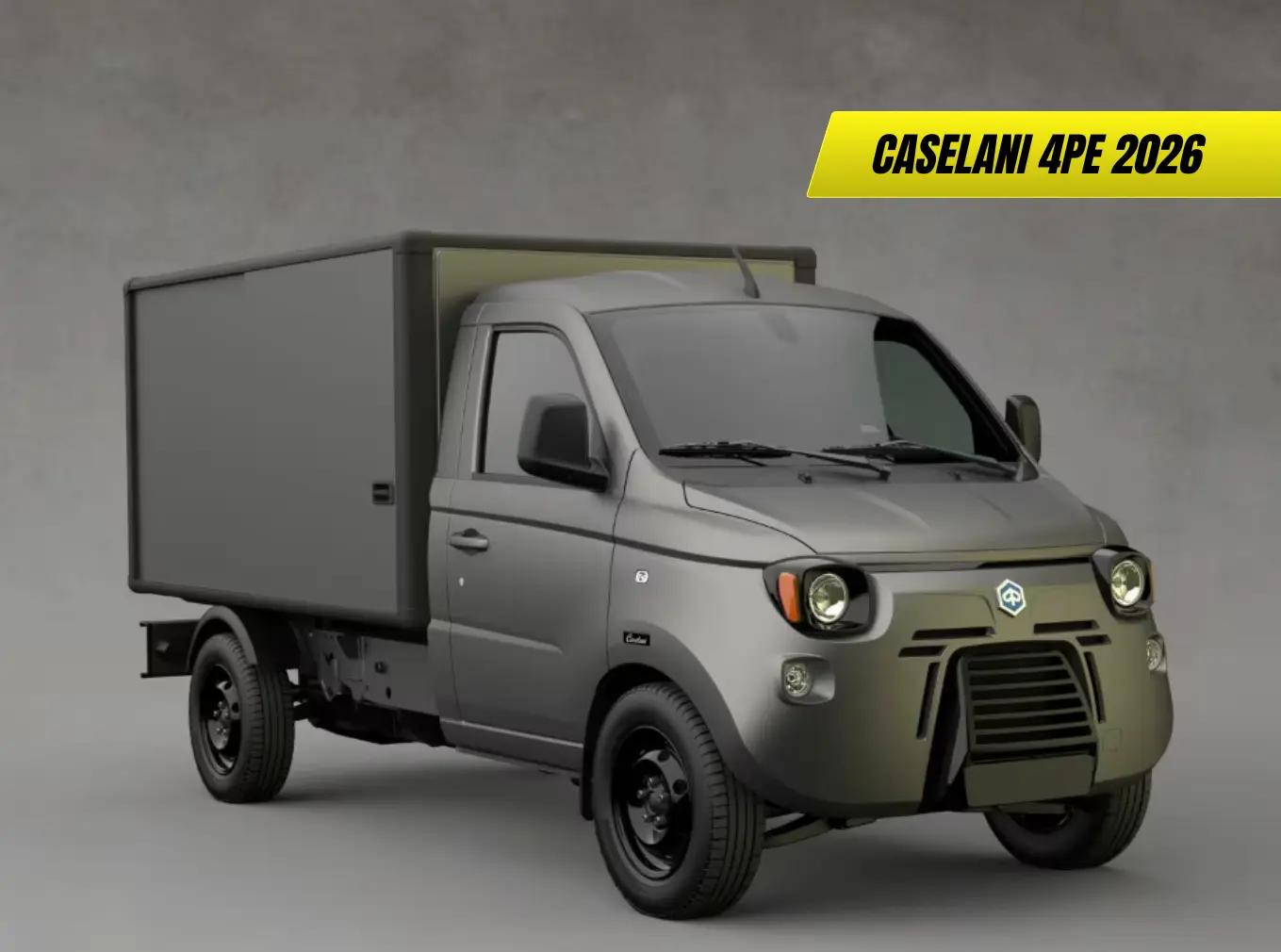
Caselani 4PE 2026 converts Piaggio Porter into retro Ape-inspired commercial vehicle with fiberglass bodywork, LED lights, and nostalgic styling. €15,000-20,000 kit price, UK availability, and installation details.
Caselani 4PE 2026: retro bodykit transforms Piaggio Porter, inspired by classic Ape. €15,000+ kit, fiberglass construction, no mechanical changes.
Italian coachbuilder Caselani introduces 4PE retro conversion kit transforming modern Piaggio Porter NP6/NPE utility vehicles into nostalgic homage to iconic Piaggio Ape three-wheeler through comprehensive fiberglass bodywork reimagining cab front with vintage-inspired fenders, bumpers, headlights, and grille designed by David Obendorfer (previous Citroën retro projects creator). The aesthetic-only transformation retains Porter’s mechanical specifications including 1.5-litre bi-fuel petrol engine (105hp gasoline/106hp LPG) or electric powertrain (201hp, 155-mile range) while replacing entire front fascia with central bumper element mimicking Ape’s distinctive three-wheel stance despite Porter’s conventional four-wheel configuration. Installation available Caselani factory or authorized bodyshops, the kit costs estimated €15,000-20,000 (£13,000-17,000) positioning as premium customization for food truck operators, artisan businesses, and collectors seeking distinctive commercial vehicle appearance compatible with all Porter body styles (fixed deck, dumper, refrigerated van, food truck). UK availability uncertain as Piaggio Porter not officially sold British market, though European buyers increasingly embrace neo-retro commercial vehicles combining modern efficiency with heritage styling appealing lifestyle businesses prioritizing brand differentiation.
Piaggio Ape Heritage and Italian Commercial Vehicle Icon Status
The Piaggio Ape represents one of Italy’s most recognizable post-war industrial designs, a three-wheeled commercial vehicle that became synonymous with small-scale entrepreneurship across Mediterranean and Asian markets. First introduced in 1948, the Ape (“bee” in Italian) evolved from Piaggio’s famous Vespa scooter platform, combining motorcycle-derived front controls with a cargo-carrying rear section that enabled war-torn Italy’s economic reconstruction through affordable commercial transportation.
| Ape Model Generation | Production Period | Configuration | Engine | Purpose | Units Produced |
|---|---|---|---|---|---|
| Ape A | 1948-1953 | 3-wheel motorcycle-based | 125cc single-cylinder | Post-war transport | 22,000 units |
| Ape B/C | 1953-1972 | 3-wheel evolved design | 150-175cc | Commercial delivery | 500,000+ units |
| Ape 50 | 1969-2009 | 3-wheel lightweight | 50cc moped-based | Urban delivery | 1 million+ units |
| Ape TM | 1982-present | 3-wheel diesel | 422-686cc diesel | Heavy-duty work | Active production |
| Ape E-City/E-Xtra | 2020-present | 3-wheel electric | Battery-powered | Urban emission zones | Limited production |
Cultural Significance Beyond Transportation
The Ape transcended its utilitarian origins to become a cultural icon representing Italian ingenuity and entrepreneurial spirit. Its compact dimensions enabled navigation through narrow medieval town centers where conventional trucks couldn’t access, making it indispensable for small businesses serving historic urban cores. The three-wheeler became particularly associated with street food vendors, gelato sellers, and mobile coffee bars – applications where the vehicle itself became part of the business’s brand identity rather than mere transportation.
This cultural resonance extended globally, with Ape production and sales spreading throughout the Mediterranean basin, Asia, and Latin America. In India, where Piaggio established licensed production, the Ape became ubiquitous as both goods transport and passenger “auto-rickshaw” service, with millions produced locally. The vehicle’s simple mechanics, minimal fuel consumption, and affordable purchase price made it ideal for emerging markets where complex modern vehicles proved impractical.
Modern Ape production continues in 2026, though volumes have declined dramatically from peak years. Current sales reach approximately 15,000-20,000 units annually, primarily in India, Italy, and emerging markets. Electric variants introduced in 2020 address European urban emission restrictions while maintaining the distinctive three-wheel format. Vintage Apes from the 1950s-1970s command collector interest, with restored examples selling for €5,000-15,000 depending on condition and rarity – substantial sums for vehicles originally marketed as disposable commercial equipment.
The Caselani 4PE conversion capitalizes on this nostalgia by applying Ape’s visual aesthetic to the modern Piaggio Porter platform, enabling businesses to leverage retro styling’s marketing appeal while benefiting from contemporary reliability, safety, and performance. For operators seeking distinctive branding in competitive food truck or artisan delivery markets, the conversion offers Instagram-friendly appearance that conventional commercial vehicles cannot match.
Caselani 4PE Design Elements and Conversion Components
The 4PE conversion comprehensively redesigns the Piaggio Porter’s front fascia while leaving the cab and cargo sections largely unchanged. This focused approach reduces costs and installation complexity compared to full-body conversions while delivering maximum visual impact from the vehicle’s most visible angle. Designer David Obendorfer, who previously created retro conversions for Citroën Type H vans and Renault 4 vehicles, developed the 4PE aesthetic to honor the original Ape’s proportions while accommodating the Porter’s fundamentally different four-wheel architecture.
Front Fender Construction
The most distinctive 4PE components are the bulbous front fenders that mimic the Ape’s motorcycle-derived wheel coverings. Constructed from hand-laid fiberglass, these fenders feature rounded, organic shapes contrasting sharply with the angular modern Porter bodywork they replace. Each fender bolts to the Porter’s existing chassis mounting points, requiring no structural modifications to the underlying vehicle.
Customers can specify body-color paint matching the Porter’s factory finish or leave the fiberglass in its raw gelcoat state for an industrial aesthetic popular among artisan businesses emphasizing handcrafted authenticity. The fenders add minimal weight – approximately 8-10kg per side – and don’t affect the Porter’s payload capacity or handling characteristics in normal use.
Central Bumper Element and Front Fascia
The conversion’s most dramatic element is the central vertical nose cone that replicates the Ape three-wheeler’s single front wheel housing despite the Porter retaining conventional four-wheel configuration. This purely aesthetic component hides the Porter’s standard bumper beneath a fiberglass shell that creates visual continuity with the bulbous fenders. The design challenge involved making a four-wheeled vehicle appear inspired by three-wheel architecture without creating visual confusion or appearing cartoonish.
The central bumper element integrates the front grille opening, which maintains functionality by allowing airflow to the radiator on petrol-powered Porters or battery cooling vents on electric NPE variants. Mesh or slat-style grille inserts reference the Ape’s simple cooling provisions while meeting modern vehicles’ greater airflow requirements. The Piaggio logo can be repositioned or supplemented with 4PE branding depending on customer preference and trademark considerations.
LED Headlight Integration
Modern LED headlight units from suppliers Hella and Giantlight replace the Porter’s standard lighting while meeting European ECE safety and photometric regulations. The twin round headlamps flank the central bumper element, creating symmetrical appearance despite the Ape’s original single central headlight. This compromise proves necessary because contemporary lighting regulations require specific beam patterns and light output levels impossible to achieve with a single central unit.
The LED technology delivers multiple benefits beyond regulatory compliance. Daytime running lights, turn indicators, and main beam functions integrate within compact housings that don’t disrupt the retro aesthetic. LED longevity (typically 50,000+ hours) reduces maintenance requirements compared to conventional bulbs, while superior light output improves safety during early morning or evening deliveries common for commercial vehicles.
Unchanged Elements: Practical Considerations
The 4PE conversion deliberately leaves the Porter’s side profile, cab interior, and rear sections unmodified. This pragmatic approach recognizes that most visual impact comes from frontal appearance, particularly for vehicles photographed for social media or parked in high-visibility locations at events and markets. Extending the conversion to encompass the entire vehicle would dramatically increase costs without proportional marketing benefit for most business operators.
The original door handles, mirrors, windows, and cab structure remain factory specification, preserving crash safety, weatherproofing, and ergonomics. Cargo areas – whether fixed decks, refrigerated boxes, or custom food truck bodies – continue using standard Porter configurations since these sections typically receive business-specific customization independent of the 4PE aesthetic treatment.
Compatibility Across Porter Body Styles
A key 4PE advantage is compatibility with all Porter body configurations, enabling businesses to combine retro aesthetics with functional requirements. The most popular application involves food truck conversions, where the distinctive Ape-inspired front attracts customers at festivals, markets, and private events. The conversion’s Instagram appeal generates organic social media promotion, potentially justifying the €15,000-20,000 investment through enhanced brand recognition and customer attraction.
Other applications include artisan delivery vehicles for florists, bakeries, and boutique retailers seeking to reinforce brand identities emphasizing traditional craftsmanship and heritage values. Mobile bars serving prosecco or craft cocktails at weddings and corporate events benefit from the conversion’s romantic visual appeal. Even utilitarian applications like construction site deliveries or agricultural transport can justify the conversion if business owners value distinctive appearance differentiating their operations from generic commercial vehicles.
Piaggio Porter Platform Specifications and Chinese Manufacturing Partnership
Understanding the 4PE conversion requires examining the underlying Piaggio Porter platform that forms its mechanical foundation. The Porter’s current generation represents a significant departure from its Italian-engineered predecessors, now based on Chinese manufacturer Foton’s Gratour V3 platform through a partnership that dramatically reduced production costs while generating controversy about authentic “Italian” branding.
Porter NP6 and NPE Technical Specifications
| Specification | Porter NP6 (Petrol/LPG) | Porter NPE (Electric) |
|---|---|---|
| Base platform | Foton Gratour V3 (China) | Foton Gratour V3 EV |
| Engine type | 1.5L inline-4 bi-fuel | Single electric motor |
| Power output | 105hp (gasoline) / 106hp (LPG) | 201hp (150kW) |
| Torque | 143Nm | 310Nm |
| Transmission | 5-speed manual | Single-speed reduction |
| Drive configuration | Rear-wheel drive | Rear-wheel drive |
| 0-62mph acceleration | ~14 seconds | ~9 seconds |
| Top speed | 87mph (140km/h) | 75mph (120km/h) limited |
| Range | 300+ miles (fuel dependent) | 155 miles (250km) urban cycle |
| Payload capacity | 1,000kg (2,200 lbs) | 800kg (1,760 lbs) |
| Gross vehicle weight | 3,500kg (Class N1 light commercial) | 3,500kg |
| Wheelbase | 2,800mm | 2,800mm |
| Cargo bed length | 2,520mm (standard) | 2,520mm |
The bi-fuel petrol/LPG capability on NP6 variants provides operational flexibility for businesses operating in areas with limited LPG infrastructure, though the LPG option reduces fuel costs by approximately 30-40% compared to gasoline in markets with favorable LPG taxation. The electric NPE variant’s 201hp output surprises for a commercial vehicle, though this power primarily enables acceptable acceleration when fully loaded rather than performance driving. The electric version’s 800kg payload capacity trails the petrol variant’s 1,000kg due to battery weight consuming available gross vehicle weight.
Foton Partnership Background and Authenticity Questions
Piaggio’s commercial vehicle division underwent dramatic restructuring following financial pressures in the late 2000s. The original Italian-designed Porter ceased production in 2008, with Piaggio unable to justify continued investment in developing new generations for the relatively small European light commercial vehicle market. In 2010, Piaggio partnered with China’s Foton Motor (a subsidiary of Beijing Automotive Group) to source a replacement platform.
The 2011 “new” Porter launched as a rebadged Foton Gratour V3 with minimal modifications beyond Piaggio badges and European-market compliance updates. This partnership reduced vehicle development costs by 40-50% compared to indigenous Italian engineering, enabling Piaggio to maintain commercial vehicle presence without unsustainable R&D expenditure. However, the Chinese origins generated controversy among customers expecting Italian-engineered products when purchasing vehicles wearing Piaggio badges.
For 4PE conversion purposes, the Porter’s Chinese platform proves largely irrelevant since the kit addresses only aesthetic concerns while mechanical components remain unchanged. The Foton underpinnings provide reliable, proven commercial vehicle engineering at accessible price points – precisely the pragmatic foundation appropriate for businesses prioritizing appearance and functionality over engineering purity.
UK Market Absence and Import Challenges
The Piaggio Porter is not officially sold in the United Kingdom, creating significant obstacles for British buyers interested in 4PE conversions. Without official UK market presence, Piaggio maintains no authorized dealer network, parts distribution infrastructure, or factory-trained service technicians for Porter vehicles. This absence reflects Piaggio’s assessment that the UK light commercial vehicle market is adequately served by domestic manufacturers (Ford Transit, Vauxhall Vivaro) and European competitors (Renault Master, Mercedes Sprinter), with insufficient demand justifying right-hand drive development investment for the Porter.
British buyers interested in acquiring Porter vehicles – with or without 4PE conversion – must navigate individual vehicle importation processes. This involves purchasing left-hand drive examples in mainland Europe, arranging transport to the UK, and completing Individual Vehicle Approval (IVA) testing demonstrating compliance with British safety and emissions standards. While left-hand drive light commercial vehicles are entirely legal for UK road use, they present practical challenges for drivers regarding visibility, parking, and toll booth access.
For established businesses with existing continental European presence, importing a 4PE-converted Porter may prove viable. However, most small British food truck operators or artisan businesses face prohibitive complexity and cost compared to sourcing locally-available commercial vehicles and applying custom livery achieving similar (if less distinctive) visual impact. This practical reality largely limits 4PE appeal to European markets where Porter vehicles are readily available through normal commercial channels.
Similar to buyers considering Dacia Jogger facelift 2025 or other European commercial vehicles, UK customers must weigh import complexities against alternative domestic options serving similar purposes.
Installation Process, Pricing Structure, and Value Proposition
The 4PE conversion requires professional installation by skilled technicians familiar with fiberglass fabrication, automotive electrical systems, and commercial vehicle construction. Caselani offers multiple installation pathways accommodating different customer preferences regarding cost, convenience, and quality assurance.
Factory Installation at Caselani Facility
The premium installation option involves delivering the Porter to Caselani’s Sospiro facility near Cremona, Italy, where trained technicians complete the conversion under controlled conditions. The process typically requires 3-5 business days depending on customization requests and paint specifications. Factory installation includes:
- Complete disassembly of Porter’s front fascia components
- Precise fitting and alignment of fiberglass fenders, bumper, and grille
- Professional paint application matching Porter’s factory color or custom finishes
- LED headlight installation and electrical integration
- Wiring harness modifications ensuring lighting compliance
- Quality control inspection before customer delivery
- 2-year Caselani warranty covering bodywork and installation
Factory installation costs approximately €15,000-18,000 including the fiberglass kit, LED lighting components, professional labor, and paint finishing. This represents the highest-quality option with guaranteed fitment and comprehensive warranty coverage, though it requires the vehicle to be out of service during conversion and incurs transport costs if the customer is located distant from northern Italy.
Authorized Bodyshop Installation
Caselani maintains a network of approved installation partners across Italy and select European markets. Customers can purchase the 4PE kit and have it installed at a local authorized facility, reducing transport logistics while maintaining quality standards through Caselani’s technician training and certification programs.
Authorized bodyshop installation typically requires 5-7 business days depending on workshop scheduling and complexity of any custom modifications requested. Costs vary by location but generally range €15,000-20,000 total including the kit (€10,000-12,000), installation labor (€3,000-5,000), and paint work (€2,000-3,000). Warranty coverage depends on the specific installer, typically providing 1-year guarantees on workmanship though Caselani may offer extended coverage through approved partners.
DIY Installation: Not Recommended
While technically possible for skilled fabricators, self-installation of 4PE kits is strongly discouraged and may void any manufacturer warranties. The conversion requires:
- Experienced fiberglass work for proper panel alignment and gap consistency
- Automotive electrical knowledge for LED headlight integration meeting safety regulations
- Paint and finishing expertise achieving professional appearance
- Specialized tools including panel bonding adhesives and headlight aim equipment
Poor fitment results in water ingress damaging cab interiors, electrical faults causing lighting failures potentially resulting in MOT failures or UK driving licence points for equipment violations, and visual appearance undermining the conversion’s marketing value. For these reasons, Caselani may decline to sell kits without approved installation, similar to how performance modifications often require professional fitting to maintain vehicle warranties and insurance coverage.
Pricing Breakdown and Cost Justification
A detailed cost analysis reveals where the €15,000-20,000 investment is allocated:
| Component | Cost Range |
|---|---|
| Fiberglass body kit (fenders, bumper, grille panels) | €8,000-10,000 |
| LED headlight units (Hella/Giantlight certified) | €1,500-2,000 |
| Installation labor (40-50 hours skilled work) | €3,000-4,000 |
| Paint and finishing (body-color matching, clearcoat) | €2,000-3,000 |
| Electrical integration (wiring, compliance certification) | €500-1,000 |
| Hardware and adhesives (mounting brackets, structural bonding) | €200-500 |
| Quality control and warranty administration | €300-500 |
| Total estimated investment | €15,000-20,000 |
For businesses evaluating this investment, the value proposition depends entirely on marketing returns rather than functional improvements. The 4PE conversion adds no performance capability, payload capacity, or operational efficiency – it purely addresses aesthetic differentiation in competitive markets where visual distinctiveness attracts customers and justifies premium pricing.
A mobile gelato vendor charging £4-5 per serving might justify the €18,000 conversion if the distinctive appearance attracts 50-100 additional daily customers during summer festival season compared to generic competitors. Over a 20-week season, this incremental business generates £20,000-40,000 additional revenue, providing positive return on investment within 1-2 years. Similarly, a boutique florist’s delivery vehicle reinforces brand identity around traditional craftsmanship and romance, potentially commanding 15-20% price premiums for wedding flower packages compared to competitors using standard vans.
Conversely, construction or agriculture businesses moving materials between sites gain little marketing value from retro styling, making the €18,000 conversion economically unjustifiable when generic Porters or diesel SUVs serve functional requirements at lower cost.
Target Markets and Business Applications
The 4PE conversion appeals to specific customer segments where visual distinctiveness delivers tangible business value beyond mere aesthetic preference. Understanding these target markets reveals why certain operators justify the substantial investment while others view it as frivolous expenditure.
Artisan Food Trucks and Mobile Catering
This segment represents the primary 4PE market, with mobile food vendors recognizing that distinctive vehicle appearance directly impacts customer attraction and social media engagement. At crowded festivals and markets where dozens of food trucks compete for attention, the Ape-inspired aesthetic creates immediate visual differentiation that draws customers before they evaluate menu offerings or pricing.
The Instagram factor proves particularly valuable for food truck operators building brand awareness through social media. A photogenic vehicle generates organic content as customers photograph their food purchases with the distinctive truck visible in backgrounds. This free marketing amplifies reach beyond physical event attendance, building follower bases that drive customers to future locations. Some operators report social media following increasing 200-300% after converting to distinctive retro vehicles compared to previous generic trucks.
Specific food truck applications particularly suited to 4PE conversions include:
- Gelato and ice cream vendors: The nostalgic aesthetic aligns perfectly with traditional Italian gelato culture
- Mobile pizzerias: Wood-fired pizza trucks leverage heritage appearance suggesting authentic preparation methods
- Specialty coffee trucks: Third-wave coffee culture emphasizes artisan craftsmanship reinforced by retro vehicle aesthetic
- Gourmet street food: Premium-priced offerings justify distinctive presentation differentiating from budget fast food
Lifestyle Businesses and Experiential Retail
Beyond food service, various lifestyle businesses leverage the 4PE’s aesthetic appeal to reinforce brand identities centered on tradition, craftsmanship, and romantic nostalgia. Wedding industry vendors particularly benefit from vehicles that photograph beautifully and enhance event ambiance beyond mere functional service provision.
Applications include:
- Wedding florists: Vintage Porter delivering bouquets creates romantic backdrop for ceremony photography
- Mobile prosecco bars: High-end event catering requires distinctive presentation justifying premium pricing
- Artisan bakers: Bread and pastry delivery in retro vehicle emphasizes traditional baking methods and heritage recipes
- Boutique retailers: Pop-up shops and promotional vehicles for luxury brands requiring sophisticated visual presentation
These applications share common characteristics: premium pricing, experience-focused service delivery, and customer demographics valuing aesthetics and brand storytelling over purely functional considerations. The €18,000 conversion cost represents marketing investment rather than vehicle expenditure, amortized across years of enhanced brand perception and pricing power.
Collectors and Automotive Enthusiasts
A smaller but significant market segment comprises collectors unable to source or afford authentic vintage Ape three-wheelers who view the 4PE-converted Porter as accessible alternative capturing similar aesthetic appeal with modern reliability and safety. This group prioritizes ownership experience and automotive culture participation over business justification.
For enthusiasts, the converted Porter enables participation in vintage vehicle events, classic car shows, and enthusiast gatherings where unusual commercial vehicles attract attention and appreciation. The modern mechanical underpinnings avoid the maintenance headaches, parts scarcity, and reliability concerns inherent in preserving 60-70 year old Apes, while still delivering retro aesthetic appeal and conversation-starting distinctiveness.
This market parallels buyers of Dacia Sandero 2026 or other affordable vehicles who prioritize character and uniqueness over raw specifications – the 4PE Porter offers similar philosophy in commercial vehicle format.
Frequently Asked Questions
How much does the Caselani 4PE conversion cost?
The complete 4PE conversion costs €15,000-20,000 (approximately £13,000-17,000) including the fiberglass body kit, LED headlight units, professional installation, and paint finishing. Factory installation at Caselani’s facility costs €15,000-18,000, while authorized bodyshop installation ranges €15,000-20,000 depending on location and customization. This price is separate from the base Piaggio Porter vehicle itself, which costs €25,000-40,000 depending on petrol or electric powertrain choice.
Can I buy a 4PE-converted Porter in the UK?
UK availability faces significant challenges because Piaggio doesn’t officially sell the Porter in Britain. British buyers would need to purchase a left-hand drive Porter in mainland Europe, arrange the 4PE conversion installation, and then import the completed vehicle to the UK through Individual Vehicle Approval (IVA) testing. Total costs including the base Porter (€35,000), conversion (€18,000), import duties, IVA testing, and transport could reach £50,000-55,000, making it economically questionable for most UK businesses compared to locally-available commercial vehicles.
Does the 4PE kit affect the Porter’s performance or payload?
No mechanical modifications occur during 4PE installation. The petrol Porter retains its 105hp output, 87mph top speed, and 1,000kg payload capacity, while electric versions maintain 201hp and 800kg payload. The fiberglass components add approximately 30kg total weight – negligible impact on performance, fuel economy, or payload in normal use. All Porter mechanical warranties remain valid since powertrain, suspension, and chassis components are unchanged. The conversion purely addresses aesthetic appearance without affecting operational capabilities.
How long does 4PE installation take?
Factory installation at Caselani’s Sospiro facility requires 3-5 business days from vehicle delivery to completion. Authorized bodyshop installation typically takes 5-7 business days depending on workshop scheduling. The process involves removing the Porter’s front fascia, fitting and aligning fiberglass components, integrating LED headlights with proper wiring, applying paint finish, and conducting quality control inspection. Businesses should plan for approximately one week of vehicle downtime during conversion.
Is the 4PE conversion street legal?
Yes, the conversion maintains full road legality across European markets. The LED headlight units meet ECE safety and photometric regulations, while the fiberglass bodywork doesn’t modify the Porter’s crash structure or safety systems. The conversion doesn’t affect the vehicle’s existing type approval since it constitutes non-structural aesthetic modification similar to aftermarket bumpers or body kits. However, UK buyers importing converted Porters must complete IVA testing demonstrating British compliance, similar to any imported vehicle not originally certified for the UK market.
Can I remove the 4PE kit later?
Technically possible but highly impractical. Removal requires cutting/grinding the bonded fiberglass panels, reinstalling original Porter components (likely damaged or disposed of during conversion), and rewiring standard headlights. Paint damage from adhesive removal necessitates complete cab refinishing. Most conversions should be considered permanent modifications. The substantial €18,000 investment makes reversal economically senseless unless the vehicle changes to applications where retro aesthetic creates negative rather than positive business impact.
What maintenance does the 4PE conversion require?
The fiberglass bodywork requires minimal maintenance beyond occasional washing and wax application like any painted surface. LED headlights typically last 50,000+ hours without bulb replacement. Annual inspection should verify no cracks developing in fiberglass panels from vibration or impact, and that bonding adhesive maintains integrity. Paint touch-ups address any chips or scratches from normal commercial vehicle use. Caselani’s 2-year warranty covers manufacturing defects in fiberglass components and installation workmanship, though normal wear from commercial operation falls outside warranty coverage.
Are there alternatives to the Piaggio Porter for 4PE conversion?
Currently, Caselani designs the 4PE kit specifically for Piaggio Porter platforms, with no direct alternatives available for other commercial vehicles. However, Caselani has created similar retro conversions for Citroën Type H vans and Renault 4 vehicles using comparable design approaches. UK businesses seeking retro aesthetic without Porter import complexity might explore custom body shop services applying vintage-inspired styling to locally-available platforms like Renault Master or Ford Transit Custom, though these would be bespoke projects without Caselani’s engineered kit approach.
Conclusion
The Caselani 4PE conversion represents a specialized solution for businesses and enthusiasts valuing visual distinctiveness sufficient to justify €15,000-20,000 investment in purely aesthetic modification. By transforming the modern Piaggio Porter into a nostalgic tribute to the iconic Ape three-wheeler, David Obendorfer’s design enables operators to leverage retro styling’s powerful marketing appeal while maintaining contemporary reliability, safety, and performance standards.
For artisan food trucks, lifestyle businesses, and experiential service providers, the 4PE conversion delivers tangible return on investment through enhanced customer attraction, social media engagement, and brand differentiation justifying premium pricing. A distinctive vehicle becomes part of the business’s marketing infrastructure rather than mere transportation, generating value beyond functional utility through Instagram posts, word-of-mouth recommendations, and memorable customer experiences that generic commercial vehicles cannot provide.
However, the conversion’s value proposition is highly selective. Businesses focused on functional transportation or operating in markets where customers prioritize price over presentation will find the €18,000 investment impossible to justify. Similarly, UK buyers face significant import challenges given the Porter’s absence from British market, potentially spending £50,000+ achieving what custom local body shops might approximate at lower cost using readily-available platforms.
The 4PE ultimately succeeds as a solution for specific niches rather than mass market appeal. It targets the intersection of businesses requiring commercial vehicle utility with brand identities emphasizing heritage, craftsmanship, and aesthetic distinction. For operators in this narrow but viable segment, particularly across Italian and European markets where Porter vehicles are readily available and vintage Ape nostalgia resonates culturally, the conversion provides compelling differentiation unavailable through conventional commercial vehicle channels.
Whether this business model sustainably supports Caselani’s operations depends on maintaining sufficient customer flow to justify the specialized engineering investment developing conversion kits for low-volume commercial platforms. The company’s broader portfolio including Citroën Type H revivals and Renault 4 updates suggests a viable strategy serving the growing neo-retro commercial vehicle segment, though scale remains limited compared to mainstream automotive markets.
For the rare British entrepreneur willing to navigate import complexities, or European operators seeking distinctive alternatives to generic light commercial vehicles, the Caselani 4PE offers genuinely unique aesthetic appeal honoring Italian design heritage while delivering modern operational capability. Just don’t expect it to make practical sense on a spreadsheet – this conversion sells dreams and differentiation, not cost-per-kilometer efficiency.
External Links:





