
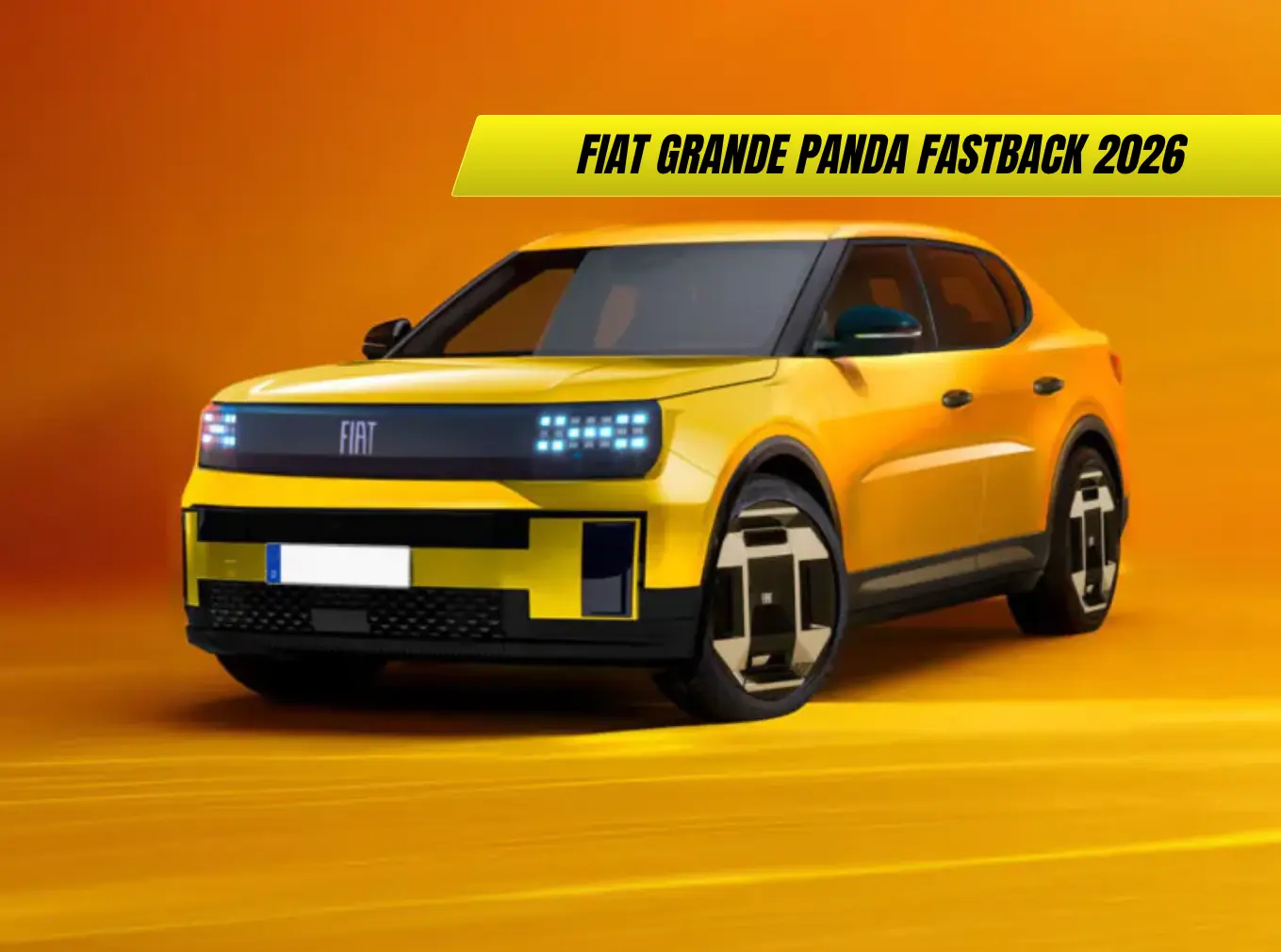
Fiat develops Panda Fastback coupe-SUV targeting late 2026 debut as sportier Grande Panda derivative featuring sloping roofline, approximately 4.3-4.5 meter length, and shared Smart Car platform offering hybrid and electric powertrains priced from £21,000-27,000 competing against Renault Arkana and Citroën C4.
Italian manufacturer Fiat expands rapidly-growing Panda family with Panda Fastback coupe-SUV scheduled late 2026 or early 2027 launch representing third distinct bodystyle alongside conventional Grande Panda crossover and seven-seat Multipla MPV, targeting style-conscious buyers seeking dynamic silhouette over pure practicality through fastback sloping roofline creating coupe-like profile within compact 4.3-4.5 meter length positioning between Grande Panda’s 3.99m and Multipla’s estimated 4.4m. Built on versatile Stellantis Smart Car platform shared across expanding B/C-segment lineup, the Fastback offers comprehensive powertrain range including 1.2-litre mild hybrid(100-136hp with 48V assistance), fully-electric variant featuring 113hp motor and 44kWh battery delivering approximately 320km (200 miles) WLTP range, and potential future extended-range electric or plug-in hybridvariants depending on market reception and competitive pressures. Design language evolves Grande Panda’s pixel-inspired aesthetic through more aggressive proportions featuring slim horizontal LED headlights, prominent front grille with FIAT lettering, muscular sculpted fenders, dramatically sloping rear roofline ending in integrated spoiler, and 3D vertical taillights creating contemporary coupe-SUV appearance competing against Renault Arkana, Citroën C4, and Peugeot 408 while undercutting pricing through budget brand positioning estimated £21,000-27,000spanning base hybrid through top electric specification. Interior mirrors Grande Panda’s minimalist philosophy featuring 10-inch digital instrument cluster, 10.25-inch touchscreen infotainment, transparent yellow dashboard accentcontaining silhouetted original Panda climbing uphill paying homage heritage, and sustainable materials including bamboo fiber trim reinforcing eco-conscious positioning appealing environmentally-aware younger buyers prioritizing style and sustainability over traditional premium badges.
Fastback Strategy: Emotional Design in Budget Segment
The Panda Fastback represents Fiat’s strategic response to coupe-SUV trend dominated by premium brands, bringing fashionable sloping roofline aesthetic to affordable pricing tier typically restricted to conventional crossover proportions.
Coupe-SUV Market Context
The coupe-SUV bodystyle combines elevated SUV ride height with sloping fastback roofline creating sportier silhouette sacrificing rear headroom and cargo capacity for improved aerodynamics and emotional styling. Pioneered by premium brands (BMW X6, Mercedes GLE Coupe, Porsche Cayenne Coupe), the format filtered downmarket through:
Premium Segment (£35,000-60,000+)
- BMW X4, X6: German engineering, sporty dynamics
- Mercedes GLC Coupe, GLE Coupe: Luxury positioning
- Audi Q5 Sportback, Q8 Sportback: Quattro capability
- Porsche Macan, Cayenne Coupe: Performance focus
Mainstream Segment (£25,000-35,000)
- Renault Arkana: Pioneer affordable coupe-SUV (from £29,000)
- Citroën C4: Quirky French styling (from £27,000)
- Peugeot 408: Fastback crossover (from £30,000)
- Mazda CX-30: Premium aspirations (from £27,000)
Budget Segment (£20,000-25,000)
- Currently underserved – opportunity for Fiat differentiation
- Most budget brands offer conventional crossover shapes only
- Fiat Fastback fills gap bringing coupe-SUV style to accessible pricing
Fiat’s Value Proposition
The Fastback’s estimated £21,000-27,000 pricing positions it as most affordable coupe-SUV in European market, undercutting established rivals by £2,000-8,000 while offering comparable styling appeal and increasingly competitive equipment through Smart Car platform efficiencies.
Target Customer Profile
Demographics
- Young professionals (25-40 years) prioritizing style over maximum practicality
- Image-conscious buyers wanting distinctive appearance without premium pricing
- Urban/suburban drivers not requiring maximum cargo capacity
- Environmentally-aware customers attracted to electric/hybrid options
- Fashion-forward buyers influenced by social media and visual aesthetics
Purchase Motivations
- Distinctive styling: Standing out from conventional crossover monotony
- Value positioning: Coupe-SUV aesthetics at budget pricing
- Brand heritage: Fiat’s Italian design legacy and Panda’s iconic status
- Electrification options: Hybrid/electric powertrains without premium pricing
- Urban suitability: Compact dimensions easy parking, maneuvering congested cities
The Fastback appeals to buyers who might otherwise default toward conventional crossovers (Nissan Juke, Peugeot 2008, Renault Captur) but prefer more dynamic silhouette justifying modest premium over standard Grande Panda’s more utilitarian proportions, similar to considerations in Toyota Aygo X 2026 hybrid.
Design Language: Pixel Aesthetic Meets Coupe Dynamism
The Fastback evolves Grande Panda’s controversial pixel-inspired design toward sportier execution emphasizing horizontal proportions and dynamic roofline while maintaining brand consistency across expanding family.
Exterior Styling Evolution
Front Fascia
- Slim horizontal LED headlights: More elongated than Grande Panda’s square units, creating wider visual stance
- Pixel-pattern grille: Continuing Grande Panda’s signature with closed grille (electric variants) or functional openings (hybrid)
- FIAT lettering prominently displayed: Retro logo treatment matching current brand identity
- Aggressive lower bumper: Larger air intakes suggesting performance capability
- Protective black cladding: Unpainted lower sections creating rugged crossover aesthetic
Side Profile (Defining Element)
- Elevated ride height: ~160-180mm ground clearance positioning between hatchback and full SUV
- Rising beltline: Character line ascending toward rear creating forward-leaning dynamic stance
- Sloping roofline: Dramatically angled from B-pillar rearward creating fastback silhouette
- Muscular wheel arches: Prominent fender flares accommodating up to 18-inch wheels (top trims)
- Embossed Panda lettering: Following Grande Panda’s door panel branding maintaining family recognition
- Black pillars: Creating floating roof effect popularized by contemporary crossover designs
Rear Design (Most Distinctive)
- Integrated spoiler: Roofline terminating in pronounced lip enhancing aerodynamics and visual drama
- Steeply raked rear window: Continuing fastback angle maximizing coupe-like appearance
- 3D vertical taillights: Transparent caps housing pixel-inspired LED elements matching Grande Panda
- Wide, horizontal emphasis: Lower bumper and light arrangement creating stable, planted appearance
- Reduced cargo opening: Trade-off for sloping roofline reducing practicality versus conventional SUVs
Dimensional Specifications
| Specification | Fiat Panda Fastback (Est) | Fiat Grande Panda | Competitive Context |
|---|---|---|---|
| Length | ~4,300-4,500 mm | 3,990 mm | Renault Arkana: 4,568mm |
| Wheelbase | ~2,650-2,700 mm | 2,540 mm | Extended for rear space |
| Width | ~1,820 mm | 1,760 mm | Increased stance |
| Height | ~1,550 mm | 1,570 mm | Lower for sportier profile |
| Ground clearance | ~160-180 mm | ~180 mm | Reduced slightly |
| Boot capacity | ~400-450 liters | ~360 liters | Compromised by roofline |
The 4.3-4.5 meter length positions Fastback as genuine C-segment player versus Grande Panda’s B+ positioning, justifying premium pricing through increased size, equipment, and distinctive styling while maintaining urban-friendly compact dimensions.
Interior Design: Grande Panda DNA With Upscale Touches
The Fastback’s cabin closely mirrors Grande Panda’s minimalist philosophy while incorporating additional refinement and premium materials justifying higher positioning within expanding Panda family hierarchy.
Dashboard and Technology
Digital Interface
- 10-inch digital instrument cluster: Customizable displays showing speed, range, navigation, driving modes
- 10.25-inch central touchscreen: Infotainment with wireless Apple CarPlay, Android Auto, navigation
- Transparent yellow accent panel: Containing silhouetted original Panda climbing uphill – heritage tribute
- Physical controls retained: Climate control and essential functions remain button/dial operated avoiding excessive touchscreen dependence
- Ambient lighting: Multiple color options (higher trims) creating premium atmosphere
Materials and Sustainability
Following Fiat’s eco-conscious positioning:
- Bamboo fiber dashboard trim: Sustainable material replacing conventional plastics
- Recycled fabric upholstery: Base trims using environmentally-friendly materials
- Synthetic leather options: Premium trims offering animal-free alternatives
- Reduced plastic chrome: Minimizing environmentally-harmful finishing materials
- Easy-clean surfaces: Practical materials suitable daily use and family requirements
Seating and Practicality
Front Seats
- Comfortable bucket seats with decent lateral support
- Manual adjustment standard (electric on top trims)
- Cloth or synthetic leather upholstery depending on specification
- Adequate space for average-height adults
Rear Seats
- Reduced headroom versus Grande Panda: Sloping roofline sacrifices ~30-50mm rear headroom
- Adults accommodated comfortably: Despite coupe styling, still suitable 5’10” passengers
- Flat floor: No central tunnel intrusion benefiting middle passenger
- 60/40 split-folding: Standard feature enabling cargo flexibility
- ISOFIX mounting: Child seat attachment points on outer positions
Cargo Capacity
The fastback roofline inevitably compromises cargo volume versus conventional crossovers:
- Seats up: ~400-450 liters (compared to Grande Panda’s ~360L, conventional crossovers ~450-500L)
- Seats folded: ~1,200-1,300 liters maximum (reduced from typical ~1,400-1,500L due to sloping angle)
- Loading height: Higher than wagons, potentially awkward loading bulky items under sloping glass
- Practical for: Weekend luggage, shopping, sports equipment – adequate most buyers not requiring maximum capacity
The 50-100 liter cargo penalty versus conventional crossovers represents acceptable compromise for target customers prioritizing styling over maximum practicality – buyers needing ultimate cargo space better served by Grande Panda, Multipla, or traditional wagon bodystyles.
Powertrain Options: Mirroring Grande Panda Lineup
The Fastback shares Grande Panda’s comprehensive powertrain range enabling customer choice across electrification spectrum while maintaining platform commonality reducing development costs and complexity.
1.2-Litre Mild Hybrid
Base Specification (100hp)
- Engine: 1.2L turbocharged 3-cylinder (PureTech/FireFly)
- Output: 100 hp / 74 kW
- Mild hybrid: 48V belt-integrated starter generator
- Transmission: 6-speed dual-clutch automatic
- Fuel economy: ~50-55 mpg combined estimated
- CO2 emissions: ~120-130 g/km
- 0-62 mph: ~11 seconds estimated
- Target: Budget-conscious buyers wanting essential electrification
Performance Specification (136hp)
- Engine: Same 1.2L turbo 3-cylinder, higher output tune
- Output: 136 hp / 101 kW
- Mild hybrid: Enhanced 48V system with larger electric motor
- Transmission: 6-speed dual-clutch automatic
- Fuel economy: ~48-52 mpg combined estimated
- CO2 emissions: ~125-135 g/km
- 0-62 mph: ~9 seconds estimated
- Target: Enthusiasts wanting livelier performance without premium pricing
The 48V mild hybrid provides meaningful benefits including smoother start-stop operation, modest electric boost during acceleration, regenerative braking energy recovery, and ~10-15% fuel economy improvement versus non-hybrid equivalent while adding minimal cost versus full hybrid complexity.
Fully-Electric Variant
Specifications
- Motor: Single front-mounted permanent magnet synchronous motor
- Output: 113 hp (83 kW)
- Torque: 230 Nm (170 lb-ft) instant from zero rpm
- Battery: 44 kWh lithium-ion (usable capacity)
- WLTP range: ~320 km (200 miles)
- Real-world range: ~240-280 km (150-175 miles) typical conditions
- DC fast charging: 100 kW maximum
- 10-80% charging: ~30 minutes at 100kW charger
- AC charging: 7.4 kW standard, 11 kW optional
- Home charging: 6-7 hours full charge (7.4kW wallbox)
- 0-62 mph: ~9 seconds estimated
- Top speed: ~140 km/h (electronically limited for range optimization)
Electric Benefits
- Zero local emissions enabling clean air zone access
- Minimal running costs (~4p/mile electricity vs ~15p/mile gasoline)
- Instant torque delivery enhancing urban responsiveness
- Silent operation improving cabin refinement
- Simplified drivetrain reducing maintenance requirements
- Government incentives potentially available (depending on pricing threshold)
Electric Challenges
- £4,000-5,000 premium over hybrid equivalents
- Limited range for long-distance touring without charging stops
- Cold weather performance degradation (~20-30% range loss winter)
- Charging infrastructure dependency versus unlimited refueling
- Battery weight affecting handling dynamics versus lighter hybrids
UK Market Positioning and Competitive Analysis
The Fastback enters competitive coupe-SUV niche requiring careful positioning balancing affordable pricing against mainstream rivals offering superior refinement at higher costs.
Direct Coupe-SUV Competitors
| Model | Starting Price | Length | Powertrain | Range/Economy | Key Positioning |
|---|---|---|---|---|---|
| Fiat Panda Fastback | £21,000-27,000 (est) | ~4.3-4.5m | Mild hybrid, BEV | 320km / 50mpg | Budget coupe-SUV leader |
| Renault Arkana | £29,000-35,000 | 4,568mm | Mild hybrid, full hybrid | 52-60 mpg | Established affordable coupe-SUV |
| Citroën C4 | £27,000-33,000 | 4,360mm | Gasoline, BEV | 349km / 51 mpg | French comfort, quirky style |
| Peugeot 408 | £30,000-38,000 | 4,690mm | PHEV, gasoline | 64km EV / 50 mpg | Premium positioning, larger |
| Mazda CX-30 | £27,000-35,000 | 4,395mm | Gasoline, mild hybrid | 45-48 mpg | Premium aspirations, driving dynamics |
Conventional Crossover Alternatives
Buyers cross-shopping against conventional crossovers offering more practicality at similar pricing:
- Nissan Juke: £21,000-28,000 (bold styling, proven reliability)
- Peugeot 2008: £23,000-32,000 (French refinement, premium feel)
- Renault Captur: £22,000-30,000 (practical, value-focused)
- Hyundai Kona: £26,000-35,000 (comprehensive warranty, technology)
Fastback’s Competitive Advantages
- Lowest coupe-SUV pricing: £2,000-8,000 cheaper than established rivals
- Comprehensive electrification: Hybrid and BEV versus gasoline-only alternatives
- Italian design heritage: Fiat brand legacy and Panda’s iconic status
- Platform modernity: Latest Smart Car architecture versus older rival platforms
- Distinctive styling: Pixel aesthetic differentiating from conventional designs
Potential Weaknesses
- Brand perception: Fiat lacks premium cachet versus French rivals
- Resale uncertainty: Limited EV track record affecting residual values
- Interior quality: Budget materials versus more refined mainstream competitors
- Limited range (BEV): 320km trails Citroën e-C4’s 349km despite similar battery
- Reduced practicality: Coupe styling sacrifices cargo/headroom versus conventional crossovers
Frequently Asked Questions
When does the Fiat Panda Fastback launch?
Late 2026 or early 2027 public debut with UK sales commencing shortly after. Exact timing depends on production ramp-up and European market prioritization. Official reveal likely autumn 2026 (Paris Motor Show October or standalone digital event) with first deliveries Q1 2027.
How much will the Panda Fastback cost?
Estimated £21,000-27,000 spanning base 100hp mild hybrid through top 113hp electric specification. Entry pricing competitive with conventional crossovers (Nissan Juke from £21,000) while undercutting established coupe-SUVs (Renault Arkana from £29,000, Citroën C4 from £27,000) by £2,000-6,000.
What’s the difference between Fastback and Grande Panda?
Fastback features sloping coupe-like roofline creating sportier silhouette versus Grande Panda’s conventional crossover proportions. Fastback is larger (4.3-4.5m vs 3.99m), slightly more expensive (£21k-27k vs £18k-24k), and less practical (reduced rear headroom, cargo capacity) but offers more emotional styling appealing image-conscious buyers.
Is the electric Fastback practical for daily use?
Yes for typical urban/suburban driving. 320km WLTP range (240-280km real-world) covers daily commutes, errands, and local activities within 30-40 mile radius. However, longer journeys require charging stops potentially inconvenient. Hybrid variants offer unlimited range through refueling making them more versatile for occasional long-distance travel.
How does cargo space compare to rivals?
Estimated 400-450 liters seats-up capacity slightly below conventional crossovers (450-500L typical) but competitive with coupe-SUV rivals sacrificing practicality for styling: Renault Arkana (513L better), Citroën C4 (380L similar), Mazda CX-30 (430L similar). Buyers prioritizing maximum cargo better served by Grande Panda or conventional crossovers.
Will there be a performance variant?
Unconfirmed but possible. Platform accommodates up to 156hp electric motor (used in Peugeot e-308) enabling potential “Sport” variant with enhanced performance, sportier suspension, upgraded brakes, and distinctive styling. However, budget positioning may preclude expensive performance development initially – dependent on standard model’s commercial success.
Is the Fastback available with all-wheel drive?
Unlikely initially. Smart Car platform supports AWD through rear electric motor (appearing in some Citroën/Peugeot models) but would add substantial cost and complexity inconsistent with budget positioning. Front-wheel drive standard maximizes affordability and efficiency – adequate for target urban/suburban customers not requiring AWD capability.
How does Fiat justify three Panda variants?
Each targets distinct customer priorities: Grande Panda serves pragmatic buyers wanting maximum value and conventional crossover versatility; Fastback appeals to style-conscious buyers prioritizing distinctive appearance over ultimate practicality; Multipla addresses large families requiring seven-seat capability. Minimal platform sharing enables diverse offerings without excessive development costs or model overlap confusion.
Conclusion
The Fiat Panda Fastback’s projected late 2026 launch represents strategic brand expansion targeting style-conscious younger buyers through affordable coupe-SUV bodystyle historically restricted to premium segments, leveraging Smart Car platform efficiencies enabling £21,000-27,000 pricing undercutting established rivals by £2,000-8,000 while offering comparable fastback silhouette, comprehensive hybrid/electric powertrain choice, and contemporary pixel-inspired design language differentiating from conventional crossover monotony. The 4.3-4.5 meter length and sloping roofline sacrifice rear headroom and cargo capacity versus practical Grande Panda crossover though remain adequate for target demographic prioritizing distinctive appearance over maximum utility, positioning Fastback competitively against Renault Arkana, Citroën C4, and premium conventional crossovers where emotional styling justifies modest practicality compromises.
For UK buyers, the Fastback’s success depends fundamentally on execution quality meeting elevated expectations given coupe-SUV segment typically dominated by more refined mainstream brands commanding premium pricing through superior materials, technology, and perceived quality. Fiat must demonstrate genuine improvements over budget brand perceptions while maintaining aggressive value proposition differentiating from established competitors, potentially challenging given thin profit margins inherent £21,000-27,000 pricing requiring strategic equipment rationalization avoiding cheapness perception deterring image-conscious target customers accustomed to premium presentations.
Whether Fastback achieves projected sales volumes capturing style-conscious buyers otherwise defaulting toward conventional crossovers or premium coupe-SUVs depends on marketing effectiveness communicating distinctive design and value positioning, product quality matching contemporary expectations, and broader market reception determining if affordable coupe-SUV niche proves substantial enough supporting dedicated model investment versus remaining niche curiosity serving small audience unwilling paying mainstream pricing for fashionable bodystyles. However, Fiat’s commitment developing three distinct Panda bodystyles (Grande Panda, Fastback, Multipla) suggests confidence in platform versatility and diverse customer segmentation enabling profitable volume production through shared mechanical components supporting varied aesthetic and functional expressions addressing wide-ranging transportation priorities across European markets increasingly prioritizing value, sustainability, and distinctive design over traditional premium badges and conventional segment boundaries.





