
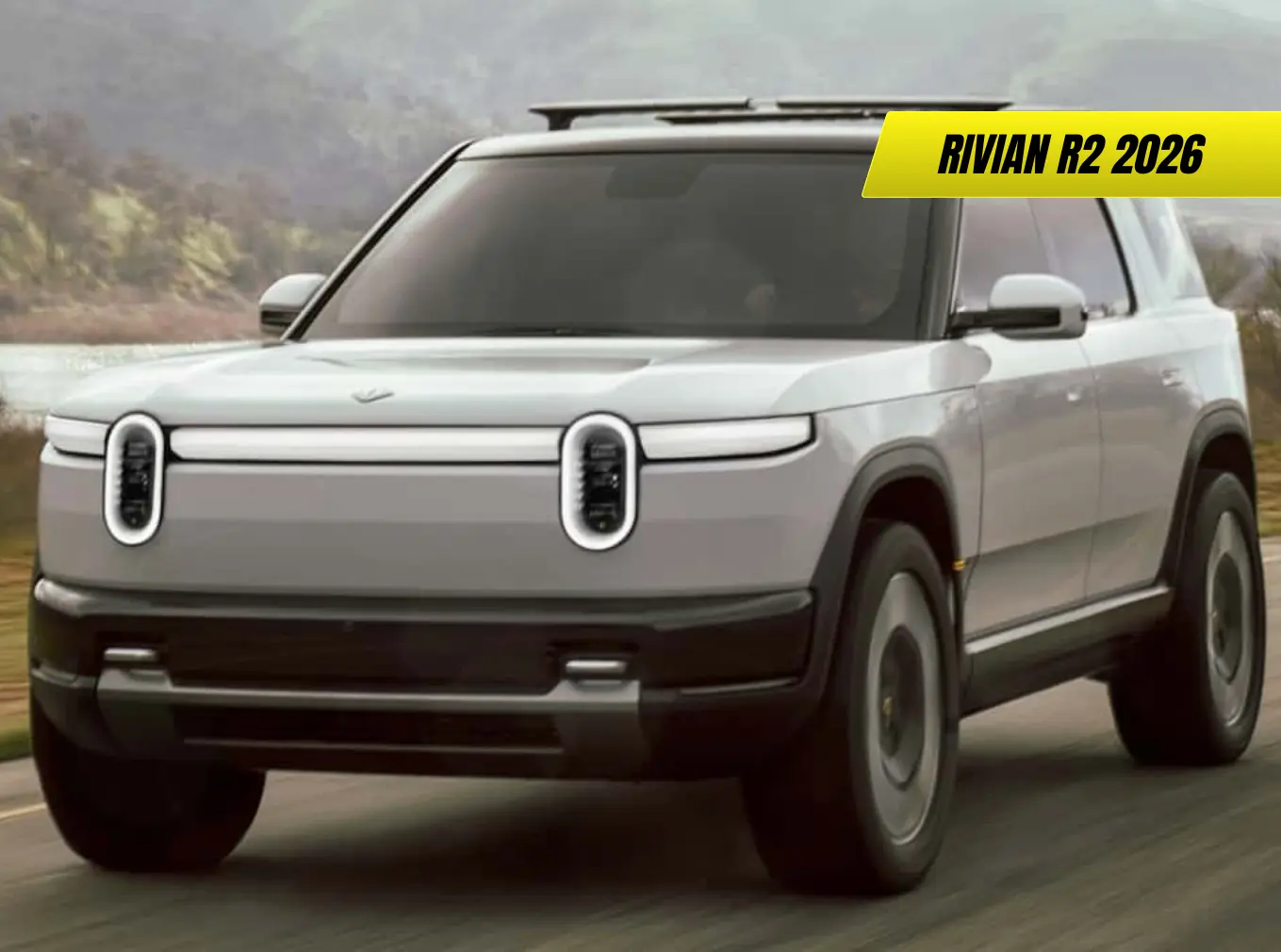
Rivian launches R2 mid-size electric SUV in first half 2026 starting $45,000 with over 300-mile range, single/dual/tri-motor configurations producing up to 700hp+, LG Energy 4695 cylindrical battery cells, and Normal Illinois production positioning as affordable alternative to $70,000+ R1S targeting mainstream EV buyers.
American electric vehicle manufacturer Rivian Automotive debuts mass-market R2 mid-size SUV with first customer deliveries H1 2026 (January-June) from expanded Normal, Illinois factory representing company’s pivot from premium $70,000-90,000 R1T truck and R1S SUV toward affordable $45,000 starting price enabling broader customer accessibility and volume production critical achieving profitability after years losses during startup phase. Built on new dedicated platform utilizing LG Energy Solution’s 4695 cylindrical battery cells (46mm diameter, 95mm height) offering 6x energy capacity per cell versus previous 2170 format improving energy density, thermal management, and manufacturing efficiency, the five-passenger two-row SUV delivers estimated 300+ mile EPA range base configuration with larger battery packs potentially extending beyond 350 miles matching Tesla Model Y’s capability while undercutting pricing $5,000-10,000. Powertrain lineup spans single-motor RWD base model (~$45,000 targeting affordability), dual-motor AWD mid-range (~$55,000-60,000 offering all-weather capability and enhanced performance), and tri-motor AWD performance flagship (~$65,000-70,000 estimated delivering 700hp+ and sub-4-second 0-60mph rivaling premium performance SUVs at fraction of cost). Design language mirrors R1’s adventurous aesthetic through bold horizontal LED headlights, vertical grille slots (non-functional but brand signature), muscular proportions, and short overhangs creating distinctive American ruggedness contrasting European minimalism, while interior features 15.6-inch center touchscreen, reconfigurable digital instrument cluster, sustainable materials including recycled plastics and vegan leathers, and flexible cargo space with flat-folding seats maximizing utility. The Normal factory expansion completed 2025 enables 155,000 annual R2 production capacityonce fully ramped though initial 2026 output likely 40,000-60,000 units as manufacturing scales, with eventual Georgia plant planned 2028+ providing additional capacity for R2 and smaller R3 crossover enabling Rivian competing volume-wise against established automakers while maintaining startup agility and direct-to-consumer sales model avoiding traditional dealer markups and inventory inefficiencies.
Strategic Importance: Make-or-Break Product for Rivian
The R2 represents Rivian’s most critical vehicle launch determining whether company survives long-term or joins numerous EV startups failing to achieve sustainable profitability beyond initial premium models.
Rivian’s Financial Challenge
| Metric | Current State (2025) | Post-R2 Target (2027+) | Challenge |
|---|---|---|---|
| Annual production | ~50,000 units (R1T/R1S) | 200,000+ units (including R2) | 4x volume increase required |
| Average selling price | ~$85,000 (R1 models) | ~$55,000 blended (R1+R2) | Lower margins per unit |
| Gross margin | Breaking even (~0-5%) | 15-25% target | Manufacturing efficiency critical |
| Annual revenue | ~$4.5 billion | $12+ billion target | Requires successful R2 ramp |
| Cash burn | ~$1 billion/quarter | Positive cash flow target | Path to profitability by 2027 |
Why R2 Is Make-or-Break
Volume Requirements
- Premium R1 models (50,000 annual sales) insufficient achieving economies of scale
- R2’s $45,000 pricing targets mainstream buyers representing 10x larger addressable market
- Tesla Model Y sells ~400,000 annually USA demonstrating segment potential
- Rivian needs minimum 100,000+ R2 annual sales achieving sustainable profitability
Manufacturing Economics
- Fixed costs (factories, R&D, salaries) spread across more units reducing per-vehicle cost
- Component supplier discounts improve with volume orders versus low-volume R1 parts
- Shared platform with future R3 crossover amplifies economies of scale benefits
- Battery cell costs decrease through long-term LG Energy contracts and volume commitments
Brand Positioning
- R1 models established Rivian as premium adventure brand but limited to affluent early adopters
- R2 brings brand recognition to mainstream buyers previously unable afford $70,000+ vehicles
- Success creates halo effect driving R1 sales through increased awareness and showroom traffic
- Failure risks brand irrelevance as niche luxury manufacturer unable competing volume leaders
Investor Confidence
- Rivian’s stock price depends on market believing company achieves profitability by 2027-2028
- Successful R2 launch and production ramp critical maintaining investor funding for future models
- Amazon commercial van business provides stable revenue but insufficient carrying entire company
- R2 delays, quality issues, or weak demand could trigger funding crisis and potential bankruptcy
This high-stakes scenario mirrors challenges faced by Tesla transitioning Model S/X to Model 3 (successfully achieving profitability) versus Lucid’s struggles scaling Air sedan (remaining unprofitable with limited volume) demonstrating execution separates survivors from casualties in capital-intensive EV industry, similar to considerations in Lucid Gravity 2026.
Platform and Technical Architecture: Purpose-Built for Volume
Unlike R1 platform designed primarily for premium capability, R2’s new architecture prioritizes manufacturing efficiency, cost optimization, and flexible configurations enabling multiple model derivatives while maintaining Rivian’s adventure-focused brand identity.
4695 Cylindrical Battery Cell Technology
LG Energy Solution Partnership
| Cell Specification | 4695 Cylindrical (R2) | 2170 Cylindrical (R1) | Improvement |
|---|---|---|---|
| Diameter × Height | 46mm × 95mm | 21mm × 70mm | Larger cell format |
| Energy per cell | ~6x capacity | Baseline | Fewer cells required per pack |
| Energy density | ~270-290 Wh/kg | ~250-260 Wh/kg | ~10% improvement |
| Thermal management | Enhanced cooling paths | Standard | Better heat dissipation |
| Manufacturing cost | Lower per kWh | Baseline | Economies of scale, simpler assembly |
| Supply chain | Arizona plant (2027+) | South Korea initially | Domestic production advantages |
Battery Pack Configurations (Estimated)
Standard Range
- Capacity: ~70-75 kWh usable
- EPA range: 300-320 miles
- Target: Base single-motor and dual-motor configurations
- Pricing impact: Enables $45,000 starting price
- Charging speed: ~200kW DC fast charging maximum
Long Range
- Capacity: ~90-100 kWh usable
- EPA range: 350-370 miles
- Target: Dual-motor AWD and tri-motor performance variants
- Pricing impact: ~$7,000-10,000 premium over standard
- Charging speed: ~250kW DC fast charging maximum
Max Range (Possible Future Option)
- Capacity: ~110-120 kWh usable
- EPA range: 400+ miles
- Target: Long-distance travelers and towing applications
- Pricing impact: ~$12,000-15,000 premium over standard
- Charging speed: ~250kW DC fast charging maximum
Powertrain Configurations
Single-Motor RWD (~$45,000)
- Power: ~300 hp / 224 kW estimated
- Torque: ~350 lb-ft / 475 Nm
- 0-60 mph: ~6.5 seconds
- Drive: Rear-wheel drive
- Target: Budget-conscious buyers, warm climate markets, efficiency priority
Dual-Motor AWD (~$55,000-60,000)
- Power: ~500 hp / 373 kW estimated (front + rear motors combined)
- Torque: ~500 lb-ft / 678 Nm
- 0-60 mph: ~4.5 seconds
- Drive: All-wheel drive with torque vectoring
- Target: Mainstream buyers wanting all-weather capability and strong performance
Tri-Motor AWD (~$65,000-70,000)
- Power: ~700+ hp / 522+ kW estimated (dual rear + front motor)
- Torque: ~700+ lb-ft / 950+ Nm
- 0-60 mph: ~3.0-3.5 seconds (supercar territory)
- Drive: Advanced AWD with individual rear wheel torque vectoring
- Target: Performance enthusiasts and R1 customers seeking compact performance SUV
Platform Capabilities and Features
- 400-volt architecture: Cost-optimized versus 800V systems, adequate charging speeds mainstream market
- Structural battery pack: Cells integrated into vehicle structure improving rigidity and safety
- Skateboard design: Flat floor with batteries between axles maximizing interior space
- Towing capacity: 5,000-7,000 lbs estimated (depending on configuration) enabling trailers, boats, equipment
- Wading depth: 3+ feet capability maintaining Rivian’s adventure positioning
- Air suspension: Optional adaptive air suspension enabling ride height adjustment and improved ride quality
Design: Adventure Aesthetic Meets Mainstream Accessibility
The R2’s styling challenge involves maintaining Rivian’s distinctive rugged character while achieving broader mainstream appeal versus R1’s polarizing boldness targeting adventure enthusiasts.
Exterior Design: Compressed R1 DNA
Front Fascia
- Horizontal LED headlights: Thin horizontal bar units creating wide, confident face
- Vertical slot “grille”: Non-functional but signature Rivian design element for brand recognition
- Flush surfaces: Smooth hood and bumper improving aerodynamics and modern aesthetic
- Skid plate aesthetic: Lower bumper suggesting off-road capability and ruggedness
- Short front overhang: Electric skateboard platform enables minimal nose overhang
Side Profile
- Taut, muscular proportions: Sculpted fenders and tight body surfacing suggesting athleticism
- Short overhangs front and rear: Skateboard architecture maximizes wheelbase within compact footprint
- Flush door handles: Pop-out handles reducing drag and contemporary appearance
- Black plastic cladding: Protective lower body trim reinforcing adventure positioning
- Roof rails: Functional luggage carrying capability standard or optional depending on trim
Rear Design
- Horizontal LED taillight bar: Full-width light signature connecting taillights
- Vertical light elements: Additional vertical signature lights matching front aesthetic
- Flat tailgate: Maximizing cargo opening and practical loading
- Integrated spoiler: Subtle roof extension improving aerodynamics and visual stance
- Hidden exhaust: Electric vehicle eliminating tailpipes creating clean appearance
Dimensional Specifications
| Dimension | Rivian R2 | Tesla Model Y | Rivian R1S | Context |
|---|---|---|---|---|
| Length | ~185-188 inches | 187 inches | 201 inches | Compact SUV segment |
| Wheelbase | ~115-118 inches | 113.8 inches | 121.1 inches | Spacious interior |
| Width | ~75-77 inches | 76 inches | 82 inches | Narrower than R1S |
| Height | ~65-67 inches | 64 inches | 77 inches | Lower than truck-based SUVs |
| Ground clearance | ~8-10 inches | 6.6 inches | 14.9 inches | Adequate off-road capability |
| Cargo capacity | ~30-35 cu ft estimated | 30.2 cu ft | 26.3 cu ft | Competitive utility |
The compact dimensions position R2 competitive with Model Y, Ford Mustang Mach-E, and Hyundai Ioniq 5 while maintaining Rivian’s adventure capability through adequate ground clearance and robust construction versus car-based crossovers prioritizing on-road dynamics exclusively.
Interior: Digital Minimalism Meets Practical Adventure
The R2 cabin balances contemporary digital-first user experience with practical materials and flexible configurations suited active lifestyles and family duties.
Digital Cockpit Architecture
Central Touchscreen (15.6-inch estimated)
- Portrait or landscape orientation (unconfirmed)
- Rivian’s proprietary infotainment software (not Android Automotive/CarPlay)
- Navigation with EV-specific routing including charging stops
- Over-the-air software updates delivering new features and improvements
- Climate controls, vehicle settings, media, and connectivity
Driver Display (Reconfigurable Digital Cluster)
- Customizable layouts showing speed, range, navigation, media
- Minimal physical gauges reducing cockpit complexity
- Head-up display potentially available on premium trims
Steering Controls
- Scroll wheels and buttons for quick access to key functions
- Voice control for hands-free operation
- Drive mode selection (Sport, All-Purpose, Conserve, Off-Road modes expected)
Materials and Sustainability
Following Rivian’s environmental commitments:
- Vegan leather upholstery: Animal-free synthetic materials standard or optional
- Recycled fabrics: Seat inserts and door panels using post-consumer plastics
- FSC-certified wood trim: Sustainably-sourced wood accents on premium trims
- Cork materials: Renewable cork used for certain interior surfaces
- Minimal chrome: Brushed aluminum and matte finishes reducing environmental impact
Seating and Space
Front Seats
- Supportive bucket seats with good lateral support
- Heating standard or optional depending on trim
- Ventilation and massage available on upper trims
- Electric adjustment with memory settings on premium models
Rear Seats
- Generous legroom from long wheelbase (~115-118 inches)
- Adequate headroom despite sloping roofline
- 60/40 split-folding enabling cargo flexibility
- ISOFIX child seat mounting points
- Rear climate vents improving passenger comfort
Cargo Versatility
Rear Cargo Area
- ~30-35 cubic feet seats up (competitive with segment)
- ~70-75 cubic feet maximum with seats folded
- Flat load floor when seats folded
- Power liftgate standard or optional
- Underfloor storage for charging cables and equipment
- Tie-down points and cargo management accessories
Front Trunk (Frunk)
- Estimated 7-10 cubic feet storage
- Ideal for charging cables, valuable items, or dirty gear separate from main cabin
- Drainage system enabling cooler functionality (following R1 tradition)
Gear Tunnel (Possible but Unconfirmed)
- R1 vehicles feature innovative gear tunnel storage between cab and wheels
- R2 may include scaled-down version given smaller dimensions
- Alternative: traditional storage under rear seats or floor compartments
Production and Manufacturing Strategy
Rivian’s R2 manufacturing approach demonstrates lessons learned from challenging R1 ramp prioritizing efficiency, cost control, and scalable processes enabling volume production.
Normal, Illinois Factory Expansion
| Facility Aspect | R1 Production (Current) | R2 Addition (2026) | Total Capacity |
|---|---|---|---|
| Production lines | 2 lines (R1T/R1S) | 1 dedicated R2 line | 3 lines total |
| Annual capacity | 60,000 units (R1) | 155,000 units (R2) | 215,000 total |
| Factory space | Original facility | New expansion wing | ~1M+ sq ft total |
| Investment | ~$5 billion original | ~$2 billion expansion | ~$7 billion total |
| Employment | ~7,000 workers | +2,000 workers | ~9,000 total |
Manufacturing Improvements vs R1 Launch
Lessons Learned from R1 Challenges
- Supply chain stability: Secured long-term contracts with critical suppliers avoiding shortages
- Quality control: Enhanced testing procedures catching defects before customer delivery
- Production sequencing: Optimized assembly line flow reducing bottlenecks and inefficiencies
- Workforce training: Comprehensive employee programs improving build quality and speed
- Vertical integration balance: Strategic parts in-house, non-critical outsourced optimally
R2-Specific Manufacturing Advantages
- Simplified design: Fewer unique parts versus complex R1 requiring extensive customization
- Single battery format: 4695 cells versus multiple R1 battery configurations reducing complexity
- Higher automation: Increased robotics for repetitive tasks improving consistency and speed
- Modular assembly: Platform designed for manufacturing efficiency from inception versus R1’s learning curve
- Supplier consolidation: Fewer suppliers with higher volumes each enabling better pricing and reliability
Georgia Plant Future Expansion
- Location: Social Circle, Georgia (near Atlanta)
- Timeline: Construction begins 2026, production start 2028+
- Capacity: 400,000 annual units eventual capacity (phased)
- Models: R2 and R3 crossover primarily, possible R1 overflow
- Investment: ~$5 billion total across multiple phases
- Employment: 7,500+ jobs created
- Incentives: Georgia state and local tax incentives supporting investment
The dual-factory strategy provides geographic diversity, risk mitigation, and capacity expansion supporting ambitious growth targets while enabling demand flexing production between facilities responding market conditions.
UK and European Market Considerations
While initially focused USA where Rivian holds brand recognition and charging infrastructure familiarity, international expansion including UK/Europe remains strategic priority following domestic success.
US Market Positioning
| Competitor | Starting Price | Range (EPA) | Power | Key Advantage |
|---|---|---|---|---|
| Rivian R2 | $45,000 | 300+ miles | 300-700+ hp | Adventure brand, tri-motor option |
| Tesla Model Y | $43,990 | 260-330 miles | 283-456 hp | Supercharger network, brand recognition |
| Ford Mustang Mach-E | $40,000 | 250-320 miles | 266-480 hp | Ford dealer network, familiar brand |
| Hyundai Ioniq 5 | $43,975 | 245-303 miles | 168-320 hp | 800V charging, warranty |
| Volkswagen ID.4 | $39,995 | 206-275 miles | 201-295 hp | VW brand, competitive pricing |
| Chevrolet Equinox EV | $34,995 | 319 miles | 210-290 hp | Lowest price, GM dealer network |
European Expansion Challenges
Barriers to UK/EU Entry
- Right-hand-drive development: UK requires RHD variants adding engineering costs and complexity
- Charging standards: CCS2 connectors and European charging protocols versus North American standards
- Regulatory certification: Euro NCAP crash testing, EU type approval expensive and time-consuming
- Service network: Zero existing dealers requiring partnerships or company-owned service centers
- Brand awareness: Limited Rivian recognition outside USA requiring marketing investment
- Price competitiveness: Import duties and VAT push pricing toward £50,000+ reducing competitiveness
Potential Timeline
- 2026-2027: US production ramp and domestic demand fulfillment priority
- 2028-2029: Possible European market entry following Georgia plant opening
- 2030+: UK right-hand-drive variant if European success justifies investment
European Positioning (If Launched)
Estimated UK pricing £50,000-70,000 positions R2 against:
- Polestar 3: £65,000-85,000 (premium Swedish positioning)
- Tesla Model Y: £45,000-60,000 (established EV leader)
- BMW iX3: £60,000-70,000 (German premium brand)
- Mercedes EQE SUV: £70,000-85,000 (luxury positioning)
The adventure brand differentiation could appeal European buyers seeking distinctive American alternative to German engineering dominance, though service network limitations and unfamiliarity present meaningful barriers requiring substantial investment overcoming.
Frequently Asked Questions
When can I buy a Rivian R2?
First customer deliveries begin H1 2026 (January-June) with production starting Normal, Illinois factory. Reservations currently open $100 refundable deposit. Initial production likely higher-trim models with base $45,000 variant arriving later 2026 or early 2027 following typical automaker launch strategy prioritizing margins before volume models.
How much does the R2 cost?
Starting price $45,000 for base single-motor RWD configuration. Dual-motor AWD estimated $55,000-60,000, tri-motor AWD performance variant $65,000-70,000. These prices before federal $7,500 EV tax credit potentially reducing net cost to $37,500 entry if R2 qualifies under IRS battery sourcing requirements and buyer meets income limits.
How far can the R2 drive on one charge?
Rivian confirms “over 300 miles” EPA range for base configuration. Larger battery packs likely enable 350-370+ miles in dual-motor variants. Real-world range typically 15-25% below EPA estimates depending on driving style, weather, terrain suggesting 240-320 miles practical range for most buyers across configurations.
What’s the difference between R2 and R1S?
R2 is smaller (185-188 inches vs 201 inches), more affordable ($45,000 vs $75,000+), and two-row only (5 seats vs 7 seats). R1S offers greater capability (towing, off-road, range) and premium positioning while R2 targets mainstream buyers prioritizing value and urban/suburban versatility over maximum adventure capability.
Does the R2 qualify for federal tax credit?
Likely yes but dependent on final battery sourcing meeting IRS requirements. R2’s Illinois production qualifies North American assembly requirement. LG Energy batteries initially from South Korea may not qualify, but Arizona plant starting 2027 enables full qualification. Consult accountant regarding income limits and specific eligibility.
Will Rivian R2 come to the UK?
Not initially. US market priority through 2026-2027 with possible European expansion 2028+ following domestic success and Georgia factory opening. UK right-hand-drive requires additional engineering investment and regulatory certifications Rivian unlikely undertaking until US demand stable and European left-hand-drive markets proven commercially viable.
How does R2 compare to Tesla Model Y?
Similar size, range (300+ miles), and pricing ($45,000 vs $44,000). R2 offers tri-motor performance option and adventure-focused brand positioning versus Model Y’s technology leadership and Supercharger network. Choice depends on priorities: Rivian adventure capability/styling versus Tesla charging infrastructure/software ecosystem and brand familiarity.
Can the R2 tow trailers?
Yes, estimated 5,000-7,000 lbs towing capacity depending on configuration (dual/tri-motor variants higher than single-motor). Adequate for campers, boats, utility trailers though below R1S’s 7,700 lb capability. Range significantly reduced when towing (potentially 40-50% decrease) requiring strategic charging planning for longer trips with trailers.
Conclusion
The Rivian R2’s H1 2026 launch represents American EV startup’s most critical product determining long-term survival through $45,000 starting price enabling mainstream accessibility versus premium $70,000+ R1 models limiting addressable market to affluent early adopters, with estimated 300+ mile range, tri-motor performance options delivering 700hp+, and adventurous styling differentiating from European minimalism targeting young families, outdoor enthusiasts, and adventure-focused buyers seeking distinctive alternative to Tesla Model Y’s technology-first positioning or established automakers’ conventional approaches. The Normal Illinois factory’s 155,000 annual R2 capacity once fully ramped provides volume production scale necessary achieving economies enabling profitability by 2027-2028 following years startup losses, though successful execution requires navigating manufacturing complexity, supply chain stability, quality control, and competitive dynamics within fiercely-contested mid-size electric SUV segment where Tesla, Ford, Hyundai, Volkswagen, and Chevrolet battle pricing, range, and features attracting mainstream buyers transitioning from internal combustion.
For potential buyers, the R2 delivers compelling value proposition combining genuine adventure capability through adequate ground clearance and robust construction, contemporary digital-first user experience through large touchscreen and over-the-air updates, flexible cargo space accommodating active lifestyles, and distinctive American design language versus European competitors’ restrained aesthetics at competitive pricing undercutting premium alternatives $10,000-20,000 while matching or exceeding performance and range specifications. However, Rivian’s limited service network compared to established brands with thousands of dealers nationwide, unproven long-term reliability without decade-plus track records, uncertain resale values given startup status, and potential early production quality issues typical new model launches present meaningful risks requiring early adopters accepting trade-offs exchanging for innovative American alternative supporting domestic EV manufacturing rather than defaulting toward safer established brands offering conventional dealer experiences and proven ownership stability.
Whether R2 achieves projected success propelling Rivian from niche premium manufacturer toward volume leader competing Tesla, Ford, and traditional automakers depends fundamentally on execution flawlessly ramping production from zero to 100,000+ annual units within two years while maintaining quality standards, cost targets, and customer satisfaction scores necessary generating positive word-of-mouth critical organic demand beyond initial reservation holders representing enthusiast customers predisposed supporting brand regardless of inevitable early challenges typical ambitious automotive launches throughout industry history.





