
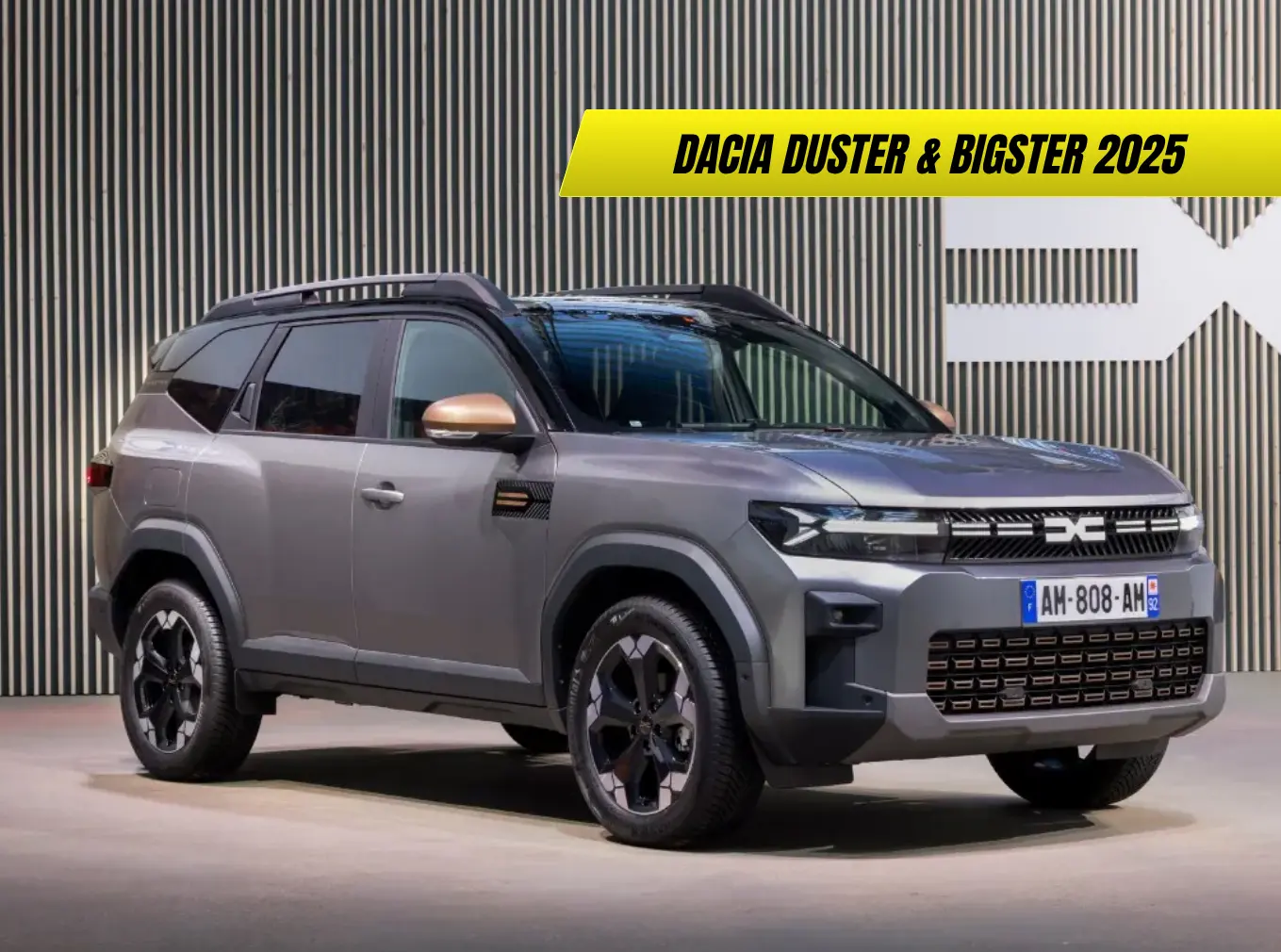
The all-new third-generation Dacia Duster 2025 raises the bar with a new platform, full hybrid power, genuine off-road ability and a price that starts below £19,000 — making it one of the most compelling family SUV propositions in Britain today.
Why the Dacia Duster 2025 Is Turning Heads in the UK
- Prices start from just £18,745, undercutting many small hatchbacks
- Available with mild hybrid, full hybrid 140 and hybrid 155 powertrains
- Optional 4×4 drivetrain with dedicated snow, mud and off-road modes plus hill descent control
- Boot volume of 594 litres — class-leading for this price bracket
- New CMF-B platform delivers improved refinement, stronger crash protection and more interior space
- Real-world hybrid fuel economy of 50–52 mpg confirmed in UK road tests
Design and Exterior: Bolder Than Ever
The third-generation Duster is the most visually assertive version yet. At 4,343 mm long, 1,847 mm wide and 1,616 mm tall, it is a tangibly larger vehicle than its predecessor, with a blockier, more purposeful stance that reflects its genuine off-road credentials. The front fascia adopts a wide trapezoidal grille flanked by slim LED daytime running lights — a design language that communicates ruggedness without resorting to excessive chrome or fussy detailing. Plastic body cladding lines the wheel arches and lower sills, serving both a protective and aesthetic function on a vehicle that will regularly encounter mud and gravel.
The 4×4 variant rides slightly higher than the front-wheel drive car, with 217 mm of ground clearance — a meaningful advantage on farm tracks, campsites and the sort of green lanes that British adventurers favour. Wheel sizes range from 17 inches on Expression trim to 18 inches on Extreme, and the overall aesthetic lands somewhere between lifestyle SUV and proper workhorse — which, for a Duster, is exactly right. From my point of view, the new Duster is the best-looking generation the model has produced.
Interior and Practicality: Surprising Substance
Step inside and the improvements over the previous generation are immediately apparent. The dashboard adopts a more structured, layered design, with physical climate controls retained below a 10-inch central touchscreen — a practical decision that will be appreciated by anyone who has fumbled through menu screens to adjust the temperature at 70 mph. The instrument cluster is fully digital on upper trims, offering clear readouts and driving data in a format that feels contemporary without being distracting.
Material quality remains honest rather than premium — hard plastics dominate the upper dashboard — but everything feels solidly assembled and the tactile surfaces in the key contact areas (steering wheel, door handles, gear lever) have been noticeably improved. Rear passenger space is generous by segment standards, with enough knee room for two adults of average height to sit comfortably behind taller occupants. The 594-litre boot is genuinely outstanding for the price point, and expands to a class-rivalling 1,696 litres with the rear seats folded.
Standard safety equipment across the range includes autonomous emergency braking, speed-limit recognition and lane departure prevention — mandated by Euro NCAP regulations — alongside a reversing camera on all but the entry Essential trim. Wireless smartphone connectivity is available on Journey and Extreme grades.
Powertrain Options: Which Duster Engine Should You Choose?
The 2025 Duster range covers three primary powertrain configurations, each suited to different buyer profiles.
TCe 100 Bi-Fuel (LPG/Petrol) — available exclusively on the entry Essential trim, this 100 hp three-cylinder engine can run on either petrol or LPG, delivering a combined tank range of approximately 900 miles. It is slow (0–62 mph in 13.2 seconds on petrol), but the running cost advantage is significant for high-mileage drivers in areas with LPG infrastructure.
TCe 130 Mild Hybrid — the volume seller, pairing a 1.2-litre turbocharged three-cylinder engine with a 48V mild hybrid system to deliver 130 hp and 205 Nm via a six-speed manual gearbox. Available in both two- and four-wheel drive configurations, the manual transmission and affordable running costs make this the rational choice for most buyers. Official fuel economy is 52.3 mpg (FWD), dropping to 47.1 mpg (4×4).
Hybrid 140 and Hybrid 155 — the full hybrid variants use a 1.6-litre Atkinson-cycle petrol engine paired with a high-voltage electric motor, driving through a multi-mode clutchless automatic gearbox. The Hybrid 140 produces 138 hp and delivers a WLTP figure of 56.5 mpg, with real-world returns of approximately 50 mpg in mixed driving. The newer Hybrid 155 ups output to 155 hp and 205 Nm from the electric motor, making it the smoothest and most refined Duster in the range. Both hybrid versions are front-wheel drive only.
| Version | Power | 0–62 mph | Drivetrain | MPG (WLTP) | Price (from) |
|---|---|---|---|---|---|
| TCe 100 Bi-Fuel | 100 hp | 13.2 sec | FWD | 43.6 mpg | £18,745 |
| TCe 130 Mild Hybrid 4×2 | 130 hp | 9.9 sec | FWD | 52.3 mpg | £19,514 |
| TCe 130 Mild Hybrid 4×4 | 130 hp | 11.0 sec | 4WD | 47.1 mpg | £21,688 |
| Hybrid 140 Auto | 138 hp | 10.1 sec | FWD | 56.5 mpg | £22,147 |
| Hybrid 155 Auto | 155 hp | TBC | FWD | TBC | £26,795 |
How Does the Dacia Duster Drive?
On the road, the third-generation Duster reveals the benefits of its new CMF-B platform in short order. Refinement has improved markedly — wind and road noise are noticeably better suppressed than in the previous car, and the revised suspension geometry delivers a ride that is firm enough to feel controlled on faster A-roads while absorbing low-speed urban imperfections without fuss. Body roll is present in corners but well within acceptable limits, and the steering — while not communicative — is consistently weighted and accurate.
The Hybrid 140 and Hybrid 155 powertrains are the most rewarding to drive. The electric motor provides immediate torque from rest, making the car feel more brisk than its 10.1-second 0–62 figure suggests, and the clutchless gearbox shifts smoothly in relaxed driving. It is only under hard acceleration — demanding swift upward changes — that the transmission can feel slightly hesitant. In our experience, the mild hybrid manual is the better driver’s car on sweeping B-roads, while the full hybrid is the more effortless motorway companion.
The 4×4 TCe 130 adds genuine capability beyond the tarmac. Hill descent control, three dedicated terrain modes (Snow, Mud/Sand, Off-Road) and 217 mm of ground clearance transform the Duster into a credible light off-roader — an increasingly rare quality at this price point. For buyers who regularly tow or venture off the beaten track, the £2,200 premium over the equivalent FWD model is money well spent.
Dacia Duster 2025 vs. Main Rivals
| Model | Boot (litres) | Hybrid Available | 4×4 Available | Price (from) |
|---|---|---|---|---|
| Dacia Duster 2025 | 594 | Yes (full hybrid) | Yes | £18,745 |
| Nissan Qashqai e-Power | 479 | Yes (e-Power) | Yes | £30,995 |
| Renault Austral | 513 | Yes (full hybrid) | No | £30,995 |
| MG ZS Hybrid | 443 | Yes (mild hybrid) | No | £22,495 |
| Skoda Kamiq | 400 | No | No | £24,275 |
The Duster’s boot advantage is decisive: 594 litres is not merely competitive — it is exceptional for a car at this price, comfortably beating rivals that cost thousands more. For a broader look at value-oriented SUVs, our guide to the 20 best SUVs to buy in 2025 under £40k covers the full spectrum, while those interested in Chinese alternatives should consult our best Chinese SUVs in the UK for 2025 guide.
Running Costs, Road Tax and Insurance
The Dacia Duster’s running cost case is one of its most compelling attributes. The Hybrid 140 emits just 105 g/km CO2 on the WLTP combined cycle, placing it in a favourable Vehicle Excise Duty band and making it one of the cheapest full-hybrid SUVs to tax annually. The mild hybrid variants emit between 122 and 143 g/km depending on the specification chosen. Servicing intervals are set at every 12 months or 18,000 miles, and Dacia’s dealer network offers competitive fixed-price service plans.
Insurance groupings are reasonable: the entry models fall into groups 12–15, with the Hybrid variants typically sitting in groups 18–21 — modest for a vehicle of this capability. Warranty coverage stands at the industry-standard three years/60,000 miles, with the option to extend. For current UK road tax rates and how CO2 emissions affect your annual charge, visit gov.uk/vehicle-tax-rate-tables. Buyers looking for a similarly practical but more compact daily companion may also wish to consider the Dacia Sandero 2026.
Is the Dacia Duster 2025 Available in the UK?
Yes — the all-new third-generation Dacia Duster is fully available in the UK right now, with a dealer network covering the entire country. The range starts from £18,745 in Essential Bi-Fuel trim, with the mid-range Journey Mild Hybrid 130 4×2 priced from £23,545 representing the volume sweet spot. The Hybrid 155 Extreme tops the range at £27,595. Full specifications, configurator and dealer locator are available at dacia.co.uk.
For those comparing the Duster against similarly priced hybrid alternatives, our roundup of the best plug-in hybrid cars UK 2025 is essential reading — and for Nissan fans, our review of the Nissan Qashqai e-Power 2025 offers a useful direct comparison.
FAQ
Is the Dacia Duster 2025 a good buy for UK families?
Yes. The Duster’s 594-litre boot, full five-seat capacity, available four-wheel drive and hybrid powertrain options make it one of the best-value family SUVs available in Britain. In my experience, no other car at this price point offers the same combination of space, capability and fuel economy.
What is the real-world fuel economy of the Dacia Duster Hybrid?
In UK road tests, the Duster Hybrid 140 has returned approximately 50–52 mpg in mixed real-world driving — close to its WLTP figure of 56.5 mpg. The mild hybrid manual achieves around 49 mpg on a real-world combined route. The 4×4 version drops to approximately 42 mpg in mixed conditions.
Does the Dacia Duster 2025 have proper four-wheel drive?
Yes — the TCe 130 Mild Hybrid is available with a genuine on-demand 4×4 system, featuring dedicated terrain modes for snow, mud/sand and general off-roading, plus hill descent control. The hybrid variants are front-wheel drive only.
How does the Dacia Duster 2025 compare to the Nissan Qashqai?
The Qashqai offers a more premium cabin, a smoother e-Power drivetrain and better motorway refinement, but costs around £7,000–£9,000 more than the equivalent Duster. The Duster wins on boot space, off-road ability and overall value. For most family buyers on a budget, the Duster is the more rational choice.
What is the boot space in the Dacia Duster 2025?
The Duster offers 594 litres of boot space with all seats in place, expanding to 1,696 litres with the rear seats folded. This is significantly larger than most rivals in the segment, regardless of price.
Is the Dacia Duster 2025 safe?
The Duster is equipped with autonomous emergency braking, lane departure warning, speed-limit recognition and a reversing camera as standard. The CMF-B platform was engineered with enhanced crash protection, and the car is expected to achieve competitive Euro NCAP ratings. Always check the latest safety assessments at Thatcham Research.
What is the cheapest way to buy a Dacia Duster 2025?
The entry Essential Bi-Fuel starts from £18,745 OTR. For buyers seeking the best all-round package, the Expression Mild Hybrid 130 4×2 at approximately £21,845 offers the best balance of specification and running cost. Dacia’s PCP finance offers are also competitive — check dacia.co.uk for current deals.
The Dacia Duster 2025 is, quite simply, the best version of a car that has always punched above its weight. The new platform addresses the previous generation’s shortcomings in refinement and perceived quality without sacrificing the value, practicality and off-road accessibility that made the Duster a British favourite. From my point of view, it is the single most rational new car purchase available under £25,000 in the UK today — and the addition of a full hybrid drivetrain removes the last meaningful objection for eco-conscious buyers. I would recommend the Journey Hybrid 140 as the sweet spot in the range: automatic, efficient, well-equipped and still remarkably affordable.





