
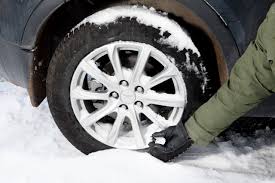
Tyre pressure drops in cold weather every winter — and many UK drivers are unaware that this is happening to their car until a warning light appears or, worse, a tyre fails. This guide explains the science, the safety implications, and the straightforward routine that prevents the problem entirely.
Why Tyre Pressure Drops in Winter — The Science Explained
Tyre pressure is directly linked to the temperature of the air inside the tyre. As temperature falls, air molecules slow down and contract, reducing the pressure they exert on the tyre walls. The relationship is governed by the Ideal Gas Law — in practical terms, tyre pressure drops by approximately 1 PSI (0.07 bar) for every 10°F (approximately 5.5°C) fall in ambient temperature.
This means that a tyre inflated to the correct 32 PSI on a 15°C autumn afternoon will read approximately 28–29 PSI on a 0°C winter morning — a drop of 3–4 PSI without any air loss from the tyre. Many tyre pressure monitoring systems (TPMS) trigger a warning at 25% below the recommended pressure — meaning a significant pressure drop can occur without alerting the driver.
| Temperature Change | Approximate Pressure Change |
|---|---|
| 5°C drop | 0.5–1 PSI / 0.03–0.07 bar |
| 10°C drop | 1–2 PSI / 0.07–0.14 bar |
| 20°C drop (e.g. 15°C to -5°C) | 2–4 PSI / 0.14–0.28 bar |
| 30°C drop (e.g. 20°C to -10°C) | 3–6 PSI / 0.21–0.41 bar |
The Safety Consequences of Under-Inflated Tyres
Under-inflated tyres are not simply an efficiency problem — they represent a genuine safety risk that is more acute in winter conditions when road surfaces already offer reduced grip:
Reduced contact patch shape: An under-inflated tyre deforms under load, distorting the contact patch from the optimal flat rectangle to a curved shape with reduced central contact. This reduces the tyre’s ability to transmit braking and steering forces — meaning stopping distances increase and steering precision reduces, precisely when both are most critical on ice or snow.
Increased risk of blowout: Under-inflated tyres flex excessively with each revolution, generating heat within the tyre sidewall. At sustained motorway speeds, this heat accumulation can cause catastrophic sidewall failure — a blowout. While less common in cold conditions than in summer heat, the risk is present whenever a significantly under-inflated tyre is used at sustained high speed.
Fuel economy reduction: Every 1 PSI below recommended pressure increases fuel consumption by approximately 0.2%. A tyre 4 PSI below specification — easily reached through winter temperature drop alone — increases fuel consumption by approximately 0.8%. Across all four tyres, the effect is meaningful over a full tank.
Uneven tyre wear: Sustained under-inflation accelerates wear on the outer edges of the tyre tread — reducing tyre life and creating uneven wear patterns that compromise wet and winter grip performance.
For drivers who have seen the TPMS warning light illuminate alongside other dashboard alerts in winter, our spanner warning light guide covers all dashboard warning lights and their relative urgency.
The Correct Tyre Pressure for Your Vehicle
The correct tyre pressure is not the maximum pressure printed on the tyre sidewall — this is the maximum the tyre can safely hold, not the recommended operating pressure. The manufacturer-recommended pressure is found in three locations:
- The sticker inside the driver’s door jamb — the most reliable reference
- The fuel filler cap — fitted on many European vehicles
- The vehicle handbook — section covering tyre specifications
Most mainstream UK family cars specify pressures in the range of 30–36 PSI (2.1–2.5 bar), with the rear tyres sometimes specified slightly higher than the fronts, and higher pressures recommended for heavy loads or motorway use. Always use the correct pressure for the load condition — a fully loaded car on a motorway run requires the higher specification.
The Winter Tyre Pressure Routine
The most effective approach is to check and adjust tyre pressures at the start of the cold season— typically October in the UK — and to recheck monthly through winter:
- Check pressures when the tyres are cold — before the car has been driven, or after no more than one mile at low speed. Driving warms the air inside the tyre and increases pressure, producing a false reading
- Use a reliable digital gauge — analogue gauges at petrol stations vary in accuracy; a digital gauge costs under £10 and provides consistent, reliable readings
- Adjust to the cold specification — add air to reach the correct cold pressure and check immediately after with the gauge to confirm accuracy
- Include the spare — a spare tyre that has lost pressure through winter temperature drop is of no use in a roadside emergency. Check its pressure at the same time as the running tyres
- Recheck when temperatures change significantly — a cold snap of 10°C or more warrants a pressure recheck, particularly before a long motorway journey
For drivers who also want guidance on tyre tread depth checks and winter tyre considerations ahead of winter driving conditions, our driving on snow and ice guide covers the complete pre-winter preparation routine including tyre condition checks. The official tyre safety guidance and minimum legal tread requirements are documented by TyreSafe, the UK’s tyre safety organisation.
Nitrogen Inflation: Does It Help in Winter?
Some tyre retailers offer nitrogen inflation as a premium option — filling tyres with nitrogen rather than compressed air. The argument for nitrogen is that its larger molecules permeate through rubber more slowly, reducing pressure loss over time, and that its temperature coefficient of expansion is slightly lower than air — meaning pressure changes less with temperature.
The reality in UK winter conditions is that the benefit is real but modest — nitrogen-inflated tyres change pressure approximately 10–15% less per degree of temperature change than air-inflated tyres. For most UK drivers, a regular monthly pressure check with a quality gauge achieves the same practical outcome at no cost. Nitrogen inflation is most genuinely beneficial for high-performance vehicles where precise pressure consistency at operating temperature is critical — for everyday family transport, it is a convenience rather than a necessity.
When should I check my tyre pressure in winter?
Always check when the tyres are cold — before the car has been driven that day, or after no more than one mile at low speed. The best habit is a monthly check on the same day each month throughout winter, plus a check whenever a significant cold snap (10°C or more temperature drop) occurs. Also check before any long motorway journey where sustained high speed increases the consequence of under-inflation.
Does cold weather affect run-flat tyres differently?
Run-flat tyres are not affected by temperature-related pressure drop differently from standard tyres — the same physics applies. However, because run-flat tyres are designed to support the vehicle’s weight without air pressure, they may not visually deform when under-inflated, making pressure checks even more important. A flat run-flat tyre can appear normal to a casual inspection — only a pressure check reveals the true state.
My TPMS warning light came on in cold weather but disappeared when the car warmed up. Is this normal?
Yes — this is the most common cause of TPMS warnings in winter. The tyre pressure was below the monitoring threshold when cold and rose above it as the air inside warmed during driving. However, this should prompt a cold-pressure check — the warning indicates the cold pressure is borderline below specification, and adding a small amount of air will prevent the warning recurring and ensure safety margins are maintained.
What happens if I ignore low tyre pressure in winter?
Short-term, the primary consequences are reduced grip and handling precision — meaningful safety concerns on any road surface but particularly on ice and snow. Longer term, under-inflation accelerates tyre wear and risks sidewall damage that shortens the tyre’s service life. A tyre running continuously at 25% below recommended pressure is at risk of overheating and blowout at sustained motorway speeds.
How do I know if my car has a tyre pressure monitoring system?
All new cars sold in the EU (and the UK under retained EU type approval) from November 2014onward are required to be fitted with TPMS. Check your dashboard for a tyre-shaped warning light — it should illuminate briefly when the ignition is switched on as part of the system self-test. If your car was registered before November 2014, it may not have TPMS fitted, making manual monthly checks even more important.
From my point of view, adding a quality digital tyre pressure gauge to the glovebox — available for under £10 — and committing to a monthly pressure check throughout winter is the single most inexpensive and impactful vehicle safety habit available to any UK driver. The five minutes it takes each month prevents tyre failures, maintains handling precision in precisely the conditions where it matters most, and delivers a small but real fuel economy benefit throughout the colder months.





