
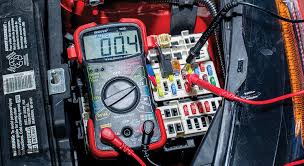
Modern cars rely on a network of sensors, modules and warning systems, so small electronic issues can create misleading symptoms long before a major failure appears. A careful check of the vehicle’s electronics helps identify battery weakness, charging faults, sensor errors and poor connections before they turn into breakdowns.
Key Points
- Modern cars use many interconnected electronic systems, so one fault can create several symptoms.
- Battery voltage, charging performance and earth connections are the first things to check.
- Warning lights should be read with a diagnostic scanner rather than guessed at.
- Moisture, corrosion and weak connections are common causes of intermittent electrical faults.
- Infotainment or dashboard glitches can sometimes point to a deeper power supply issue.
- If several unrelated systems fail at once, the issue is often electrical rather than mechanical.
Why Electronics Matter
A modern vehicle depends on the battery, alternator, control modules and wiring network to keep everything running properly. That means a fault in one area can affect starting, lighting, charging, engine management and even comfort systems at the same time.
What makes this tricky for drivers is that electronic faults are often intermittent. A dashboard may work one day, then glitch the next, which can make the problem look minor even when the root cause is serious.
First Checks to Make
Start with the battery condition, because low voltage is one of the most common reasons for strange electrical behaviour. A weak battery can trigger warning lights, slow cranking and random system resets even if the car still starts.
Next, check the alternator output and the condition of the main earth straps. If the charging system is weak or the earth connection is poor, the car may seem to have multiple unrelated faults when in reality the electrical supply is unstable.
Warning Lights and Fault Codes
Dashboard warning lights should never be ignored or cleared without understanding the cause. A diagnostic scan gives the actual fault code, which is far more useful than relying on guesswork from the light alone.
Some warnings point to a sensor problem, while others indicate a supply or communication issue between control modules. In practice, the same light can sometimes be caused by a bad sensor, a wiring fault or a weak battery, so the code matters more than the icon.
Common Signs of Electrical Trouble
One of the clearest signs is a car that behaves differently each time it is started. A radio that resets, a clock that loses time or a dashboard that flickers can all point to voltage instability.
Other clues include intermittent non-starting, central locking that behaves erratically or systems that work only after the car has been left to sit. From my experience, these are often early signs of a charging or connection issue rather than a full component failure.
Moisture and Connector Problems
Water ingress and corrosion are major causes of electrical faults, especially on older UK cars or vehicles that spend a lot of time outdoors. A corroded connector can create a fault that looks electronic even though the underlying problem is simply poor contact.
That is why it is worth checking connectors, fuse boxes and visible loom sections when troubleshooting. A small amount of corrosion can interrupt a signal enough to trigger a warning light or cause a module to behave unpredictably.
When to Seek Help
If the fault affects starting, charging or safety-critical systems, it should be checked promptly by a qualified technician. Repeatedly resetting a warning light without repairing the cause can lead to larger faults and more expensive diagnostics later.
The safest approach is to treat electronic symptoms as information rather than annoyance. Once the code, voltage and connection quality are known, the cause usually becomes much easier to narrow down.
What is the first thing to check in an electrical fault?
The battery. Low voltage can create several different symptoms at once and is one of the easiest faults to verify.
Can a weak battery cause warning lights?
Yes. A weak battery can trigger multiple warning lights and make control modules behave unpredictably.
Why do electrical faults come and go?
Loose connections, corrosion and moisture can interrupt signals intermittently, so the fault may appear and disappear depending on temperature or movement.
Is a diagnostic scanner necessary?
Yes, for serious faults. It helps identify the actual code instead of guessing from the dashboard light alone.
Can moisture really cause electrical problems?
Absolutely. Water or corrosion in connectors and fuse boxes can create erratic behaviour and false warnings.
What if several systems fail at once?
That often points to a supply problem such as battery, alternator, fuse or earth connection rather than individual component failures.
Should I keep driving if the electronics seem odd?
If the issue is minor and the car still behaves normally, a short trip may be possible, but safety-critical faults or charging problems should be checked immediately.
Conclusion
Electrical faults are often less about dramatic failure and more about early warning signs that build gradually. A sensible check of battery health, charging output, connectors and fault codes gives a much clearer picture than relying on symptoms alone, and it helps prevent small issues becoming larger ones.





