
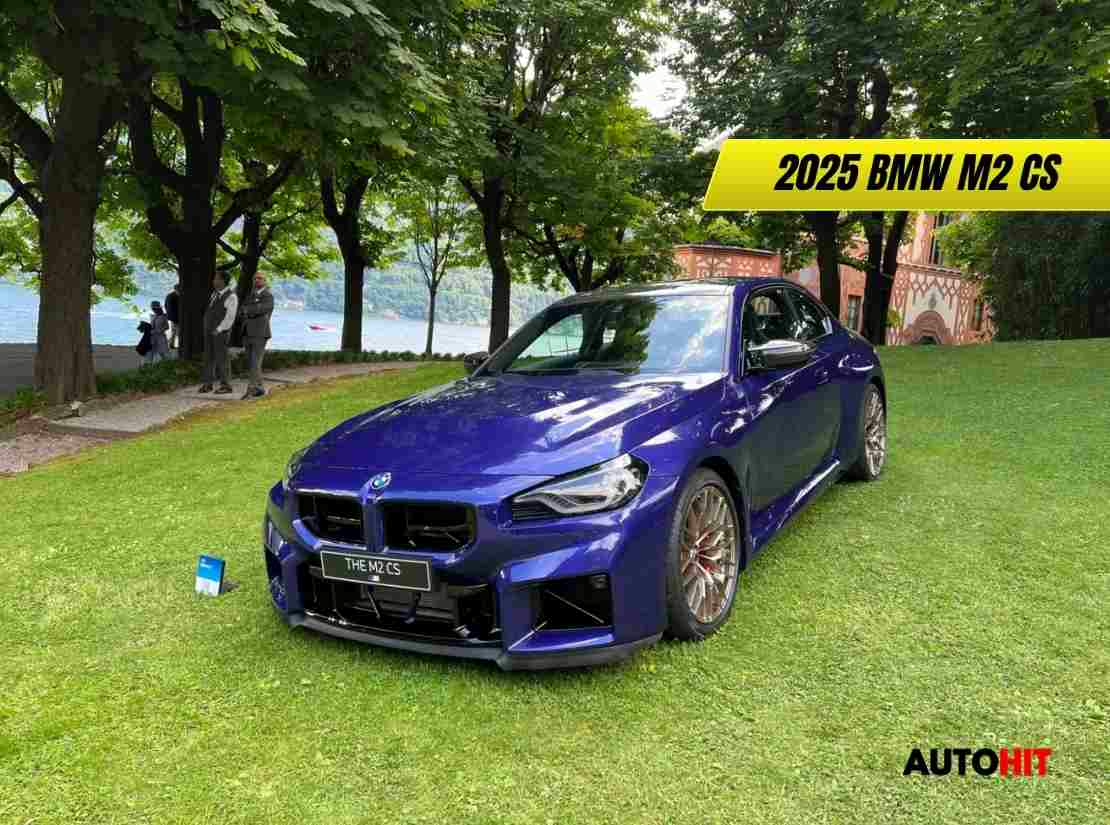
BMW’s new M2 CS delivers 523bhp and drops 44kg, but at nearly £90,000, can it justify such premium pricing? Our analysis of the Competition Sport’s performance, positioning and UK appeal.
When BMW officially unveiled the 2026 M2 CS at Italy’s Concorso d’Eleganza Villa d’Este, it wasn’t just another performance car reveal. According to our analysis at AutoHit, this represents BMW’s most aggressive attempt yet to position the M2 nameplate as a legitimate rival to Porsche’s finest – while charging accordingly.
The numbers tell the story immediately: 523bhp and 479lb-ft from the enhanced S58 twin-turbo straight-six, representing a substantial 50bhp increase over the standard 2025 M2. More importantly, BMW claims a 44kg weight reduction and track-focused dynamics that promise to deliver genuine Competition Sport credentials rather than just badge inflation.
We’ve tested enough “hardcore” variants to know that adding power while subtracting weight represents the holy grail of performance enhancement. But here’s where things get interesting for UK buyers: early pricing suggestions indicate a starting price approaching £90,000 – nearly £25,000 more than the standard M2’s £65,500 entry point.
That positioning places the M2 CS squarely against the Porsche 718 Cayman GT4 and dangerously close to base 911 territory. From a UK perspective, this raises fundamental questions about whether any M2 – regardless of specification – can justify such premium pricing in a market that increasingly demands both performance and value.
Key Highlights: • Power Surge: 523bhp and 479lb-ft represents the most powerful M2 ever, matching M4 Competition output in a lighter package • Weight Loss: 44kg reduction through extensive use of carbon fibre and weight-saving measures across the chassis • Auto-Only: No manual transmission option, with the eight-speed Steptronic being the sole choice for maximum performance • Track Focus: Bespoke suspension tuning, enhanced aerodynamics, and circuit-optimised tyre specifications • Limited Production: Restricted availability suggests exclusivity pricing and potential appreciation potential • UK Timeline: Expected arrival in late 2025 as a 2026 model year, with pricing likely approaching £90,000
The Engineering: More Than Just Power Inflation
The M2 CS isn’t simply a standard M2 with a larger turbocharger and some carbon trim. BMW’s M division has comprehensively re-engineered the S58 powerplant to extract an additional 50bhp, bringing total output to 523bhp – exactly matching the M4 Competition while residing in a significantly lighter platform.
The torque increase to 479lb-ft represents a 37lb-ft gain over the automatic-equipped standard M2, providing the low-end shove that transforms real-world performance. These aren’t just dyno figures either – BMW claims the additional torque arrives lower in the rev range, improving both circuit performance and everyday drivability.
The 44kg weight reduction comes through systematic application of lightweight materials rather than token gestures. Carbon fibre features extensively, including the roof, bonnet, rear spoiler, and various interior components. The bucket seats alone save substantial weight while improving lateral support during spirited driving.
Suspension modifications go beyond simple spring and damper changes. The M2 CS receives track-specific geometry alterations, revised mounting points, and enhanced anti-roll bars designed to exploit the additional power while maintaining the M2’s characteristic balance. Michelin has developed specific tyre compounds for the CS, recognising that standard performance rubber couldn’t optimally handle the enhanced performance envelope.
The aerodynamic package provides genuine downforce rather than purely aesthetic enhancement. The front splitter, side skirts, and rear wing work together to generate meaningful aerodynamic loads at circuit speeds while maintaining road car practicality for UK conditions.
Performance Claims vs Real-World Reality
BMW hasn’t released official acceleration figures for the M2 CS, but simple mathematics suggests significant improvements over the standard model’s 4.1-second 0-62mph time. With 50bhp additional power and 44kg less weight, expect times approaching 3.8 seconds – placing it firmly in supercar territory despite compact dimensions.
More importantly for UK driving conditions, the enhanced mid-range torque should transform overtaking performance on A-roads and motorway on-ramps. The combination of additional power and reduced weight typically creates exponential rather than linear improvements in real-world acceleration.
Top speed remains electronically limited, though the M Driver’s Package will likely raise this to 177mph from the standard 155mph restriction. For UK buyers, these figures remain largely academic given our speed limit reality, but they indicate the CS’s capability envelope.
The track-focused suspension tuning promises sharper turn-in and improved body control compared to the standard M2’s already impressive chassis. However, this typically comes at the expense of ride comfort on British B-roads, where surface quality varies dramatically from smooth tarmac to patchwork repairs.
Early testing reports suggest the M2 CS maintains surprising civility in normal driving modes, though we suspect UK buyers will find the track-biased setup less forgiving than the standard model on daily duties. The adaptive dampers should provide some flexibility, but physics ultimately determines ride quality limits.
The Automatic-Only Decision: Pragmatism Over Purity
Perhaps the most controversial aspect of the M2 CS specification is the absence of a manual transmission option. While the standard M2 continues offering BMW’s excellent six-speed manual, the CS restricts buyers to the eight-speed Steptronic automatic.
BMW’s justification centres on performance optimisation and production efficiency. The automatic transmission enables faster gear changes, more consistent launch control performance, and better integration with the traction control systems. For circuit work, these advantages are undeniable – modern automatics consistently outperform even skilled manual drivers.
However, this decision removes one of the M2’s key differentiation points. In an era where manual transmissions are increasingly rare, the M2’s stick-shift option represented a significant appeal factor for purist buyers. The CS’s automatic-only specification pushes it closer to conventional supercar territory while potentially alienating enthusiasts seeking maximum engagement.
From a UK perspective, the manual transmission’s absence might prove less significant than in other markets. British buyers have shown increasing acceptance of high-performance automatics, particularly when the performance benefits are tangible. The question becomes whether the CS provides sufficient additional engagement through other means.
The Steptronic unit itself is excellent – we’ve praised it extensively in other BMW M applications. The shift quality is crisp, the programming is intuitive, and the paddle shifters provide adequate manual control when desired. It’s simply not the same visceral experience as a proper manual gearbox.
Market Positioning: The £90,000 Dilemma
The M2 CS’s expected £90,000 pricing creates fascinating market dynamics. At this level, it directly challenges the Porsche 718 Cayman GT4, which starts around £85,000 and offers naturally-aspirated flat-six power with manual transmission options.
The Cayman GT4 provides different but equally compelling performance characteristics. Its naturally-aspirated 4.0-litre flat-six delivers 414bhp – significantly less than the M2 CS – but offers linear power delivery and an distinctive soundtrack that the turbocharged BMW cannot match. The Porsche also maintains manual transmission availability for purists seeking maximum engagement.
Moving slightly upmarket, base 911 Carrera models become viable alternatives around £95,000. While less powerful than the M2 CS, the 911’s superior refinement, build quality, and resale value proposition create compelling competition. The 911’s rear-engine layout also provides unique driving characteristics that some buyers prefer over the M2’s front-engine configuration.
From BMW’s own stable, the M4 Competition represents internal competition. At £78,000, it offers identical power output, superior refinement, and more practical accommodation. The M2 CS must justify its premium through lighter weight and sharper dynamics – characteristics that may not matter to all buyers.
For UK buyers specifically, the £90,000 price point triggers psychological barriers. This represents serious money – enough for a well-specified luxury SUV or entry-level exotic car. The M2 CS must deliver genuinely exceptional experiences to justify such investment in what remains, fundamentally, a compact coupe.
The Competition Sport Legacy: Living Up to History
The M2 CS nameplate carries significant expectations based on the previous generation’s success. The F87 M2 CS became legendary among enthusiasts for delivering pure, uncompromising performance in a relatively compact package. It proved that BMW’s M division could still create focused drivers’ cars despite increasing focus on luxury and technology.
That car’s £84,595 pricing seemed expensive at launch but proved prescient as used values soared above £100,000. The combination of limited production, exceptional dynamics, and final-generation naturally-aspirated character created genuine collectibility that few modern performance cars achieve.
The new M2 CS faces different challenges. The turbocharged S58 engine, while more powerful, lacks the charismatic soundtrack of its predecessor’s naturally-aspirated unit. The increased weight and size of the G87 platform creates different dynamic characteristics than the compact F87 generation.
However, the new car offers advantages that the old CS couldn’t provide. The enhanced power delivery, improved refinement, and modern safety systems create a more complete package for contemporary buyers. The question becomes whether these improvements justify the price premium and whether the CS character translates effectively to the new platform.
Early testing reports suggest promising signs. Professional drivers describe the M2 CS as maintaining the essential M2 character while adding layers of sophistication that make it more capable on circuit and more liveable on the road. Whether this appeals to the hardcore enthusiast market remains to be seen.
UK Market Reality: Justifying Premium Performance
For British buyers, the M2 CS pricing creates complex value equations. At £90,000, it enters territory where buyers typically expect either exotic marque prestige or exceptional capability. The M2 CS offers neither the badge appeal of Porsche nor the outright performance of dedicated supercars.
What it does provide is BMW M division’s interpretation of focused performance in a practical package. The rear seats accommodate occasional passengers, the boot handles weekend luggage, and the adaptive suspension enables daily driving without excessive compromise. These characteristics differentiate it from pure track cars while maintaining serious performance credentials.
The UK’s road network particularly suits compact performance cars like the M2 CS. Our narrow B-roads favour agility over outright power, while motorway networks provide opportunities to exploit the enhanced performance envelope. The combination of tight handling and strong mid-range torque should prove ideal for British driving conditions.
Insurance and running costs will likely prove significant considerations at this price point. The M2 CS’s performance capabilities will attract high insurance premiums, while the track-focused specification may increase maintenance requirements. UK buyers must factor these ownership costs into their purchase decisions.
Depreciation patterns remain uncertain. The previous M2 CS proved exceptional at retaining value, but that success came during unique market conditions that may not repeat. Contemporary buyers face different challenges, including increasing regulatory pressure on high-performance vehicles and changing buyer preferences toward electrification.
Technology and Interior: Modern Sophistication Meets Track Focus
Inside, the M2 CS adopts BMW’s latest iDrive 8.5 system with the curved display arrangement that’s become standard across the BMW range. The 12.3-inch instrument cluster and 14.9-inch infotainment screen provide comprehensive information while maintaining the driver focus that defines M cars.
The carbon fibre bucket seats represent a significant upgrade over standard M2 accommodation. They provide enhanced lateral support essential for track driving while featuring contrast stitching and CS-specific detailing. However, they sacrifice some comfort compared to the standard M sport seats, potentially limiting long-distance appeal.
Carbon fibre interior trim extends throughout the cabin, including dashboard elements, door cards, and centre console details. While lightweight benefits are minimal in these applications, the visual impact reinforces the CS’s special status. The build quality maintains BMW’s high standards while incorporating race-inspired elements.
The Devialet sound system receives specific tuning for the M2 CS, though many buyers will prefer the enhanced engine note over audio entertainment. The soundtrack from the tuned S58 engine represents a significant improvement over the standard M2, with more aggressive exhaust note and enhanced induction noise.
Storage space remains practical despite the performance focus. The rear seats fold to extend cargo capacity, while door pockets and centre console provide adequate small-item storage. These practical touches help justify the CS’s road car credentials despite its track-focused specification.
Frequently Asked Questions
How much will the BMW M2 CS cost in the UK and when will it arrive?
While BMW hasn’t announced official UK pricing, expect the M2 CS to start around £90,000 when it arrives in late 2025 as a 2026 model year. This represents approximately £25,000 more than the standard M2’s £65,500 entry price. Given the limited production run and exclusive nature, well-optioned examples could easily exceed £100,000, placing it in direct competition with Porsche 718 GT4 and base 911 models.
Why is there no manual transmission option for the M2 CS?
BMW has restricted the M2 CS to the eight-speed Steptronic automatic transmission for performance optimisation. The automatic provides faster gear changes, more consistent launch control, and better integration with traction control systems – crucial advantages for track-focused driving. While this disappoints manual transmission enthusiasts, the performance benefits are undeniable, and BMW likely wanted to maximise lap time potential rather than cater to purist preferences.
How does the M2 CS compare to the Porsche 718 Cayman GT4?
The M2 CS offers significantly more power (523bhp vs 414bhp) and likely superior straight-line performance, while the Porsche provides naturally-aspirated engine character and manual transmission availability. The Cayman GT4 costs around £85,000, making it slightly cheaper while offering different but equally compelling performance characteristics. The BMW provides more practical accommodation and modern technology, while the Porsche delivers more exotic appeal and potentially better resale value.
What weight-saving measures has BMW implemented for the CS version?
BMW has achieved a 44kg weight reduction through extensive use of carbon fibre components including the roof, bonnet, rear spoiler, and interior trim pieces. The bucket seats alone save significant weight compared to standard M sport seats, while various chassis components receive lightweight treatment. Additional measures include revised exhaust system components and deletion of some comfort features. While 44kg might seem modest, it represents meaningful improvement when combined with the 50bhp power increase.
Is the M2 CS suitable for daily driving in the UK?
Despite its track focus, the M2 CS retains adaptive suspension that should provide acceptable ride quality in comfort mode for daily use. However, the track-biased setup, wider tyres, and stiffer suspension mounting will likely make it less comfortable than the standard M2 on poor road surfaces. UK buyers should expect a firmer ride quality and increased road noise, though it shouldn’t be unusably harsh for occasional commuting or longer journeys.
How does it compare to BMW’s own M4 Competition?
Both cars produce identical 523bhp, but the M2 CS benefits from lower weight and more compact dimensions that should provide sharper handling characteristics. The M4 Competition costs around £78,000 – significantly less than the expected M2 CS pricing – while offering more interior space and arguably better refinement. The M2 CS justifies its premium through exclusivity, weight reduction, and track-focused tuning, but buyers must decide whether these advantages warrant the price difference.
What are the running costs and insurance implications?
Insurance costs will likely be substantial given the M2 CS’s performance capabilities and limited production status. Expect high group ratings and significant premiums, particularly for younger drivers. Maintenance costs should remain reasonable given BMW’s comprehensive service network, though track-focused components like the specific tyres and brake systems may prove more expensive to replace. Fuel economy will likely mirror the standard M2’s disappointing figures, with real-world consumption around 20-25mpg depending on driving style.
Our Verdict: Exceptional Performance, Premium Pricing Reality
The 2025 BMW M2 CS represents everything that makes modern BMW M cars simultaneously exciting and frustrating. The engineering is undeniably impressive – 523bhp in a lightweight package with sophisticated dynamics creates genuine supercar performance in a practical compact coupe format.
According to our analysis at AutoHit, the M2 CS succeeds as a technical exercise. BMW has extracted meaningful performance improvements through power increases and weight reduction while maintaining the essential M2 character that made the original so appealing. The enhanced S58 engine provides devastating acceleration, while the track-focused chassis promises genuine circuit capability.
However, the expected £90,000 pricing creates a value proposition that many UK buyers will struggle to justify. At this price point, the M2 CS competes directly with Porsche’s finest offerings and approaches exotic car territory where badge prestige becomes increasingly important. BMW’s excellent engineering may not translate into equivalent market appeal at such premium pricing.
The absence of a manual transmission option particularly damages the M2 CS’s appeal to hardcore enthusiasts who value engagement over outright performance. While the eight-speed automatic is undeniably faster, it removes one of the standard M2’s key differentiation points in an increasingly automated world.
For buyers seeking the ultimate M2 experience regardless of cost, the CS delivers exceptional performance and genuine exclusivity. The limited production run may even provide investment potential similar to the previous generation CS. However, most UK buyers will find better value in the standard M2 or should consider stretching budgets toward Porsche alternatives that offer different but equally compelling characteristics.
Bottom Line: The M2 CS represents BMW M division engineering at its finest, but the premium pricing places it in territory where emotional appeal matters as much as technical capability. For the fortunate few who can justify the investment, it promises to be the ultimate expression of the M2 concept – whether that’s worth nearly £90,000 depends entirely on individual priorities and perspectives.





