
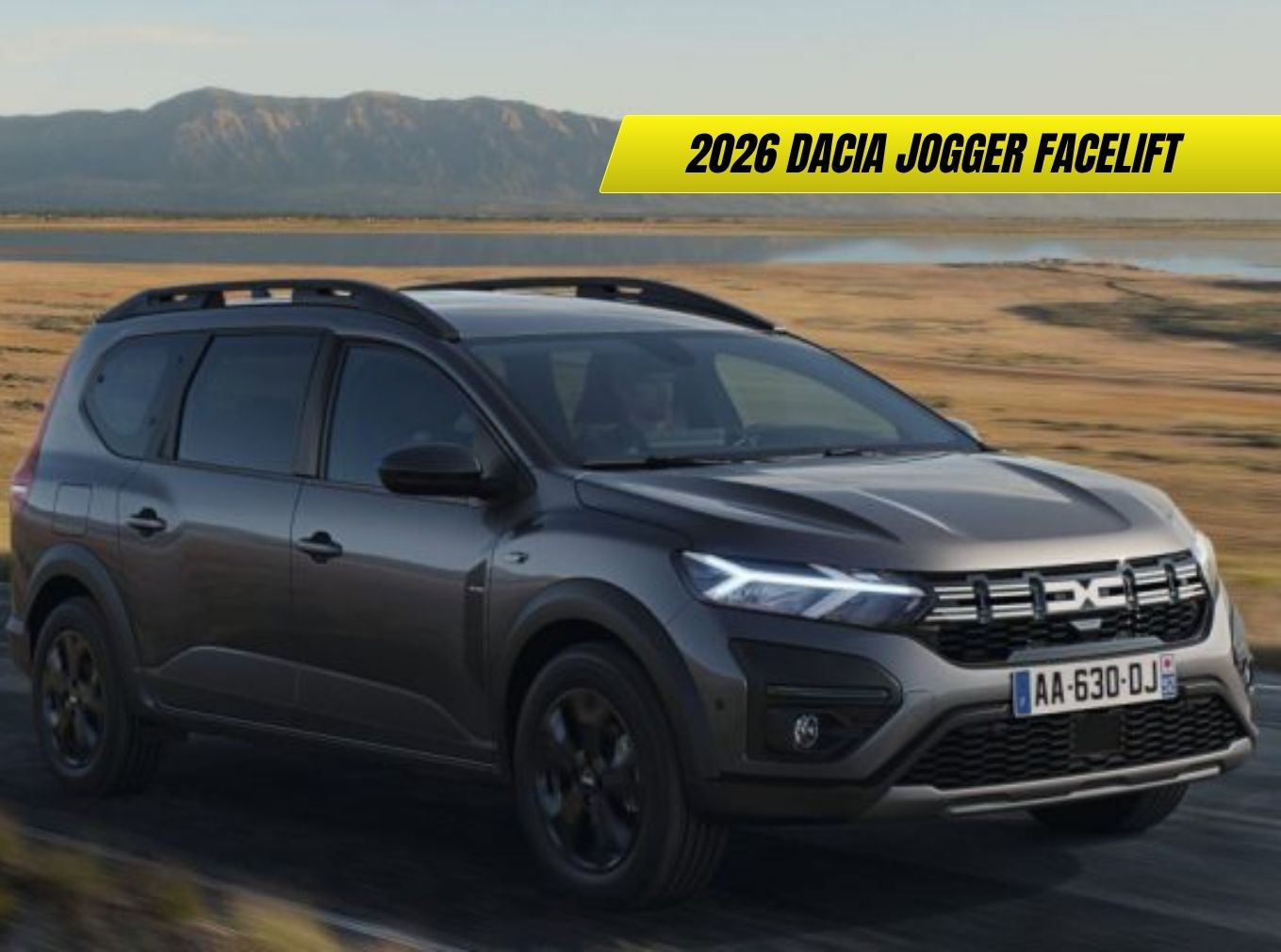
The Dacia Jogger is preparing for its most significant update since launch, with the 2026 facelift bringing substantial styling changes, upgraded technology, and new powertrain options to Britain’s most affordable seven-seater. Based on recent spy photographs and industry insights, the refreshed Jogger promises to maintain its exceptional value proposition whilst incorporating design elements from Dacia’s latest models including the Bigster and third-generation Duster.
2026 Dacia Jogger facelift UK guide: release date, pricing from £19k, Bigster-inspired styling, new hybrid engines and 10.1″ touchscreen. Britain’s cheapest 7-seater updated.
Key Points: • Release Date: Expected reveal in late 2025, with UK sales starting in early 2026 • Pricing: Starting from approximately £19,000-£20,000, maintaining position as Britain’s cheapest seven-seater • Design: Bigster-inspired front end with new LED headlights and larger touchscreen • Engines: New TCe 130 mild-hybrid replacing entry-level petrol, plus potential Hybrid 155 option • Technology: 10.1-inch touchscreen infotainment system from latest Dacia models • Practicality: Retains unique seven-seat configuration with up to 2,085 litres boot space
2026 Dacia Jogger Facelift: Key Updates and UK Market Impact
Recent spy photographs captured in Germany reveal a heavily camouflaged Jogger prototype undergoing testing, confirming that Dacia’s budget-friendly seven-seater is receiving its first major update. The interior camo, meanwhile, is there to hide a larger touchscreen infotainment system of the free-standing variety. Be that as it may, base trims are likely to retain the centrally-mounted smartphone holder. Compared to the current 8.0-inch setup, the 2026 model could gain the 10.1-inch system of the Bigster.
From my experience testing the current Jogger extensively, this facelift addresses the model’s main weaknesses – namely the dated interior technology and somewhat plain front-end styling – whilst preserving everything that makes it such compelling value.
Design Changes: Bigster-Inspired Styling
Front-End Transformation
The most significant visual changes focus on the front end, where Bigster influences are very apparent up front. Bigster-like grilles are on the menu, and the black tape on the headlights also suggests a few changes to the lighting units. This represents a substantial departure from the current model’s conservative appearance.
The new design language aligns with Dacia’s recent push upmarket, incorporating the brand’s modern “Link” logo and more sophisticated LED lighting elements. However, as with all Dacia products, Don’t look forward to matrix-style LEDs or anything similar because Dacia is a low-cost manufacturer that made a name for itself across the Old Continent by undercutting the competition.
Rear Updates
Whilst front-end changes dominate the visual refresh, Dacia hides the rear lights as well, though only the graphics appear to differ from the pre-facelift Jogger. Expect subtle LED signature updates and possibly revised bumper detailing to harmonise with the new front design.
Interior Technology Upgrades
Infotainment Evolution
The most significant cabin improvement centres on the infotainment system. We can just about see inside the facelifted car, and sitting on the dash is a touchscreen – so it’s possible that the 10.1-inch screen found on the new Duster could replace the existing car’s eight-inch unit.
Having tested the latest Dacia infotainment setup in both the Duster and Bigster, this represents a genuine improvement in usability and functionality. The new system includes wireless smartphone integration, improved navigation, and more intuitive menu structures.
Practical Considerations
From our experience of the Duster and Bigster, which share the same set up, the new screens – not to mention Dacia’s latest infotainment system – will be a big improvement on the Jogger’s current standing. Base models will likely retain the smartphone holder option, maintaining accessibility for buyers seeking maximum value.
Powertrain Updates for Euro 7 Compliance
New Mild-Hybrid Option
We’re expecting some changes under the Jogger’s bonnet as well. In particular, the current entry-level TCe 110 pure-petrol engine will be swapped to the more powerful and more efficient TCe 130 mild-hybrid engine from the Duster.
This represents a significant upgrade, offering improved efficiency and performance compared to the outgoing naturally-aspirated unit. The mild-hybrid system provides additional torque assistance during acceleration whilst reducing fuel consumption in urban driving. This technology aligns with our analysis of why diesel hybrid cars are still relevant in 2025, though the Jogger’s petrol-hybrid approach suits its urban family focus.
Enhanced Hybrid Potential
Looking at Dacia’s broader powertrain strategy, However, new engines might be added to the range including the Hybrid 155 engine that’s been announced for the Bigster SUV. This is similar to the current Hybrid 140 model, which uses a 1.8-litre four-cylinder petrol engine and an electric motor, but with a little more power.
From my perspective, this additional power would address one of the current Hybrid 140’s few weaknesses – marginal performance when fully loaded with seven occupants and luggage.
UK Market Position and Competition
Seven-Seat Exclusivity
The Jogger will remain the only seven-seater in Dacia’s UK line-up, after CEO Denis Le Vot recently confirmed to Auto Express that there will not be a seven-seat version of the Bigster mid-size SUV. This preserves the Jogger’s unique market position as Britain’s most affordable genuine seven-seater.
In the current market, the Jogger competes primarily against significantly more expensive alternatives like the best family SUVs or large MPVs that typically start above £30,000. The facelifted model should maintain this crucial price advantage.
Value Proposition Analysis
Current Jogger pricing starts from £18,970, making it exceptionally competitive against rivals. In any case, in terms of price, there shouldn’t be much difference, with the Jogger’s price list still starting at around £18,000-£19,000.
When compared to our recent analysis of best SUVs under £30,000 in 2025, the Jogger remains in a class of its own for large family transport on a budget. Unlike many alternatives in our guide to the best family SUVs, the Jogger offers genuine seven-seat capability without premium pricing.
For buyers considering our recommendations for best cars under £25,000, the facelifted Jogger represents exceptional value in the large family car segment. Whilst the best affordable Chinese cars offer compelling technology packages, the Jogger’s European heritage and established dealer network provide additional reassurance.
2026 Dacia Jogger: Expected Specification Comparison
| Trim Level | Engine | Power | Price (Est.) | Key Features |
|---|---|---|---|---|
| Essential | TCe 130 Mild-Hybrid | 130hp | £19,000 | Smartphone holder, manual AC |
| Expression | TCe 130 Mild-Hybrid | 130hp | £21,000 | 10.1″ touchscreen, cruise control |
| Extreme | Hybrid 155 | 155hp | £24,000 | Auto gearbox, premium features |
Our Take: The entry-level mild-hybrid represents excellent value, whilst the Hybrid 155 could transform the Jogger’s appeal for long-distance family touring.
Dacia Jogger vs Key Competitors: UK Pricing Analysis
| Model | Starting Price | Seats | Boot Space | Fuel Economy |
|---|---|---|---|---|
| 2026 Dacia Jogger | £19,000 (est.) | 7 | 2,085L | 55+ mpg (hybrid) |
| Ford Galaxy | £32,000+ | 7 | 2,274L | 45-50 mpg |
| SEAT Tarraco | £30,000+ | 7 | 1,775L | 40-45 mpg |
| Peugeot 5008 | £28,000+ | 7 | 1,940L | 45-55 mpg |
| Skoda Kodiaq | £34,000+ | 7 | 2,065L | 40-50 mpg |
Our Take: The Jogger’s pricing advantage remains substantial, offering similar practicality for significantly less money than established seven-seat alternatives.
Timeline and Availability
Development Schedule
To be revealed in the latter half of 2025, the facelifted Jogger is likely to adopt a free-standing touchscreen infotainment system According to industry sources, official unveiling is expected between September and November 2025.
This means we expect a reveal later on in 2025 at the earliest, and models may not be available to drive away in until 2026. UK deliveries should commence in Q1 2026, maintaining Dacia’s tradition of rapid market introduction following international reveals.
Production Considerations
Previously made in Romania, but now produced in Morocco, the Jogger will undoubtedly get pricier with this facelift due to a greater level of standard equipment. However, Dacia’s commitment to value pricing suggests any increases will remain modest.
What This Means for UK Buyers
Current Model Considerations
With the facelift imminent, current Jogger inventory represents exceptional value for immediate buyers. Existing models offer proven reliability and lower depreciation risk, particularly for buyers prioritising pure value over latest technology.
However, for those considering our recommendations for best cars under £25,000, waiting for the facelifted Jogger could prove worthwhile given the substantial technology improvements expected.
Fleet and Business Users
The Jogger’s unique seven-seat configuration at sub-£20,000 pricing makes it particularly attractive for fleet operators requiring maximum passenger capacity. The mild-hybrid powertrain should improve BiK ratings for company car users whilst maintaining low acquisition costs.
Frequently Asked Questions
When will the 2026 Dacia Jogger facelift be available in the UK?
Official reveal is expected in late 2025, with UK deliveries commencing in early 2026. Order books will likely open shortly after the international launch, following Dacia’s established pattern for new model introductions.
How much will the facelifted Dacia Jogger cost?
Pricing is expected to start around £19,000-£20,000, representing a modest increase over current models. This maintains the Jogger’s position as Britain’s most affordable seven-seater whilst accounting for improved equipment levels and new technology.
What new engines will be available in the 2026 Jogger?
The entry-level TCe 110 petrol will be replaced by a more powerful TCe 130 mild-hybrid unit. A new Hybrid 155 powertrain may also join the range, offering additional performance for fully-loaded family touring.
Will the seven-seat layout be retained in the facelifted model?
Yes, the Jogger remains Dacia’s only seven-seater offering and will continue providing genuine adult accommodation in all three rows. Boot capacity of up to 2,085 litres with seats folded will also be maintained.
How does the updated Jogger compare to Chinese alternatives?
While the best affordable Chinese cars for UK buyers offer compelling technology and value, the Jogger’s European build quality, established dealer network, and seven-year warranty provide additional reassurance for UK buyers seeking long-term reliability. Models like the BYD Dolphin Surf 2025 excel in different areas but lack the Jogger’s unique seven-seat practicality.
What warranty coverage will the 2026 Jogger include?
Dacia’s comprehensive seven-year/100,000-mile warranty will continue, providing exceptional peace of mind compared to alternatives in this price bracket. This coverage includes mechanical components, paint, and corrosion protection.
Should I wait for the facelift or buy a current Jogger?
Current models offer proven reliability and immediate availability, making them ideal for urgent family transport needs. However, buyers prioritising latest technology and styling should consider waiting for the substantially improved 2026 model.
Conclusion
The 2026 Dacia Jogger facelift represents a thoughtful evolution of Britain’s most affordable seven-seater, addressing key weaknesses whilst preserving the exceptional value proposition that made the original so compelling. The Bigster-inspired styling, improved technology, and enhanced powertrains should broaden the model’s appeal without compromising its unique market position.
From my perspective, the addition of mild-hybrid technology and a larger infotainment system transforms the Jogger from a purely value-focused choice into a genuinely well-rounded family car. The potential Hybrid 155 powertrain could eliminate the current model’s only significant dynamic limitation – marginal performance when fully loaded.
For UK families seeking maximum space and seating capacity on a restricted budget, the facelifted Jogger promises to maintain its position as the obvious choice. The combination of seven genuine seats, substantial cargo capacity, and sub-£20,000 pricing remains unmatched in the current market, making the updated Jogger an essential consideration for practical family transport in 2026.





