
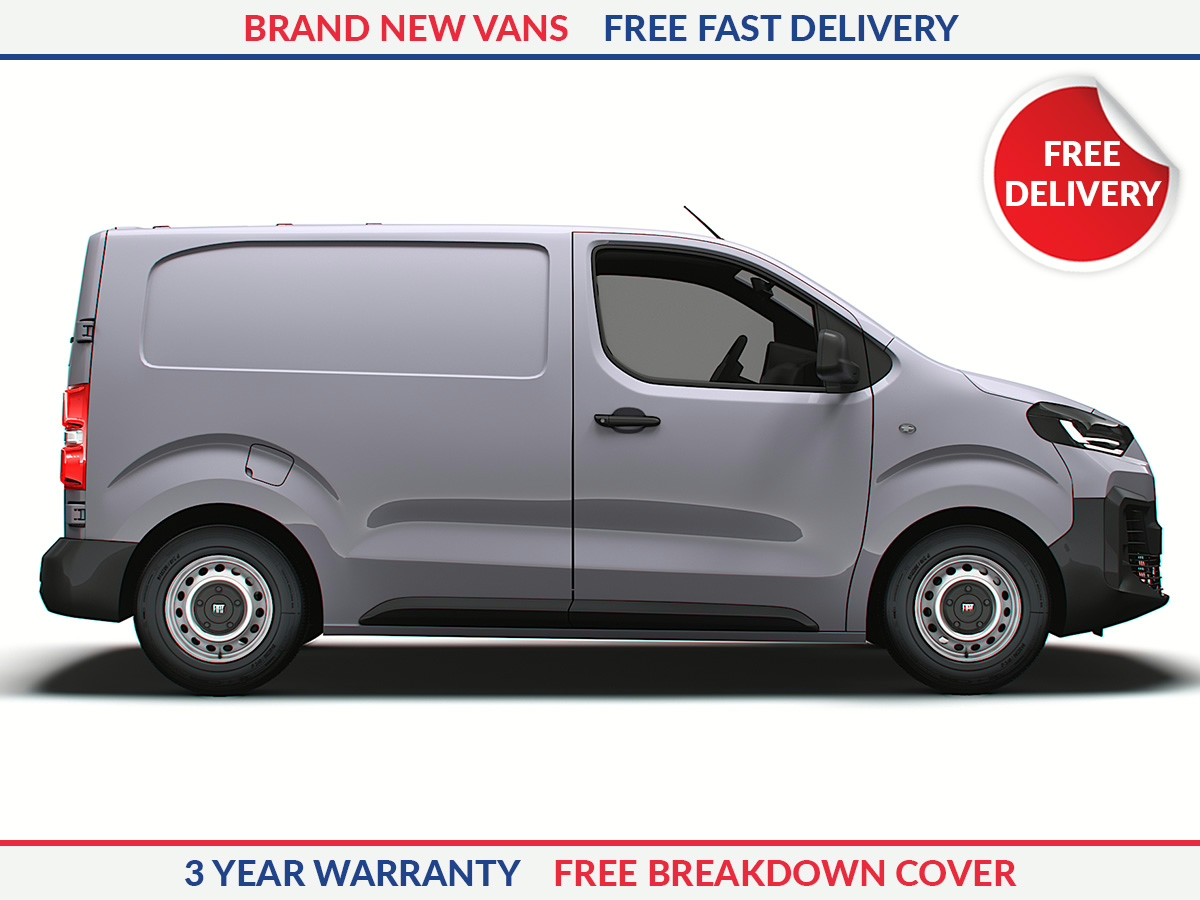
In the UK’s crowded world of commercial vans and light trucks, Fiat Professional has decided to buck the trend of bland, utilitarian designs. Their new Scudo & e-Scudo S-Design 2025 line-up signals that an LCV (Light Commercial Vehicle) doesn’t have to be all drab practicality. Instead, they combine real-world performance and capabilities with a dash of automotive style, reminiscent of premium SUVs or MPVs.
For builders, couriers, and tradespeople who spend more hours in transit than many do in a standard car, these S-Design vans aim to balance comfort, technology, and — for the first time in a while — an unabashed sense of design flair. And, crucially, the e-Scudo variant caters to businesses operating within Clean Air Zones or looking to reduce running costs and emissions. Are these new Scudos the perfect fleet addition for UK-based professionals? Let’s find out!
1. Rethinking the Van’s Image: Why “S-Design”?
1.1 The “S-Design” Concept
For British van drivers accustomed to understated white panel vans, “S-Design” might sound like a fancy trim borrowed from passenger cars. In fact, that’s precisely the case: Fiat has transplanted its S-Design ethos (originally found in certain 500X or Tipo models) into the commercial sector. This means a distinctive black gloss grille, black mirror caps, special alloy wheels, body-colour bumpers (depending on the spec), and perhaps a specific paint palette (e.g., a unique grey or metallic).
The goal? Let your van represent your brand as a cut above. In an environment where first impressions can matter, delivering quotes or supplies in a sharper-looking van might just make you stand out from local competition. It’s an unusual angle for an LCV, but it aligns with a broader trend: more comfortable cabs, better design, and more advanced in-cab equipment. The S-Design labeling ensures you get a consistently high level of spec.
1.2 Inside: A Step Up from Utilitarian Minimalism
Climb inside, and you’ll notice a few differences from a typical spartan commercial environment:
- Improved seat fabrics (sometimes with partial leatherette or stylish stitching).
- Soft-touch dashboard inserts or decorative trims instead of pure scratchy plastic.
- Steering wheel in leather or with metallic accents.
- Enhanced infotainment with up to a 7- or 8-inch touchscreen, including Apple CarPlay/Android Auto.
This might not turn your Scudo into a Bentley, but for a daily van, it does promise an environment less draining on your comfort. If you’re stuck on the M25 or the M6 in a jam, the difference can feel significant.
2. Diesel or Electric? Motorisations to Suit Different UK Needs
2.1 Diesel MultiJet for Long-Distance Efficiency
Though the electric revolution is in full swing, many UK trades still prefer diesel for robust pulling power, straightforward refuelling, and motorway journeys that can top 200-300 miles in a day. Here, the Scudo S-Design with a 2.0 MultiJet engine (around 145 bhp, ~340 Nm torque) offers:
- Decent fuel economy (~6.5 L/100 km / ~43 mpg on combined cycles, depending on load).
- A choice of 6-speed manual or optional 8-speed automatic.
- Towing capacity up to 2,500 kg on certain models (subject to final official specs).
For delivering supplies from Glasgow to Aberdeen or skipping along the A1 corridor, this diesel should handle main roads effectively. The engine meets Euro 6d standards, meaning compliance with current emission regulations. Still, in certain city centres (London’s ULEZ, or other Clean Air Zones), you’d face daily charges if your van doesn’t meet the right criteria (though brand-new Euro 6 typically meets them at present, it might tighten in the future).
2.2 The e-Scudo S-Design: Emissions-Free Utility
Alternatively, the fully electric e-Scudo variant addresses the rising wave of zero-emission requirements. Some local councils across the UK push for greener fleets, and “Electric LCVs” are in demand. Key points:
- Two battery sizes: 50 kWh for ~230 km (WLTP) or 75 kWh for ~330 km (WLTP).
- ~136 bhp (100 kW) motor with instant torque, plus single-speed transmission.
- Up to 1,000 kg payload capacity.
- Rapid DC charging at up to ~100 kW, for a 0-80% top-up in roughly 45 minutes.
For businesses operating predominantly within city confines — think central Manchester, Birmingham, or Bath’s Clean Air Zones — e-Scudo can drive in freely, pay less or zero in local emissions-based charges, and also help portray an eco-friendly brand image. If you do multi-drop routes or short distribution loops, 200-ish real-world miles can suffice. However, for heavier loads or daily cross-country travel, the range might require more frequent recharge stops.
3. UK-Specific Considerations: Clean Air Zones & Tolls
3.1 Does the Diesel Face Future Charges?
Some in the UK are worried about how quickly councils might restrict diesel vans. Right now, brand-new Euro 6 diesel vehicles can still enter Ultra Low Emission Zones (like London’s ULEZ) without penalty, as they meet the standard (Euro 6). But if future expansions tighten to only allow zero-emission in certain zones (like proposed Zero Emission Zones in Oxford or other city centres), the e-Scudo might be the safer long-term investment. The S-Design approach is available on both powertrains, so your choice depends on daily mileage, route type, and official legislation in your area.
3.2 Grants or Incentives
- The Plug-in Van Grant changed over time, and it’s worth checking the current rules. If an e-Scudo meets the Office for Zero Emission Vehicles (OZEV) criteria, a portion of the purchase price might be covered or reduced.
- Some local authorities or combined mayoral regions in England offer additional support for scrapping older diesel vans in exchange for going electric.
- For the diesel version, not many direct subsidies remain, though certain tax allowances might apply if your small business invests in a new LCV.
4. Practical Aspects: Loading and Dimensions
4.1 Capacity
Both S-Design diesel and electric variants maintain the core Scudo architecture:
- Length: around 4.96 m (Standard) or 5.30 m (Maxi).
- Load volume: up to 6.6 m³ with the “Moduwork” system, good for big parcels or building supplies.
- Payload: up to ~1,400 kg (diesel) or ~1,000 kg (electric).
That’s plenty for a local builder, electrician, or catering service. The “Maxi” version suits heavier usage or trades that carry extended materials (wood planks, piping, etc.). Meanwhile, the e-Scudo’s capacity is only marginally lower, but enough for a range of tasks that demand quiet city operation.
4.2 Moduwork for Versatility
Fiat’s Moduwork is a neat seat solution letting you slide items under the passenger bench, extending the load length. The back of the middle seat can fold down to form a desk area. Perfect for a quick lunch break or signing contracts on the go. If you’re parked outside a client’s house in suburban Reading or Bristol, that small detail can save time rummaging for a writing surface.
4.3 Cabins, Double Cabs, and Possible Configurations
The standard offering is a panel van with three front seats, but there may also be a double-cab variant or passenger-based version, although the S-Design might be restricted primarily to the standard cargo van. For example, if you want a “crew van” layout, you should check with your local Fiat Professional dealer whether that’s offered in S-Design trim.
5. On the Road: Comfort and Drivability
5.1 Car-Like Interior
S-Design introduces a more sophisticated dash design:
- Soft-touch surfaces or brushed trim (depending on exact spec).
- Larger infotainment screen with Apple CarPlay/Android Auto.
- Possibly an upgraded instrument cluster with digital readouts for speed, gear, and basic telematics.
While not a “luxury saloon,” you certainly get a big step above the typical no-frills approach. That’s valuable for extended journeys on the M1 or M5 or if you must repeatedly deal with city congestion. The seat improvements and cabin noise damping can reduce fatigue over an eight-hour shift.
5.2 Diesel vs. E-Scudo Driving Experience
- Diesel: 2.0 MultiJet 145 bhp is fairly punchy, especially if you opt for the 8-speed automatic. Motorway cruising at 70 mph is stable, and the torque suits hauling heavier loads or towing. Fuel consumption is on par with competitor vans (like a Peugeot Expert or a Renault Trafic).
- Electric: The e-Scudo feels smooth and quiet, with immediate torque from a standstill. Great for delivering packages in central London or Bath, zero engine noise and minimal vibrations. Downside: range depends on speed, cargo weight, and you must plan recharges if covering more than ~200 miles in a day.
Regardless, the S-Design cabin fosters a more refined vibe, meaning you won’t dread the daily haul.
6. Technology and ADAS
Safety tech once seen only in passenger cars increasingly migrates to LCVs. In the S-Design, expect:
- Automatic Emergency Braking (AEB) to avoid collisions at low-mid speeds.
- Lane Departure Warning or correction (assuming you keep the lines visible).
- Blind Spot Monitoring in side mirrors, which is crucial on British multi-lane motorways with a van’s limited rear visibility.
- Parking sensors plus optional reversing camera with dynamic guidelines, super helpful in tight city corners or small loading bays.
These features can reduce insurance claims, which might matter if your van operates in major urban areas like Manchester or Newcastle with heavy traffic.
7. Cost and Maintenance in the UK
7.1 Price Points
Exact UK RRP for a Scudo S-Design can vary, but typically:
- Diesel S-Design: from around £25,000–£27,000 + VAT (for the base standard length) going higher for the Maxi or auto versions.
- e-Scudo S-Design: from ~£30,000 + VAT for the 50 kWh, up to ~£32k–£33k + VAT for the 75 kWh battery. The final “on-the-road” cost depends on government grants or manufacturer promotions.
If your business can reclaim VAT, the net figure might be more appealing. Additionally, if the e-Scudo qualifies for a Plug-in Van Grant, the cost could drop by an additional chunk, subject to the latest OZEV rules.
7.2 Running Costs
- Diesel: ~40–45 mpg if you drive moderately, though city usage can push that figure down. Regular servicing intervals (annual or ~20k miles).
- Electric: You skip diesel expenses (with electricity rates varying from ~15p/kWh to 40p/kWh or more if using public fast chargers). Service costs typically lower because no oil changes or filters. However, tyres, brakes, etc., remain.
- Some city councils or boroughs offer free or discounted parking for EVs, or no daily charges in Clean Air Zones, so that can further reduce daily overhead.
7.3 Warranty and Reliability
Fiat’s standard cover in the UK for commercial vehicles is typically 2 years unlimited mileage or 3 years up to a certain mileage, plus anti-perforation and so on. The e-Scudo’s battery might carry an 8-year / 100,000-mile warranty (70% capacity guarantee), but you should confirm specifics with your local dealer. Reliability for the underlying platform is shared with other Stellantis vans (e.g., Peugeot, Citroën), so parts availability is usually decent. For peace of mind, extended warranties or service plans are often available.
8. Comparison with Some UK Rivals
| Model | Fuel/Electric | Max Range (EV) | Load Volume | Starting RRP (ex. VAT) |
|---|---|---|---|---|
| Fiat e-Scudo S-Design | Electric | ~330 km | ~6.6 m³ | ~£32k–£33k |
| Ford Transit Custom | Diesel/Ecoblue | n/a (unless PHEV) | up to 6.0 m³ | ~£25k–£35k (diesel) |
| Renault Trafic E-Tech | Electric | ~300 km | ~6.0 m³ | ~£31k+ |
| Vauxhall Vivaro-e | Electric | ~330 km | ~6.6 m³ | ~£32k+ |
Fiat’s pitch is about the S-Design’s flair, while many alternatives remain functional but conservative. Price and performance seem broadly in line with the Stellantis stable (Vivaro-e, e-Expert, etc.). The advantage for the Scudo is brand loyalty from some UK-based Fiat customers, plus the new styling that sets it apart.
9. Extra Focus: The S-Design Cabin for UK Drivers
Consider the typical British driving environment: frequent roundabouts, narrow city roads, overhead car parks restricted to 2.0 m height, big dual carriageways. The S-Design approach helps with:
- Better side mirror coverage with Blind Spot Monitoring so you don’t miss that overtaking car on the M4.
- Cozy seat with more refined upholstery, beneficial if your shift is 10 hours delivering parcels across urban London.
- Cabin insulation to reduce stress from traffic noise, especially relevant on slow city roads where an engine can drone.
If you ever use your van for multi-purpose events (like picking the family occasionally, or turning it into a mini camper for weekends?), the S-Design interior ambiance is less “industrial.”
FAQ
How does the interior sound insulation of the S-Design compare to the standard Scudo for motorway driving?
Fiat’s S-Design specification typically focuses on aesthetic enhancements, but it also often includes better cabin trim materials or added sound-deadening measures to elevate comfort. For the Scudo S-Design, one of the objectives is to minimize noise penetration on longer runs (such as the M25 or M60). This can involve thicker door seals, extra insulation behind the dashboard, and more absorptive headliner fabric. Consequently, you might notice a distinct difference in motorway environments – for instance, less wind noise around the side mirrors or improved damping of engine vibrations.
In a standard Scudo, road rumble at 70 mph can be noticeable, especially if you’re carrying minimal payload. The S-Design version, however, might mitigate some of that resonance through under-floor insulation or wheel-arch liners. Meanwhile, the choice of 17- or 18-inch alloy wheels could slightly affect the overall noise experience. Larger rims with lower-profile tyres may produce more road roar, but it’s often offset by the better sound-deadening in the cabin.
Another aspect: in certain S-Design vans, there could be a refined shape for the side mirrors, reducing aerodynamic whistles. Also, a windscreen with acoustic properties might be standard or optional, further cutting high-frequency wind noise. The result is a comfortable drive that feels closer to a typical passenger MPV, rather than an unadorned commercial van.
Still, don’t expect it to be silent like a premium SUV – you have a large cargo space and a boxier silhouette by nature. But relative to a conventional trim-level Scudo, the S-Design invests more in occupant calm, which matters a lot if your daily schedule involves multiple hours on motorways or if you’re frequently commuting between cities. For many UK operators, that difference can reduce fatigue and sharpen driver satisfaction, something especially valued by small business owners who also double as the primary driver.
Are the driver-assistance systems (ADAS) on the e-Scudo S-Design customizable or do they come in a fixed package?
Modern vans increasingly offer advanced driver-assistance features, such as lane departure alerts, blind-spot monitoring, and adaptive cruise control. In the case of the e-Scudo S-Design, Fiat typically bundles these ADAS technologies into “packs” or trim-level packages rather than allowing an extensive à la carte selection. That means if you want a specific feature like automatic emergency braking (AEB), you might have to opt for the broader “Safety Pack” or “Tech Pack.”
While some passenger car line-ups offer the ability to add or remove specific ADAS at will, commercial vehicles tend to keep it simpler: either you have a standard suite or an optional pack that aggregates multiple functions. The S-Design trim often includes an upgraded baseline of safety features – for instance, crosswind assist, rear parking sensors, and possibly a reversing camera. The question is whether more advanced systems like Adaptive Cruise Control or Traffic Sign Recognition come standard or as part of an optional add-on.
In the UK market, it’s common to see a single “top-tier” specification that lumps together many items. If a business wants to reduce cost, they’d pick a lower trim, but then might lose out on certain ADAS. In any event, the e-Scudo S-Design is geared toward a higher-end experience, so expect at least some ADAS like lane assist and blind-spot detection included. If you’re keen on customizing only certain elements – for example, wanting adaptive cruise but not caring about lane centering – it may not be individually selectable.
Additionally, software updates might slightly expand or improve these systems later, although vans rarely receive major OTA expansions. Hence, prospective buyers should confirm with a Fiat dealership which safety pack is included in the standard S-Design and which items require an extra paid upgrade. That approach ensures you get the best balance of cost vs. advanced safety tech for your daily operational needs.
What financing or leasing options does Fiat offer for UK-based small businesses that want an S-Design diesel or electric van?
Small business owners in the UK often prefer either a finance lease, contract hire, or HP (Hire Purchase) arrangement instead of buying a new van outright. For the Scudo S-Design, both in diesel and electric forms, Fiat (through its financing division) typically proposes a range of packages:
- Business Contract Hire: You pay a monthly rental over, say, 24 to 60 months, with mileage limits. Maintenance may or may not be included. At the end of the term, you return the van to the leasing company. This might keep monthly outlays lower, freeing up capital for other business expenses.
- Hire Purchase: A deposit plus fixed monthly instalments over a set period, after which you own the vehicle outright. The difference from contract hire is that at the end of HP, the van is yours, so you can resell or keep it. HP can be especially attractive if you want to keep hold of the van beyond the finance term.
- Finance Lease: Involves lower initial outlay, but you typically have to find a buyer at the end or continue paying a reduced rental. This is popular with certain trades that switch vans frequently.
- Balloon Payment: Some deals incorporate a final balloon, lowering monthly costs, but requiring a bigger sum at the end or a refinance if you want to keep the vehicle.
If you’re interested in an e-Scudo S-Design, there might be additional deals tied to green incentives, or you can offset some cost via the Plug-in Van Grant (subject to current government rules). Some local authorities also offer top-up grants for electric LCVs.
Make sure you’re aware of residual value assumptions. S-Design might hold more value on the used market, thus reducing monthly payments or improving final resale prospects, but it can also carry a slightly higher initial price. Also, confirm if maintenance or service packages are integrated – it’s often beneficial for an electric van to have a guaranteed service plan, including battery check-ups. Finally, check the interest rates, especially if small businesses prefer flexible terms, and read the mileage clauses carefully to ensure your typical usage is covered.
Is it possible to equip the Scudo S-Design with a second sliding door on both sides for easier loading in tight urban areas?
Urban deliveries in the UK can involve narrow kerbs or busy streets. Having dual sliding side doors can be a game-changer, letting you load/unload from either side. While some mid-size vans come standard with a single passenger-side slider and an optional driver-side slider, availability in a special trim like the S-Design might vary.
Fiat typically offers a single sliding door as standard on the Scudo (on the nearside for UK spec). The second sliding door is usually an optional extra on certain variants. With S-Design, you might be able to specify that second door, although it could require an additional cost. The main difference is whether there’s a pre-configured “pack” that includes dual side doors plus cargo tie-down rails, etc., or if you can pick it individually.
For example, in some markets, they brand that as a “Twin Slider” package. If you rely on frequent city stops where you can’t always choose which side is safe to open, the twin-door approach significantly eases the process. Particularly if you’re a multi-drop courier in busy city centres like London or Manchester, you’ll find it invaluable.
However, note that adding the second door can reduce potential shelving space if you mount interior racking or solutions. Also, check if any seat or configuration in the cabin might conflict. In general, no major mechanical or structural changes should hinder the S-Design from having the second door: it’s mostly about part compatibility and order codes.
Hence, if you desire symmetrical side loading, mention it to your Fiat dealer. They should confirm if the S-Design’s body styling (like black side mouldings) is fully matched for that second door setup. Once installed, you’ll appreciate the convenience for safe, quick loading in congested roads or curbside stops on either side.
Does the e-Scudo S-Design have any specific temperature management features for winter conditions in the UK?
Cold British winters can reduce an electric van’s range if the battery is chilled or if the driver uses heavy cabin heating. Some EVs mitigate this with advanced thermal management systems. Does the e-Scudo S-Design incorporate anything special?
Typically, Stellantis-based electric vans (like the e-Expert, e-Vivaro, e-Scudo) include a liquid-cooled battery pack to keep the cells within an optimal temperature band, preventing major performance dips in low temperatures. The system helps reduce extreme range loss, though you should still expect, on frosty mornings, the effective range to drop compared to mild weather. Possibly around a 15-20% difference if you’re using cabin heating intensively.
Regarding cabin warmth, many modern EVs have a heat pump that’s more efficient than a traditional resistive heater. While it’s not always guaranteed in every trim, the S-Design might well have it as standard or in an optional comfort pack. A heat pump can yield big savings in energy consumption for the heater, so you don’t drain the battery too quickly. This is crucial if your daily route includes long stints on the M40 or A9 in winter, or if you do lots of short journeys with repeated stops in sub-zero conditions.
Some drivers also warm or pre-condition the cabin while still plugged in at base. That way, the battery itself is heated to an optimal level, so the initial miles are more efficient. If the e-Scudo S-Design supports a connected app, you could schedule a departure time so the van is toasty and the battery is at optimum temperature. That’s beneficial in places like North England or Scotland, where winter mornings get especially cold.
In summary, yes, the e-Scudo likely has battery cooling/heating, plus the possibility of a heat pump, to handle typical UK winter conditions. Combine that with pre-conditioning, and your range loss is moderated, ensuring you can continue your deliveries without constant recharging stops.
Are there optional seat configurations for those who need to transport both workers and cargo in the same van?
One question that arises for many trades or site managers in the UK is whether they can have a “crew van” or “double-cab in van” arrangement. The Scudo S-Design typically comes as a panel van with a 3-seat front bench. But some LCV owners need a second row of seating for an extra team of staff while retaining a partial load space behind them.
Fiat often calls such variants “Cabine Approfondie” or “Crew Cab.” If the S-Design includes that from the factory, it might seat five or six total: an additional row behind the driver, plus a partition that separates the cargo zone. This layout is ideal if you frequently move two or three workers plus tools to job sites. However, not all brand trims combine a crew-cab layout with a premium styling package. Sometimes the brand focuses S-Design purely on the cargo versions.
Additionally, each seat arrangement alters the cargo length and volume. The second row can reduce load volume by a metre or so. For UK buyers specifically wanting an S-Design Crew version, it’s best to confirm with a main dealer if it’s officially offered. If not, some aftermarket conversions exist, but then you lose the official “S-Design interior” finishing on that second row, unless the converter replicates it.
Keep in mind that each seat must meet safety/homologation standards, which is simpler if the manufacturer does it at the factory. If your daily routine involves picking up colleagues and still needing a decent cargo area, a factory crew-cab S-Design is quite appealing. Otherwise, the straightforward panel van approach might suffice, with 3 seats up front, if you rarely need to carry more than two passengers. So yes, the possibility exists, but availability may be somewhat limited. Always check official brochures or discuss with the local Fiat Professional centre.
How do fuel (or electricity) costs per mile for the diesel vs. electric version stack up in real UK conditions?
Running-cost comparisons are crucial for a small business deciding whether to invest in the e-Scudo or remain with diesel. In the UK, fuel prices fluctuate around £1.65–£1.85 per litre for diesel, meaning a standard Scudo might achieve ~40–45 mpg, so roughly 10p–12p per mile depending on conditions. Meanwhile, an e-Scudo might consume ~22–25 kWh per 100 miles under real conditions, or 0.22–0.25 kWh per mile. If you pay 15p/kWh at your business’ overnight tariff, that’s around 3.3–3.8p per mile. Quite a saving. But if you rely on public fast chargers at, say, 45p–60p/kWh, it might climb to 10–15p per mile, closer to diesel levels.
Additionally, consider initial cost differences. The e-Scudo is more expensive to buy outright. Yet if you do many short trips inside a Clean Air Zone, you might save daily charges (in, for instance, London’s ULEZ if your older diesel fails compliance). Also, you avoid the risk of future local restrictions on diesel vans. Maintenance costs on electric are typically lower: no oil changes, fewer brake replacements because of regenerative braking. Some owners claim 50% less maintenance cost year over year.
On the other hand, if your work involves frequent journeys up and down the M6 or hauling heavier loads, you may see reduced e-Scudo range and might need more recharge stops. Each stop extends your route time unless you can plan it with lunch breaks. That operational trade-off can matter for time-sensitive deliveries.
So, from a pure cost-per-mile perspective, electric wins if you can charge cheaply (especially at your own premises off-peak). But if you must rely heavily on rapid public chargers, the advantage narrows. Also, factor in the potential benefit of not paying certain city access tolls for zero-emission vehicles. Overall, for many local or regional operators, e-Scudo running costs come out significantly lower, making the TCO (Total Cost of Ownership) quite attractive within a few years.
Is there a limit on how many times per day you can fast-charge the e-Scudo without impacting battery warranty?
Electric vehicle manufacturers typically set recommended guidelines about DC rapid charging frequency. This is because each high-power charge can generate more heat and stress on the battery. With the e-Scudo S-Design, the official line is that occasional fast charging (up to 100 kW) is well within design tolerance. However, like most EVs, repeated multiple DC charges daily, especially from near 0% to 80%, may accelerate battery wear over time.
The warranty usually states coverage for a certain capacity retention threshold (e.g., 70% after 8 years). If you consistently fast-charge five times daily, you might see the battery degrade faster than average, but proving “abuse” to void a warranty is complicated. Stellantis (Fiat’s parent group) rarely sets a strict daily limit, but it’s known that excessive frequent DC charging can hamper long-term capacity. For a typical urban delivery scenario, you might only need a single “top-up” mid-day if at all. Overnight, AC charging at 7 kW or 11 kW is gentler on the cells.
So, there’s no explicit daily limit like “no more than two fast-charges,” but the brand might recommend not to rely solely on high-power DC for every recharging cycle. In practical terms, you might do one DC top-up midday, plus an overnight AC charge, which is standard practice for many EV fleets. If the battery still suffers an extreme early degradation, the warranty covers it unless they prove gross misuse.
Hence, while the manufacturer acknowledges frequent DC usage is feasible, they also expect typical usage patterns revolve around slower depot charging. Your best bet is to follow the manual’s guidelines about battery temperature management, and avoid letting the state of charge drop to 0% too often. Doing so ensures optimal battery longevity in line with your 8-year coverage.
Does Fiat provide a higher-spec audio system or connectivity upgrade for the S-Design trim level?
In many automotive line-ups, stepping up to a special trim level unlocks upgraded infotainment, possibly a better speaker set or subwoofer. The same logic can apply to a van: the Scudo S-Design might come with improved radio, more intuitive touchscreen software, or a multi-speaker arrangement beyond the base two-speaker system. However, LCV buyers do vary in how much they care about premium audio.
Often, the stock S-Design includes a 7- or 8-inch display, Apple CarPlay/Android Auto, DAB radio, and a few extra USB ports. That’s generally enough for typical phone pairing, streaming, or route guidance. But if you’re an owner-driver who wants near-passenger-car-level entertainment, you might ask about an “Upgraded Sound Pack” or something similar. Some markets or dealers carry such an add-on with more speakers and possibly an amplifier.
Additionally, the S-Design might integrate more advanced telematics or connectivity features, like real-time vehicle data for fleets or a built-in navigation module. The seat of the S-Design buyer is presumably looking for a polished user experience, so it’s not unusual to see a top-tier head unit. If that’s not enough, third-party audio specialists can fit better speakers or subwoofers, but that might require custom door panels or bridging the factory harness.
Check with your local UK Fiat Professional dealership. In some countries, they standardize an “all-in” approach with the S-Design, bundling a “Tech Pack,” including a high-grade infotainment and reversing camera. Elsewhere, that could remain optional. If you do consistent motorway journeys, or just want to enjoy high-fidelity music or podcasts on the go, see if you can specify the best audio at ordering. For many tradespeople, it’s a nice perk to help pass the hours behind the wheel — or impress clients if you’re using the van as a passenger shuttle.
How does residual value differ between the e-Scudo S-Design and the diesel S-Design when selling after three or four years?
Residual value is critical for businesses that might flip their vans every few years. Some fear that electric vans, still a relative novelty, might depreciate faster if battery technology advances rapidly or if new models overshadow the older version. On the other hand, a used zero-emission LCV can hold strong appeal, especially in cities with rising emissions restrictions.
The diesel S-Design presumably enjoys a stable resale demand among more traditional operators. Because the S-Design is rarer and more stylish, it could fetch a slight premium over a standard white panel version. Of course, if city regulations tighten drastically, future second-hand buyers might prefer electric vehicles to avoid fees. In that scenario, a diesel’s desirability may drop. But near-term (within the next 3–4 years), a Euro 6 diesel likely remains marketable, given the many UK trades that rely on straightforward diesel performance.
Electric e-Scudo residuals might depend on how quickly second-hand shoppers trust used EV batteries. If the battery warranty is still in effect (8 years total coverage, for instance) and the van’s capacity remains above 70%, that can reassure used buyers. Government incentives for used electric vans are less direct, but some local businesses want EVs for brand reasons or to meet council contracts. Additionally, if battery technology leaps forward, older 75 kWh packs may look modest. Yet for many local tasks, a used e-Scudo with ~200 real miles of range remains adequate. So demand among smaller outfits might be decent.
The S-Design branding, offering a more upmarket interior, could also help the e-Scudo keep a robust second-hand price — it sets it apart from generic EV vans that feel spartan. Ultimately, in 3 or 4 years, if ULEZ expansions continue, any electric LCV retains an advantage. Diesel might hold value in rural or motorway usage markets but might see diminishing interest in high-restriction zones. Summarily, both S-Design versions might do fairly well, with the e-Scudo possibly having an edge in major city areas, offset by battery concerns or limited knowledge among some used van shoppers.
10. Conclusion: A Modern Workhorse with Style
The Fiat Scudo & e-Scudo S-Design 2025 might just redefine how we see mid-sized vans in the UK:
- On the one hand, you have a robust base (1,400 kg payload on diesel or 1,000 kg on EV, up to 6.6 m³ capacity, reliable mechanicals).
- On the other, you get a sharper design, a classed-up interior, and advanced safety/tech that used to be reserved for upmarket passenger cars.
- Diesel remains a strong solution for extended motorway routes, while the e-Scudo is a timely response to Low Emission Zones popping up across British cities.
Whether you’re a sole trader seeking a van that’s also your daily commuter, or a larger fleet upgrading to an EV line for brand image and compliance reasons, the S-Design format adds an attractive dimension. Sure, it might cost a bit more than standard specs, and you’ll want to confirm the real benefits if you often lug heavy loads. But from a brand perspective, the S-Design sets you apart.
In the end, it’s all about synergy: delivering capable cargo solutions while ensuring comfort and style. The UK market for vans is competitive, but the Scudo S-Design’s approach is hard to ignore if you want a bit of “panache” with your practicality. For British professionals in a variety of trades, it’s arguably one of the most interesting additions to the van segment in recent years. Now, it’s about test-driving one at your local Fiat Professional dealership and seeing if that extra “wow factor” seals the deal for your daily operations.





