
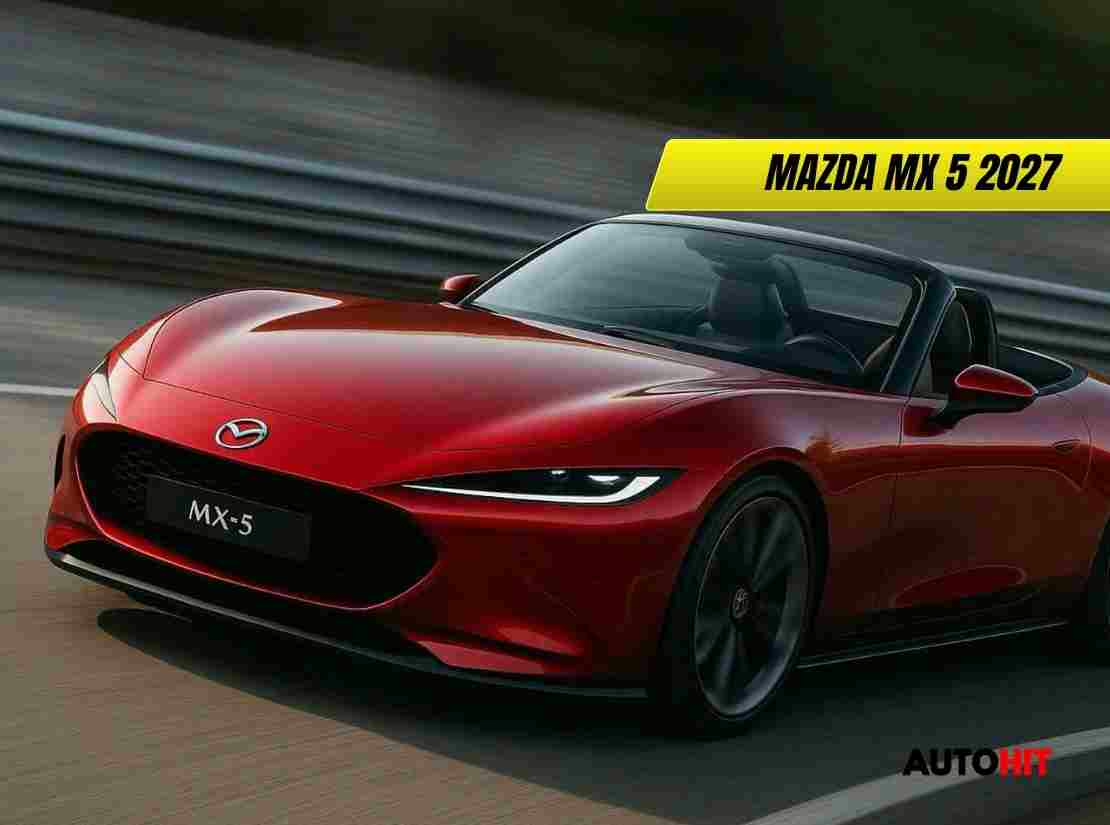
Mazda MX-5 2027 promises naturally aspirated 2.5L Skyactiv-Z engine, manual gearbox, and even lighter weight. The anti-SUV sports car that keeps petrol alive.
In an automotive landscape increasingly dominated by electric crossovers and digital dashboards, Mazda is preparing to deliver something refreshingly analog. The fifth-generation MX-5, expected to arrive in 2027, represents a bold statement against modern trends – and according to our analysis at AutoHit, it could be the most important sports car launch of the decade.
While manufacturers rush toward electrification and autonomous driving, Mazda has confirmed that the next MX-5 will stick to the fundamentals that made it legendary: naturally aspirated engines, manual transmissions, and lightweight construction. In fact, the new car aims to be even lighter than the current model, targeting sub-1,000kg weight while delivering more power through an all-new 2.5-litre Skyactiv-Z engine.
This isn’t just stubborn traditionalism – it’s a calculated bet that driving enthusiasts still crave mechanical connection over digital convenience. With sports cars under £30,000 becoming increasingly rare, the MX-5’s commitment to accessible performance feels more important than ever.
Key Highlights: What Makes the 2027 MX-5 Special
• Revolutionary Skyactiv-Z Engine: All-new 2.5-litre naturally aspirated four-cylinder with Lambda 1 combustion technology • Weight Reduction: Target weight below 1,000kg (2,205 lbs) – lighter than the current generation • Manual Transmission Guaranteed: Six-speed manual remains standard, with automatic as an option • No Turbocharging: Mazda rejects forced induction in favour of linear throttle response • Potential Mild Hybrid: 48V system may assist efficiency without compromising character • UK Market Certainty: Right-hand drive production confirmed, with competitive pricing expected around £32,000-£38,000
Design Philosophy: Bigger Engine, Smaller Car
The next MX-5 faces a fascinating engineering challenge: how do you fit a larger 2.5-litre engine into an even smaller, lighter package? According to Mazda’s executives, this contradiction lies at the heart of their development philosophy.
Exterior Evolution
Early teasers suggest the fifth-generation MX-5 will retain the current car’s essential proportions while refining aerodynamics and reducing weight. The signature long bonnet and short overhangs remain, but expect subtly more muscular rear haunches to accommodate the larger engine.
Mazda’s design team has hinted at elements inspired by their Vision Study concept, including a more pronounced axle-to-dash ratio and possibly updated lighting signatures. However, the fundamentals won’t change – this remains a classic front-engine, rear-drive roadster with impeccable weight distribution.
Interior Minimalism
We’ve tested enough modern sports cars to know that interior complexity often detracts from driving focus. The 2027 MX-5 will likely continue the current car’s philosophy of purposeful simplicity, though expect an updated infotainment system and improved materials quality.
The driver-focused cockpit will retain physical controls for essential functions, resisting the industry trend toward touch-screen everything. For UK buyers accustomed to premium German interiors, this might initially feel sparse, but it’s entirely intentional – every gram saved contributes to the car’s dynamic superiority.
Revolutionary Skyactiv-Z Powertrain
The headline news for the 2027 MX-5 is its all-new Skyactiv-Z 2.5-litre engine, representing Mazda’s most significant powertrain development since the original Skyactiv technology launched in 2011.
Lambda 1 Combustion Technology
The Skyactiv-Z employs what Mazda calls “Lambda 1” combustion – essentially the theoretically perfect air-fuel ratio across the entire rev range. This allows for super-lean burn combustion from idle to redline, dramatically improving both efficiency and emissions without sacrificing performance.
Chief Technical Officer Ryuichi Umeshita describes it as the “ideal internal combustion engine,” claiming it will deliver noticeably improved fuel efficiency while maintaining the naturally aspirated character that makes the MX-5 special. The engine meets Euro 7 regulations and US LEV4/Tier 4 standards – no small achievement for a performance-focused naturally aspirated unit.
Power and Performance
While Mazda hasn’t released official power figures, expect around 210-220bhp from the 2.5-litre unit – a significant increase over the current car’s 184bhp. More importantly, torque should improve substantially, addressing one of the current MX-5’s few dynamic weaknesses.
The larger displacement means Mazda can maintain power output while employing the lean-burn combustion strategy. As Umeshita explains, keeping the current 2.0-litre capacity while switching to Lambda 1 would have resulted in lower output – unacceptable for a car that prioritises driving pleasure.
Manual Transmission Commitment
In an era where even Ferrari offers paddle-shift-only supercars, Mazda’s commitment to manual transmission feels almost radical. The 2027 MX-5 will retain its six-speed manual as standard equipment, with the same short-throw, precise action that current owners cherish.
An automatic option will remain available, likely the six-speed torque converter from current models rather than a CVT or dual-clutch setup. For UK buyers, this represents genuine choice rather than the compromise automatics often forced upon sports car enthusiasts.
Weight Reduction: The Holy Grail
Perhaps the most ambitious aspect of the 2027 MX-5 development is Mazda’s weight target. Despite the larger engine and modern safety requirements, they’re aiming for a kerb weight below 1,000kg.
Engineering Challenges
Current MX-5s weigh around 1,050kg for the manual 1.5-litre version, rising to 1,100kg for the 2.0-litre RF. Removing 50-100kg while adding engine capacity and maintaining crash safety represents a significant engineering challenge.
Expect extensive use of aluminium body panels, possibly carbon fibre for certain components, and continued refinement of the car’s structure. The weight distribution should remain close to the current car’s excellent 50:50 split, with the slightly heavier engine potentially offset by weight savings elsewhere.
Real-World Benefits
For UK driving conditions – from narrow country lanes to congested city centres – the combination of increased power and reduced weight should deliver transformative performance. We’re talking about power-to-weight ratios approaching 220bhp per tonne, putting the MX-5 in genuine sports car territory while maintaining its everyday usability.
Electrification Strategy: Mild Hybrid Reality
While Mazda executives emphasise that the 2027 MX-5 won’t use full hybridisation, a 48V mild hybrid system remains possible for efficiency compliance.
48V Integration
A 48V system could assist with engine start-stop functionality, provide subtle torque fill during gear changes, and power ancillary systems without adding significant weight. Crucially, it wouldn’t alter the fundamental driving experience – the internal combustion engine remains the primary power source.
This approach reflects Mazda’s broader electrification strategy, which prioritises efficient combustion over pure electric power. As we’ve seen with other manufacturers’ mild hybrid systems, the technology can enhance rather than dilute the driving experience when properly implemented.
UK Regulatory Compliance
For UK buyers, mild hybrid technology could prove crucial for future regulatory compliance. With ULEZ expansion and potential urban combustion engine restrictions, the 48V system might provide the environmental credentials needed to maintain access to city centres.
UK Market Analysis: Pricing and Positioning
Expected Pricing Structure
Based on current MX-5 pricing and the additional technology, expect the 2027 model to start around £32,000 for the base manual version, rising to £38,000 for top-specification RF models. This positions it competitively against premium hot hatches while offering unique roadster appeal.
Compared to current pricing – the 2024 MX-5 starts at £28,000 – this represents reasonable inflation given the significant powertrain improvements and enhanced technology.
Competitive Landscape
The MX-5’s unique position as an affordable, lightweight roadster means it faces no direct competition in the UK market. The closest rivals are the Toyota GR86 and Subaru BRZ, but these are fixed-roof coupés with different appeal.
Detailed Specification Comparison
| Specification | 2027 MX-5 (Est.) | 2024 MX-5 2.0 | Toyota GR86 | BMW Z4 20i |
|---|---|---|---|---|
| Engine | 2.5L NA Skyactiv-Z | 2.0L NA Skyactiv-G | 2.4L NA Boxer | 2.0L Turbo |
| Power Output | ~215bhp | 184bhp | 234bhp | 197bhp |
| Weight | <1,000kg | 1,050kg | 1,270kg | 1,540kg |
| Power-to-Weight | >215bhp/tonne | 175bhp/tonne | 184bhp/tonne | 128bhp/tonne |
| Price (Est.) | £32-38k | £28-37k | £32k | £43k |
| Transmission | 6MT/6AT | 6MT/6AT | 6MT/AT | 8AT only |
| Convertible | Yes | Yes | No | Yes |
| Our Rating | TBC | ★★★★★ | ★★★★☆ | ★★★☆☆ |
Our Take: The 2027 MX-5’s combination of increased power, reduced weight, and manual availability should establish it as the definitive affordable sports car. Its unique roadster configuration and lightweight philosophy offer something no competitor can match.
Timeline and Development Progress
Launch Schedule
Development is reportedly well advanced, with production expected to begin in late 2026 for a 2027 model year launch. UK deliveries would likely commence in spring 2027, giving Mazda time to establish right-hand-drive production at their Hiroshima facility.
Expected Development Timeline
| Phase | Timeline | Key Milestones |
|---|---|---|
| Concept Reveal | Q2 2025 | Design direction and powertrain confirmation |
| Production Preview | Q4 2025 | Near-final specification and pricing |
| Global Launch | Q1 2027 | Production begins in Japan |
| UK Deliveries | Q2 2027 | Right-hand-drive models arrive |
| Performance Variants | 2028+ | Potential Type-R or special editions |
UK Market Preparation
Mazda UK has already begun preparing dealers for the new model, with emphasis on maintaining the MX-5’s position as an accessible sports car rather than a premium niche product. The brand’s commitment to right-hand-drive production ensures UK customers won’t face the compromises that affected some previous-generation imports.
Real-World Considerations for UK Buyers
Running Costs and Practicality
The 2027 MX-5 should deliver impressive fuel economy despite its increased performance. Mazda’s efficiency improvements suggest real-world figures around 40-45mpg for mixed driving – remarkable for a 200+bhp sports car.
Company car drivers will benefit from relatively low BiK rates thanks to efficient combustion technology, while private buyers face reasonable VED charges and insurance costs that reflect the car’s excellent safety record.
Service and Maintenance
One advantage of Mazda’s naturally aspirated approach is reduced complexity compared to turbocharged rivals. Expect service intervals around 12,000 miles with relatively affordable maintenance costs – crucial for younger enthusiasts who represent the MX-5’s core market.
The lack of hybrid complexity (beyond potential 48V systems) should keep long-term reliability high and repair costs manageable. This contrasts sharply with some premium electric alternatives that face uncertain residual values and expensive battery replacements.
Weather and Seasonal Usability
UK buyers often question roadster practicality, but modern MX-5s prove surprisingly usable year-round. The 2027 model should continue this tradition with improved soft-top sealing, better heating systems, and enhanced refinement for motorway cruising.
The lightweight construction that benefits handling also aids traction in slippery conditions, while the balanced chassis provides confidence-inspiring behaviour when grip levels drop.
Frequently Asked Questions
Q: Will the 2027 MX-5 really be lighter than the current car despite the larger engine?
A: Mazda is targeting sub-1,000kg weight, which would represent a 50-100kg reduction despite the larger 2.5-litre engine. This will require extensive use of lightweight materials and structural optimisation, but Mazda’s engineers have confirmed this is a primary development goal. The current ND generation proved that weight reduction is possible even with modern safety standards, so we’re cautiously optimistic about achieving this target.
Q: How much will the new Skyactiv-Z engine cost compared to current MX-5 pricing?
A: Based on the technology involved and current market positioning, expect starting prices around £32,000 for the entry-level manual model – approximately £4,000 more than today’s base 1.5-litre car. However, you’re getting significantly more power (215bhp vs 131bhp) and advanced combustion technology that should improve efficiency and longevity. This pricing keeps the MX-5 competitive with premium hot hatches while offering unique roadster appeal.
Q: Will manual transmission really be available across the range, or just base models?
A: Mazda has confirmed that manual transmission will remain standard equipment throughout the MX-5 range, including top-specification models. This isn’t just a cost-cutting measure for entry-level cars – it’s a fundamental part of the MX-5’s character. The six-speed manual will continue to offer the precise, short-throw action that current owners appreciate. An automatic option will remain available for those who prefer it, but the manual remains the default choice.
Q: How will the larger engine affect insurance costs for younger drivers?
A: While the 2.5-litre capacity might initially concern insurers, the MX-5’s excellent safety record and relatively modest power output should keep premiums reasonable. The naturally aspirated engine and manual transmission actually appeal to insurers compared to turbocharged alternatives that younger drivers might modify. We’d expect insurance groups similar to current 2.0-litre models – typically group 20-25 depending on specification.
Q: Is there any chance of an electric MX-5 in the future?
A: Mazda has been clear that electrification adds weight, which contradicts the MX-5’s fundamental philosophy. While a fully electric version might eventually appear to meet regulatory requirements, it won’t happen until battery technology becomes significantly lighter and more efficient. CEO statements suggest the company will resist electrification as long as possible, potentially making the MX-5 one of the last pure petrol sports cars. Any future EV version would likely be a separate model rather than replacing the conventional car.
Q: How does the new MX-5 compare to premium alternatives like the BMW Z4 or Porsche Boxster?
A: The MX-5’s appeal has always been about accessible performance rather than premium luxury. While cars like the Z4 (from £43,000) offer more power and equipment, they’re also much heavier and less engaging at legal speeds. The MX-5’s lightweight philosophy means it delivers sports car thrills in everyday driving that heavier, more powerful cars simply can’t match. For UK roads – narrow, twisty, and often congested – the MX-5’s agility trumps raw power every time.
Q: Will the 2027 model be available in both soft-top and RF (hard-top) versions from launch?
A: Based on current production patterns, expect both soft-top and RF variants to be available from launch. The RF’s power-folding hard top has proven popular in the UK market, offering enhanced security and refinement while maintaining most of the convertible experience. The weight penalty should be minimal with the new lightweight construction, though we’d still recommend the soft-top for ultimate driving purity.
Final Verdict: The Last of the Analog Heroes
After examining all available information about the 2027 Mazda MX-5, we believe this could be the most significant sports car launch in a generation. Not because it breaks new technological ground, but because it deliberately doesn’t.
In an automotive landscape rushing toward electrification, autonomous driving, and digital interfaces, the MX-5’s commitment to mechanical purity feels genuinely radical. The combination of a larger naturally aspirated engine, reduced weight, and guaranteed manual transmission creates a proposition that simply doesn’t exist elsewhere in the market.
What Excites Us:
- Revolutionary Skyactiv-Z engine offering more power with better efficiency
- Sub-1,000kg weight target maintaining the MX-5’s dynamic superiority
- Manual transmission as standard across the range
- Naturally aspirated character in an increasingly turbocharged world
- Competitive pricing keeping sports car ownership accessible
What Concerns Us:
- Ambitious weight targets may prove difficult to achieve profitably
- Regulatory pressure could force unwanted electrification
- Limited interior space remains unchanged
- Increasing competition from hot hatches offering more practicality
The Reality: The 2027 MX-5 represents Mazda’s most compelling argument for the continued relevance of traditional sports cars. If they achieve their engineering targets, this could be the definitive lightweight roadster – a car that proves electrical assistance isn’t always the answer to automotive challenges.
For UK enthusiasts who remember when sports cars prioritised feel over figures, the 2027 MX-5 offers hope that driving pleasure hasn’t been completely digitised. Whether it can maintain this philosophy against tightening regulations remains to be seen, but early signs suggest Mazda has found a way to evolve without compromising their core values.
In a world of increasingly homogeneous electric crossovers, the 2027 MX-5 promises to be beautifully, stubbornly different. And that might just make it the most important car of the decade.





