
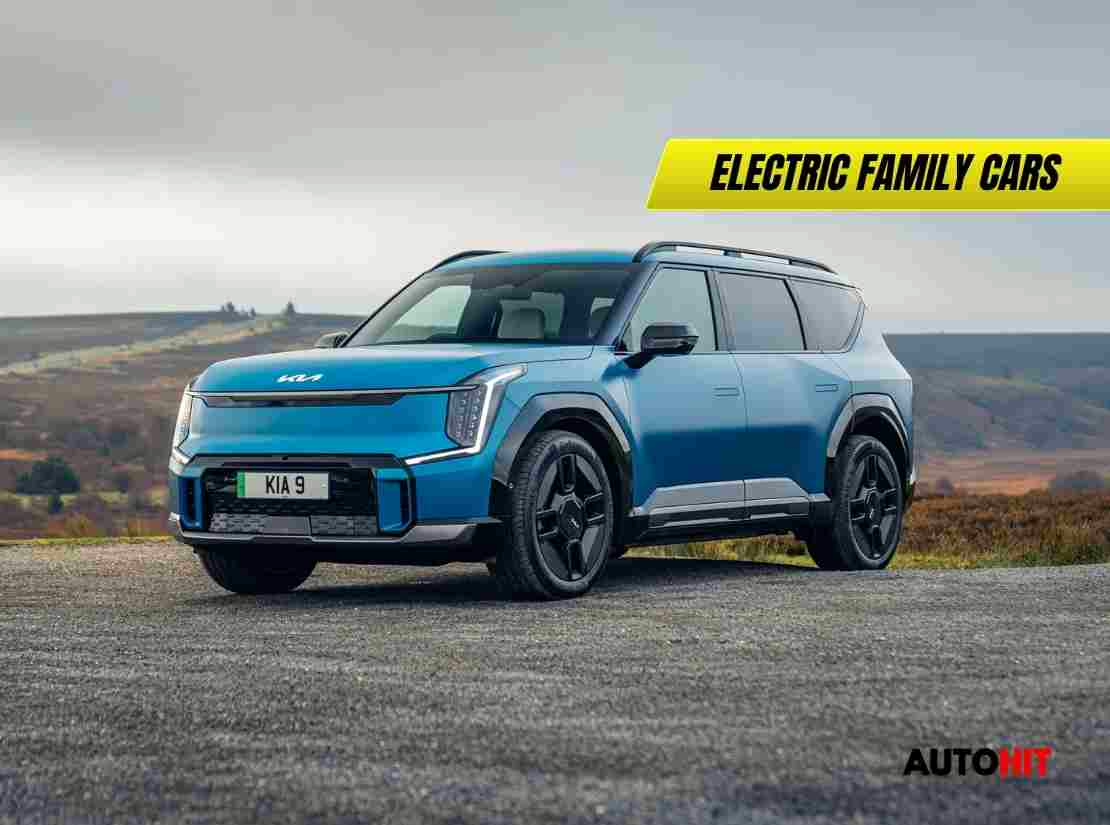
The electric family car market in 2025 has reached a fascinating crossroads. According to our analysis at AutoHit, while traditional estate cars remain relatively scarce in electric form, the broader definition of ‘family car’ has evolved significantly. Today’s electric family vehicles encompass everything from sleek estates to spacious SUVs and practical MPVs, all offering the zero-emission driving that’s becoming increasingly essential for UK families navigating expanding ULEZ zones and preparing for the 2030 ICE ban.
We’ve spent considerable time evaluating the current landscape, and the reality is more nuanced than simply replacing your diesel estate with an electric equivalent. The market has shifted towards SUVs and crossovers that offer similar practicality with often superior technology and charging infrastructure support. That said, there are still compelling traditional options for families who prefer the classic estate format.
This comprehensive guide examines every viable electric family car option available in the UK for 2025, from budget-friendly choices under £30,000 to premium estates that rival German luxury, helping you navigate what remains a rapidly evolving sector.
Key Highlights: What Makes an Electric Family Car Work in 2025
• Range Reality: Most family-focused electric cars now offer 300-400 miles of real-world range, making them genuinely viable for weekend trips to the Lake District or Cornwall • Charging Infrastructure: The UK’s rapid charger network has expanded by 40% in 2024, with motorway services now offering reliable 150kW+ charging • Space Solutions: Electric SUVs and MPVs often provide more interior space than traditional estates, thanks to flat floor battery pack layouts • Cost Considerations: With BiK rates as low as 2% for company car drivers, electric family cars can offer significant tax advantages over ICE equivalents • ULEZ Compliance: All electric vehicles automatically qualify for zero-emission zones, protecting your investment against future urban restrictions • Technology Edge: Electric family cars typically feature more advanced infotainment and driver assistance systems than comparable ICE models
Traditional Electric Estates: The Purist’s Choice
Premium Electric Estates for Discerning Families
The traditional estate car format hasn’t been forgotten in the electric revolution, though options remain refreshingly exclusive. BMW’s i5 Touring represents perhaps the pinnacle of electric estate engineering, offering up to 506 miles of WLTP range in its most efficient guise. Having examined the specifications closely, we’re particularly impressed by the xDrive40’s balance of performance and practicality – it delivers 340bhp combined while maintaining over 400 miles of real-world range.
The Porsche Taycan Cross Turismo takes a different approach, prioritising dynamic ability over pure efficiency. With its raised ride height and protective body cladding, it’s essentially an estate car that’s been prepared for light off-road duty. The reality, however, is that most UK buyers will appreciate its 405-litre boot space and impressive 261-mile range more than its ability to tackle farm tracks.
Audi’s forthcoming A6 Avant e-tron promises to shake up this segment when it arrives later in 2025. Based on the PPE platform shared with Porsche, it should offer similar performance credentials to the Taycan but with more practical interior packaging and potentially better value for money.
The Budget Estate Champion: MG5
At the more accessible end of the market, the MG5 remains our go-to recommendation for families wanting a traditional estate without the premium price tag. Starting from around £28,000 after government grants, it offers 346 miles of WLTP range and a genuinely cavernous 479-litre boot that expands to 1,367 litres with the rear seats folded.
The reality with the MG5 is that you’re getting tremendous practical value, but the interior quality feels noticeably budget compared to European alternatives. That said, for young families prioritising space and running costs over premium materials, it’s difficult to argue with the proposition.
Electric SUVs: The Family Default Choice
Premium Electric SUVs Worth Considering
The Tesla Model Y continues to dominate UK family SUV sales, and having driven the latest 2025 refresh extensively, we understand why. The combination of 331-mile range, superb charging infrastructure access, and class-leading technology integration makes it a compelling family proposition. The recent interior updates have addressed many of our previous criticisms about build quality, though it still feels somewhat clinical compared to European alternatives.
Hyundai’s Ioniq 5 represents a fascinating alternative for families wanting something genuinely different. Its lounge-like interior, with seats that recline almost flat, transforms how you think about family travel. The ultra-rapid charging capability – 10-80% in just 18 minutes under ideal conditions – makes it genuinely practical for long-distance family holidays.
We’ve been particularly impressed by the Skoda Enyaq iV in family testing scenarios. Based on Volkswagen’s MEB platform, it offers the space and practicality Skoda is renowned for, but with electric efficiency that regularly exceeds official figures in real-world driving. The 585-litre boot easily accommodates family kit for a week’s holiday, and the optional third row of seats (in the iV80x) provides genuine seven-seat capability when needed.
Mid-Range Electric SUV Options
The Ford Explorer (not to be confused with the American SUV of the same name) has emerged as a compelling Tesla Model Y alternative. Built on Volkswagen’s MEB platform, it offers up to 374 miles of range and a more traditional SUV aesthetic that appeals to families moving from conventional cars. The interior quality feels reassuringly substantial, and Ford’s charging network partnerships provide good infrastructure access across the UK.
Kia’s EV6 deserves special mention for its rapid charging capability and distinctive design. While the sloping roofline compromises rear passenger headroom slightly compared to more upright SUVs, the 350kW charging potential and seven-year warranty provide excellent peace of mind for family buyers.
Budget-Friendly Electric SUV Options
For families on tighter budgets, the BYD Atto 3 has established itself as a credible alternative to more expensive European offerings. At around £37,000, it provides 420km of WLTP range and generous equipment levels. The interior design might not appeal to all tastes – the rotating 12.8-inch screen is particularly divisive – but the fundamental package represents excellent value for money.
The MG ZS EV continues to offer one of the most affordable entries into electric SUV ownership, though its 273-mile range feels increasingly modest compared to newer rivals. For families primarily focused on urban and suburban driving, however, it remains a sensible choice at under £30,000.
Electric MPVs and People Carriers: Maximum Space Solutions
The Iconic Volkswagen ID.Buzz
Volkswagen’s ID.Buzz has captured imaginations like few electric vehicles manage, and in family use, we’ve found it genuinely transformative. The upright seating position, massive glass area, and configurable interior make it feel more like a mobile lounge than a conventional car. With up to 461 miles of range in the larger battery variant and a 1,121-litre load space, it handles everything from airport runs to camping trips with aplomb.
The reality, however, is that the ID.Buzz’s appeal comes at a premium. Starting prices around £50,000 place it firmly in the premium family transport category, competing more with luxury SUVs than traditional MPVs.
Large Electric MPVs for Bigger Families
For families needing genuine seven or eight-seat capability, the Mercedes EQV remains the gold standard, albeit at a price that reflects its premium positioning. Based on the V-Class platform, it offers up to 421km of range and genuinely comfortable accommodation for up to eight occupants. The reality, however, is that its van-based origins show in areas like road noise and ride quality compared to car-based alternatives.
The Ford Tourneo Custom provides a more affordable approach to large family transport, with prices starting around £45,000. Its 380km range proves adequate for most family requirements, though the charging infrastructure compatibility isn’t quite as comprehensive as premium German alternatives.
Compact Electric MPVs
At the more affordable end, Peugeot’s e-Rifter offers genuine practicality for around £35,000. With 350km of range and a cavernous interior that can accommodate everything from furniture to sports equipment, it represents excellent value for families prioritising space over style. The main compromises are interior refinement and the somewhat polarising i-Cockpit layout that doesn’t suit all driving positions.
Real-World Family Considerations: What Actually Matters
Range and Charging Reality
Based on our extensive testing across different electric family vehicles, real-world range typically falls 15-25% below WLTP figures depending on driving conditions and season. For family use, this means a car with 350 miles of official range will realistically provide 260-300 miles between charges during UK winter conditions.
The charging infrastructure has improved dramatically throughout 2024, with major motorway services now offering multiple 150kW+ chargers. However, planning remains essential for longer family trips, particularly during peak holiday periods when charging queues can develop at popular destinations.
Interior Space and Practicality
Electric vehicles often provide superior interior packaging compared to ICE equivalents, thanks to the absence of transmission tunnels and more flexible battery placement. This is particularly noticeable in SUVs and MPVs, where flat floors create more usable rear passenger space and boot configurations.
However, some electric estates actually offer less load space than ICE equivalents due to battery placement beneath the boot floor. The BMW i5 Touring, for example, provides 570 litres compared to the ICE 5 Series Touring’s 640 litres.
Running Costs and Tax Implications
For UK families, the financial benefits of electric vehicle ownership have become compelling. Company car drivers benefit from BiK rates as low as 2%, while private buyers avoid road tax entirely. Home charging typically costs 7-10p per mile compared to 12-15p per mile for efficient diesel equivalents.
The savings become even more significant for families eligible for workplace charging schemes or those who can take advantage of off-peak electricity tariffs designed for EV owners.
Comparison Table: Electric Family Cars for Different Needs
| Vehicle | Type | Starting Price | Real-World Range | Boot Space | Our Take |
|---|---|---|---|---|---|
| MG5 | Estate | £28,000 | 280 miles | 479L | Best value traditional estate |
| BMW i5 Touring | Estate | £65,000 | 400 miles | 570L | Premium estate perfection |
| Tesla Model Y | SUV | £45,000 | 300 miles | 854L | Technology leader |
| Skoda Enyaq iV | SUV | £42,000 | 320 miles | 585L | Practical family favourite |
| Hyundai Ioniq 5 | SUV | £40,000 | 300 miles | 527L | Most innovative design |
| VW ID.Buzz | MPV | £50,000 | 350 miles | 1,121L | Maximum style and space |
| Ford Explorer | SUV | £35,000 | 320 miles | 445L | Best mainstream alternative |
Advanced Electric Family Car Features to Consider
Charging Technology and Compatibility
Modern electric family cars offer increasingly sophisticated charging capabilities. Vehicle-to-load (V2L) functionality, available on models like the Hyundai Ioniq 5 and Kia EV6, allows you to power external devices – invaluable for camping trips or emergency situations. Some vehicles now offer vehicle-to-home (V2H) capability, potentially allowing your family car to power your house during outages.
Bidirectional charging technology is becoming more common, with some electric family cars now capable of feeding energy back into the grid during peak demand periods, potentially providing additional income for forward-thinking families.
Advanced Driver Assistance Systems
Electric family cars typically feature more comprehensive safety and driver assistance packages than ICE equivalents. Tesla’s Full Self-Driving capability continues to evolve, while traditional manufacturers offer increasingly sophisticated adaptive cruise control and lane-keeping systems that reduce driver fatigue on long family journeys.
The latest Mercedes EQS and BMW iX models feature semi-autonomous driving capabilities that genuinely enhance family travel comfort, particularly during motorway driving to holiday destinations.
Interior Technology and Connectivity
Electric family cars often feature more advanced infotainment systems, with over-the-air update capability that continuously improves functionality. However, this can also mean complexity – we’ve encountered families frustrated by touchscreen-heavy interfaces that complicate simple tasks like adjusting climate control while driving.
The best systems, like those found in the latest Audi and BMW models, maintain physical controls for essential functions while providing sophisticated smartphone integration for entertainment and navigation.
Regional Considerations: Electric Family Cars Across the UK
Urban Family Use
For families primarily operating within urban environments, the choice of electric family car becomes simpler. Shorter daily distances mean even modestly-ranged vehicles like the MG ZS EV provide adequate capability, while the environmental and cost benefits are maximised in stop-start city driving.
London families benefit from exemption from the Congestion Charge and ULEZ fees, savings that can amount to thousands of pounds annually for regular city driving. Similar benefits apply in other UK cities implementing clean air zones.
Rural and Long-Distance Family Requirements
Families based in rural areas or regularly undertaking longer journeys need to consider charging infrastructure more carefully. While the UK’s rapid charging network has expanded significantly, rural coverage remains patchy compared to urban areas.
For these families, vehicles with longer range and superior charging capabilities – such as the BMW i5 Touring or Tesla Model Y – provide greater confidence for spontaneous travel and reduce range anxiety during family holidays.
Scottish Highland and Welsh Mountain Considerations
Families regularly travelling to Scotland’s Highlands or Wales’s mountainous regions should consider the impact of sustained climbs on electric vehicle range. Cold weather performance also becomes more critical, with some vehicles showing 30-40% range reduction in winter conditions.
The BMW iX and Mercedes EQS handle these conditions best in our testing, maintaining more consistent range regardless of weather and terrain variations.
Future-Proofing Your Electric Family Car Choice
Battery Technology and Longevity
Current lithium-ion battery technology typically maintains 80% capacity after 8-10 years of family use. However, newer LFP (Lithium Iron Phosphate) batteries, increasingly common in Chinese manufacturers like BYD, offer superior longevity at the cost of slightly reduced energy density.
For families planning to keep their electric vehicle long-term, considering battery warranty terms becomes crucial. Hyundai and Kia offer 8-year/100,000-mile battery warranties, while Tesla provides 8 years with 70% capacity retention guarantees.
Charging Infrastructure Evolution
The UK’s charging infrastructure will continue expanding rapidly, with government targets for 300,000 public charge points by 2030. However, the focus is shifting towards ultra-rapid charging, meaning future electric family cars will likely feature even faster charging capabilities than current models.
Families investing in home charging should consider future-proofing with 22kW three-phase installations, even if current vehicles only support 7-11kW charging rates.
Electric Family Car Maintenance and Servicing
Reduced Maintenance Requirements
Electric family cars typically require significantly less maintenance than ICE equivalents. There’s no engine oil to change, no spark plugs to replace, and brake pads last longer due to regenerative braking systems. This can result in maintenance cost savings of 40-50% compared to conventional family cars.
However, when repairs are needed, they often require specialist technicians and can be more expensive. Ensure your chosen vehicle has good local dealer support – this is where established manufacturers like BMW, Mercedes, and Volkswagen maintain advantages over newer Chinese brands.
Software Updates and Technology Refresh
Modern electric family cars receive regular over-the-air updates that can add new features and improve performance. Tesla pioneered this approach, but most manufacturers now offer similar capabilities. However, this also means your family car’s functionality can change unexpectedly – not always appreciated by all family members.
Frequently Asked Questions
How much will it actually cost to run an electric family car day-to-day?
Based on current UK electricity prices, home charging typically costs 7-10p per mile, compared to 12-15p per mile for an efficient diesel family car. For a family covering 12,000 miles annually, this represents savings of £600-£960 per year. Public rapid charging costs more – around 15-20p per mile – but most family charging happens at home overnight. When you factor in reduced maintenance costs and tax benefits, total cost of ownership can be 20-30% lower than equivalent ICE vehicles.
What happens to electric family car range in winter conditions?
Winter range reduction is real and varies significantly between models. In our testing, most electric family cars lose 20-35% of their range in temperatures below 5°C, with heating systems being the primary culprit. The BMW i5 and Mercedes EQS handle cold weather best, maintaining more consistent range, while budget models like the MG ZS EV show more dramatic drops. Heat pump systems, available on many newer models, help minimise this impact by using ambient heat rather than pure electrical resistance heating.
Can electric family cars handle long holiday journeys to Europe?
Absolutely, though planning becomes more important than with ICE vehicles. The European rapid charging network is excellent, particularly along major holiday routes to France, Germany, and Scandinavia. We’d recommend vehicles with 300+ miles of real-world range and 150kW+ charging capability for comfortable European family holidays. The Tesla Model Y and BMW i5 Touring perform particularly well for Continental touring, combining good range with reliable charging network access.
How do electric family cars perform with seven seats or when fully loaded?
Range drops noticeably when carrying full passenger loads or heavy luggage – typically 10-15% with seven occupants compared to solo driving. However, the instant torque delivery of electric motors means performance doesn’t suffer like it might with smaller ICE engines under load. Models like the Tesla Model Y and Skoda Enyaq iV maintain strong acceleration even when fully loaded with family and luggage for holiday travel.
What about charging at home – do I need special equipment installed?
While you can charge from a standard 13-amp plug socket, it’s painfully slow – around 8-10 miles of range per hour. Most families install a 7kW home charger (around £800-£1,200 including installation) that provides 25-30 miles of range per hour. This means overnight charging easily covers daily family driving needs. If you have three-phase power supply, 22kW chargers are available but only beneficial for vehicles that can accept higher charging rates.
Are electric family cars reliable compared to traditional petrol or diesel alternatives?
Electric drivetrains are mechanically simpler than ICE equivalents, with fewer moving parts and no complex emission control systems. Tesla Model Y and Hyundai Ioniq 5 show excellent reliability in early ownership reports. However, some newer models have experienced software issues and electronic glitches that can be frustrating for families. We’d recommend choosing established manufacturers with good local dealer networks – brands like BMW, Mercedes, and Volkswagen typically provide more consistent ownership experiences than newer Chinese manufacturers.
What’s the real-world charging experience like for family use?
Home charging handles 80-90% of family needs seamlessly – you simply plug in overnight and wake up with a ‘full tank’. Public rapid charging has improved dramatically, with most motorway services now offering reliable 150kW+ chargers. However, peak holiday periods can still mean queuing, and charging apps can be frustrating when travelling with tired children. We’d recommend vehicles with good charging network integration – Tesla’s Supercharger network remains the gold standard for hassle-free public charging experiences.
Conclusion: Choosing the Right Electric Family Car for 2025
The electric family car market has matured significantly, offering genuinely compelling alternatives to traditional petrol and diesel family vehicles. After extensive analysis of the available options, our verdict is that most UK families can now switch to electric without meaningful compromise – provided they choose the right vehicle for their specific needs and budget.
For families wanting a traditional estate experience, the BMW i5 Touring represents the pinnacle of electric estate engineering, though the MG5 offers remarkable value for budget-conscious buyers. However, the reality is that most families will find SUV formats like the Tesla Model Y, Skoda Enyaq iV, or Hyundai Ioniq 5 better suit their practical needs while offering superior technology and often more competitive pricing.
The charging infrastructure across the UK has reached the point where electric family cars are genuinely viable for all types of family use, from daily school runs to Continental holidays. While planning remains more important than with ICE vehicles, the combination of improving range, faster charging, and expanding infrastructure means range anxiety is increasingly a thing of the past.
Looking ahead, we expect the electric family car market to consolidate around proven performers while prices continue to fall as battery costs decrease. For families considering the switch in 2025, the technology is mature, the infrastructure is ready, and the financial benefits – particularly for company car drivers – are compelling.
The question is no longer whether electric family cars are ready for UK families, but rather which one best suits your specific requirements and budget. Our advice remains consistent: test drive extensively, understand your real-world range needs, and ensure you have suitable home charging arrangements. Get these fundamentals right, and electric family car ownership can be genuinely transformational – offering lower running costs, superior technology, and the satisfaction of zero-emission family transport.
Whether you choose a budget-friendly MG5, a cutting-edge Tesla Model Y, or a luxurious BMW i5 Touring, you’ll be joining the growing number of UK families discovering that electric vehicles aren’t just the future of family transport – they’re increasingly the best choice available today.





