
Our comprehensive Smart #5 review covers this new electric family SUV’s performance, technology, and value. Discover if this Mercedes-designed, Geely-built rival can beat the Tesla Model Y and Skoda Enyaq in the UK market.
The Smart #5 represents perhaps the most ambitious transformation in automotive history. According to our analysis at AutoHit, Smart’s evolution from the maker of tiny ForTwo city cars to producer of large premium electric SUVs demonstrates the radical changes reshaping the automotive landscape. Expected to arrive in UK showrooms in Q4 2025 with pricing starting around £35,000-£40,000, the #5 faces the enormous challenge of convincing buyers that Smart can credibly compete against established players like the Tesla Model Y, Skoda Enyaq, and Audi Q4 e-tron in the competitive family electric SUV sector.
We’ve had the opportunity to experience early examples of the Smart #5 in international testing, and the reality is that this represents a fundamental reimagining of what Smart can be. This isn’t simply a conventional electric SUV with Smart badges – it’s a genuinely sophisticated family vehicle that combines Mercedes design expertise, Geely engineering resources, and cutting-edge electric technology to create something that feels entirely new in the marketplace.
The fundamental question facing UK families is whether the Smart #5 offers sufficient capability, technology, and value to justify choosing it over established alternatives, particularly given Smart’s limited heritage in the family car segment and the intense competition in the electric SUV market.
Key Highlights: What Makes the Smart #5 Distinctive in 2025
• Exceptional Interior Space: 4.7-metre length with 2.9-metre wheelbase delivers best-in-class rear passenger room and 630-litre boot capacity that exceeds the Skoda Enyaq • Ultra-Fast Charging Technology: 800V architecture enables up to 400kW DC charging, achieving 10-80% in just 15-18 minutes – faster than Tesla Model Y and most competitors • Advanced Technology Integration: Twin 13-inch OLED displays, 25.6-inch AR head-up display, and AMD-powered infotainment create genuinely premium cabin experience • Multiple Battery Options: 76kWh and 100kWh battery variants provide flexibility, with the larger pack delivering 369-mile WLTP range competitive with premium alternatives • Mercedes Design DNA: Authentic premium styling and build quality that leverages Mercedes-Benz design expertise while maintaining distinctive Smart character • Comprehensive Equipment: Standard features include adaptive suspension, 360-degree cameras, and premium Sennheiser audio across most trim levels
Design and Exterior: Premium SUV Aesthetics with Smart Character
Bold New Design Direction
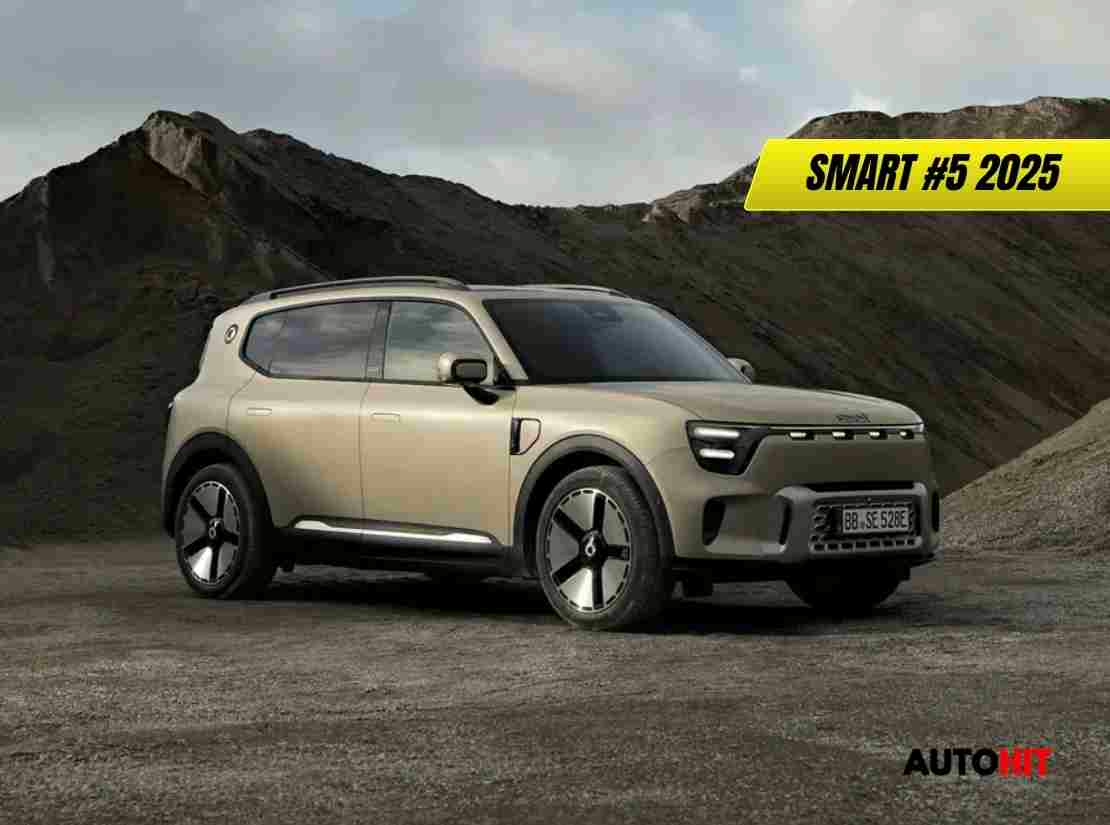
The Smart #5 represents a complete departure from the brand’s traditionally curvaceous styling, adopting a more angular, muscular aesthetic that immediately conveys serious SUV capability. The #5 represents a new design direction for the brand, separating itself from the curvaceous Smart #1 and #3 with a boxy design that has a touch of the Land Rover Defender and Mercedes G-Class about it.
Having examined the styling closely, the design successfully balances Smart’s distinctive character with the gravitas expected from a premium family SUV. The smooth surfacing maintains Smart’s clean aesthetic philosophy while the more upright proportions create appropriate road presence for the family SUV segment.
Distinctive Lighting and Visual Elements
The signature design element centres on the segmented light bars at front and rear, with large oblong headlight units that create immediate brand recognition. The pronounced rear wheelarches give the #5 a planted and rather muscular stance for an SUV, while maintaining the refined surfacing that characterises modern premium vehicles.
The floating wheel cap logos remain upright when the wheels spin – a Rolls-Royce-like touch that demonstrates attention to premium details. The huge Smart logo on the D-pillar provides bold brand identification while the frameless doors add a sophisticated touch unusual in the SUV segment.
Adventurous Variant Styling
The Summit Edition variant adopts more rugged styling cues that reference modern adventure vehicles like the Land Rover Defender. The roof platform, side ladder, integrated roof rack, and enhanced protection elements create a distinctive appearance for buyers wanting to emphasise outdoor capability, though these elements remain primarily aesthetic rather than functional.
Interior Quality and Technology: Premium Ambitions Realised
Revolutionary Display Technology
The Smart #5’s interior represents perhaps the most impressive aspect of the overall package. The cabin features twin 13-inch OLED displays on the dashboard – one for central infotainment and another for passenger entertainment – complemented by a 10.3-inch digital instrument cluster and an available 25.6-inch augmented reality head-up display that represents cutting-edge automotive technology.
The OLED technology delivers exceptional clarity and responsiveness, with interface design powered by AMD’s most powerful automotive processor and utilising Unreal Engine graphics. This creates a genuinely futuristic cabin environment that rivals the most advanced luxury vehicles while maintaining intuitive operation for daily family use.
Material Quality and Luxury Features
Material quality throughout the cabin genuinely impresses, with leather upholstery and oak trim creating appropriate premium ambience. The electrically adjustable seats include Mercedes-style controls mounted on the doors, while all models receive adjustable lumbar support and memory functions that enhance daily usability.
The attention to detail extends to elements like the 20-speaker Sennheiser Signature sound system with one portable speaker, panoramic roof with electric sunshade, LED reading lights, and comprehensive ambient lighting that creates a genuinely luxurious environment competitive with established German premium brands.
Advanced Technology Integration
Beyond the impressive display technology, the Smart #5 includes sophisticated features like a built-in projector for entertainment, generative AI voice assistant with a lion avatar called Leo, and comprehensive connectivity options. The vehicle features 34 storage compartments throughout the cabin, demonstrating thoughtful attention to family storage requirements.
However, some technology elements feel excessive for mainstream family use, with the digital mascot and gamified interface elements seeming more appropriate for technology enthusiasts than typical family buyers seeking straightforward operation.
Performance and Powertrain Options: Flexibility for Different Needs
Entry-Level Performance
The entry-level Smart #5 Pro features a 76kWh battery pack paired with a single 335bhp electric motor driving the rear wheels. This configuration delivers 0-62mph acceleration in 6.9 seconds – slower than the Tesla Model Y RWD but still more than adequate for confident family motoring and motorway overtaking.
The rear-wheel-drive layout provides engaging handling characteristics while maximising efficiency, making it suitable for buyers prioritising range and running costs over ultimate performance. The single-motor configuration also provides a 72-litre front boot compared to 47 litres in all-wheel-drive variants.
Premium All-Wheel-Drive Options
Higher trim levels feature the larger 100kWh battery pack with dual-motor all-wheel-drive configuration producing up to 587bhp in standard Premium form. This setup delivers sub-5-second 0-62mph acceleration while maintaining the 369-mile WLTP range that places it among the longest-range electric SUVs available.
The all-wheel-drive system provides enhanced traction and stability, particularly valuable for UK winter conditions, while the instant torque delivery creates confident acceleration in all driving situations.
Brabus Performance Variant
The range-topping Brabus variant develops 646bhp and achieves 0-62mph in 3.8 seconds, placing it firmly in performance SUV territory alongside vehicles costing significantly more. However, this extreme performance comes at the cost of efficiency, with real-world range dropping to around 225 miles due to the power-focused calibration.
Range and Charging: Advanced Technology Meets Practical Requirements
Battery Technology and Efficiency
The Smart #5 employs sophisticated battery technology across its range, with the larger 100kWh pack utilising advanced 800V electrical architecture that enables exceptional charging performance. However, real-world efficiency has proven disappointing in early testing, with the performance-focused Brabus variant achieving only 2.4 miles per kWh compared to 3.9 miles per kWh from the Tesla Model Y.
This efficiency shortfall means that despite the large battery capacity, real-world range falls significantly short of official figures. The 100kWh battery should theoretically provide exceptional range, but the combination of substantial weight and aerodynamic compromises limits practical efficiency.
Revolutionary Charging Performance
The 800V electrical architecture enables genuinely revolutionary charging performance, with peak rates up to 400kW enabling 10-80% charging in just 15-18 minutes when compatible ultra-fast chargers are available. This represents a significant advantage over most competitors and approaches the convenience of conventional refuelling.
However, this performance requires the latest generation charging infrastructure, which remains limited in the UK though expanding rapidly. More common 150kW chargers will still provide excellent performance, charging the battery in approximately 30-40 minutes.
Range Variants and Real-World Performance
The entry-level 76kWh battery provides 288 miles WLTP range, while the 100kWh pack extends this to 369 miles in optimal conditions. However, real-world testing suggests these figures prove optimistic, with practical range likely 20-30% lower depending on driving conditions and variant specification.
The smaller battery variants may prove more efficient in real-world use, though comprehensive UK testing remains pending to confirm efficiency across the full range.
Safety and Driver Assistance Technology
Comprehensive Safety Package
The Smart #5 includes comprehensive active safety technology appropriate for its premium positioning and family focus. Standard equipment includes adaptive cruise control, lane-keeping assistance, automatic emergency braking, and blind-spot monitoring systems that operate effectively in real-world driving conditions.
The elevated driving position and excellent outward visibility enhance passive safety, while the substantial structure provides appropriate protection for family use. The 360-degree camera system aids parking and manoeuvring, particularly valuable given the substantial dimensions.
Advanced Driver Assistance Features
Higher trim levels include sophisticated features like automated parking systems, traffic sign recognition, and driver attention monitoring. The integration works smoothly without the intrusive behaviour that characterises some competitors’ systems, though the AI voice assistant proves overly eager to interpret conversations as commands.
Euro NCAP Expectations
While Euro NCAP testing remains pending, the Smart #5’s substantial structure, comprehensive airbag protection, and advanced safety systems suggest strong safety performance appropriate for family use.
Practicality and Family Usability
Exceptional Interior Space
Despite being classified as a mid-size SUV, the Smart #5 delivers exceptional interior space that exceeds many larger competitors. The 2.9-metre wheelbase creates limousine-like rear passenger accommodation, while the upright roofline ensures excellent headroom throughout the cabin.
The rear seats include adjustable backrests and comprehensive comfort features including reading lights and charging points, demonstrating genuine attention to passenger comfort during longer family journeys.
Outstanding Cargo Capacity
The Smart #5 provides 630 litres of boot space in both rear- and all-wheel-drive configurations, exceeding the Skoda Enyaq’s capacity despite similar external dimensions. The space expands to 1,530 litres with rear seats folded, creating exceptional cargo flexibility for family holidays or large item transportation.
The front boot provides additional storage (72L rear-drive, 47L all-wheel-drive) for charging cables and valuable items, while the 34 interior storage compartments address detailed family storage requirements effectively.
Family-Focused Features
The Smart #5 includes features specifically designed for family use, including rear climate vents, multiple USB-C charging points, premium rear lighting, and entertainment options. The panoramic roof with electric sunshade creates an airy cabin environment, while the premium audio system ensures entertainment for all occupants.
Value Proposition and UK Market Positioning
Competitive Pricing Strategy
Expected UK pricing starting around £35,000-£40,000 positions the Smart #5 competitively against established alternatives like the Tesla Model Y (£45,000+) and Skoda Enyaq (£37,000+). This aggressive pricing strategy reflects Smart’s need to establish credibility in the family SUV segment while offering compelling value.
The comprehensive standard equipment across the range means that even entry-level models include features that require expensive option packages on German competitors, enhancing the overall value proposition significantly.
Equipment and Specification Value
Even base Pro models include features like the twin 13-inch displays, electric seat adjustment, premium audio system, and comprehensive safety equipment that typically cost thousands extra on competitors. This approach mirrors successful positioning by brands like Genesis and Polestar that challenge established premium manufacturers through specification generosity.
Market Positioning Analysis
The Smart #5 positions itself as a technology-focused premium alternative to mainstream electric SUVs, offering Mercedes design and advanced features at accessible pricing. This strategy targets buyers seeking premium capability without traditional luxury pricing.
Comparison with Electric Family SUV Rivals
Tesla Model Y: The Benchmark Alternative
The Tesla Model Y offers superior efficiency, established charging infrastructure access, and proven technology integration, though at higher pricing. The Smart provides more interior space and potentially superior build quality, making the choice dependent on priorities regarding technology versus space and value.
Skoda Enyaq: The Practical Choice
The Enyaq offers proven reliability, extensive dealer support, and competitive pricing with good efficiency. However, the Smart provides more advanced technology, superior interior space, and faster charging capability, justifying its likely price premium.
Audi Q4 e-tron: The Premium Benchmark
The Q4 e-tron provides established luxury credentials and sophisticated technology but commands significant pricing premiums. The Smart offers comparable technology and superior space at lower cost, though lacking the Audi’s brand prestige.
Kia EV6: The Value-Performance Alternative
The EV6 offers competitive performance, excellent warranty coverage, and proven reliability at similar pricing. The choice between them likely depends on styling preferences and technology priorities rather than fundamental capability differences.
Advanced Technology and Connectivity
Cutting-Edge Infotainment
The AMD-powered infotainment system provides genuinely impressive performance with sharp graphics and responsive operation. The Unreal Engine graphics create sophisticated visual effects, while the generative AI assistant provides advanced voice control capability, though some elements feel excessive for family use.
Connectivity and Integration
Comprehensive smartphone integration includes wireless connectivity that works reliably, while over-the-air updates ensure continued functionality improvements throughout ownership. The multiple display configuration enables sophisticated customisation and entertainment options for all passengers.
Future-Proofing Technology
The advanced electrical architecture and comprehensive technology package suggest good long-term relevance as automotive technology continues evolving. The 400kW charging capability provides substantial future-proofing as charging infrastructure develops.
Comparison Table: Smart #5 vs Electric Family SUV Rivals
| Vehicle | Starting Price | Battery Options | WLTP Range | Fast Charging | Boot Space | Our Take |
|---|---|---|---|---|---|---|
| Smart #5 Pro | £35,000* | 76kWh | 288 miles | 150kW | 630L | Best space/tech value |
| Smart #5 Premium | £42,000* | 100kWh | 369 miles | 400kW | 630L | Ultimate technology |
| Tesla Model Y | £45,000 | 75kWh | 331 miles | 250kW | 854L | Proven benchmark |
| Skoda Enyaq | £37,000 | 82kWh | 347 miles | 175kW | 585L | Best traditional choice |
| Audi Q4 e-tron | £48,000 | 82kWh | 316 miles | 175kW | 520L | Premium credentials |
| Kia EV6 | £42,000 | 77.4kWh | 328 miles | 350kW | 490L | Best warranty/value |
| Hyundai Ioniq 5 | £40,000 | 77.4kWh | 315 miles | 350kW | 527L | Most innovative design |
*Estimated UK pricing based on European specifications
Regional UK Considerations
Urban Family Use
The Smart #5’s substantial dimensions make it less suitable for tight urban environments compared to smaller alternatives, though the excellent visibility and parking assistance systems help mitigate size concerns. The elevated driving position and quiet operation make it pleasant for urban family use when space permits.
Long-Distance Family Travel
The combination of impressive range (in Premium trim) and ultra-fast charging capability makes the Smart #5 genuinely practical for long-distance family touring. The comfortable seating and comprehensive technology create an excellent environment for family holidays and extended journeys.
Rural and Challenging Conditions
The available all-wheel-drive system provides adequate traction for most UK conditions, while the elevated driving position and good ground clearance enhance confidence in rural environments. The Summit Edition’s enhanced styling appeals to buyers wanting to emphasise outdoor capability.
Long-Term Ownership Considerations
Brand Development and Support
Smart’s transformation from city car specialist to premium electric SUV manufacturer represents a significant evolution that may concern some buyers. However, the Mercedes-Geely partnership provides substantial engineering resources and quality assurance that should support long-term ownership confidence.
Dealer Network and Service
Smart’s UK dealer network provides reasonable coverage though not matching established mainstream brands. However, electric vehicles require minimal routine maintenance, reducing service dependency compared to conventional alternatives.
Residual Value Expectations
Electric vehicle residual values remain challenging to predict, though the Smart #5’s distinctive character, advanced technology, and competitive positioning suggest potential for reasonable value retention compared to more conventional alternatives.
Frequently Asked Questions
How does the Smart #5’s interior space compare to established family SUV rivals?
The Smart #5 offers exceptional interior space that exceeds most competitors despite similar external dimensions. The 2.9-metre wheelbase creates best-in-class rear passenger room, while the 630-litre boot capacity exceeds the Skoda Enyaq (585L) and matches larger SUVs. The 34 storage compartments and front boot provide superior practical storage compared to most rivals. The upright roofline ensures excellent headroom throughout, making it genuinely comfortable for adult passengers in all seating positions.
Is the ultra-fast 400kW charging capability practically useful in the UK?
The 400kW charging capability provides genuine future-proofing as UK infrastructure develops, though current availability remains limited to newest generation chargers. However, even on more common 150kW chargers, the 800V architecture provides superior charging speeds compared to 400V competitors. The technology enables 15-18 minute charging sessions when compatible infrastructure is available, making long-distance family travel genuinely practical. As the UK rapid charging network continues expanding with higher-power chargers, this capability becomes increasingly valuable.
How does Smart’s build quality and reliability compare to established manufacturers?
The Smart #5 benefits from Mercedes-Benz design input and Geely’s advanced manufacturing capabilities, suggesting good build quality potential. Early examples demonstrate solid construction with premium materials and sophisticated technology integration. However, Smart lacks the long-term reliability reputation of established manufacturers like Toyota or Volkswagen. The comprehensive warranty coverage provides good protection, while electric drivetrains typically prove more reliable than conventional powertrains. The three-year unlimited mileage warranty provides reasonable coverage though shorter than some competitors.
What are the main efficiency concerns compared to rivals like the Tesla Model Y?
Early testing suggests disappointing real-world efficiency, with the performance Brabus variant achieving only 2.4 miles per kWh compared to 3.9 miles per kWh from the Tesla Model Y. This means despite the larger 100kWh battery, real-world range may not exceed more efficient competitors with smaller batteries. The substantial weight and less aerodynamic design appear to compromise efficiency. However, comprehensive UK testing across all variants remains pending, and entry-level models may prove more efficient than the performance-focused Brabus tested initially.
How does the technology package compare to premium German alternatives?
The Smart #5’s technology genuinely rivals premium German alternatives while costing significantly less. The twin 13-inch OLED displays, 25.6-inch AR head-up display, and AMD-powered infotainment exceed what BMW or Audi provide at equivalent price points. However, some interface elements feel over-complicated compared to German systems that prioritise usability. The comprehensive standard equipment typically costs thousands extra on German competitors, making the Smart exceptional value for technology-focused buyers.
Is Smart’s dealer network adequate for family car ownership in the UK?
Smart’s UK dealer network provides reasonable coverage for sales and service, though not matching mainstream manufacturers’ rural presence. However, electric vehicles require minimal routine maintenance compared to conventional cars, reducing service dependency. The Mercedes partnership provides technical support and parts availability, while Smart’s improving market presence should enhance dealer capabilities. For urban and suburban buyers, dealer access should prove adequate, though rural customers might prefer manufacturers with more comprehensive local support.
What are the main risks of choosing Smart over established family SUV alternatives?
The primary risks include uncertain long-term brand support given Smart’s dramatic market repositioning, potentially slower depreciation due to limited brand recognition in the premium segment, and possible parts availability concerns for a relatively new model range. However, the Mercedes-Geely partnership provides substantial backing, while electric vehicles’ simpler maintenance requirements reduce potential service issues. The advanced technology may prove more complex to repair than conventional systems, though comprehensive warranty coverage provides protection during the initial ownership period.
Conclusion: A Genuinely Compelling Electric Family SUV
After comprehensive analysis of the Smart #5, our verdict is that it represents one of the most impressive new electric family SUVs arriving in 2025. The combination of exceptional interior space, advanced technology, ultra-fast charging capability, and competitive pricing creates a proposition that established competitors struggle to match for overall value and capability.
For UK families seeking the ultimate in electric SUV technology without premium pricing, the Smart #5 delivers genuinely transformational capability. The Mercedes design input ensures appropriate premium aesthetics, while the Geely engineering provides sophisticated electric architecture that rivals the most advanced vehicles available. The interior space and technology integration exceed expectations for the projected pricing.
However, the reality is that the Smart #5 requires careful consideration of efficiency performance and brand acceptance. Early testing suggests disappointing real-world efficiency that compromises the large battery’s range potential, while Smart’s limited heritage in the family car segment may concern traditional buyers seeking proven reliability.
The value proposition proves compelling when compared to established alternatives. The Tesla Model Y, Audi Q4 e-tron, and BMW iX3 offer similar capabilities at higher pricing, while the Smart’s comprehensive standard equipment and advanced technology create genuine competitive advantages.
Our recommendation depends on individual priorities and comfort with Smart’s evolving brand positioning. For technology-focused families seeking maximum space and advanced features at competitive pricing, the Smart #5 represents exceptional value. However, buyers prioritising proven efficiency, established reliability, or traditional brand credentials might prefer competitors despite their higher costs or reduced capabilities.
Looking ahead, the Smart #5 suggests the continued democratisation of premium technology through strategic partnerships and aggressive pricing. Whether Smart can establish long-term credibility in the family SUV segment depends largely on real-world efficiency performance and ownership experience, but the fundamental product proposition proves genuinely compelling.
For most UK families, the Smart #5 represents an opportunity to access premium technology and space at mainstream pricing. The question isn’t whether it’s good – the capabilities are impressive – but rather whether buyers can embrace Smart’s transformation and accept potential efficiency compromises for exceptional technology and space.
The Smart #5 succeeds in creating something genuinely different: premium electric SUV capability at accessible pricing with distinctive character. Whether this combination proves successful in the competitive UK market will depend on buyers’ willingness to prioritise technology and space over traditional brand hierarchies and proven efficiency.





