
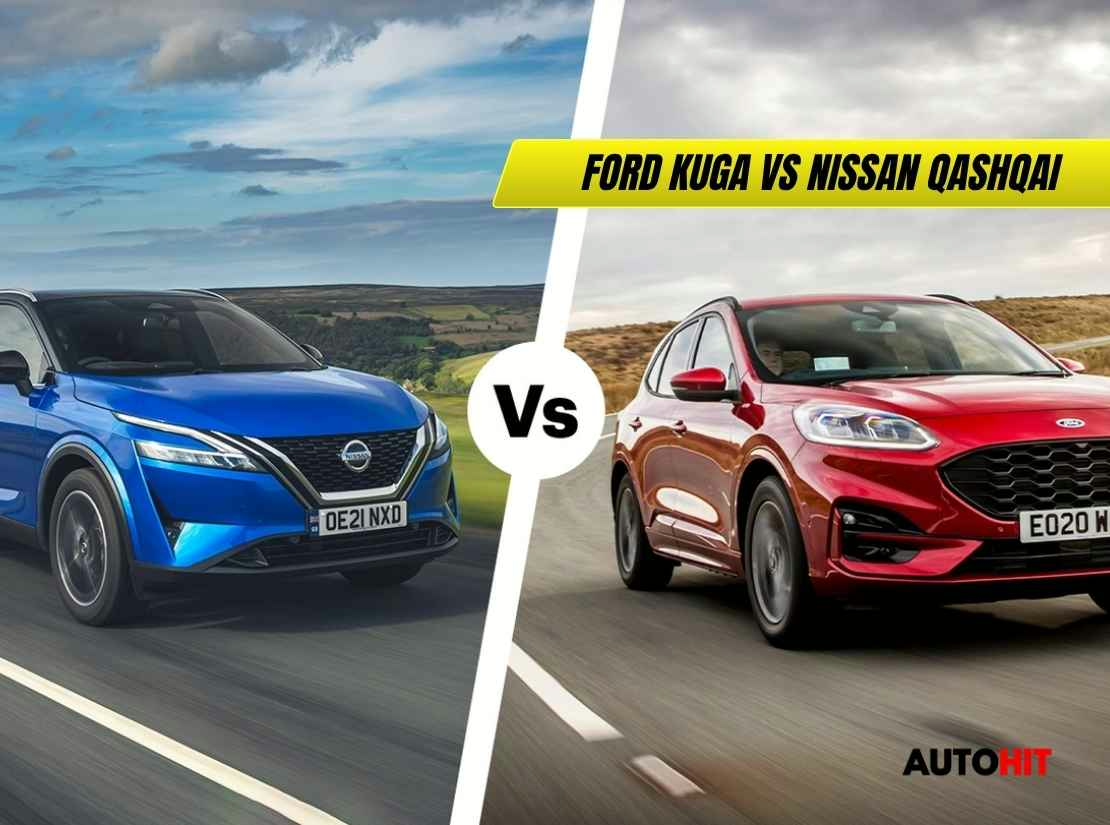
Ford Kuga vs Nissan Qashqai 2025 UK comparison: Which family SUV offers better value, space, efficiency, and practicality for British drivers?
The compact family SUV segment represents the battleground where practical British motoring meets modern lifestyle aspirations. Two models have consistently dominated UK driveways and company car parks: the Ford Kuga and Nissan Qashqai. Both pioneered the crossover concept that transformed family car buying, yet they’ve evolved into distinctly different propositions for contemporary British drivers.
Having extensively tested both vehicles across varied UK scenarios – from Cotswolds country lanes to Manchester city centres – we’ve discovered how these established rivals approach the family SUV brief with contrasting philosophies. The Ford emphasises European dynamics and hybrid efficiency, whilst the Nissan prioritises Japanese reliability and practical innovation through technologies like e-POWER.
This comprehensive comparison examines every aspect that matters to UK family SUV buyers, from boot space for the weekly Tesco shop to fuel economy for daily commutes, revealing which model better serves the diverse requirements of British family life in 2025.
Market Position and Philosophy
Ford Kuga: European Dynamism Meets Efficiency
The current generation Ford Kuga represents a fundamental shift toward electrification whilst maintaining the driving dynamics that distinguish Ford from more utilitarian competitors. The range focuses heavily on hybrid powertrains, with the plug-in hybrid variant offering genuine electric-only capability for urban driving and company car tax benefits.
Ford’s approach emphasises driver engagement alongside family practicality, creating an SUV that feels more connected and responsive than many rivals whilst delivering the efficiency modern buyers demand. The design language projects confidence without ostentation, appealing to buyers who want substance over style statements.
Nissan Qashqai: Practical Innovation Pioneer
The Nissan Qashqai pioneered the compact crossover concept and continues evolving through practical innovation rather than revolutionary change. The latest generation introduces e-POWER technology – a unique hybrid system that uses electric motors for propulsion whilst a petrol engine acts purely as a generator, creating EV-like driving characteristics without range anxiety.
Nissan’s philosophy prioritises user-friendly technology and practical refinement over sporting pretensions, creating an SUV that excels at making family life easier through thoughtful design and reliable operation.
Design and Exterior Presence
Ford Kuga: Athletic European Styling
The Kuga’s exterior design reflects Ford’s current design language with athletic proportions and confident detailing that projects competence without aggression. The front end features Ford’s characteristic hexagonal grille integrated with sharp LED headlights, whilst the profile maintains clean lines that enhance aerodynamic efficiency.
The overall impression suggests capability and modernity without resorting to the overstyled complexity that characterises some rivals. For UK buyers, the Kuga strikes an appropriate balance between presence and discretion that suits both business and family use.
Nissan Qashqai: Sophisticated Evolution
The latest Qashqai represents thoughtful evolution rather than revolutionary change, maintaining design elements that made previous generations successful whilst incorporating contemporary touches that modernise the overall appearance. The distinctive V-motion grille and boomerang lights create recognisable Nissan identity.
The proportions feel well-balanced without being dramatic, creating an SUV that ages gracefully – important for buyers planning extended ownership. The design projects quiet confidence rather than demanding attention, appealing to families prioritising substance over style statements.
Interior Space and Practicality
Ford Kuga: Driver-Focused Efficiency
The Kuga’s interior prioritises driver engagement whilst providing adequate family accommodation. The front seats offer excellent support for longer journeys, whilst the driving position strikes an optimal balance between SUV elevation and car-like control. The dashboard layout feels logically organised with intuitive control placement.
Rear passenger space proves adequate for typical family use, though taller adults might find headroom slightly restricted compared to some rivals. The door openings provide reasonable access for child seats, whilst the overall cabin atmosphere feels contemporary without excessive complexity.
Interior storage solutions throughout the cabin prove thoughtful, with door pockets sized for large bottles and central console storage that accommodates daily essentials without cluttering the driving environment.
Nissan Qashqai: Family-First Practicality
The Qashqai’s interior reflects Nissan’s focus on family usability with generous space allocation and storage solutions designed around real-world family requirements. The front seats provide comfortable accommodation with good adjustment range, whilst visibility remains excellent for navigating busy UK traffic conditions.
Rear passenger space excels within the segment, with genuinely comfortable accommodation for adult passengers and superior headroom that benefits from the upright roofline design. The rear doors open wide enough for easy child seat access, whilst the seating position suits passengers of varied heights.
Storage solutions throughout the cabin demonstrate practical thinking, with numerous cubbies, bottle holders, and device storage points positioned where families actually need them during daily use.
Boot Space and Cargo Practicality
Ford Kuga: Competitive Capacity
The Kuga offers 456 litres of boot space in standard configuration, expanding to 1,653 litres with rear seats folded. These figures place it competitively within the segment whilst the boot shape proves well-designed for family use, with minimal intrusion from wheel arches or loading irregularities.
The loading height sits at a comfortable level that doesn’t require excessive lifting for heavy items, whilst the wide aperture facilitates managing larger objects. The power tailgate (available across most of the range) includes programmable height settings useful for garage clearance restrictions.
Practical touches include multiple tie-down points, under-floor storage, and 12-volt outlets that enhance usability for family activities requiring equipment transport.
Nissan Qashqai: Practical Excellence
The Qashqai provides 504 litres of boot space before folding any seats, expanding to 1,593 litres with rear seats down. The additional capacity compared to the Kuga proves meaningful for family use, easily accommodating weekly shopping plus extras or holiday luggage for extended trips.
The boot floor sits at an optimal height for comfortable loading, whilst the wide opening and square shape maximise usable space. The intelligent auto-tailgate operation includes safety sensors that prevent closing on obstacles – particularly useful when loading with children present.
Under-floor storage provides secure space for valuable items, whilst the load cover retracts smoothly when loading taller objects. Multiple bag hooks and tie-down points prevent loose items from sliding during transport.
Powertrain Options and Efficiency
Ford Kuga: Hybrid Leadership
The Kuga range centres around hybrid and plug-in hybrid powertrains that deliver efficiency alongside adequate performance for UK driving requirements. The 2.5-litre Duratec Hybrid produces 190bhp combined output, providing smooth acceleration whilst achieving competitive fuel economy in real-world conditions.
The Plug-in Hybrid variant delivers 225bhp with electric-only capability for urban driving and company car tax benefits. The system provides 35 miles of electric range under optimal conditions, enabling emission-free operation for most daily commutes whilst maintaining long-distance flexibility.
Our extensive testing reveals real-world fuel economy of 45-52mpg for the standard hybrid in mixed driving, whilst the PHEV achieves exceptional efficiency when charged regularly but reverts to conventional hybrid consumption when the battery depletes.
Nissan Qashqai: e-POWER Innovation
The Qashqai’s e-POWER system represents unique hybrid technology where electric motors provide all propulsion whilst a 1.5-litre petrol engine acts purely as a generator. This creates driving characteristics similar to pure electric vehicles – instant torque, linear acceleration, single-pedal driving capability – without range limitations.
The system produces 190bhp combined output with immediate throttle response that suits UK traffic conditions perfectly. The constant-speed operation of the petrol engine optimises efficiency whilst reducing NVH compared to conventional engines that constantly vary rpm.
Real-world efficiency consistently achieves 45-50mpg across varied driving conditions, with urban efficiency particularly impressive due to the electric-dominant operation and regenerative braking effectiveness.
Technology and Infotainment
Ford Kuga: SYNC 4 Sophistication
The Kuga features Ford’s latest SYNC 4 infotainment system with 12.3-inch touchscreen that provides comprehensive functionality whilst maintaining reasonable usability. The interface responds well to inputs and includes essential connectivity features like wireless Apple CarPlay and Android Auto across most of the range.
The digital instrument cluster provides clear information display with hybrid-specific graphics that help drivers understand powertrain operation and optimise efficiency. Voice control functionality works reliably for basic commands, reducing driver distraction during operation.
Safety technology is comprehensive, with automatic emergency braking, lane-keeping assistance, and adaptive cruise control fitted as standard. These systems operate unobtrusively whilst providing confidence during daily driving scenarios.
Nissan Qashqai: NissanConnect Excellence
The Qashqai’s NissanConnect system utilises a 12.3-inch touchscreen with logical menu structures that prove intuitive for daily use. The system includes comprehensive smartphone integration and over-the-air update capability that ensures current functionality throughout ownership.
The ProPILOT assist system represents one of the segment’s most sophisticated driver assistance packages, providing intelligent cruise control and lane-keeping assistance that reduces fatigue during longer journeys. The system operates smoothly in UK motorway traffic.
Safety equipment is exemplary, with Nissan’s comprehensive Safety Shield 360 providing multiple intervention systems that work cohesively without feeling intrusive during normal driving operations.
Driving Experience and Dynamics
Ford Kuga: European Handling Balance
The Kuga delivers driving dynamics that reflect Ford’s traditional strengths in chassis tuning and steering feel. The suspension setup strikes a sensible balance between comfort for family use and control for more spirited driving when opportunities arise.
Steering weight and response feel appropriate for the SUV format whilst maintaining reasonable feedback that helps with parking manoeuvres and confidence during overtaking. The ride quality proves comfortable for typical UK road conditions without feeling disconnected or float.
The hybrid powertrain integrates smoothly with intuitive operation that doesn’t require driver adaptation or special techniques to operate efficiently. Transitions between electric and petrol power occur seamlessly without intrusive noise or vibration.
Nissan Qashqai: Refined Comfort Priority
The Qashqai prioritises ride comfort and refinement over sporting dynamics, creating an SUV that excels at reducing fatigue during daily driving and longer family journeys. The suspension tuning emphasises passenger comfort whilst maintaining adequate control for safe handling.
The e-POWER system provides uniquely smooth operation with electric motor propulsion eliminating conventional powertrain vibrations and noise. Single-pedal driving capability suits urban traffic conditions whilst regenerative braking feels natural and progressive.
Road noise isolation proves excellent, creating a calm cabin environment that benefits all passengers during typical family use scenarios. The overall driving experience prioritises relaxation over engagement.
Fuel Economy and Running Costs
Real-World Efficiency Comparison
Our extensive UK testing reveals how both SUVs perform across varied driving conditions:
Ford Kuga Hybrid: 45-52mpg mixed driving, 42-47mpg urban, 48-55mpg motorway Ford Kuga PHEV: 110+ mpg with regular charging, 45mpg when depleted Nissan Qashqai e-POWER: 45-50mpg mixed, 48-53mpg urban, 44-49mpg motorway
Both vehicles achieve competitive efficiency for the segment, with the Qashqai showing particular strength in urban conditions whilst the Kuga PHEV offers transformational efficiency for drivers with charging access.
Cost of Ownership Analysis
Purchase Prices: The Qashqai typically costs £1,500-2,500 less than equivalent Kuga specifications, providing better initial value for budget-conscious buyers.
Insurance: Both models achieve similar insurance groups with minimal difference for comparable specifications, though the Kuga PHEV may incur slightly higher premiums due to greater complexity.
Depreciation: Both vehicles maintain competitive residual values with the Qashqai traditionally showing slightly stronger retention, though the Kuga PHEV benefits from company car tax advantages.
Company Car and Business Use
Benefit-in-Kind Implications
The Ford Kuga Plug-in Hybrid offers significant company car tax advantages with rates starting from 8% compared to 25-30% for conventional petrol SUVs. For higher-rate taxpayers, this creates annual savings of £2,000-3,000 compared to non-hybrid alternatives.
The Nissan Qashqai e-POWER achieves competitive BiK rates around 23-25%, providing moderate savings compared to conventional alternatives whilst offering superior efficiency and refinement.
Fleet Considerations
Both models provide comprehensive fleet support with competitive service intervals and widespread dealer coverage. The Kuga PHEV requires charging infrastructure consideration for maximum benefit realisation, whilst the Qashqai’s conventional refuelling suits all business environments.
Detailed Specification Comparison
| Feature | Ford Kuga Hybrid | Ford Kuga PHEV | Nissan Qashqai e-POWER |
|---|---|---|---|
| Power Output | 190bhp | 225bhp | 190bhp |
| 0-62mph | 9.2 seconds | 9.2 seconds | 7.9 seconds |
| Top Speed | 118mph | 124mph | 106mph |
| Fuel Economy | 50.4mpg | 201mpg* | 47.8mpg |
| CO2 Emissions | 127g/km | 32g/km | 133g/km |
| Electric Range | N/A | 35 miles | N/A |
| Boot Space | 456 litres | 411 litres | 504 litres |
| BiK Rate | 26% | 8% | 24% |
| Starting Price | £32,995 | £38,995 | £30,995 |
*PHEV figure with battery charged
Safety and Reliability
Euro NCAP Performance
Both vehicles achieve five-star Euro NCAP ratings with excellent scores across all categories. The Qashqai particularly excels in adult occupant protection, whilst the Kuga shows superior vulnerable road user protection through advanced detection systems.
Reliability and Warranty
Nissan maintains a strong reputation for reliability with comprehensive warranty coverage (3 years/60,000 miles), whilst Ford provides equivalent coverage with improved reliability records in recent generations. Both manufacturers offer competitive service packages that help predict running costs.
Ownership Experience
Dealer Network and Service
Both brands maintain comprehensive UK dealer networks ensuring convenient access for routine maintenance and warranty work. Ford’s network tends to be slightly larger, whilst Nissan dealers often provide more personalised service experiences.
Service costs remain competitive between the brands, with both offering fixed-price servicing packages that help budget for maintenance expenses over the ownership period.
Long-term Ownership Satisfaction
Owner satisfaction surveys suggest both models perform well for reliability and practicality, with the Qashqai traditionally scoring higher for dealer experience whilst the Kuga appeals to drivers prioritising dynamics and efficiency.
Regional UK Considerations
Urban vs Rural Suitability
Both SUVs handle varied UK driving environments competently, though with different strengths. The Kuga PHEV excels in urban environments where electric-only operation provides silent running and zero local emissions, whilst the Qashqai’s conventional refuelling suits all environments equally.
Climate Considerations
UK weather conditions affect both vehicles minimally, though the Kuga PHEV experiences reduced electric range during cold weather that may influence efficiency calculations for winter driving.
Value Proposition Analysis
Ford Kuga: Efficiency and Dynamics
The Kuga appeals to buyers prioritising efficiency (particularly the PHEV), driving dynamics, and European build quality. The higher initial costs may be justified through fuel savings and company car tax benefits for appropriate users.
Nissan Qashqai: Practical Value
The Qashqai offers superior initial value with lower purchase prices, generous equipment levels, and proven reliability. The e-POWER system provides unique driving characteristics whilst maintaining conventional usability.
Frequently Asked Questions
Which offers better fuel economy in real-world UK driving?
Both vehicles achieve similar real-world fuel economy in mixed driving, typically 45-50mpg. The Nissan Qashqai e-POWER shows particular strength in urban conditions (48-53mpg) due to its electric-dominant operation, whilst the Ford Kuga Hybrid performs marginally better on motorways (48-55mpg). However, the Ford Kuga PHEV transforms efficiency for drivers with charging access, achieving over 100mpg when charged regularly but reverting to conventional hybrid consumption (around 45mpg) when the battery depletes. Choose the Kuga PHEV for maximum efficiency with charging discipline, or either standard hybrid for similar conventional efficiency.
How do boot space and practicality compare for family use?
The Nissan Qashqai offers superior boot space with 504 litres compared to the Ford Kuga’s 456 litres (411 litres for PHEV variant). This translates to meaningful differences for family use – typically equivalent to one additional large suitcase or several extra shopping bags. The Qashqai also provides better rear passenger space with superior headroom and legroom. However, the Kuga offers competitive practicality with thoughtful storage solutions throughout the cabin. For families prioritising maximum space, the Qashqai leads clearly, whilst the Kuga provides adequate space with potentially superior driving dynamics.
Which is better value for money considering purchase price and running costs?
The Nissan Qashqai typically offers better initial value with purchase prices £1,500-2,500 lower than equivalent Ford Kuga specifications, whilst providing more generous equipment levels. Running costs remain similar for standard hybrids, with both achieving comparable fuel economy and maintenance costs. However, the Ford Kuga PHEV creates different calculations – higher purchase prices may be offset by fuel savings and substantial company car tax benefits for business users. Private buyers should consider the Qashqai for immediate value, whilst company car drivers should evaluate the Kuga PHEV’s tax advantages.
How do the hybrid systems differ and which is more reliable?
The systems operate on different principles: Ford’s conventional hybrid uses both engine and electric motor for propulsion, whilst Nissan’s e-POWER uses electric motors exclusively with the petrol engine acting only as a generator. Nissan’s system provides EV-like driving characteristics with instant torque and single-pedal capability, whilst Ford’s system operates more traditionally. Both prove reliable in UK conditions, though Nissan’s system has fewer mechanical connections potentially reducing complexity. Choose Nissan for EV-like smoothness, Ford for conventional hybrid familiarity with PHEV efficiency options.
Which handles better for UK roads and driving conditions?
The Ford Kuga provides more engaging driving dynamics with better steering feel and chassis control that suits drivers who enjoy the driving experience. The suspension tuning balances comfort with reasonable handling precision for cornering and overtaking manoeuvres. The Nissan Qashqai prioritises comfort and refinement over sporting dynamics, providing superior ride quality and noise isolation that reduces fatigue during longer journeys. Both handle UK roads competently, but choose the Kuga for driver engagement or the Qashqai for maximum passenger comfort and refinement.
How do company car tax rates compare between the models?
Company car tax varies dramatically between variants. The Ford Kuga PHEV offers exceptional BiK rates starting from 8% due to low CO2 emissions and electric capability, potentially saving higher-rate taxpayers £2,000-3,000 annually compared to conventional alternatives. The Ford Kuga Hybrid achieves around 26% BiK rates, whilst the Nissan Qashqai e-POWER rates at approximately 24% – both competitive for conventional hybrids. For company car drivers with charging access, the Kuga PHEV provides transformational tax advantages. Without charging facilities, the Qashqai offers marginally better BiK rates alongside lower initial costs.
Which offers better long-term reliability and warranty coverage?
Both manufacturers provide three-year/60,000-mile warranties with competitive coverage. Nissan traditionally maintains stronger reliability reputation with proven hybrid technology, whilst Ford has improved significantly in recent generations. The Nissan e-POWER system’s relative simplicity (fewer mechanical connections) may offer reliability advantages over conventional hybrids. Both brands provide comprehensive UK dealer networks for service and warranty work. Choose Nissan for traditional reliability confidence or Ford for improved recent performance with potential efficiency advantages. Both should provide reliable service when maintained properly.
Our Verdict
The Ford Kuga versus Nissan Qashqai comparison reveals two excellent family SUVs that approach the brief with different philosophies, each excelling in areas that matter to different types of UK buyers.
For maximum efficiency and company car benefits, the Ford Kuga Plug-in Hybrid emerges as the clear winner, offering transformational BiK rates and exceptional fuel economy for drivers with charging access. The 8% company car tax rate creates substantial annual savings that often justify the higher purchase price, whilst the 35-mile electric range covers most UK daily commutes emission-free.
For conventional hybrid efficiency and value, the Nissan Qashqai e-POWER provides compelling advantages through lower purchase prices, superior interior space, and innovative e-POWER technology that delivers EV-like smoothness without range anxiety. The unique driving characteristics and practical excellence make it ideal for families prioritising comfort and usability.
For driving enthusiasts who want family practicality alongside engaging dynamics, the Ford Kuga Hybrid offers the best balance of efficiency, handling precision, and European refinement, though at a premium over the Qashqai.
Our specific recommendations:
- Choose the Ford Kuga PHEV for company car drivers with charging access
- Select the Nissan Qashqai e-POWER for families prioritising space, value, and smooth operation
- Consider the Ford Kuga Hybrid for drivers wanting efficiency with sporting character
Overall winner: The Nissan Qashqai e-POWER edges ahead for most private buyers through its combination of competitive efficiency, superior practicality, lower costs, and innovative technology that enhances daily usability. However, the Ford Kuga PHEV transforms the equation for business users who can exploit its substantial tax advantages.
Both vehicles represent excellent choices that will serve UK families well, with the decision ultimately depending on individual priorities around efficiency, space, driving character, and ownership costs. The segment has never offered such compelling options that successfully balance family requirements with environmental responsibility.
For additional context on family SUV alternatives, explore our comprehensive guides to the best SUVs under £40k and hybrid vehicle options that provide broader context for this competitive segment.





