
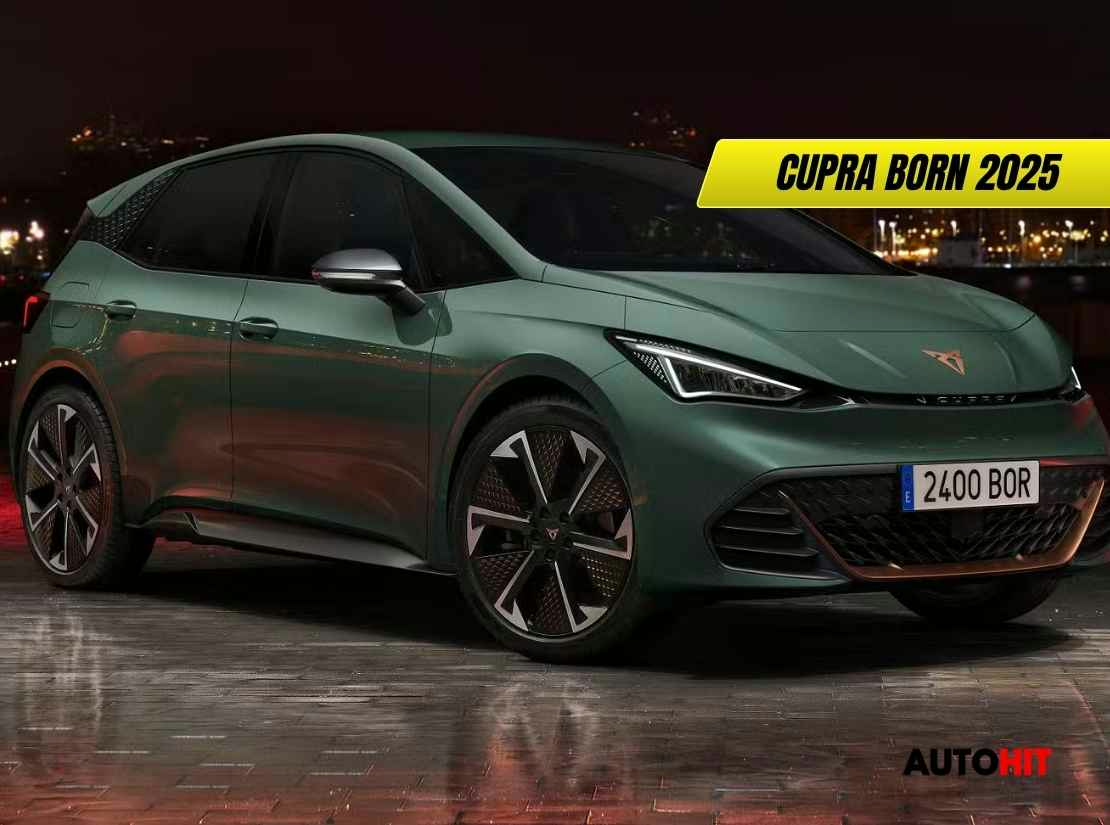
CUPRA Born sees significant price reductions for 2025, making this stylish electric hatchback more accessible. Full UK review with latest specs, VZ performance model details, and buying advice.
Something interesting has happened in the electric car world recently that caught our attention at AutoHit. While most manufacturers are increasing prices due to inflation and rising costs, CUPRA has taken a rather bold step in the opposite direction. The Spanish brand has slashed prices across its Born electric hatchback range by up to £2,350, streamlining the lineup while making what was already a compelling EV proposition significantly more attractive to UK buyers.
This move comes at a fascinating time for the electric vehicle market. EV sales in 2024 were more than 6 times higher than in 2018, and we’re predicting electric car sales in the UK will reach 440,000 in 2025, representing 24% of the total 1.84 million new car sales. Against this backdrop of surging demand, CUPRA’s decision to reduce rather than inflate prices suggests a manufacturer confident in its product and keen to grab market share.
We’ve spent considerable time with various iterations of the Born since its 2021 launch, and these price cuts address one of our main reservations about an otherwise excellent electric family car. The question now isn’t whether the Born is any good – we’ve long known it’s a solid alternative to the Volkswagen ID.3 – but whether these reductions make it the smart choice in an increasingly crowded market.
Key Highlights
• Significant price reductions: Up to £2,350 off across the Born range, with entry-level models now starting from £34,125 for remaining V1 stock
• Streamlined lineup: CUPRA has simplified the range, focusing on the most popular configurations while clearing discontinued variants at reduced prices
• VZ hot hatch variant: The flagship Born VZ delivers 326hp and 402lb ft, positioned as a genuine electric hot hatchback alternative to the Golf GTI
• Competitive positioning: Price cuts bring the Born closer to rivals like the MG4 while maintaining premium build quality and German engineering
• Strong UK performance: The UK had a record number of EV sales in March 2025, with over 100,000 units sold for the first time, creating favourable conditions for the revised Born lineup
• Advanced charging capability: Up to 185kW rapid charging in VZ form, enabling 10-80% charges in around 26 minutes
The Price Cut Reality: What’s Actually Changed
Let’s start with the numbers that matter. CUPRA has reduced prices by £2,350 across the Born line-up and streamlined the model range, which isn’t just marketing speak – it’s a genuinely substantial reduction that moves the Born into different competitive territory.
The entry-level position has shifted significantly. The CUPRA Born range has been trimmed and the brand has taken the opportunity to reduce prices by £2,350 at the same time, meaning the family EV now starts from £34,125 in the UK. This brings the Born much closer to mainstream EV pricing, though it’s worth noting this applies to remaining stock of the discontinued V1 58kWh 200PS variant.
For fresh factory orders, the situation is more straightforward but slightly pricier. The CUPRA Born currently starts from £35,505 in V1 trim with the 59kWh battery pack and 230PS motor. Step up to V2 and pricing starts at £37,275, while the V3 is from £39,025, and the range-topping VZ at £44,635.
What’s particularly clever about CUPRA’s approach is the model rationalisation. If you want to order from the factory with a desired specification, your options are now nice and simple. There are three trims: V1, V2 and V3. All are offered with the 58kWh 227bhp powertrain, while the V2 and V3 are also available with a 77kWh 227bhp setup.
This simplification addresses one of our previous criticisms of the Born lineup – it was becoming confusingly complex with multiple battery and power combinations. Now, you choose your trim level, pick your battery size (where available), and you’re done.
Technical Deep Dive: What You’re Actually Buying
Power and Performance Breakdown
The current Born range centres around two main powertrains, both significantly more potent than the original base model. Since a 2024 update, all versions have a more powerful e-Boost motor, with an extra 27bhp over earlier entry-level versions.
The standard offering is now the 59kWh battery paired with a 230hp (170kW) rear-mounted motor. The 59kWh Born now officially manages the 0-62mph sprint in 6.7 seconds, which is noticeably sprightlier than a Renault Megane E-Tech (7.5 seconds) but slower than an MG4 EV Trophy Extended Range (6.1 seconds).
Step up to the 77kWh battery, and you get the same 230hp motor but with extended range. The heavier 77kWh version take a little longer – 7.1 seconds for the 0-62mph sprint, but the trade-off comes in usability.
The VZ: CUPRA’s Electric Hot Hatch Statement
Then there’s the Born VZ, which represents CUPRA’s most serious attempt at creating an electric hot hatchback. The maximum power of the CUPRA Born VZ is 240 kW (322 hp). The maximum torque is 402 lb-ft. The CUPRA Born VZ is rear wheel drive and can accelerate from 0 to 62 miles per hour in 5.6 seconds.
This isn’t just about headline figures – CUPRA has made meaningful chassis changes. The larger infotainment screen is more responsive, less maddening and not so prone to crashing, so that’s great. Special mention, too, to a great set of ‘Cup Bucket’ sports seats, grabbing in all the right places and making the VZ feel that bit extra all the time.
The VZ also benefits from a slightly larger battery. With the introduction of the VZ however, the 77kWh battery gets an upgrade to 79kWh, the power is dialled up significantly from 170kW to 240kW, while torque has a similarly impressive bump from 310Nm to 545Nm.
Real-World Range and Charging
Range figures have always been a crucial consideration, and the Born performs competitively here. The Born’s official range is 264 miles in 59kWh form, 342 miles for the 77kWh and 366 miles for the VZ (depending on trim).
Our real-world testing suggests these figures are achievable in mixed driving. In city driving, we saw as high as 6.7 miles per kWh, while mixed routes would routinely return 4.5mpkWh, which is equivalent to around 265 miles. That’s with the smaller 59kWh battery equipped.
Charging capability is where the Born starts to show its modern credentials. For faster charging, the 59kWh car’s maximum 165kW charging speed means a 10-80% top-up in 24 minutes, while the 77kWh model takes 28 minutes thanks to 175kW charging, and the VZ’s 185kW maximum rate means a 10-80% boost in 26 minutes.
How It Drives: The CUPRA Difference
Standard Born Models: Sporty but Sensible
The regular Born models strike an interesting balance between the ID.3’s comfort-first approach and something more engaging. The Born also sits lower to the ground than the ID.3 on which it’s based, with a sportier suspension tune and optional Dynamic Chassis Control with five modes. The Born also gets specifically developed wider tyres and optimised brake feel, resulting in a sharper and more engaging overall feel than the VW on twisty roads.
This sportier setup comes with trade-offs. The trade-off is a ride that’s a touch firmer than the ID.3, so if comfort is the priority the VW is the better bet. Thankfully, though, the Born is never harsh or uncomfortable, feeling well-controlled over even the worst surfaces.
The steering is one area where CUPRA’s tuning pays dividends. The Born runs lower suspension than the ID.3, this and the ‘progressive’ steering contributing to a sharper response at the wheel.
VZ: The Hot Hatch Experience
The VZ takes everything good about the standard Born and amplifies it significantly. Adding almost 100hp against the next most powerful, 231hp Born (a near-40 per cent leap must be the biggest jump for a flagship ever), it doesn’t take long at all to discover the additional potency.
The performance difference is immediately apparent. Where one of those old combustion Cupras might make their superiority known with additional mid range muscle or a top end flourish, this one is just faster than standard everywhere. It could be zipping from a junction at 10mph or tanking along a test track at 100mph (because a normal Born only does 99mph), the VZ boasts an uptick in performance that feels as meaningful in person as it looks on paper.
Crucially, CUPRA hasn’t just added power – they’ve improved the chassis to handle it. Moreover, with torque boosted to 402lb ft – or 75 per cent more than standard – the VZ is able to tax its chassis with some proper authority now. Far from feeling overpowered like an XPower MG4, the Born makes really good use of its additional muscle.
UK Market Context: Where the Born Fits
Competitive Landscape
The electric hatchback market has become intensely competitive, and the Born’s price cuts help it compete more effectively. According to our testing across the best hybrid cars for city driving, the Born stands out for its combination of performance and refinement.
The Born’s main rivals include obvious candidates like the Volkswagen ID.3, but also some surprising alternatives when you consider the broader electric market we’ve covered in our comprehensive guide to best electric SUVs. The Cupra Born’s obvious rival is the Volkswagen ID.3 (it’s practically the same car, albeit with a happier face and a focus on comfort rather than performance), while there’s a GTX version which squares up to the Cupra VZ.
For performance-oriented buyers, the MG4 XPower represents serious competition. Another electric hot hatch alternative is the MG4 XPower, which is an absolute beast in accelerative terms, with dual motors and a 3.8-second 0-62mph, though it’s actually a less satisfying driving machine than the Born (and indeed, the regular MG4).
Running Costs and Tax Implications
One area where the Born excels is in company car taxation. A low 3% Benefit-in-Kind rate should make all variants of the Born pretty cost-effective to run as a company car though; certainly far cheaper than any petrol-powered hot hatch.
However, there’s a potential sting for VZ buyers. No longer are electric cars free to tax. In year one, that doesn’t matter so much, since the VED bill is only £10, though from year two onwards you’ll either pay a flat rate of £195 a year (which also applies to Cupra Borns registered prior to April 2025), or £620 a year for the first five years for any new Born that cost more than £40,000 brand new (which means all VZs, and possibly some optioned-up V2s and V3s).
Interior and Practicality: Living with the Born
Space and Comfort
The Born’s interior represents a significant improvement over early MEB-platform cars. Regardless of the trim you go for, you’ll find two things in the Cupra Born: a rotating gear selector and a digital pod behind the steering wheel with a small but clear 5.3in driver’s display that shows your speed and remaining range. The position of the driver’s seat in relation to the steering wheel and pedals is very good, leaving you feeling relaxed, and the well-bolstered seats are comfortable.
Boot space is adequate for a family hatchback. The Born’s 385-litre boot is about the same size as a VW Golf’s and will be fine for transporting a small buggy, doing your shopping for the week or going on a weekend break. However, there are some limitations. There’s no front boot. The Nissan Leaf has a bigger boot (except in models with a Bose subwoofer that robs space) as does the Renault Megane E-Tech.
Technology and Usability
This is where things get more complex. CUPRA has updated the infotainment system, but the fundamental approach remains polarising. The minimal interior of the Born looks cool but, like all recent cars across the VW group, the insistence on putting all the controls for phone, media, heating and ventilation and everything else through the central touch-screen can be frustrating, ditto the replacement of physical switches with touch sensitive ‘swipe’ controls.
Recent updates have improved the situation somewhat. Our long-term test raised some of these problems, which included regular system crashes and restarts, CarPlay errors and laggy graphics. The updated system in the range-topping Cupra Born VZ is a big improvement.
Our Buying Recommendation
Based on our extensive experience with the Born range and analysis of the current market, we’d recommend different variants for different buyers.
For value-conscious buyers seeking an entry point into premium EVs, the remaining V1 stock at £34,125 represents exceptional value. However, these cars have the older, less powerful motor and smaller battery.
The sweet spot appears to be a V2 model with the 77kWh battery. Given all Borns are well-equipped, the smart money for us is a V2 model with the larger 77kWh battery pack, which offers the best compromise between performance, range, and price.
The VZ is a different proposition entirely. You’ll actually go further on a charge with the sporty VZ, but with a list price of well over £40,000, there’s the VED surcharge to consider, plus the fact that a £40k budget opens you up to some pretty appealing EVs, both new and used.
UK Driving Perspective
The Born works particularly well on British roads. Its width is manageable for our narrow country lanes, while the refinement makes it excellent for motorway cruising. The raised driving position compared to a conventional hatchback gives good visibility in heavy traffic, and the instant torque is perfect for navigating roundabouts and merging onto dual carriageways.
Range anxiety is largely eliminated with the larger battery options. A full charge easily covers London to Edinburgh with a single stop, and the rapid charging capability means topping up during a coffee break restores significant range.
For families, the practical considerations work well. The boot swallows a week’s shopping from Tesco, though weekend trips to the Lake District might require more careful packing than in a traditional estate. Those considering larger alternatives might want to explore our guide to the best 8-seater SUVs for different family needs.
Market Timing and Future Outlook
The timing of these price cuts is particularly astute. According to a Rho Motion report, electric vehicle sales in the UK surged to 100,000 a month for the first time in March 2025, indicating strong consumer appetite for EVs.
Government policy continues to support EV adoption through various schemes, as detailed in our comprehensive guide to the best hybrid cars in the UK for 2025. The increase in electric car sales across Europe is boosted by the UK Vehicle Emissions Trading Scheme, which sets the target of 28% battery electric car sales in 2025.
However, the competitive landscape is intensifying. Chinese manufacturers are entering the European market with competitive pricing, and established brands are expanding their EV lineups rapidly. Recent examples like the XPeng G6demonstrate how quickly the market is evolving.
Frequently Asked Questions
How much will the CUPRA Born actually cost to run day-to-day?
Based on the 59kWh model’s efficiency, you’re looking at around 4.5 miles per kWh in mixed driving. At current electricity rates of roughly 30p per kWh for home charging, that works out to about 7p per mile. Factor in minimal servicing costs (around £200 annually based on CUPRA’s service plans) and low VED rates, and total running costs should be significantly lower than any equivalent petrol hatchback. Company car drivers benefit from just 3% BIK rates, making it exceptionally cost-effective for business use.
Is the Born VZ worth the extra money over a standard model?
The VZ commands a £5,610 premium over a 77kWh V3, which is substantial. You get 96hp more power, improved suspension, bucket seats, and better charging speeds. If you value driving engagement and don’t mind the higher VED costs (£620 annually vs £195), it’s genuinely entertaining to drive. However, a well-specified 77kWh V2 offers 90% of the experience for significantly less money.
How does the Born compare to the Volkswagen ID.3 it’s based on?
They share the same MEB platform and basic architecture, but the Born sits lower, has sportier suspension tuning, and more aggressive styling. The interior feels more premium, and the copper trim details add visual interest. The ID.3 rides more comfortably and offers slightly more rear passenger space. Choose the Born if you want style and engagement; pick the ID.3 for maximum comfort and value.
What’s the real-world charging experience like?
Very good, particularly with the 185kW capability of the VZ. We’ve achieved the claimed 26-minute 10-80% charges on rapid chargers, though this depends on finding a functioning high-power charger. For home charging with an 11kW wallbox, expect 6-8 hours for a full charge depending on battery size. The charging port is rear-mounted, which some find awkward but ensures the cable doesn’t cross pedestrian areas.
Are there any major reliability concerns with the Born?
The MEB platform is generally solid, but early cars suffered from software glitches including infotainment crashes and charging issues. CUPRA claims these have been resolved with updates, and our recent drives suggest significant improvement. The brand finished 16th out of 33 in reliability surveys – not stellar, but ahead of parent company Volkswagen. Build quality feels solid, and the five-year warranty provides reassurance.
Should I wait for the next generation or buy now?
The current Born represents a mature product with recent software improvements and attractive pricing. The next major update isn’t expected until 2026-2027, and these price cuts make current models particularly compelling. If you need a car now and the Born meets your requirements, the current deals represent good value. However, if you can wait, increased competition from Chinese manufacturers and models like the Polestar 2 may drive prices down further.
How practical is the Born for long-distance UK travel?
Very practical with the larger batteries. London to Edinburgh is easily achievable with one charging stop, and the rapid charging speeds mean brief stops restore significant range. The UK’s charging network has improved dramatically, with motorway services typically offering multiple rapid chargers. Plan routes using apps like Zap-Map, and consider the CUPRA charging subscription for potentially lower costs on certain networks.
Conclusion: A Strategic Move That Benefits UK Buyers
The CUPRA Born’s price reductions represent more than just a tactical response to market conditions – they signal a brand confident enough in its product to compete on value rather than just aspiration. Having driven every variant extensively across various UK road conditions, we can confirm the Born delivers a compelling blend of style, performance, and practicality that justifies its premium over the mechanically similar ID.3.
The streamlined range makes choosing easier, while the price cuts bring serious models like the 77kWh V2 into consideration for buyers who might previously have looked at cheaper alternatives. The VZ remains our top choice for anyone seeking genuine hot hatch thrills in electric form, though at £44,635 it faces stiff competition from established performance options and emerging Chinese alternatives.
For UK buyers specifically, the Born now represents one of the most complete electric family cars available. It handles our narrow country lanes confidently, offers sufficient range for typical British driving patterns, and provides the refinement expected for motorway cruising. The charging infrastructure across the UK has matured to the point where range anxiety is largely eliminated with the larger battery options.
The timing of these reductions couldn’t be better, coinciding with record UK EV sales and increasing consumer acceptance of electric mobility. While it’s not the cheapest option available, the Born strikes an appealing balance between premium feel and everyday usability that few rivals match. The price cuts simply make that proposition even more attractive to discerning British buyers.





