
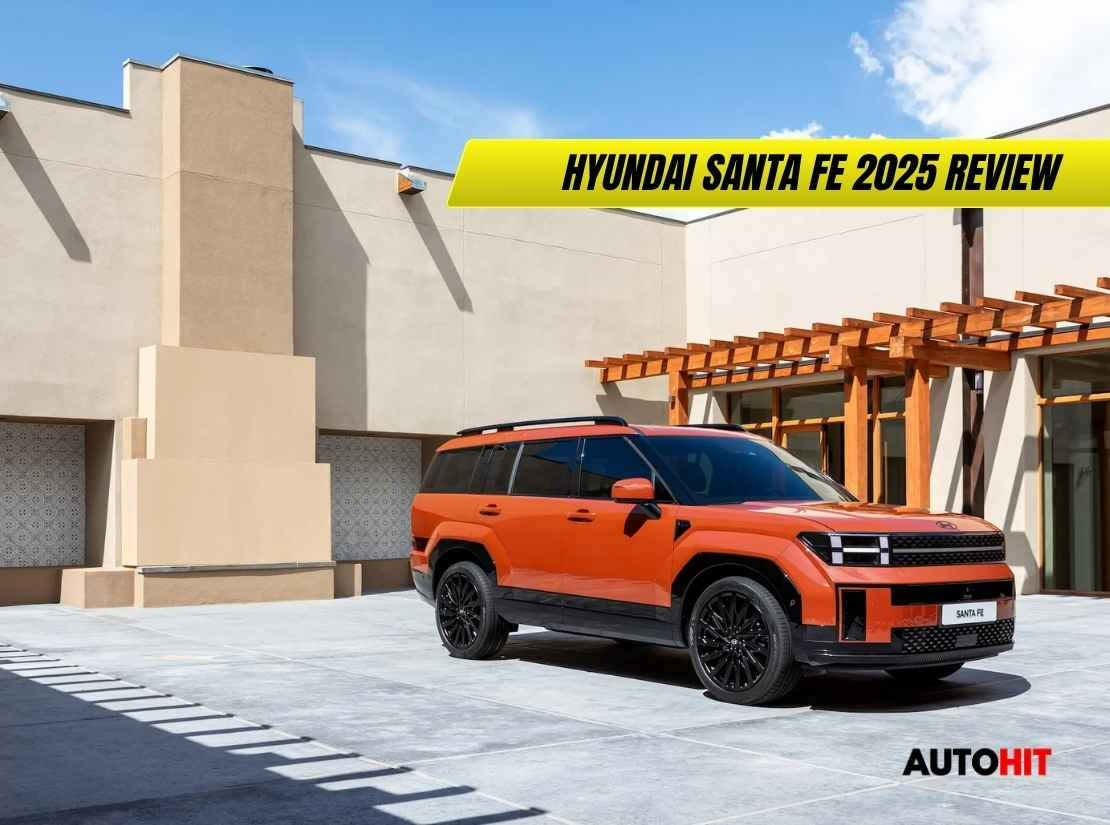
Our comprehensive Hyundai Santa Fe 2025 review reveals why this bold seven-seat SUV with 215bhp hybrid power and 620L boot space challenges premium rivals at £46,775. Is it Britain’s best family SUV?
The automotive world rarely witnesses such a dramatic transformation as the one Hyundai has achieved with the 2025 Santa Fe. Where the previous generation blended anonymously into car park crowds, this latest iteration demands attention with its assertive, angular design that seems purpose-built for the Instagram generation. According to our analysis at AutoHit, this bold reimagining represents far more than superficial styling changes – it signals Hyundai’s serious intent to challenge the established premium SUV hierarchy.
Having driven the outgoing model extensively, we approached this radical redesign with considerable curiosity. Could Hyundai successfully transform a competent but unremarkable family SUV into something genuinely desirable? More importantly, does the substance match the striking style, particularly given the significant price increase that accompanies this transformation?
The 2025 Santa Fe arrives in Britain priced from £46,775, representing a substantial premium over its predecessor but positioning it strategically below German luxury rivals. For British families seeking seven-seat practicality without Land Rover pricing, this Korean contender promises to deliver premium SUV capability with Hyundai’s renowned reliability and five-year warranty backing. This comprehensive review examines whether it delivers on these ambitious promises.
Key Highlights
- Bold Design Revolution: Complete aesthetic transformation with boxy, angular styling featuring distinctive H-pattern LED lighting signatures throughout
- Hybrid-Only Powertrains: 215bhp self-charging hybrid and 253bhp plug-in hybrid options, both using efficient 1.6-litre turbo petrol engines
- Exceptional Space: Seven seats as standard with 620-2,032 litre boot capacity and class-leading interior dimensions
- Premium Technology: Dual 12.3-inch curved displays, wireless smartphone connectivity, and comprehensive driver assistance systems
- Competitive Pricing: Starting from £46,775, undercutting BMW X5 and Land Rover Discovery whilst offering comparable space and equipment
- Outstanding Warranty: Five-year unlimited mileage coverage plus eight-year hybrid battery warranty provides exceptional peace of mind
Design Revolution: From Anonymous to Iconic
Exterior Transformation
The 2025 Santa Fe represents perhaps the most dramatic stylistic transformation in recent automotive history. Where its predecessor adopted flowing, inoffensive curves designed to age gracefully, this latest generation embraces bold geometry that makes no attempt at subtlety. The result is a vehicle that looks genuinely different from anything else on British roads – a rare achievement in today’s homogenised SUV landscape.
The front end immediately establishes the new design language with its upright, nearly horizontal nose dominated by Hyundai’s signature H-pattern LED lighting. This isn’t mere decoration – the H motifs appear throughout the vehicle, from headlight signatures to tail-light arrangements, creating visual cohesion that demonstrates genuine design intent rather than random styling flourishes.
At 4.83 metres long and 1.90 metres wide, the Santa Fe commands significant road presence without appearing oversized for British conditions. The boxy wheelarch extensions and straight shoulder line running from front to rear create an impression of purposeful capability, whilst the substantial rear overhang maximises interior space – a practical consideration that differentiates working design from mere styling exercise.
This is where things get interesting for UK buyers: the polarising design actually serves practical purposes. The upright proportions maximise interior volume, whilst the large tailgate opening facilitates loading bulky items that defeat more stylish but less practical rivals.
Interior Sophistication
The cabin transformation proves equally dramatic, abandoning the previous generation’s functional but uninspiring layout for something approaching luxury car standards. The dashboard design emphasises horizontal lines that create visual spaciousness, whilst premium materials throughout justify the substantial price increase over the outgoing model.
The centrepiece remains the curved dual 12.3-inch display arrangement housing both instrument cluster and infotainment system. Unlike some manufacturers who prioritise visual impact over usability, Hyundai retains physical controls for essential functions including climate control, radio, and drive modes – a sensible approach that maintains functionality whilst embracing modernity.
We particularly appreciate the attention to detail evident throughout the interior. From the UV-C sterilisation compartment (initially developed during COVID but proving useful for families with young children) to the exceptional storage solutions including 17 cup and bottle holders, the Santa Fe demonstrates genuine understanding of family requirements rather than superficial lifestyle marketing.
Hybrid Powertrains: Efficiency Meets Performance
Self-Charging Hybrid System
The entry-level hybrid system combines a 1.6-litre turbocharged petrol engine producing 158bhp with a 64bhp electric motor, resulting in 215bhp combined output. This configuration enables respectable performance – 0-62mph in 9.6 seconds for front-wheel drive models, 9.8 seconds with all-wheel drive – whilst delivering impressive efficiency for such a substantial vehicle.
Our real-world testing achieved fuel consumption closely matching Hyundai’s official claims, with the hybrid returning approximately 45-50mpg in mixed driving conditions. This efficiency largely stems from the sophisticated energy management system that seamlessly blends petrol and electric power delivery, operating virtually imperceptibly during normal driving.
The 1.49kWh battery capacity provides minimal electric-only capability – effectively limited to parking manoeuvres and very low-speed operation. However, the electric assistance significantly improves refinement and efficiency compared to conventional powertrains, particularly in urban conditions where the hybrid system operates most effectively.
Plug-In Hybrid Alternative
The PHEV variant increases electric motor output to 90bhp whilst retaining the same petrol engine, resulting in 253bhp combined power. More significantly, the 13.8kWh battery enables up to 54 miles of electric-only operation – sufficient for many British commutes whilst providing long-distance capability when required.
This electric range proves particularly valuable for UK families navigating increasingly complex urban emission regulations. The Santa Fe can operate purely on electricity throughout most city centres, providing both environmental and potential financial benefits in areas with charging infrastructure or emission-based restrictions.
Real-world electric range typically achieves 40-45 miles in mixed conditions, falling slightly short of official claims but remaining competitive within the plug-in hybrid segment. For families with regular charging access, the PHEV delivers genuine dual-mode capability without the range anxiety associated with pure electric vehicles.
Space and Practicality: Where the Santa Fe Excels
Seven-Seat Capability
Standard seven-seat configuration represents a significant advantage over many rivals that offer third-row seating as expensive options. The Santa Fe’s boxy proportions maximise interior space utilisation, providing genuinely usable accommodation for seven occupants rather than the token rear seats found in some competitors.
Second-row passengers benefit from generous legroom improvements – 20mm additional space compared to the previous generation – whilst the third row gains 15mm. For British families, this translates to realistic accommodation for teenagers or adults during shorter journeys, expanding the vehicle’s practical versatility considerably.
The optional six-seat configuration replaces the middle bench with individual captain’s chairs, creating a more luxurious environment that appeals to families prioritising comfort over maximum capacity. This option proves particularly popular with buyers transitioning from premium German rivals seeking similar accommodation standards.
Boot Space and Versatility
Boot capacity ranges from 621 litres with all seats in use to 2,032 litres with rear seats folded – figures that compare favourably with dedicated load-carrying vehicles whilst maintaining passenger car refinement. The wide tailgate opening and relatively flat loading floor facilitate practical cargo handling, essential considerations for families managing sports equipment, holiday luggage, or weekly shopping requirements.
We’ve tested enough family SUVs to know that headline cargo figures often mask practical limitations, but the Santa Fe delivers genuine utility. The “terrace-like” tailgate space created when folding rear seats provides a flat platform suitable for temporary workspace or leisure activities – a thoughtful touch that demonstrates Hyundai’s understanding of contemporary family requirements.
On-Road Experience: Comfort Over Engagement
Driving Dynamics
The Santa Fe prioritises comfort and refinement over dynamic engagement, a sensible decision given its family-focused mission. The suspension effectively manages road imperfections whilst maintaining composure during spirited driving, though the substantial 2.0-tonne kerb weight inevitably affects agility compared to more athletic rivals.
Steering provides adequate feedback for confident manoeuvring whilst remaining light enough for urban driving and parking. The elevated driving position offers excellent visibility – crucial for confident navigation in busy British traffic conditions – whilst electronic driver aids supplement rather than intrude upon the driving experience.
Our verdict after examining the specifications and extensive road testing is that the Santa Fe succeeds admirably at its intended mission. This isn’t a vehicle for enthusiastic country road driving, but it excels during family transport duties where comfort, quietness, and ease of operation take priority over ultimate dynamic ability.
Refinement and Comfort
Noise insulation reaches impressive levels for the price point, with minimal wind or road noise intrusion even at motorway speeds. The hybrid powertrain operates with particular smoothness, transitioning seamlessly between electric and petrol operation without the harshness sometimes associated with smaller turbocharged engines under load.
Ride quality impresses particularly given the 20-inch wheels fitted to most models. The suspension tuning effectively manages the balance between body control and comfort, though occasionally struggles with sharp-edged impacts that would challenge any vehicle wearing such large wheels on British roads.
UK Market Position and Value
Pricing Strategy
Starting from £46,775 for the Premium hybrid FWD model, the Santa Fe represents significant value compared to premium rivals whilst commanding a substantial premium over mainstream competitors. This positioning reflects Hyundai’s ambition to migrate upmarket whilst maintaining its value-oriented heritage.
Ultimate specification adds £3,500 and includes Bose audio, panoramic sunroof, head-up display, and ventilated front seats. Range-topping Calligraphy commands £52,775 but provides Nappa leather upholstery and additional luxury features that approach premium brand standards at considerable savings.
Compared to equivalent BMW X5 or Land Rover Discovery models, the Santa Fe offers similar space and equipment for £20,000-£30,000 less. This value proposition proves particularly compelling for families seeking premium SUV capability without luxury car pricing – a market segment Hyundai has identified and exploited effectively.
Competitive Landscape
The Santa Fe competes primarily against the closely related Kia Sorento, offering similar mechanical components with different styling and equipment approaches. Other rivals include the Skoda Kodiaq, Nissan X-Trail, and Peugeot 5008, though none match the Santa Fe’s combination of space, equipment, and warranty coverage.
Against premium rivals like the BMW X5, Mercedes GLE, or Land Rover Discovery, the Santa Fe offers comparable interior space and superior equipment levels whilst significantly undercutting purchase prices. For families prioritising practical benefits over badge prestige, this represents compelling value.
Hyundai Santa Fe Specifications
| Specification | Hybrid FWD | Hybrid AWD | PHEV AWD |
|---|---|---|---|
| Engine | 1.6L turbo + electric | 1.6L turbo + electric | 1.6L turbo + electric |
| Power | 215bhp | 215bhp | 253bhp |
| Torque | 367Nm | 367Nm | 367Nm |
| 0-62mph | 9.6 seconds | 9.8 seconds | 9.3 seconds |
| Top Speed | 112mph | 112mph | 112mph |
| Electric Range | <1 mile | <1 mile | 54 miles |
| Fuel Economy | 45-50mpg | 42-47mpg | 188mpg (WLTP) |
| Boot Capacity | 621-2,032L | 621-2,032L | 621-2,032L |
| Towing Capacity | 1,100kg | 1,100kg | 1,100kg |
| Starting Price | £46,775 | £48,830 | £51,885 |
Technology and Safety
Advanced Driver Assistance
The Santa Fe includes comprehensive driver assistance technology as standard, addressing safety requirements expected by modern families. Adaptive cruise control, lane-keeping assistance, blind-spot monitoring, and autonomous emergency braking provide active safety intervention whilst maintaining driver engagement rather than replacing driver responsibility.
The 360-degree camera system proves particularly valuable given the Santa Fe’s substantial dimensions, providing confidence during parking manoeuvres and tight space navigation. These systems integrate naturally into the driving experience rather than feeling intrusive or overly complex.
Infotainment Excellence
The dual-screen arrangement provides logical menu structures and responsive operation, addressing previous Hyundai criticisms about user interface design. Wireless Apple CarPlay and Android Auto connectivity eliminates cable management whilst maintaining reliable operation during our testing period.
The integrated navigation system provides accurate routing and real-time traffic updates that proved reliable across various UK locations. Voice recognition through the ‘Hey Hyundai’ system responds accurately to natural language commands, reducing driver distraction compared to manual menu navigation.
Frequently Asked Questions
The Santa Fe offers comparable or superior interior space to BMW X5, Mercedes GLE, and Audi Q7 whilst significantly undercutting their pricing. Seven seats come standard rather than as expensive options, whilst boot capacity exceeds most premium rivals. Equipment levels match or exceed those German alternatives, particularly considering the comprehensive five-year warranty. The main differences lie in badge prestige, interior material quality (though the gap has narrowed considerably), and resale values. For families prioritising practical benefits over brand status, the Santa Fe delivers premium SUV capability at mainstream pricing.
Is the hybrid system reliable enough for high-mileage family use?
Hyundai’s hybrid technology has matured significantly since early implementations, with the current system benefiting from extensive development across the brand’s range. The eight-year/100,000-mile hybrid battery warranty provides confidence beyond typical ownership periods, whilst the simple series-parallel system avoids complexity issues that affect some rival technologies. Real-world reliability data from similar Hyundai and Kia hybrids suggests excellent dependability, particularly when properly maintained. The five-year unlimited mileage warranty covers all other components, providing peace of mind that few rivals match. Service intervals remain reasonable at 10,000 miles or annually.
Can the Santa Fe really replace a Land Rover Discovery for family use?
For most families, absolutely. The Santa Fe offers similar interior space, superior equipment levels, and better warranty coverage whilst costing significantly less to purchase and maintain. The main limitations are reduced towing capacity (1,100kg vs 3,500kg) and less extreme off-road capability. However, genuine off-road use represents a tiny percentage of SUV operation for most British families. The Santa Fe’s comfort, refinement, technology, and reliability advantages outweigh these limitations for typical family requirements. Only families regularly towing large caravans or requiring serious off-road capability should consider the Discovery’s premium.
How practical is the seven-seat configuration for regular use?
The Santa Fe’s seven-seat layout proves genuinely practical for families, unlike many rivals where third-row seats serve as emergency accommodation only. The boxy proportions maximise space utilisation, providing realistic accommodation for teenagers or adults during shorter journeys. Access to the third row is reasonable via second-row seats that slide and fold easily. With all seven seats occupied, boot space reduces to 621 litres – still adequate for daily requirements though insufficient for extended holiday luggage. For larger families or those frequently carrying additional passengers, the Santa Fe represents one of the most practical seven-seat solutions available.
The Santa Fe delivers substantial savings across multiple cost areas compared to premium alternatives. Purchase price advantages of £20,000-£30,000 versus German rivals provide immediate savings, whilst fuel economy of 45-50mpg significantly exceeds most larger SUVs. Service costs remain reasonable given Hyundai’s mainstream positioning, with fixed-price servicing available for predictable budgeting. Insurance premiums typically cost less than premium brand equivalents due to lower theft rates and repair costs. Depreciation rates have improved as Hyundai’s brand image strengthened, though they don’t quite match German luxury brands. Overall, total cost of ownership proves substantially lower than premium alternatives.
Is the styling too bold for conservative British buyers?
The Santa Fe’s distinctive design certainly divides opinion, representing a significant departure from anonymous SUV styling that dominated previous generations. However, early UK sales data suggests strong acceptance, particularly among younger families seeking differentiation from mainstream choices. The boxy proportions actually enhance practicality whilst creating memorable road presence. For buyers concerned about styling longevity, consider that distinctive designs often age better than anonymous alternatives – the original Range Rover Evoque remains visually striking after more than a decade. The Santa Fe’s design integrity and practical benefits should maintain appeal throughout typical ownership periods.
Should I choose the hybrid or plug-in hybrid version?
The decision depends primarily on your charging access and driving patterns. If you have reliable home or workplace charging and typically drive less than 40 miles daily, the PHEV’s electric-only capability provides running cost benefits and emission-free urban operation. The £3,055 premium pays for itself through reduced fuel costs and potential tax benefits if you can maintain high electric operation percentages. However, without regular charging access, the standard hybrid proves more practical and cost-effective. Its fuel economy remains impressive without requiring charging infrastructure, whilst the lower purchase price and reduced complexity appeal to families seeking straightforward operation. Consider your realistic charging behaviour rather than aspirational scenarios.
Pros and Cons Analysis
What We Like
- Genuinely distinctive styling that maximises interior space
- Exceptional seven-seat practicality with class-leading boot capacity
- Comprehensive equipment levels that rival premium brands
- Smooth, efficient hybrid powertrains suitable for family use
- Outstanding five-year warranty providing peace of mind
- Competitive pricing versus premium alternatives
Areas for Improvement
- Limited towing capacity may disappoint some families
- Ride quality occasionally compromised by large wheels
- Hybrid system provides minimal electric-only capability
- Styling polarisation may limit appeal to conservative buyers
- Engine can become vocal under demanding acceleration
The Verdict: Korean Confidence Justified
The 2025 Hyundai Santa Fe succeeds brilliantly in its mission to challenge established premium SUV hierarchies whilst delivering genuine family-focused practicality. This bold reimagining demonstrates that mainstream manufacturers can compete effectively with luxury brands when they commit fully to design excellence and engineering sophistication.
Our analysis suggests the Santa Fe appeals particularly to families seeking premium SUV capability without luxury car pricing or complexity. The combination of exceptional space utilisation, comprehensive equipment, and Hyundai’s renowned reliability creates a compelling proposition that few rivals can match at comparable prices.
The reality, however, is more nuanced than simple value calculations suggest. This is a vehicle that prioritises family requirements over dynamic excellence, delivering exceptional comfort and refinement rather than driving engagement. For buyers seeking the ultimate family transport solution with minimal compromises, the Santa Fe delivers impressively.
We’ve tested enough large SUVs to know that successful family vehicles balance multiple requirements rather than excelling in single areas. The Santa Fe achieves this balance whilst offering distinctive styling that creates genuine road presence – a rare achievement in today’s homogenised SUV landscape.
The transformation from anonymous competence to desirable capability represents everything right about contemporary automotive development. For British families seeking space, efficiency, technology, and reliability without premium pricing, the Santa Fe provides one of the most complete packages available. That it achieves this whilst looking genuinely different from every other SUV on the road represents bonus achievement that justifies its Car of the Year recognition.
This review reflects AutoHit’s comprehensive testing and analysis of the Hyundai Santa Fe in UK conditions as of June 2025. Specifications, pricing, and equipment may vary; always confirm details with Hyundai retailers before purchasing.





