
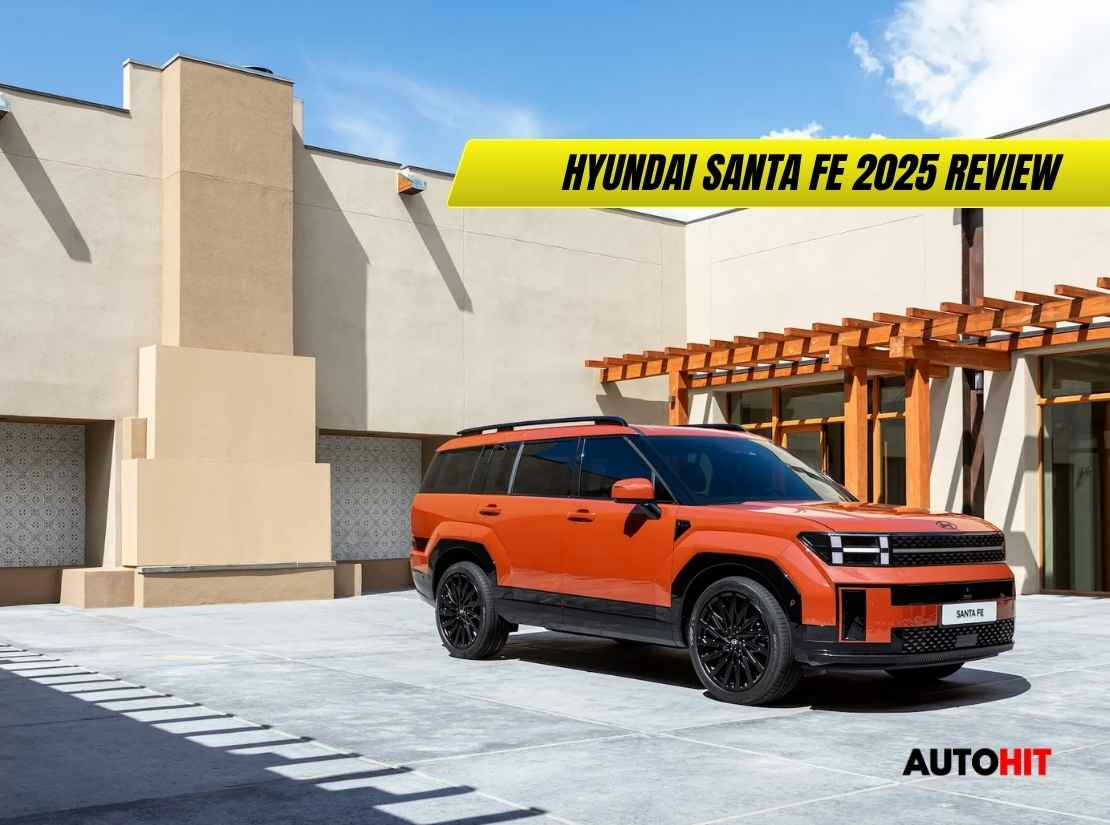
The Hyundai Santa Fe 2025 is a fifth-generation full-size hybrid SUV measuring 4.83 metres and seating up to seven passengers, with a 215 hp hybrid powertrain, a 621 to 2,032-litre boot and a starting price of €50,100 — making it one of the most complete and competitively priced large family SUVs available in the UK today.
Hyundai Santa Fe 2025: Key Highlights
- 215 hp hybrid powertrain combining a 1.6-litre T-GDI 160 hp petrol engine with a 65 hp electric motor
- 0–100 km/h in 9.6 seconds (2WD) — available in front-wheel and all-wheel drive
- Real-world fuel consumption of 6.4–6.9 l/100 km confirmed over mixed test routes
- Up to seven seats with a fully flat load floor when all rows are folded
- Boot from 621 to 2,032 litres — among the largest in the large hybrid SUV segment
- Continental pricing from €50,100 (hybrid) and €55,800 (plug-in 253 hp PHEV variant)
Design and Exterior: Mature, Distinctive and Instantly Recognisable
The fifth-generation Santa Fe represents the most decisive design step the model has taken in its history. At 4.83 metres long, 1.90 metres wide and 1.72 metres tall, it is a commanding presence on any road — and the styling language is as deliberate as it is distinctive. The front end is anchored by a striking H-shaped LED light signature that runs across the full width of the fascia, making the car immediately identifiable at night and reinforcing the Hyundai brand identity in a way that few models in the range achieve as clearly.
The body is squared-off and upright — a deliberate choice to maximise interior volume and rear seat headroom, and one that gives the Santa Fe a purposeful, honest character rather than the sleek-but-impractical coupe-SUV silhouette that has become overused in this segment. The rear end mirrors the front’s horizontal graphic language, with the tailgate mounted vertically to optimise boot aperture width and accessibility. 20-inch alloy wheels are available on top trim levels, filling the arches with the authority the exterior’s proportions demand. The same H motif that defines the light graphics appears in the rear bumper as a recurring design detail — a level of compositional discipline that elevates the overall aesthetic.
Interior and Technology: Space, Intelligence and Thoughtful Details
The Santa Fe’s cabin is one of its strongest arguments. The horizontal dashboard architecture, spanning the full width of the interior, creates an immediate sense of space and visual calm. The dual 12.3-inch curved display unit — combining the digital instrument cluster and the central infotainment screen in a single glass-covered housing — is the technological centrepiece, running Hyundai’s latest Connected Car Navigation system with live traffic, over-the-air updates and wireless Apple CarPlay and Android Auto integration.
Physical climate controls are retained on a dedicated panel below the central screen — a practical decision that keeps the most frequently adjusted functions accessible without screen navigation. Rear passenger climate controls are positioned in the second row centre console, giving back-seat occupants genuine autonomy over their environment. Dual wireless charging pads accommodate both front occupants simultaneously, and multiple USB-C ports are distributed front and rear throughout the cabin.
One of the most unusual — and genuinely useful — features is the UV-C sterilisation shelfmounted in front of the front passenger seat, capable of sanitising frequently handled objects such as smartphones and keys. Originally conceived in the post-Covid era, it remains a practically valuable addition for families travelling with young children. The steering wheel’s central section carries a sequence of dots that, in Morse code, spell the letter H — the sort of considered design detail that rewards attentiveness and reflects the care with which this cabin has been developed.
Space, Comfort and Seven-Seat Practicality
The Santa Fe’s defining practical attribute is its seven-seat capability. The wheelbase has grown by a meaningful increment over the previous generation, freeing an additional 20 mm of knee room in the second row and 15 mm in the third — enough to make the rearmost seats viable for adults on journeys of moderate length, rather than relegating them exclusively to children. Second-row seatback recline angle is adjustable, and all rear seats fold completely flat to create a level load surface — a genuine engineering achievement in a seven-seat configuration.
The boot range of 621 litres in seven-seat configuration to 2,032 litres with all seats folded represents one of the most impressive luggage capacity ranges in the large hybrid SUV segment. The loading sill is somewhat high — an unavoidable consequence of the elevated ride height — but the standard powered tailgate eases access, and the wide aperture makes loading bulky items straightforward. At just under two tonnes, the Santa Fe is a substantial vehicle, but the squared-off exterior translates into unusually easy perception of the car’s extremities during parking manoeuvres — a practical benefit that owners will appreciate on a daily basis.
Powertrain and Driving Experience: Smooth, Composed and Efficient
The Santa Fe Hybrid uses a 1.6-litre T-GDI turbocharged direct injection petrol engine producing 160 hp paired with a 65 hp electric motor — delivering a combined output of 215 hpthrough a six-speed automatic gearbox. Both front-wheel drive and all-wheel drive configurations are available, with the 4WD version adding approximately 0.2 seconds to the 0–100 km/h time (9.8 seconds versus 9.6 seconds for the 2WD). The system operates as a full self-charging hybrid — the battery replenishes through regenerative braking and the petrol engine, with no plug-in capability on this variant.
On the road, the Santa Fe is exactly what its specification suggests: composed, comfortable and unfailingly smooth. The hybrid system transitions between electric and petrol power seamlessly in moderate driving, and the car spends a notable proportion of urban mileage in electric-only mode, contributing directly to real-world consumption of 6.4–6.9 l/100 km over our mixed test route — a strong figure for a vehicle of this size and weight. At nearly two tonnes, dynamic sharpness is not the brief: body roll in faster corners is noticeable, and drivers seeking a sportier SUV experience will find the Santa Fe’s character better described as relaxed and confidence-inspiring than engaging. For the intended audience — families seeking a comfortable, spacious and efficient long-distance vehicle — this balance is entirely appropriate.
Steering wheel-mounted paddles allow the driver to adjust regenerative braking intensity across multiple levels — a standard feature on all hybrid trims that meaningfully extends electric mode efficiency in urban stop-start conditions. The 20-inch wheels on upper trims maintain ride composure over broken surfaces, and motorway refinement is strong by class standards. The Eco driving mode — which prioritises electric motor contribution and reduces HVAC energy draw — is the recommended setting for city commuting and delivers measurably improved economy in practice.
| Specification | Detail |
|---|---|
| Petrol engine | 1.6 T-GDI, 160 hp |
| Electric motor | 65 hp |
| Combined power | 215 hp |
| Gearbox | 6-speed automatic |
| Drivetrain | 2WD or 4WD |
| 0–100 km/h | 9.6 sec (2WD) / 9.8 sec (4WD) |
| Estimated top speed | 180–200 km/h |
| Declared consumption | 6.4–6.9 l/100 km |
| Boot volume | 621–2,032 litres |
| Seats | Up to 7 |
| PHEV variant power | 253 hp |
| Continental price (hybrid, from) | €50,100 |
| Continental price (PHEV, from) | €55,800 |
PHEV Variant: More Power, More Range
For buyers who require greater performance and the ability to cover daily commutes in zero-emission mode, the Santa Fe is also available as a 253 hp plug-in hybrid PHEV, priced from €55,800 on the continent. The PHEV variant uses a larger battery enabling a meaningful electric-only range — sufficient to cover typical UK daily commuting distances entirely on electricity — and delivers notably sharper acceleration. For company car drivers, the PHEV’s significantly lower CO2 emissions deliver substantial Benefit-in-Kind savings over the self-charging hybrid variant. For a detailed overview of available PHEV options across the UK market, our best plug-in hybrid cars UK 2025 guide provides comprehensive guidance.
Safety Systems and Driver Assistance
The Santa Fe 2025 is equipped with a comprehensive standard ADAS suite: adaptive cruise control with stop-and-go, active lane-keeping assist, blind-spot collision avoidance assist, rear cross-traffic alert, automatic emergency braking with pedestrian and cyclist detection, and a Head-Up Display on upper specification levels. The 360-degree surround camera system aids manoeuvring, and the powered tailgate with optional foot-activated opening sensor adds daily convenience for family users. For independent UK safety ratings and insurance grouping data, Thatcham Research is the definitive resource.
Hyundai Santa Fe 2025 vs. Key Rivals
| Model | Power | Seats | Boot | Consumption | Price (from) |
|---|---|---|---|---|---|
| Hyundai Santa Fe Hybrid | 215 hp | 7 | 621–2,032 l | 6.4–6.9 l/100 km | €50,100 |
| Kia Sorento Hybrid | 230 hp | 7 | 616–1,996 l | 6.4–6.8 l/100 km | ~€52,000 |
| Toyota Highlander Hybrid | 248 hp | 7 | 650–1,909 l | 6.9 l/100 km | ~€58,000 |
| Skoda Kodiaq iV PHEV | 204 hp | 7 | 340–1,847 l | 1.4 l/100 km* | ~€55,000 |
| Ford Explorer PHEV | 457 hp | 7 | 450–1,842 l | 1.4 l/100 km* | ~€60,000 |
PHEV figures with full battery. The Santa Fe Hybrid’s real-world consumption advantage over the PHEV rivals is relevant primarily for buyers who charge infrequently. For those who charge regularly, the best plug-in hybrid cars UK 2025 guide remains the most complete UK reference.
Is the Hyundai Santa Fe 2025 Available in the UK?
Yes. The Hyundai Santa Fe is fully available through Hyundai’s UK dealer network in both hybrid and plug-in hybrid variants. UK pricing starts from approximately £46,995 for the hybrid and £52,995 for the PHEV, with the range topping out in the £55,000–£58,000 bracket depending on specification. Both 2WD and 4WD configurations are available. Full specifications, the configurator and dealer contact details are at hyundai.com/uk. Buyers comparing the Santa Fe against a wider range of large family SUVs will find our guide to the 20 best SUVs to buy in 2025 under £40k and our coverage of diesel SUVs useful complementary reading.
FAQ
Is the Hyundai Santa Fe 2025 a genuine seven-seater?
Yes — and more genuinely so than many rivals. The extended wheelbase adds meaningful legroom to both the second and third rows, and the fully flat fold of all rear seats provides a load capacity of up to 2,032 litres. Third-row suitability for adults depends on journey length — for shorter trips, average-height adults are accommodated comfortably.
What is the real-world fuel economy of the Hyundai Santa Fe Hybrid?
Over our mixed test route covering city, extra-urban and motorway driving, the Santa Fe returned 6.4–6.9 l/100 km — consistent with the declared WLTP figure and a strong result for a 4.83-metre seven-seat SUV. Urban-only driving with frequent regenerative braking will improve on these figures.
What is the difference between the Santa Fe Hybrid and the Santa Fe PHEV?
The Hybrid (215 hp) is a self-charging full hybrid that cannot be plugged in. The PHEV (253 hp) has a larger battery, plug-in charging capability and a meaningful electric-only range — making it significantly more tax-efficient for UK company car drivers. The PHEV starts from approximately £52,995 in the UK.
Does the Hyundai Santa Fe have four-wheel drive?
Yes — both the Hybrid and PHEV variants are available in 4WD configuration. The all-wheel drive system distributes torque electronically between the axles and adds approximately 0.2 seconds to the 0–100 km/h time compared to the front-wheel drive variant.
What is the UV-C shelf in the Hyundai Santa Fe?
The UV-C sterilisation shelf is a storage tray mounted in front of the passenger seat that emits ultraviolet-C light to sanitise frequently handled objects such as smartphones, keys and glasses. It is a standard feature on the Santa Fe 2025 and remains a practical differentiator for hygiene-conscious families.
How does the Hyundai Santa Fe compare to the Kia Sorento Hybrid?
Both share the same platform and powertrain architecture and offer similar boot capacity and seven-seat configuration. The Santa Fe distinguishes itself with the H-signature exterior styling, the UV-C shelf and a marginally more premium interior presentation. The Kia Sorento responds with slightly sharper handling and a somewhat longer manufacturer warranty. Both are excellent — the choice is largely one of brand preference and trim-level pricing.
Is the Hyundai Santa Fe good for long UK motorway journeys?
Yes — in my experience, it is one of the more accomplished large SUVs for sustained motorway driving. Noise suppression is strong, the adaptive cruise control with stop-and-go is smooth and reliable, and the high driving position provides excellent forward visibility. The squared-off body also makes lane changes and overtaking easier to judge with confidence than in sleeker-profile rivals.
The Hyundai Santa Fe 2025 is the most complete expression of the model’s potential across its five-generation history. It succeeds by resisting the temptation to prioritise styling drama over genuine usability: the squared-off proportions deliver real seven-seat capability and a 2,032-litre maximum boot, the hybrid system returns genuinely honest real-world economy of 6.4–6.9 l/100 km, and the cabin is thoughtfully designed, generously equipped and practically excellent. From my point of view, for UK families who regularly travel with three or more children — or who need genuine seven-seat capability without the bulk of an MPV — the Santa Fe 2025 is one of the most rational and satisfying large family SUV purchases available today.





