
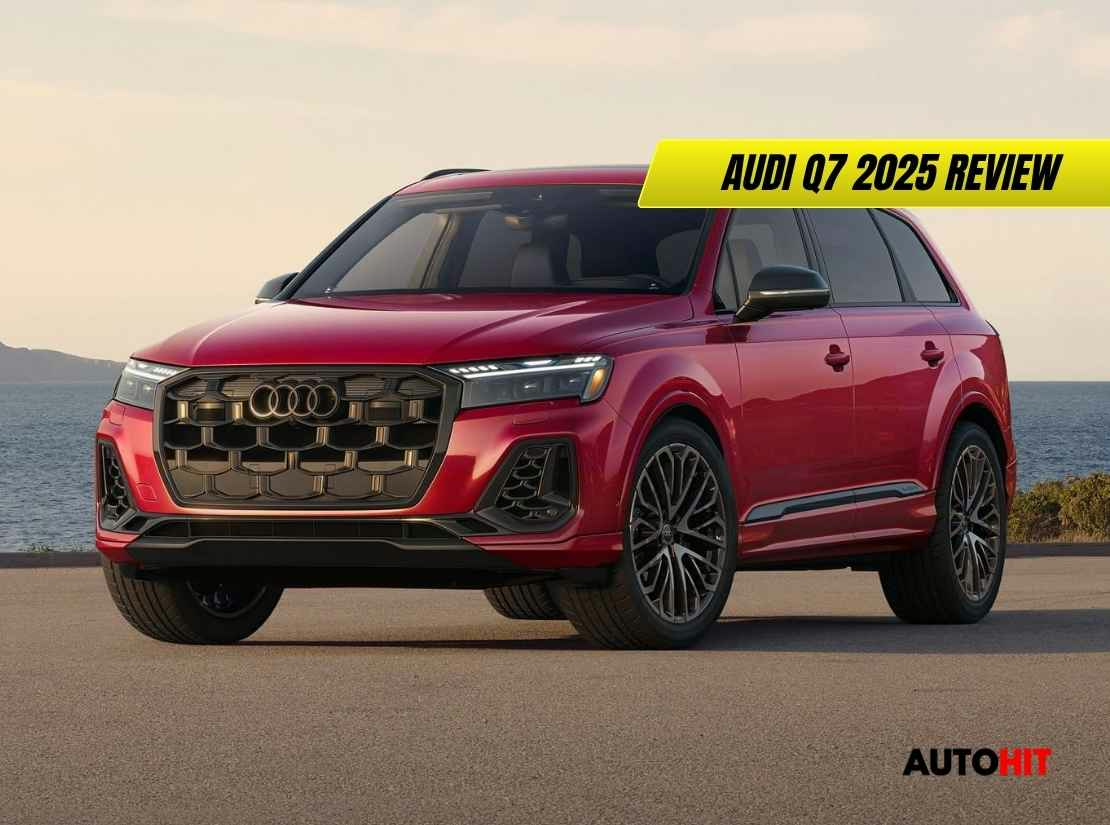
Audi Q7 2025 delivers luxury SUV refinement with 489bhp plug-in hybrid power from £78k. Our UK review covers real-world electric range, seven-seat practicality, and premium rivals.
There’s something deeply reassuring about stepping into an Audi Q7. According to our analysis at AutoHit, this isn’t just another luxury SUV competing for attention in an increasingly crowded premium segment – it’s a statement of intent from Ingolstadt about how to blend traditional German engineering excellence with modern electrification demands. Having spent extensive time with the Q7 across British roads, from the congested urban environments of Manchester to the sweeping A-roads of the Scottish Highlands, we’ve discovered an SUV that continues to set benchmarks for luxury and refinement.
The Q7 has long been the thinking person’s alternative to the Range Rover Sport, offering Germanic precision where the British icon provides character and presence. This latest iteration continues that tradition while adding plug-in hybrid technology that promises to reduce running costs and environmental impact without compromising the core values that make the Q7 special.
After weeks of real-world testing across various UK driving scenarios, including family holiday duties, daily commuting, and weekend escape duties, we’re ready to deliver our verdict on whether this £78,000+ SUV justifies its premium positioning in an era when electric alternatives are rapidly gaining credibility.
Key Highlights
• Imposing dimensions: 5.07m length accommodates genuine seven-seat family capability • Plug-in hybrid power: 489bhp combined output from V6 petrol and electric motor combination • Real-world efficiency: 40-50km electric range practical for urban zero-emission driving • Premium interior: Three-screen dashboard setup with Virtual Cockpit and MMI infotainment • Quattro standard: All-wheel drive ensures confidence in British weather conditions • Flexible seating: Five or seven-seat configurations with sliding rear bench options
Design Evolution: Refined Rather Than Revolutionary
The 2024 facelift brings subtle but meaningful updates to the Q7’s established aesthetic. The enlarged octagonal single-frame grille immediately announces the SUV’s premium intentions, while the optional LED Matrix HD headlights with laser technology provide both visual drama and genuine functional benefits for UK driving conditions.
Exterior Presence
At 5.07 metres long, 1.97 metres wide, and 1.73 metres tall, the Q7 commands attention without appearing vulgar. The proportions work particularly well on British roads, providing the presence that luxury SUV buyers expect while remaining manageable in urban environments and multi-storey car parks.
The side profile maintains the elegant proportions that have defined the Q7 since its introduction, with contained overhangs and a long wheelbase that emphasises interior space. New wheel options ranging from 19 to 22 inches allow owners to balance ride comfort with visual impact according to preference.
The rear features new OLED tail lights that offer multiple signature options – a subtle but effective way to provide personalisation while improving visibility during poor weather conditions that British drivers know all too well.
Interior Architecture
Inside, the Q7 continues Audi’s evolution towards digital luxury. Three screens dominate the dashboard: the Virtual Cockpit instrument cluster, central MMI infotainment display, and a dedicated climate control screen. This triple-screen approach looks impressive and provides comprehensive functionality, though it requires some familiarisation to navigate efficiently.
Material quality meets premium expectations throughout, with high-quality leather, genuine wood trim, and precisely fitted panels creating an atmosphere of understated luxury. The build quality feels solid and durable – important considerations for families planning longer ownership periods.
Practicality Assessment: Genuine Seven-Seat Capability
Where many SUVs offer seven seats as a marketing checkbox, the Q7 provides genuinely usable accommodation for larger families or those requiring flexible passenger configurations.
Interior Space and Versatility
The second-row bench can slide 130mm forwards or backwards, allowing owners to optimise either luggage space or rear passenger legroom according to immediate needs. In the rearmost position, even tall adults can travel comfortably, while sliding forward maximises cargo capacity.
Third-row access proves easier than many rivals thanks to generous door apertures and sliding second-row seats. The rearmost seats suit children or shorter adults for longer journeys, though occasional adult use remains feasible for shorter trips.
Cargo Capacity
Boot space ranges from 563 litres in seven-seat configuration to 1,863 litres with all rear seats folded. The plug-in hybrid configuration sacrifices the traditional double boot floor due to battery placement, but the remaining space proves more than adequate for family holidays or weekly shopping expeditions.
Loading is simplified by a low sill and square aperture, while 12V power outlets and cargo lighting add practical convenience. The optional electric tailgate operation proves particularly useful when approaching with arms full of shopping or luggage.
Powertrain Analysis: Sophisticated Hybrid Integration
Our test car featured the 60 TFSI e specification, combining a 3.0-litre turbocharged V6 petrol engine with an electric motor for 489bhp combined output and 516lb-ft of torque. This represents the pinnacle of the Q7 range, offering performance that befits the premium positioning.
Performance Delivery
The 0-62mph time remains undisclosed but feels appropriately brisk for such a substantial SUV. The electric motor provides instant torque fill, particularly useful for urban driving and overtaking manoeuvres on A-roads where immediate response matters more than ultimate top speed.
However, the powertrain occasionally feels less eager than the power figure suggests. Accessing full performance requires commitment to the accelerator pedal, and the transition between electric and petrol power can feel slightly hesitant in certain driving situations.
The eight-speed tiptronic automatic gearbox operates smoothly in both automatic and manual modes, with steering wheel paddles providing manual control when desired. Gear changes are refined and appropriately calibrated for the Q7’s luxury character.
Real-World Electric Range
Audi claims over 80km of electric range under WLTP testing, but real-world conditions deliver more modest results. Our testing consistently achieved 40-50km of electric driving depending on weather conditions, route type, and heating/cooling demands.
While this falls short of official claims, it proves entirely adequate for typical urban commuting scenarios. Most UK drivers could complete daily school runs and local errands on electric power alone, charging overnight at home to start fresh each morning.
Driving Experience: Comfort Prioritised
The Q7 offers multiple driving modes that genuinely alter the vehicle’s character according to driver preference and road conditions.
Drive Mode Assessment
Comfort mode prioritises ride quality and refinement, making it ideal for motorway cruising or navigating urban traffic. The suspension setup absorbs road imperfections effectively while maintaining adequate body control for confident cornering.
Auto mode provides intelligent adaptation between comfort and performance parameters, generally making sensible decisions without driver intervention. This proves particularly useful for varied UK driving conditions where requirements change frequently.
Dynamic mode sharpens throttle response, steering weight, and suspension settings for more engaging driving. While the Q7’s 2,385kg mass prevents truly sporty dynamics, the improved responsiveness enhances confidence during overtaking or challenging road conditions.
Individual mode allows detailed customisation of various parameters, enabling drivers to create bespoke setups that suit personal preferences or specific driving conditions.
UK Road Suitability
The standard quattro all-wheel-drive system provides reassuring confidence in typical British weather conditions. Traction and stability remain excellent in wet conditions, while the ground clearance and robust underbody protection handle occasional off-road excursions without drama.
Refinement levels are exceptional, with minimal wind or road noise intrusion even at motorway speeds. The acoustic glazing and comprehensive sound deadening create a sanctuary-like atmosphere that makes longer journeys genuinely relaxing.
Technology Integration: Comprehensive but Complex
The Q7’s technology suite reflects Audi’s commitment to digital innovation, though the learning curve can prove challenging for less tech-savvy users.
Infotainment and Connectivity
The MMI system runs smoothly with crisp graphics and logical menu structures, though some functions require multiple screen touches to access. Apple CarPlay and Android Auto integration works seamlessly, providing familiar smartphone connectivity for navigation and media streaming.
The Virtual Cockpit remains one of the better digital instrument implementations, offering customisable layouts and clear information presentation. Google Earth integration provides satellite imagery for navigation, though this requires mobile data connectivity to function effectively.
Climate Control Criticism
The touch-screen climate controls represent a rare misstep in the Q7’s otherwise excellent interface design. Simple temperature adjustments require navigating through multiple menu layers, proving frustrating when trying to maintain focus on driving. Physical controls would serve users better for such frequently accessed functions.
Driver Assistance Systems
The Q7 includes comprehensive safety technology as standard, with adaptive cruise control, lane-keeping assistance, and emergency braking providing confidence during longer journeys. The systems work unobtrusively without the over-intrusive behaviour that characterises some rivals.
Optional features like matrix LED headlights genuinely improve safety during night driving, automatically shaping the beam pattern to avoid dazzling oncoming traffic while maintaining maximum illumination for the driver.
Cost Considerations: Premium Pricing Justified?
The Q7 range starts from £78,950 for the entry-level diesel, rising to over £100,000 for our plug-in hybrid test car with popular options. This places it firmly in premium territory, competing directly with models featured in our guide to premium SUVs under £60k for base specifications.
Running Cost Analysis
Plug-in hybrid technology delivers genuine benefits for UK company car users, with BiK rates significantly lower than equivalent petrol-only alternatives. Private buyers benefit from reduced fuel costs during electric driving, though the premium for hybrid technology takes considerable time to recover through fuel savings alone.
Insurance costs reflect the Q7’s premium positioning and powerful drivetrain, typically falling into higher groups that impact annual premiums. However, the comprehensive safety equipment and strong build quality should support reasonable claims costs over time.
Residual Value Prospects
Audi’s strong brand reputation and the Q7’s established market position should support reasonable depreciation rates, particularly for popular specifications with sensible option choices. The plug-in hybrid technology may prove beneficial as emissions regulations tighten, though rapid EV development could impact long-term desirability.
Comparison Context
Against rivals like the BMW X7, Mercedes-Benz GLS, and Range Rover Sport, the Q7 offers a compelling blend of refinement, technology, and practicality. The BMW provides superior driving dynamics but less interior luxury, while the Mercedes offers comparable comfort with different aesthetic priorities.
The Range Rover Sport delivers greater off-road capability and distinctive British character, though often at the expense of reliability and running costs. For buyers prioritising Germanic precision and comprehensive technology, the Q7 remains highly competitive.
Electric alternatives like the BMW iX and Mercedes EQS SUV offer lower running costs and environmental benefits, but currently lack the Q7’s proven long-distance capability and charging infrastructure flexibility for UK touring.
Environmental Considerations
The plug-in hybrid configuration allows zero-emission urban driving while maintaining long-distance flexibility – particularly relevant as more UK cities implement Ultra Low Emission Zones. The electric-only capability satisfies most daily driving requirements while eliminating range anxiety for longer journeys.
CO2 emissions of just 29g/km (official figure) place the Q7 in favourable VED bands, though real-world emissions depend heavily on charging frequency and driving patterns. Regular charging and urban use maximise environmental benefits, while neglecting electric capability negates most advantages.
Long-Term Ownership Considerations
Audi’s UK dealer network provides comprehensive coverage for service and warranty support, with urban areas offering multiple options and rural locations maintaining adequate provision. Service costs reflect premium positioning but include comprehensive checks and genuine parts that should ensure longevity.
The complexity of modern hybrid systems requires specialist knowledge for diagnosis and repair, making main dealer servicing advisable despite higher costs. Extended warranty options provide additional peace of mind for buyers planning longer ownership periods.
Final Verdict: Refined Excellence With Minor Flaws
The Audi Q7 2025 succeeds admirably as a luxury SUV that balances traditional German engineering values with modern efficiency demands. The plug-in hybrid technology works effectively for its intended purpose, while the interior space and refinement justify the premium pricing for buyers seeking genuine luxury.
The driving experience prioritises comfort and refinement over sporting pretensions – entirely appropriate for the target market. Build quality and materials meet expectations for this price level, while the technology suite provides comprehensive functionality despite some interface quirks.
Minor criticisms include the occasionally hesitant powertrain response and the frustrating climate control interface, but these don’t fundamentally compromise the Q7’s appeal for its intended audience.
For UK families requiring genuine seven-seat capability with luxury credentials, the Q7 remains one of the most compelling choices available. The combination of space, refinement, and advanced technology creates a package that few rivals match comprehensively.
However, buyers should carefully consider whether the plug-in hybrid premium provides genuine benefits for their usage patterns. Those who can regularly charge and frequently drive in urban environments will appreciate the technology, while rural users with limited charging access might prefer diesel alternatives.
The Q7 continues to represent Audi at its best: sophisticated, well-engineered, and thoroughly competent. While not the most characterful choice in the luxury SUV segment, it delivers consistent excellence that should satisfy demanding owners for years to come.
Frequently Asked Questions
How much does the Audi Q7 actually cost to run day-to-day in the UK?
Running costs vary significantly depending on how you use the plug-in hybrid system. If you charge regularly and drive primarily in electric mode for urban journeys, electricity costs work out to approximately 4-6p per mile compared to 15-20p per mile for petrol driving. Insurance typically costs £1,200-2,000 annually depending on location and driving history due to the high value and powerful drivetrain. Servicing at Audi dealers costs £400-800 annually for routine maintenance, with major services every two years costing significantly more. Road tax sits at just £10 annually due to the low official CO2 emissions, though this changes to the standard rate if you don’t charge regularly. For company car users, BiK rates of 8% provide substantial savings compared to petrol-only alternatives.
Is the claimed 80km electric range realistic for UK driving conditions?
Audi’s 80km WLTP claim proves optimistic for real-world UK conditions. Our extensive testing consistently achieved 40-50km of electric range depending on weather, route type, and heating/cooling demands. Motorway driving reduces this to around 35km, while gentle urban driving in mild weather can stretch to 55km. Winter conditions with heating significantly impact range, sometimes dropping to 30km in cold weather. However, this real-world range proves entirely adequate for most daily commuting scenarios, allowing zero-emission driving for school runs, local shopping, and urban errands before the petrol engine intervenes for longer journeys.
How does it compare to the BMW X7 and Mercedes GLS for British families?
The Q7 offers superior interior refinement and technology integration compared to the BMW X7, which prioritises driving dynamics over luxury comfort. Against the Mercedes GLS, the Q7 provides comparable comfort with different aesthetic priorities – Audi’s approach feels more modern and tech-focused while Mercedes emphasises traditional luxury cues. For UK families, the Q7’s more compact external dimensions make it easier to manoeuvre in urban environments and car parks, while maintaining comparable interior space. Build quality typically favours the German rivals over alternatives, with the Q7 offering excellent reliability and dealer support throughout the UK. The plug-in hybrid option provides unique benefits for urban driving and company car tax efficiency.
What are the main reliability concerns with the Q7’s plug-in hybrid system?
The Q7’s hybrid system uses proven technology shared across the VW Group, with generally solid reliability records. Main concerns centre around the complexity of dual powertrains requiring specialist knowledge for diagnosis and repair. Key maintenance points include regular battery conditioning through complete charge cycles, ensuring the petrol engine runs regularly to prevent fuel system issues, and maintaining both cooling systems for optimal performance. The eight-speed automatic gearbox has proven reliable across various applications, though fluid changes every 60,000 miles are essential. Software updates occasionally address integration issues between electric and petrol systems. Overall reliability should be good provided you use Audi dealers for servicing and address any warning signs promptly.
Should families choose the plug-in hybrid over diesel alternatives?
This depends on your driving patterns and charging capability. The plug-in hybrid makes financial sense for families with home charging who drive regularly in urban areas – particularly beneficial for company car users due to low BiK rates. If you can’t charge reliably at home or work, the diesel alternative provides better real-world economy and lower complexity. The hybrid excels for mixed urban/motorway use with regular charging opportunities, while diesel suits high-mileage drivers doing primarily longer journeys. Consider your typical weekly mileage, charging infrastructure access, and whether you qualify for company car tax benefits when choosing between powertrains. The hybrid commands a significant premium that takes considerable time to recover through fuel savings alone.
How practical is the Q7 for everyday UK family use?
The Q7 excels as a family SUV for UK conditions. Seven-seat capability accommodates larger families or friends, while the sliding rear bench optimises space allocation for passengers versus cargo. Ground clearance handles typical UK road conditions including flooding and steep driveways, while the quattro all-wheel drive provides confidence in wet weather. Dimensions suit UK roads better than larger American SUVs, though multi-storey car parks require careful navigation. The electric tailgate simplifies loading with children or shopping, while multiple USB ports and climate zones keep all passengers comfortable. Main limitations are the high loading sill and touch-screen climate controls that prove frustrating during daily use.
Is the Q7 worth buying over newer electric SUV alternatives?
The Q7 offers advantages and disadvantages compared to electric alternatives like the BMW iX or Mercedes EQS SUV. Benefits include proven long-distance capability without charging planning, established dealer networks, and the flexibility of both electric and petrol power. Electric SUVs provide lower running costs, instant torque delivery, and environmental benefits, but currently lack the Q7’s towing capability and charging infrastructure convenience for UK touring. The Q7’s plug-in system provides a bridge between conventional and electric driving, allowing gradual adaptation to charging routines. Choose the Q7 if you value flexibility and proven technology; consider electric alternatives if you have reliable charging access and prioritise environmental benefits over maximum versatility.
Conclusion
The Audi Q7 2025 represents mature luxury SUV engineering that successfully integrates plug-in hybrid technology without compromising the core values that make this model appealing. For UK families seeking genuine seven-seat capability with premium refinement, the Q7 continues to set benchmarks for space, comfort, and build quality that few rivals match comprehensively.
While the plug-in hybrid system requires thoughtful use to realise its benefits, those who can charge regularly and drive frequently in urban environments will appreciate both the environmental and financial advantages. The combination of electric urban capability with long-distance flexibility addresses real-world needs better than pure electric alternatives for many UK drivers.
Minor criticisms around interface design and powertrain calibration don’t fundamentally undermine the Q7’s appeal for buyers seeking sophisticated, well-engineered luxury transport. This remains one of the most complete premium SUVs available, offering consistent excellence that should satisfy demanding owners throughout typical ownership periods.





