
Standing in a Jeep dealership contemplating whether the Renegade’s compact dimensions can accommodate a growing family’s needs, or wondering if its rugged styling comes at the expense of practical everyday usability, represents a common dilemma for UK buyers attracted to this characterful small SUV. The Renegade promises the authentic Jeep experience in a city-friendly package, but how does its storage capacity and interior space stack up against fierce competition in Britain’s crowded compact SUV segment?
Having extensively tested the Renegade’s practicality across various UK conditions at AutoHit, we’ve found it represents an interesting compromise between genuine off-road capability and urban usability. While its boxy styling maximises interior volume compared to sleeker rivals, the reality of 351 litres boot space places it firmly in the middle of a competitive field where every litre matters for family buyers.
The Renegade’s Italian heritage (built alongside the Fiat 500X in Melfi) shows in thoughtful interior packaging that prioritises functionality over flashiness, though the execution doesn’t always match the ambition. Understanding exactly what this compact Jeep offers – and where it falls short – becomes crucial for buyers considering it against alternatives like the Ford Puma, Skoda Kamiq, or Honda HR-V.
With prices starting around £33,000 new and solid used availability from £5,000, the Renegade targets buyers who want authentic SUV character without full-size penalties, but the boot space reality requires careful consideration against family requirements and alternative options.
Key Highlights: Essential Jeep Renegade Practicality Facts
• Boot Capacity: 351 litres with seats up (330 litres for 4xe hybrid), expanding to 1,227-1,297 litres with rear seats folded • Overall Dimensions: 4.24m long × 1.81m wide × 1.67m high – compact enough for city use while maximising interior space through boxy design • Seating Configuration: Five seats with priority given to two outer rear positions; middle rear seat best suited for children • Loading Features: 760mm loading height, reversible wipe-clean boot floor, adjustable height storage, space for spare wheel (even on 4xe) • Towing Capacity: Ranges from 1,150kg (4xe) to 1,450kg (1.3-litre automatic), making it suitable for modest trailer applications • Storage Compromises: Plug-in hybrid loses 20 litres boot space to AC/DC converter, while thick pillars and chunky styling reduce interior space efficiency
Boot Space Analysis: Capacity, Usability, and Real-World Performance
The Renegade’s boot represents a study in compact SUV compromises, where exterior dimensions and mechanical packaging limit absolute capacity while thoughtful design attempts to maximise practical usability.
Standard Boot Capacity and Configuration
Volume and Shape Analysis
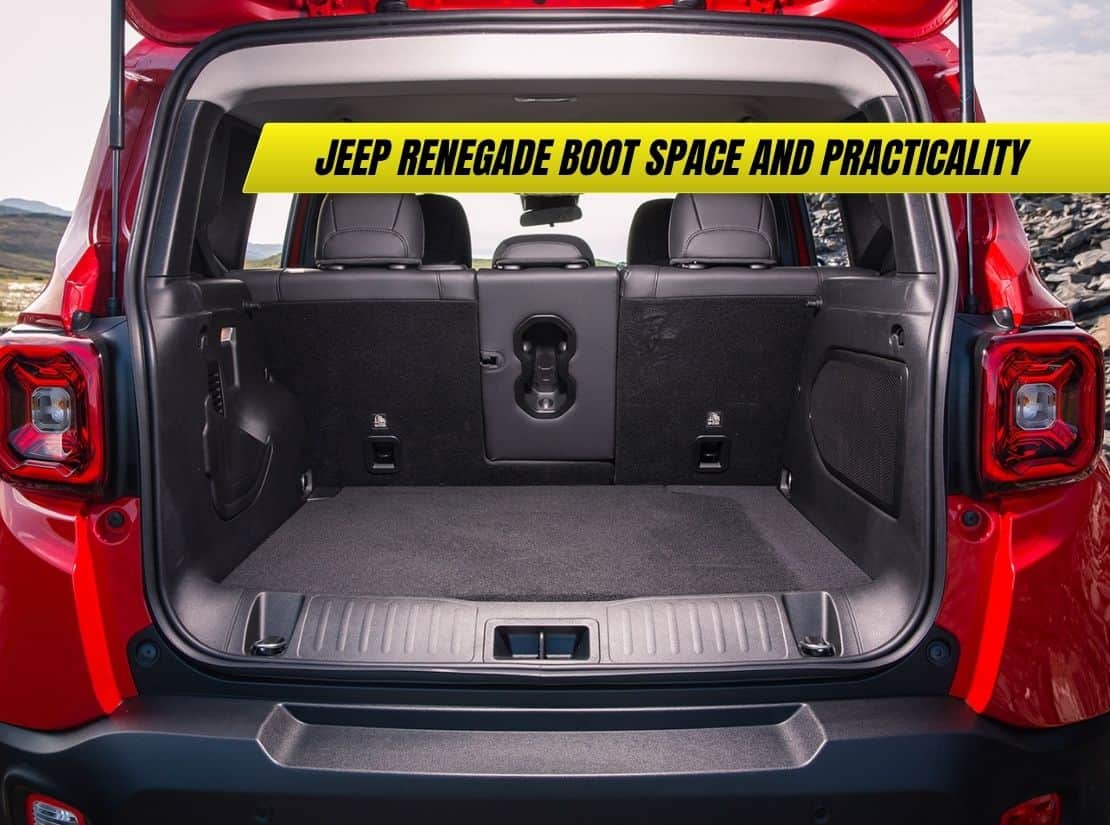
The Renegade’s 351-litre boot (regular models) falls into the middle tier of compact SUV offerings, significantly trailing class leaders like the Ford Puma (456 litres) and Skoda Kamiq (400 litres) while matching alternatives like the Seat Arona (350 litres).
The boot’s flat, wide shape compensates partially for limited volume, enabling efficient packing of regular-shaped items and making the most of available space. The relatively low loading height of 760mm assists heavy item loading compared to some taller SUV rivals.
However, the plug-in hybrid 4xe model sacrifices 20 litres to 330 litres due to the AC/DC converter positioning, placing it at a disadvantage compared to some hybrid rivals that better integrate their electrical systems.
Practical Loading Features
Innovative Storage Solutions
The Renegade includes several thoughtful touches that enhance everyday usability beyond basic capacity figures. The reversible boot floor provides a wipe-clean surface on one side for muddy boots or wet dogs – appropriate for a vehicle with genuine off-road pretensions.
Height-adjustable boot floor sections enable load space optimisation for different item types, while the spare wheel location (retained even on the 4xe hybrid) avoids the space penalties that affect many modern vehicles forced to use puncture repair kits.
Storage nets and pockets provide organisation for smaller items, though higher-specification models sacrifice some space to subwoofer mounting for premium audio systems.
Access and Usability
The wide-opening tailgate facilitates large item loading, including bicycles and furniture, though the boot lip can create challenges when sliding heavy items across the threshold. The boxy exterior design aids visibility during parking and loading operations.
However, the relatively narrow overall width (1.81m) and thick C-pillars can make judging available space challenging when loading bulky items that approach the boot’s dimensional limits.
Interior Space and Passenger Accommodation
The Renegade’s boxy exterior translates to generous headroom and a commanding driving position, though overall interior space efficiency suffers compared to more optimised compact SUV designs.
Front Seat Accommodation
Driver and Passenger Experience
Front seat space impresses with generous headroom and shoulder space that exceeds expectations for the Renegade’s compact exterior dimensions. The high seating position provides excellent visibility over traffic while maintaining a traditional SUV driving experience.
However, seat support falls short of premium expectations, with longer journeys potentially causing discomfort particularly for the driver. The clutch pedal positioning (manual models) sits slightly high, potentially causing left knee strain during extended driving periods.
Storage solutions throughout the cabin include practical touches like a dedicated smartphone holder, multiple USB charging points, and various cubbyholes for everyday items, though door bin space is limited due to speaker positioning.
Rear Seat Reality
Adult and Child Accommodation
The rear seats clearly prioritise the two outer positions, with the middle seat best reserved for children due to limited width and cushioning. However, the low central tunnel (unlike many 4×4 vehicles) enables three-across seating when necessary.
Knee room disappoints for tall passengers, with limited space behind standard driving positions. While headroom remains generous due to the boxy roofline, overall rear space falls short of competitors like the Skoda Kamiq or Honda HR-V.
The wide-opening rear doors assist access, particularly important for child seat installation, while ISOFIX mounting points on outer seats meet family requirements for younger passengers.
Load Space Extension and Flexibility
Understanding the Renegade’s full storage potential requires examining seat-folding configurations and maximum capacity scenarios that transform the compact SUV into a capable load carrier.
Seat Folding Configurations
Standard 60/40 vs Optional 40/20/40 Split
Standard models include 60/40 split-folding rear seats that provide reasonable flexibility for carrying passengers alongside longer items. The optional 40/20/40 split (available on higher trim levels) enhances versatility by enabling ski-pass-through or mixed passenger/cargo configurations.
With rear seats completely folded, total capacity ranges from 1,227 litres (4xe) to 1,297 litres (standard models) – sufficient for large appliances, furniture items, or substantial holiday luggage for family trips.
The relatively flat load floor when seats are folded aids practical loading, though the folded seat backs don’t create a completely level surface due to packaging constraints.
Maximum Load Scenarios
Real-World Capacity Applications
The maximum load space can accommodate items like washing machines, large furniture pieces, or extensive camping equipment for family adventures. The retained spare wheel doesn’t significantly compromise maximum capacity compared to vehicles using space-saver arrangements.
However, the narrow overall width (1.81m interior) can limit large, wide items that might fit in wider alternatives like the Honda HR-V or larger SUV categories.
Load capacity must be balanced against payload limits (typically 400-500kg), making weight distribution important for dense items like building materials or gardening supplies.
Hybrid and Electric Variants: Space Compromises
The Renegade’s electrified versions demonstrate thoughtful integration that minimises space penalties while maintaining practical functionality often compromised in hybrid SUV designs.
4xe Plug-In Hybrid Packaging
Battery and System Integration
The 4xe’s battery pack positioning under rear seats avoids major boot space compromises while the electric motor mounting in the rear axle maintains drivetrain compactness. The main space penalty comes from the 20-litre reduction due to AC/DC converter placement.
Remarkably, the 4xe retains spare wheel provision – unusual for plug-in hybrids that typically sacrifice this feature for electrical component storage. This practical consideration enhances the vehicle’s utility compared to many electrified competitors.
The integration demonstrates Stellantis’ experience with hybrid packaging, avoiding the major compromises that affect some plug-in hybrid SUVs where battery placement significantly reduces passenger or cargo space.
e-Hybrid Self-Charging System
Minimal Space Impact
The newer e-Hybrid self-charging system shows even better space integration, with electrical components hidden in the central tunnel without affecting boot or passenger space compared to pure petrol models.
This packaging demonstrates the benefits of purpose-designed hybrid systems versus retrofitted solutions, enabling the environmental benefits of hybridisation without practical penalties.
Towing and Load Carrying Capability
The Renegade’s towing capacity varies significantly across the engine range, reflecting different mechanical configurations and cooling requirements that affect trailer applications.
Towing Capacity Across the Range
Engine-Specific Limits
Towing capacity ranges from 1,150kg (4xe plug-in hybrid) to 1,450kg (1.3-litre automatic), with the base 1.0-litre manual achieving 1,250kg. These figures suit modest trailer applications including small caravans, boat trailers, or equipment transport.
The 4xe’s reduced towing capacity reflects the additional complexity of managing both engine and electric motor cooling under sustained high loads, though 1,150kg remains adequate for many recreational applications.
The discontinued 2.0-litre diesel previously offered 1,500kg capacity but current engine options prioritise efficiency over maximum towing capability.
Practical Towing Considerations
Real-World Performance
While the Renegade can legally tow within its capacity limits, the combination of compact dimensions and relatively modest power outputs means towing feels more effortful compared to larger SUVs with higher power reserves.
The 4xe’s electric assistance can provide useful low-speed torque for trailer manoeuvring and hill starts, though sustained motorway towing will rely primarily on the petrol engine with corresponding fuel consumption increases.
Wind resistance from the boxy body shape becomes more apparent when towing, affecting both fuel economy and stability compared to more aerodynamic alternatives.
Storage Solutions and Interior Practicality
Beyond basic boot and seating space, the Renegade’s interior design includes various storage solutions that enhance everyday usability for UK families and active lifestyle users.
Interior Storage Features
Everyday Item Accommodation
The cabin includes multiple storage solutions designed for modern connectivity and convenience requirements. A dedicated smartphone holder, multiple USB charging points, and auxiliary connections cater to digital device needs.
Cup holders and small item storage throughout the cabin address family requirements, though door bin space is limited compared to some rivals due to speaker positioning and chunky door panel design.
The glovebox provides adequate documentation storage while centre console areas offer reasonable space for wallets, keys, and daily essentials without cluttering the driving environment.
Lifestyle Equipment Storage
Outdoor Activity Support
The Renegade’s outdoor-focused positioning is supported by practical touches like the reversible boot floor that handles muddy boots, wet sports equipment, or gardening supplies without interior damage concerns.
Optional roof rail systems enable roof box or bike carrier mounting for equipment that exceeds interior capacity, though the relatively low roof height aids loading compared to taller SUV alternatives.
The spare wheel retention enables remote area confidence without sacrificing storage space to puncture repair kits that may prove inadequate for serious off-road punctures.
Competitor Comparison: How the Renegade Stacks Up
Understanding the Renegade’s practicality requires comparison with direct rivals in the increasingly competitive compact SUV segment where space efficiency varies dramatically.
Direct Compact SUV Rivals
Class-Leading Space Champions
The Ford Puma leads the class with 456 litres boot capacity, demonstrating superior space packaging compared to the Renegade’s 351 litres. The Puma’s clever interior design and “MegaBox” under-floor storage create significant practical advantages.
The Skoda Kamiq offers 400 litres plus superior rear passenger space, making it more family-friendly for buyers prioritising passenger accommodation over off-road capability.
The Honda HR-V provides class-leading rear space through clever seat folding mechanisms and efficient packaging, though it lacks the Renegade’s off-road credentials and character.
Character-Focused Alternatives
Style vs Substance Trade-offs
The Mini Countryman offers similar premium positioning and individual character but with even more compromised space efficiency and significantly higher running costs.
The Suzuki Vitara provides genuine 4×4 capability in a similar size package with competitive space efficiency, though without the Renegade’s brand appeal or interior sophistication.
The Seat Arona matches the Renegade’s boot capacity while offering sharper on-road dynamics, though lacking authentic off-road capability for buyers prioritising adventure potential.
UK Market Considerations and Value Analysis
The Renegade’s position in the UK market reflects both its authentic character appeal and practical limitations that affect its suitability for different buyer profiles.
Pricing and Value Proposition
New Car Positioning
Current Renegade pricing starts around £33,000, positioning it at the premium end of the compact SUV segment while competing with larger, more spacious alternatives in higher categories.
The pricing reflects comprehensive standard equipment including advanced safety features, quality interior materials, and genuine off-road capability that differentiate it from purely urban-focused competitors.
However, the price premium versus more space-efficient alternatives requires careful justification based on individual priorities including off-road capability, brand appeal, and character preferences.
Used Market Opportunities
Depreciation and Availability
Strong depreciation creates attractive used market opportunities, with decent examples available from around £5,000-8,000 for older models, making the Renegade accessible to buyers who couldn’t justify new car pricing.
The relatively low UK sales volumes mean used availability varies regionally, though sufficient stock exists for serious buyers willing to travel for the right specification.
Reliability concerns (Jeep ranked poorly in recent UK satisfaction surveys) make thorough inspection and warranty considerations important for used purchases.
Jeep Renegade Practicality FAQ: UK Family Questions
Is the Jeep Renegade big enough for a family of four?
The Renegade can accommodate a family of four, but with limitations. Two adults and two children fit comfortably, with ISOFIX points for child seats and reasonable rear headroom. However, rear legroom is tight for adults, and the 351-litre boot struggles with larger families’ luggage needs – you’ll likely need roof storage for holiday trips. Three children across the rear bench is possible but cramped. If your children are small and you prioritise character over space, it works, but larger families should consider the Ford Puma (456L boot) or Honda HR-V (superior rear space).
How does the boot space compare to popular alternatives?
The Renegade’s 351-litre boot sits in the middle of the compact SUV class. It’s significantly smaller than the Ford Puma (456L), Skoda Kamiq (400L), and Honda HR-V’s clever folding seats, but matches the Seat Arona (350L). The plug-in hybrid 4xe reduces this to 330L. While the boot is well-shaped and practical with its reversible floor, you’re definitely making space sacrifices for the Renegade’s character and off-road capability compared to more space-efficient rivals.
Can you fit a pushchair and weekly shopping in the boot?
Yes, a single pushchair and reasonable weekly shopping will fit, though it might be tight with a large double buggy. The Renegade’s wide boot opening helps with pushchair loading, and the flat shape means you can pack shopping around it efficiently. However, families with multiple pushchairs, sports equipment, or substantial shopping loads will find the space limiting. The boot’s practical features like the wipe-clean floor help with messy family life, but absolute capacity lags behind more family-focused alternatives.
What’s the difference between the regular and hybrid versions for boot space?
The standard petrol/diesel Renegade offers 351 litres boot space, while the 4xe plug-in hybrid reduces this to 330 litres due to the AC/DC converter. That’s a 21-litre reduction – roughly equivalent to a small suitcase. However, the 4xe remarkably retains the spare wheel (unusual for plug-in hybrids) and maintains underfloor storage. The e-Hybrid self-charging model doesn’t reduce boot space at all. Unless you absolutely need maximum capacity, the hybrid space penalty is manageable for most users.
How practical is the Renegade for outdoor activities and equipment?
The Renegade excels for outdoor activities despite limited space. The reversible wipe-clean boot floor handles muddy boots and wet gear, while roof rails enable bike racks or roof boxes for additional equipment. The retained spare wheel provides remote area confidence, and genuine 4×4 capability (on Trailhawk models) enables access to outdoor locations that challenge other compact SUVs. However, you’ll need careful packing for camping gear or multiple bikes – the narrow width limits some equipment configurations that larger SUVs accommodate easily.
Is rear passenger space adequate for adults on longer journeys?
Rear passenger space is the Renegade’s weak point for adult passengers. While headroom is generous, legroom behind a normally positioned driver’s seat is tight for adults over 5’8″. The wide-opening doors help access, and the low central tunnel allows three-across seating occasionally, but longer journeys become uncomfortable for adult rear passengers. It’s genuinely best suited for two adults plus children, or four adults on shorter trips only. The Honda HR-V or Skoda Kamiq provide significantly superior rear adult accommodation.
How does the boot access and loading height compare to other SUVs?
The Renegade’s 760mm loading height is reasonable for a compact SUV – lower than taller rivals but higher than hatchback-based alternatives. The wide tailgate opening aids large item loading, though the boot lip can make sliding heavy items challenging. The squared-off design helps with space utilisation and loading judgment compared to sloping coupe-SUV designs. However, the relatively narrow width (1.81m) can limit wide items that fit in broader alternatives. Overall, it’s functional rather than exceptional for loading convenience.
Regional UK Considerations and Ownership Patterns
The Renegade’s appeal varies significantly across different UK regions and usage patterns, reflecting both its authentic off-road capability and practical limitations in various contexts.
Urban vs Rural Suitability
City Driving Considerations
The Renegade’s compact 4.24m length aids urban parking and maneuvering, while the upright driving position provides good visibility in traffic. However, the firm suspension tuning and road noise levels make it less refined than urban-focused alternatives for daily city commuting.
The squared-off body aids parking judgment though the relatively narrow width can limit loading in tight urban parking spaces. Fuel economy in stop-start traffic falls short of more efficient hybrid alternatives.
Rural and Outdoor Applications
Rural buyers appreciate the Renegade’s genuine off-road capability and higher ground clearance for farm tracks and unmade roads. The spare wheel retention and robust construction suit areas where puncture repair kits might prove inadequate.
However, the limited load space can frustrate rural buyers accustomed to larger vehicles for livestock feed, gardening supplies, or farm equipment transport that requires more substantial cargo capacity.
Seasonal Usage Patterns
Holiday and Leisure Applications
The Renegade suits outdoor enthusiasts who prioritise access over absolute load capacity, with roof-mounted storage supplementing the modest boot for camping equipment or sports gear.
However, family holiday packing requires careful planning, with roof boxes almost essential for larger families or extended trips. The narrow interior width can limit equipment loading compared to wider alternatives.
Future Outlook and Model Evolution
The Renegade’s future in the UK market faces challenges from both regulatory pressures and changing buyer preferences that may affect its long-term viability and practicality positioning.
Electrification Timeline
Model Transition Strategy
Stellantis has committed to electrifying its entire range, with the Renegade likely transitioning to full electric propulsion within the next model generation. This transition may address current space compromises through purpose-designed electric architectures.
However, electric vehicle weight and battery packaging could potentially reduce towing capacity and affect load space configuration compared to current combustion engine variants.
Market Competition Evolution
Segment Development Trends
The compact SUV segment continues expanding with increasingly sophisticated alternatives that better balance space efficiency with character appeal, potentially challenging the Renegade’s unique positioning.
Rising fuel costs and ULEZ restrictions in major cities may favour more efficient alternatives over the Renegade’s character-focused approach, affecting its appeal to urban buyers.
Conclusion: Weighing Character Against Compromise in UK Context
The Jeep Renegade occupies a unique position in the UK compact SUV market, offering authentic off-road character and genuine capability in a city-friendly package, but this distinctiveness comes with practical compromises that buyers must carefully consider against their specific requirements and alternative options.
The 351-litre boot capacity places the Renegade firmly in the middle tier of compact SUV practicality, trailing class leaders like the Ford Puma and Skoda Kamiq while matching alternatives like the Seat Arona. However, raw capacity figures don’t reflect the thoughtful design touches like the reversible boot floor and retained spare wheel that enhance real-world usability for outdoor-focused buyers.
The interior space story follows similar patterns, with generous front accommodation and good headroom throughout, but rear legroom that disappoints for adult passengers on longer journeys. The Renegade clearly works best for families with younger children or buyers prioritising driver experience over rear passenger luxury.
From a UK market perspective, the Renegade’s pricing premium requires careful justification against more space-efficient alternatives. New car buyers paying £33,000+ must value the authentic Jeep character, genuine off-road capability, and distinctive styling enough to accept space compromises. However, the used market presents attractive opportunities where depreciation makes the character appeal more accessible.
The hybrid variants demonstrate thoughtful engineering that minimises space penalties while adding efficiency benefits. The 4xe’s 20-litre capacity reduction is manageable for most buyers, while the e-Hybrid maintains full space with improved efficiency. Both options position the Renegade competitively for ULEZ compliance and environmental considerations.
For UK buyers, the Renegade succeeds best when purchased for its strengths rather than despite its weaknesses. Outdoor enthusiasts, rural drivers, and character-conscious buyers who value authenticity over pure efficiency will find it delivers unique appeal that sterile efficiency champions cannot match.
However, buyers prioritising maximum family practicality, refinement, or value-per-litre calculations should seriously consider alternatives like the Honda HR-V, Ford Puma, or Skoda Kamiq that better optimise space efficiency within similar external dimensions.
The Renegade ultimately represents a lifestyle choice disguised as a practical purchase decision. It delivers enough everyday usability for most buyers while providing authentic character and capability that few compact alternatives can match. Success depends on honest assessment of priorities and acceptance that maximum efficiency requires different choices than maximum character.
For the right buyer – someone who values distinctiveness, appreciates genuine off-road capability, and can work within the space limitations – the Renegade offers a unique proposition in an increasingly homogenised market segment. Just ensure you understand exactly what you’re gaining and giving up before committing to this characterful but compromised compact SUV.





