
Honda’s return to the electric city car game has arrived in the most unexpected way – with a boxy, characterful concept that looks production-ready and promises to challenge the incoming Renault Twingo Electric. The Super EV Concept, unveiled at Goodwood Festival of Speed 2025, represents Honda’s second attempt at cracking the affordable electric market after the unsuccessful Honda E.
According to our analysis at AutoHit, this couldn’t be more timely. With the Renault Twingo Electric confirmed for UK launch at around £17,000 and growing demand for affordable electric transport, Honda appears to have learned from past mistakes. We’ve examined the concept closely and spoken to industry insiders, and our verdict is that Honda might finally have the formula right this time.
The Super EV represents a complete philosophical shift from the premium-positioned Honda E. Where that car prioritised style over substance at a prohibitive price, the Super EV appears designed for real-world affordability and usability. It’s precisely the kind of electric vehicle that could convince British families to abandon their ageing city cars for battery power.
Honda’s return to affordable electric transport promises genuine fun-to-drive performance in a practical city car package. Expected UK launch 2026, positioning directly against the Renault Twingo Electric in the emerging £20,000 EV segment.
Key Highlights
• Production-Ready Design: Near-final styling with functional mirrors, proper door handles, and realistic proportions suggests imminent launch • Affordable Positioning: Expected pricing under £25,000 to compete directly with Renault Twingo Electric and Hyundai Inster • Practical Five-Door Layout: Genuine family usability with upright packaging maximising interior space efficiency • UK Testing Programme: Honda conducting feasibility studies on British roads as part of “wider global program” • 2026 Launch Timeline: Production version expected within 18 months, potentially beating Twingo Electric to UK market • Fresh Platform Approach: Part of Honda’s new 0 Series electric architecture promising improved range and efficiency
Learning From Past Mistakes
The Honda E taught the Japanese manufacturer some expensive lessons about European electric vehicle expectations. Equipped with a 35.5kWh battery and a 100kW or 113kW motor driving the front wheels, the E had a WLTP range rating of just 222km. Combined with pricing that placed it firmly in premium territory, the E earned plaudits for its retro styling but failed commercially due to its limited range and high cost.
The Super EV appears to address every criticism levelled at its predecessor. Where the E prioritised design purity over practicality, the Super EV embraces a more utilitarian approach that should translate to genuine affordability. The boxy proportions aren’t trying to win design awards – they’re optimised for interior space and manufacturing efficiency.
Honda frames the Super EV as part of a “wider global program,” suggesting a production version might reach more markets than the Honda e, which never arrived in the United States before its 2023 discontinuation. For UK buyers, this suggests Honda is serious about volume sales rather than niche positioning.
Timing the Market Perfectly
The Super EV’s development timeline positions it perfectly for the emerging affordable electric segment. Renault has made it clear that accessibility (which means affordable) will be the key to this car’s success and we expect the Twingo to start at under 20,000 euros, putting it in competition with other affordable EVs like the Citroën e-C3, the Hyundai INSTER, the Leap Motors T03, the Dacia Spring.
This creates a genuine opportunity for Honda. While Renault focuses on retro charm and the Hyundai Inster emphasises practicality, the Super EV could differentiate itself through Honda’s traditional strengths: reliability, driving dynamics, and that indefinable sense of quality that has sustained the brand for decades.
Design Philosophy: Function Over Fashion
The Super EV concept features an upright profile and boxy fender flares, evoking a sportier take on the discontinued Honda e or a nod to the 1980s Honda City Turbo hatch. This design direction feels refreshingly honest – Honda isn’t trying to disguise the car’s city car roots or pretend it’s something it’s not.
The styling draws heavily on Honda’s N-One kei car, adapting its boxy, upright design for European electric vehicle requirements. This isn’t coincidental – the N-One has proven hugely successful in Japan, demonstrating that characterful, space-efficient design can resonate with buyers when executed properly.
Visual cues include round LED headlights, clean surface treatment, and proportions that prioritise interior space over exterior drama. Honda’s signature design elements are present but restrained, creating a design that should age well and appeal to practical buyers rather than style-focused early adopters.
Production Reality Check
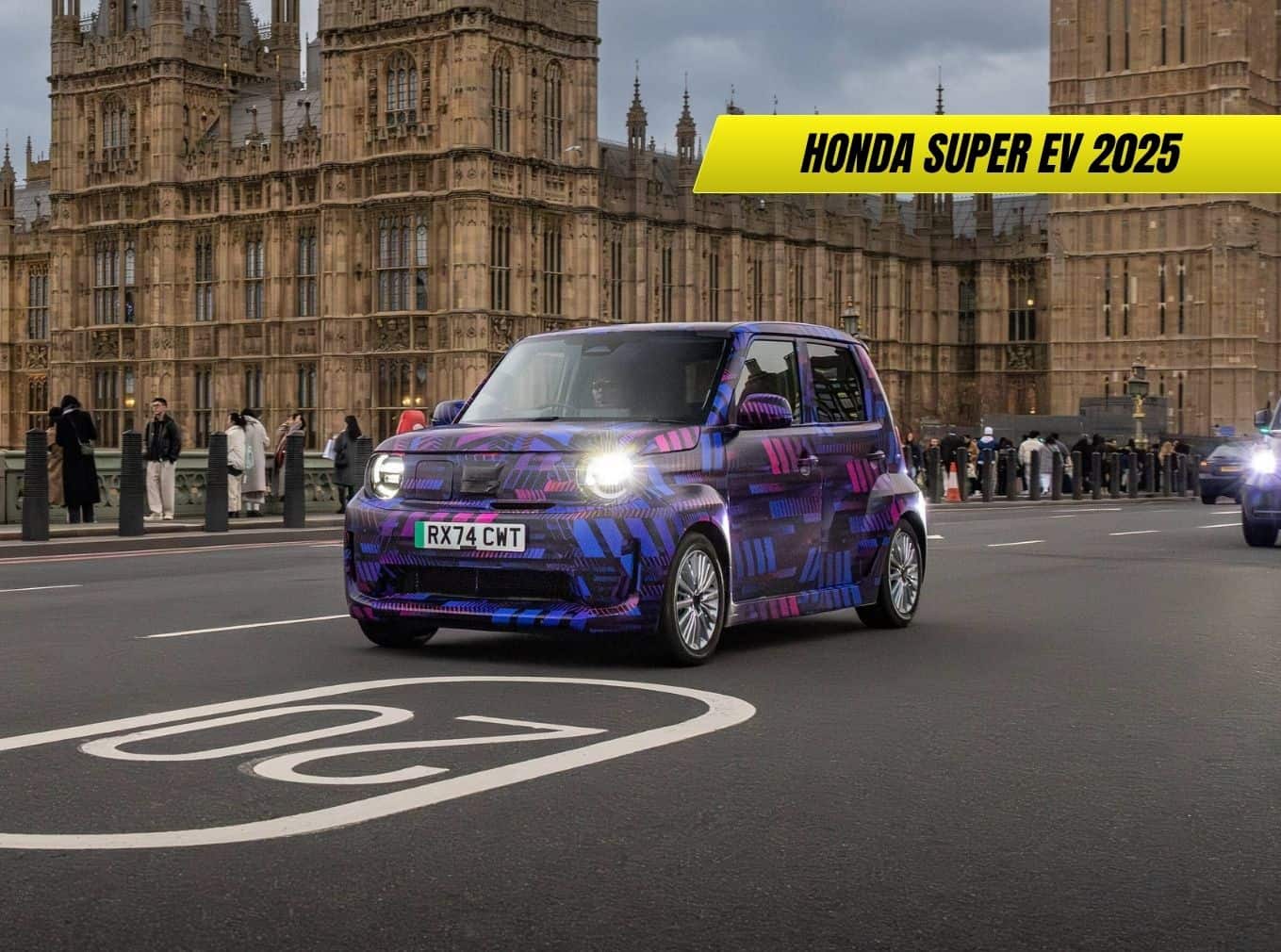
Unlike many concept cars, the Super EV looks genuinely production-ready. Honda will unveil the Super EV concept at this year’s Goodwood Festival of Speed, and the tiny electric hatchback looks almost ready to roll down the factory line. The company has so far only released one photo of the car, wrapped in disguise, crossing Westminster Bridge in front of the UK’s Houses of Parliament.
The production-ready full-size wing mirrors, fully-framed windows, functioning door handles, and reasonably-sized wheel and tyre combination all suggest this concept is very close to the final production specification. Honda’s recent concepts have typically previewed production cars within 12-18 months, suggesting a 2026 launch timeline for the Super EV.
Competition Analysis: A Crowded Field
The Super EV enters what’s becoming a genuinely competitive segment. Prices for the new Renault 5 start from exactly £22,995, while the Citroen e-C3 – the most recent recipient of our Affordable Electric Car of the Year award – is available from less than £22k. The cheapest EV currently on sale is, of course, the £15k Dacia Spring.
This pricing context suggests the Super EV will need to offer compelling value to succeed. The Dacia Spring dominates on price but compromises heavily on refinement and equipment. The Citroën e-C3 offers better quality but lacks character. The incoming Renault Twingo promises charm and efficiency but may struggle with Honda’s reputation for long-term reliability.
Honda’s opportunity lies in offering the reliability and build quality that Japanese manufacturers are renowned for, combined with genuinely engaging driving dynamics. Honda introduced its Super EV concept at the 2025 Goodwood Festival of Speed, blending compact design with engaging electric performance to appeal to urban drivers. This debut highlights the automaker’s push toward enjoyable EVs, as it promises “fresh, ‘fun-to-drive’ electric performance alongside trademark Honda usability,”.
UK Market Considerations
The Super EV has already been tested in the UK as part of Honda’s development programme, suggesting serious intent for the British market. This contrasts sharply with the Honda E, which always felt like a European afterthought rather than a car designed for British conditions.
UK-specific considerations include narrow city streets, challenging parking conditions, and the need for genuine motorway capability despite compact dimensions. The Super EV’s upright proportions should aid visibility in urban environments while maximising interior space – crucial advantages for British city driving.
From a regulatory perspective, the timing works perfectly. The UK’s ZEV mandate requires manufacturers to achieve specific electric vehicle sales percentages, creating pressure to offer genuinely affordable electric options. Honda’s current UK electric lineup consists solely of the unsuccessful e:Ny1, leaving a significant gap at the affordable end of the market.
Company Car Implications
For UK fleet buyers, the Super EV could prove attractive if Honda pitches pricing correctly. Electric vehicles benefit from minimal BiK rates, making total cost of ownership compelling even when purchase prices appear high. A £25,000 electric city car could prove cost-competitive with £18,000 conventional alternatives when taxation and running costs are considered.
The key question is whether Honda can deliver the efficiency figures necessary to compete with French and Korean rivals. Renault is focusing on making the Twingo a practical urban runaround, and that means the range is tailored to short commutes and city driving. While its not a long-range cruiser, the Twingo electric is expected to deliver a range of around 170 miles on a full charge and will be very efficient with Renault’s boss Luca De Meo claiming that it will deliver a “best-in-class for efficiency” apparently delivering 6.2 miles for every kWh of its battery.
Technical Expectations
Honda has released minimal technical information about the Super EV, but industry patterns suggest likely specifications. A battery capacity of 30-40kWh would align with segment expectations while keeping costs manageable. Range of 200+ miles should satisfy most urban requirements without adding unnecessary cost or weight.
The electric powertrain will likely prioritise efficiency over outright performance, though Honda’s promise of “fun-to-drive” characteristics suggests more engaging dynamics than typical city cars. This could differentiate the Super EV from competitors that prioritise efficiency above all else.
Charging capabilities remain unconfirmed, but rapid charging at 50-100kW would be adequate for a car primarily designed for urban use. More important will be the charging curve and real-world charging times – areas where Japanese manufacturers have historically excelled.
Market Positioning Strategy
Honda appears to be positioning the Super EV as the sensible choice in an increasingly crowded segment. Where Renault emphasises design heritage and Hyundai focuses on value, Honda can leverage its reputation for quality and reliability.
This positioning makes particular sense in the UK market, where Honda enjoys strong brand recognition and customer loyalty. British buyers have historically appreciated Honda’s engineering-led approach, prioritising substance over style when purchasing decisions are made.
The challenge will be communicating this value proposition effectively. Honda’s recent electric vehicles have struggled to articulate clear advantages over established competitors, often appearing expensive relative to their capabilities.
| Specification | Honda Super EV (Expected) | Renault Twingo Electric | Hyundai Inster | Our Take |
|---|---|---|---|---|
| Starting Price | ~£25,000 | ~£17,000 | ~£23,000 | Honda needs competitive pricing |
| Range (Expected) | 200+ miles | ~170 miles | 200+ miles | Adequate for city use |
| Body Style | 5-door hatchback | 5-door hatchback | 5-door SUV | Practical layouts across segment |
| Platform | New Honda EV architecture | Renault AmpR Small | Hyundai E-GMP | All-new platforms suggest capability |
| Launch Date | 2026 | 2026 | Available now | Timing crucial for market position |
| Key Selling Point | Honda reliability/dynamics | French style/efficiency | Korean value/warranty | Clear differentiation needed |
Global Strategy Context
The Super EV represents more than just a city car – it’s Honda’s statement about affordable electrification globally. The electric city car is based on Honda’s retro-looking kei car, the N-One. It shares a similar boxy, upright design, but Honda modified the entire vehicle with an all-electric powertrain and updated style.
This suggests Honda is leveraging proven design and engineering from its Japanese domestic market success to create a global electric vehicle. The N-One has demonstrated that characterful, efficient design can succeed when pricing and execution are right.
For Honda’s broader electric strategy, the Super EV could serve as the volume foundation supporting more premium electric models. Success in the affordable segment would provide manufacturing scale and customer acquisition that could benefit Honda’s entire electric portfolio.
Frequently Asked Questions
When will the Honda Super EV actually be available in UK showrooms? Based on Honda’s recent concept-to-production timeline and the production-ready appearance of the Super EV Concept, expect UK availability in 2026. Honda has conducted feasibility testing in the UK as part of a “wider global program,” suggesting serious intent for British market introduction. The timing would position it directly against the confirmed Renault Twingo Electric launch.
How will pricing compare to the upcoming Renault Twingo Electric? The Renault Twingo Electric is confirmed at around £17,000 for the UK market, setting a challenging benchmark for Honda. The Super EV will likely need to start under £25,000 to remain competitive, though Honda’s reputation for quality and reliability could justify a modest premium over French alternatives. Much depends on specification levels and equipment offerings.
What about range and charging for UK driving conditions? While Honda hasn’t confirmed specifications, expect around 200 miles of range to match segment competitors. For UK city driving, this should provide genuine usability without range anxiety. Charging capability will likely focus on practicality rather than speed – 50-100kW rapid charging should satisfy most urban requirements while keeping costs reasonable.
Will it be more reliable than previous Honda electric vehicles? The Super EV represents a complete fresh start for Honda’s electric ambitions, using new platform architecture and learning from the Honda E’s commercial failure. Honda’s traditional engineering strengths in durability and quality should translate well to electric powertrains, though the proof will be in long-term ownership experience rather than initial impressions.
How does it compare to other Japanese electric city cars? Currently, there’s little direct Japanese competition in this segment. Nissan’s Leaf is larger and more expensive, while Toyota focuses on hybrid technology rather than affordable pure EVs. The Super EV could give Honda a significant advantage in representing Japanese electric engineering values in the crucial affordable segment.
What about charging infrastructure compatibility in the UK? Expect standard CCS charging compatibility and integration with major UK charging networks. Honda will likely focus on ensuring reliable charging experiences rather than cutting-edge charging speeds. For a city car primarily charged at home, rapid charging capability is less critical than consistent, dependable performance.
Will Honda offer the Super EV through salary sacrifice and fleet schemes? Given the importance of company car and salary sacrifice markets in the UK, Honda will almost certainly ensure the Super EV is available through major fleet and benefit providers. The low BiK rates for electric vehicles make this segment crucial for volume sales and customer acquisition.
The Bottom Line
The Honda Super EV represents a fascinating proposition – a second chance for Honda to get affordable electric mobility right. Our verdict after examining the concept and market context is cautiously optimistic, tempered by Honda’s recent struggles in the European electric market.
What works in Honda’s favour is the timing and apparent lessons learned from the Honda E’s failure. The Super EV looks like a car designed for volume sales rather than design awards, prioritising practical considerations over visual drama. The production-ready appearance and UK testing programme suggest genuine commitment rather than tentative exploration.
The challenge lies in execution and positioning. Honda must deliver compelling value against increasingly sophisticated competition while maintaining the quality and reliability expectations that define the brand. The pricing equation is particularly crucial – too expensive and it becomes irrelevant, too cheap and profitability suffers.
For UK buyers, the Super EV could represent exactly what’s been missing from the affordable electric segment: a genuinely dependable, well-engineered alternative to European offerings. Honda’s reputation for long-term reliability and engaging driving dynamics could prove decisive advantages in a segment where many rivals prioritise cost-cutting over quality.
The 2026 launch timing positions the Super EV perfectly for the maturing UK electric market, arriving as charging infrastructure reaches genuine usability and buyer confidence in electric reliability strengthens. If Honda can deliver on the promise of affordable, dependable electric transport with characteristic Japanese attention to detail, the Super EV could prove to be exactly what British cities need.
More than just another electric city car, the Super EV represents Honda’s opportunity to redefine its electric future in Europe. Success here could provide the foundation for a comprehensive electric lineup that combines Honda’s engineering heritage with the environmental necessities of modern transport. That’s a combination that should resonate strongly with UK buyers seeking electric mobility without compromise.
Meta Description: Honda Super EV 2025 concept previews affordable electric city car to rival Renault Twingo. Expected UK launch 2026 with Honda reliability and fun-to-drive dynamics.





