
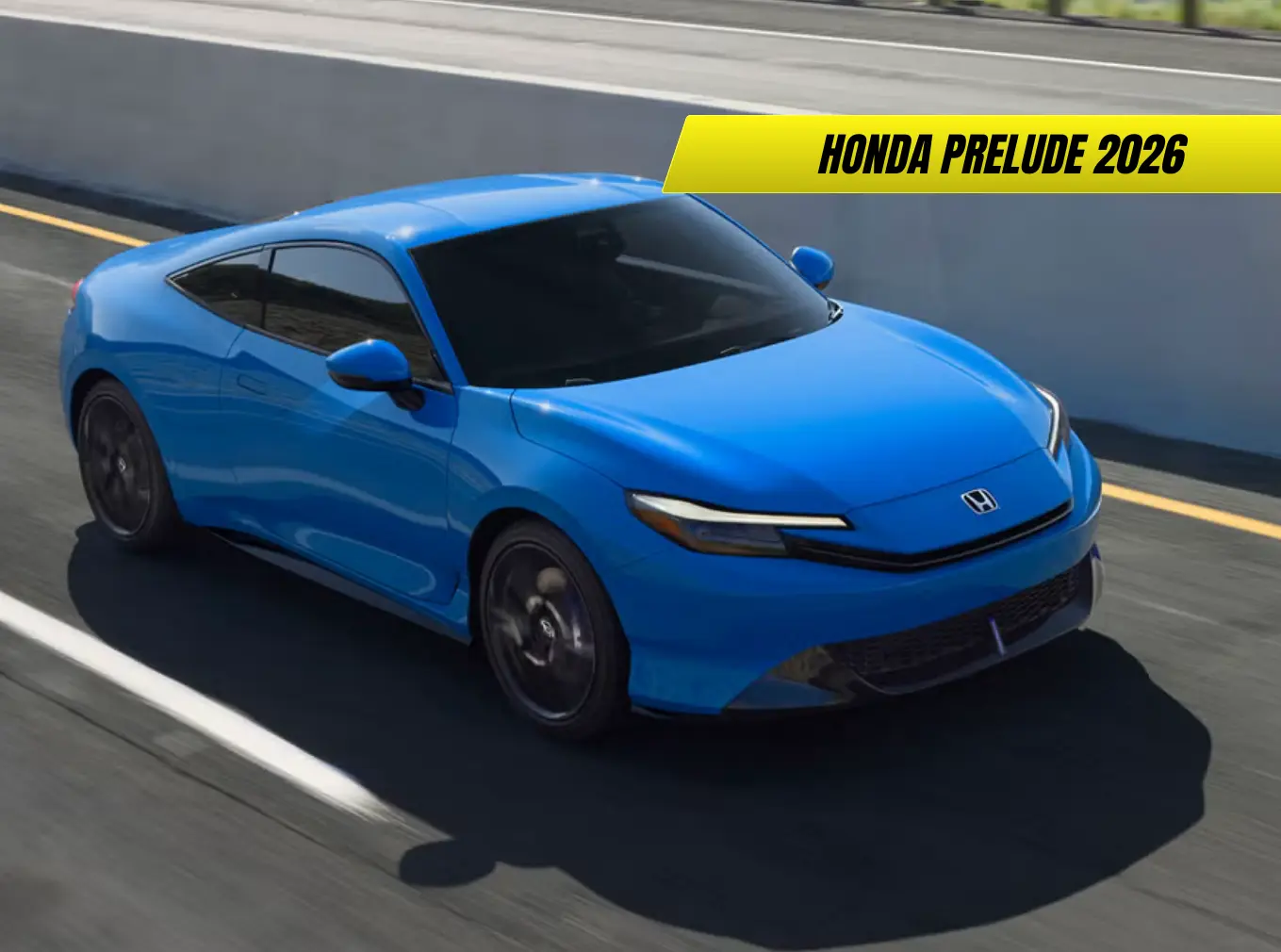
Honda Prelude 2026 hybrid coupe revealed at Lyon Motor Show 2025. UK release date, pricing, specs and features for the iconic sports coupe’s return to Britain.
Honda has officially unveiled the all-new Prelude at the Lyon Motor Show 2025, marking the celebrated nameplate’s return after a two-decade absence. This isn’t merely nostalgic badge engineering—the 2026 Prelude represents Honda’s vision for a modern hybrid sports coupe combining driving pleasure with environmental responsibility, a combination that might seem contradictory but reflects the evolving automotive landscape where electrification and engagement must coexist. For UK buyers who remember the original Prelude’s cult following through the 1980s and 1990s, this return generates both excitement and questions: can a hybrid powertrain deliver the sporting character that made the Prelude legendary, and will UK enthusiasts embrace a coupe positioned somewhere between affordable sports cars and premium grand tourers in an era where SUVs dominate British sales charts?
Key Points:
- Honda Prelude 2026 debuts at Lyon Motor Show 2025 as hybrid sports coupe reviving iconic nameplate
- Expected UK launch late 2025 or early 2026 with right-hand-drive production confirmed
- Hybrid powertrain combining 2.0-litre petrol engine with electric motors delivering approximately 200-220 bhp
- Anticipated UK pricing £32,000-£38,000, positioning between Toyota GR86 and BMW 2 Series
- Two-door coupe configuration with 2+2 seating and focus on driver engagement over pure practicality
- Advanced hybrid system prioritises performance and responsiveness rather than maximum fuel economy
- Represents Honda’s strategy to offer enthusiast-focused models alongside expanding SUV and electric lineup
The Prelude Legacy and Why This Return Matters
Understanding the original Prelude’s significance helps contextualise why Honda’s decision to revive the nameplate carries such weight amongst automotive enthusiasts. Produced across five generations from 1978 to 2001, the Prelude established Honda’s credentials as a manufacturer capable of building sophisticated, engaging sports coupes competing against European rivals whilst maintaining Japanese reliability and affordability.
The fourth-generation Prelude (1991-1996) particularly captured enthusiast imagination with its innovative four-wheel steering system, VTEC engine technology, and sublime chassis balance. The fifth generation (1996-2001) continued this excellence with even more sophisticated engineering, though declining coupe sales globally led Honda to discontinue the model as SUVs and crossovers increasingly dominated consumer preferences.
For UK buyers specifically, the Prelude represented an affordable path to sophisticated sports car ownership. Whilst German rivals like the BMW 3 Series Coupe commanded premium prices, and British sports cars like the MG RV8 suffered reliability concerns, the Prelude delivered consistent performance, bulletproof Honda reliability, and running costs that made enthusiast ownership practical rather than aspirational. This combination created a devoted UK following that persists today, with well-maintained examples commanding strong prices in the classic car market.
Honda’s decision to revive the Prelude in 2026 reflects several strategic considerations. The sports coupe market, whilst smaller than SUV segments, remains commercially viable for manufacturers with strong enthusiast followings. Toyota’s success with the GR86 demonstrates continued demand for affordable driver-focused coupes. Additionally, the Prelude’s return provides Honda with a halo model enhancing brand image beyond the practical Civic, CR-V, and HR-V models that dominate actual UK sales volumes.
From my point of view, this strategy makes sense—manufacturers need aspirational models attracting enthusiasts and generating positive publicity, even if volume sales occur in less exciting segments. Our guide to best hybrid cars in 2025 demonstrates how hybrid technology has matured, making its application in sports-focused vehicles increasingly viable without compromising driver engagement.
Design Philosophy and Exterior Styling
The 2026 Prelude showcased at Lyon Motor Show presents dramatically modern interpretation of the classic coupe silhouette, balancing Honda’s current design language with subtle nods to the original model’s iconic proportions. This approach mirrors successful revivals like the Alpine A110 and Toyota GR86—respecting heritage without slavishly copying it, creating contemporary designs that work on their own merits whilst acknowledging their lineage.
Key exterior design elements include:
Proportions: The Prelude maintains traditional front-engine, front-wheel-drive sports coupe proportions with a long bonnet, steeply raked windscreen, and fastback roofline flowing into an integrated boot. Length appears around 4.5-4.6 metres—larger than the Toyota GR86 (4.27m) but more compact than premium coupes like the BMW 4 Series (4.77m). This sizing positions it perfectly for UK roads where manoeuvrability matters whilst providing adequate interior space.
Front design: Honda’s latest design language features prominently, with slim LED headlights, hexagonal grille elements (likely closed or semi-closed given the hybrid powertrain’s reduced cooling requirements), and pronounced air intakes managing aerodynamic flow. The overall impression suggests aggression tempered by sophistication—appropriate for a sports coupe that must appeal to mature buyers rather than exclusively young enthusiasts.
Side profile: Character lines and sculpted surfaces create visual drama whilst maintaining clean overall forms. Large wheels—likely 18-19 inches on production models—fill the arches convincingly, and frameless doors (if retained from concept) add sporting elegance. The roofline’s curve references the fourth-generation Prelude’s distinctive silhouette without directly copying it.
Rear design: Full-width tail light signatures create modern visual impact, whilst a subtle integrated spoiler and diffuser elements suggest aerodynamic sophistication. Dual exhausts hint at the internal combustion component of the hybrid system—a deliberate styling choice ensuring the car doesn’t visually disappear into anonymity despite its partial electrification.
Colour and finish: The show car presents in sophisticated metallic grey with contrasting black accents, though production models will offer typical Honda colour palettes including bold reds, blues, and whites alongside conservative metallics appealing to broader demographics.
The overall design succeeds in looking expensive and sophisticated—crucial for a vehicle anticipated to start around £32,000-£38,000 where it must compete against established premium alternatives whilst justifying substantial premiums over mainstream Honda models.
Hybrid Powertrain: Performance-Focused Electrification
The 2026 Prelude’s hybrid powertrain represents its most significant departure from traditional sports coupe formula, yet Honda insists the system enhances rather than compromises driver engagement. This claim requires scrutiny—hybrid systems typically prioritise efficiency over excitement, and successfully combining both demands sophisticated engineering and careful calibration.
Expected powertrain specifications include:
Petrol engine: A 2.0-litre four-cylinder turbocharged unit likely producing around 180-200 bhp independently. This engine probably shares architecture with powerplants used across Honda’s lineup, modified for performance-focused applications with revised tuning emphasising responsiveness over economy.
Electric motors: Front-mounted electric motor(s) adding approximately 40-60 bhp to total system output, delivering instant torque response eliminating traditional turbo lag. The motor placement suggests front-wheel-drive configuration, though Honda might offer all-wheel-drive variants using rear-mounted electric motors—a configuration increasingly common in performance hybrids.
Total system output: Approximately 200-220 bhp combined, with peak torque around 250-280 lb-ft. These figures position the Prelude as genuinely quick without entering supercar territory—0-62 mph acceleration likely falls around 6.5-7.5 seconds depending on specification, with top speed electronically limited around 140 mph.
Battery capacity: Relatively small lithium-ion pack, probably 1-2 kWh, providing momentary power boosts and regenerative braking capability rather than meaningful electric-only range. This differs from plug-in hybrid systems, instead prioritising performance assistance and efficiency gains without the weight penalty of larger batteries.
Transmission: Honda’s expertise suggests either an advanced CVT tuned for sporting response (mimicking conventional automatic shifts in manual mode) or potentially a dual-clutch automatic gearbox. Manual transmission availability remains uncertain—enthusiasts desperately want it, but commercial reality suggests automatic-only may prevail to control costs and appeal to broader demographics.
From my experience with modern performance hybrids, success depends entirely on calibration. Poorly-integrated systems feel disjointed, with electric motors and combustion engines fighting rather than complementing each other. Honda’s engineering reputation suggests confidence they’ve solved this challenge, but proof arrives only through real-world driving evaluation. For context on hybrid technology variations, our comprehensive plug-in hybrid guideexplains different approaches, though the Prelude uses performance-focused full-hybrid technology rather than PHEV systems.
Interior Design and Technology Integration
The Prelude’s interior must balance sporting focus with everyday usability—a challenge for two-door coupes where practicality inherently compromises versus four-door alternatives. Honda’s approach appears to prioritise driver experience whilst acknowledging that most buyers need occasional rear seats and adequate boot space for the coupe to serve as a practical daily driver.
Expected interior features include:
Driver-focused cockpit: Traditional sports car philosophy positions all controls within easy reach, with the steering wheel, pedals, and gear selector arranged for intuitive operation. Digital instrumentation—likely a 10-12 inch configurable display—provides essential information without overwhelming with extraneous data. A head-up display projecting key information onto the windscreen might feature on higher specifications.
Central touchscreen: Modern expectations demand smartphone connectivity, so expect a 9-10 inch central touchscreen incorporating Apple CarPlay and Android Auto as standard, along with navigation, audio controls, and vehicle settings. Honda’s latest infotainment systems have improved dramatically from earlier efforts that suffered usability issues, suggesting the Prelude should deliver acceptable if not class-leading technology integration.
Material quality: Sports coupes at this price point face higher interior expectations than equivalent family cars. Expect soft-touch materials on primary contact points, metal or quality plastic switchgear, and available leather or premium synthetic upholstery. Build quality should reflect Honda’s typically excellent standards, matching or exceeding mainstream competitors whilst acknowledging that premium German rivals might edge ahead in ultimate material richness.
Rear seats: The 2+2 configuration provides occasional rear accommodation adequate for children or short-distance adult passengers, but unsuitable for regular four-adult transportation. This represents typical sports coupe compromise—rear seats exist more for insurance categorisation and occasional utility than genuine family transport capability.
Boot capacity: Expect around 300-350 litres—adequate for weekend luggage or weekly shopping but insufficient for larger items. The fastback design might enable folding rear seats expanding capacity for occasional larger loads, though the structural requirements of coupe bodies often limit this flexibility compared with hatchbacks or saloons.
Driving position: Honda traditionally excels at creating comfortable, supportive driving positions, and the Prelude should continue this strength. Manually adjustable seats come standard, with electric adjustment likely optional or standard on higher trims. The steering wheel position and pedal placement create the foundation for driver engagement—get these wrong, and no amount of power or technology compensates.
Understanding vehicle systems becomes important for any ownership experience. Resources covering common dashboard indicators like the handbrake warning light help owners respond appropriately to alerts, ensuring safe operation regardless of vehicle type.
UK Pricing Strategy and Market Positioning
Pricing strategy will critically determine the Prelude’s UK commercial success. The sports coupe must balance enthusiast expectations for value against commercial realities requiring reasonable profit margins, whilst positioning distinctly versus both mainstream and premium alternatives occupying similar price territory.
I anticipate UK pricing structured approximately:
Base specification: £32,000-£34,000 incorporating the hybrid powertrain, essential equipment including LED lighting, digital instrumentation, smartphone connectivity, comprehensive safety systems, and decent 18-inch alloy wheels. This pricing positions slightly above the Toyota GR86 (from £29,995) and Mazda MX-5 RF (from £31,000), justified by the Prelude’s hybrid technology, additional practicality, and Honda brand positioning.
Mid-specification: £35,000-£37,000 adding enhanced interior materials, larger wheels (19 inches), upgraded audio system, additional driver assistance features, and potentially adaptive damping for improved ride/handling balance. This specification likely captures majority UK sales, balancing equipment with value for buyers seeking genuine sports coupe experience without absolute maximum performance.
Top specification: £38,000-£40,000 incorporating premium interior finishes, largest wheels compatible with ride quality (19-20 inches), comprehensive technology including head-up display and 360-degree cameras, potentially more aggressive suspension tuning, and all available driver assistance systems. This pricing approaches premium territory occupied by entry-level BMW 2 Series and Audi A5, requiring the Prelude to justify its positioning through distinctive character rather than badge prestige alone.
These projections position the Prelude carefully between affordable sports cars and premium coupes—more sophisticated and practical than pure sports cars like the GR86, yet substantially cheaper than German premium alternatives. Success requires the Prelude feeling worth its premium over affordable alternatives whilst offering compelling value versus premium competitors. For UK buyers shopping across various segments, our guide to cars under £25,000 explores more affordable alternatives, though genuine sports coupes rarely fit that budget constraint.
ModelUK Price (from)PowertrainPower Output0-62 mphSeatingHonda Prelude 2026 (projected)£32,000-£40,0002.0L Turbo Hybrid200-220 bhp~6.5-7.5 sec2+2Toyota GR86£29,9952.4L Petrol234 bhp6.3 seconds2+2Mazda MX-5 RF£31,0002.0L Petrol184 bhp6.5 seconds2 seatsBMW 2 Series Coupe£39,1452.0L Petrol184 bhp7.5 seconds2+2Audi A5 Coupe£40,9652.0L Petrol204 bhp7.1 seconds2+2
Driving Dynamics and Performance Expectations
For sports coupe success, driving dynamics matter far more than specification sheets suggest. UK enthusiasts and automotive journalists place enormous emphasis on steering feel, chassis balance, and overall engagement—intangible qualities that separate memorable driving machines from mere transportation appliances with sporting pretensions.
Honda faces several challenges delivering engaging dynamics:
Front-wheel-drive limitations: The anticipated front-drive configuration creates inherent dynamic compromises versus rear-wheel-drive alternatives. Front-drive cars suffer torque steer (steering wheel tugging under hard acceleration), understeer (front-end pushing wide in corners), and generally less balanced feel than rear-drive equivalents. Honda must employ sophisticated suspension geometry, electronic differential controls, and careful chassis tuning to minimise these limitations.
However, front-drive isn’t inherently inferior for driver engagement—Honda’s own Civic Type R demonstrates that world-class dynamics remain achievable with front-drive architecture when engineering excellence applies. The question becomes whether Honda invests equivalent development effort into the lower-volume Prelude versus the Civic Type R halo model.
Hybrid system integration: Adding electric motors, batteries, and associated hardware increases weight—the enemy of sporting performance. The Prelude’s kerb weight likely exceeds 1,400kg, potentially approaching 1,500kg depending on specification and equipment. For comparison, the Toyota GR86 weighs just 1,270kg, providing inherent dynamic advantages through lower mass.
Honda must overcome this weight penalty through power advantage (which the hybrid system provides) and sophisticated chassis engineering distributing mass optimally. Low centre of gravity proves crucial—mounting batteries low in the chassis structure creates dynamic benefits similar to mid-engine sports cars, improving stability and turn-in response.
Steering and feedback: Modern electric power steering systems often disappoint enthusiasts seeking tactile connection between steering wheel and road surface. Honda must tune the Prelude’s steering for maximum feedback and precision whilst maintaining reasonable parking-speed effort—a balance requiring extensive development and calibration.
Suspension setup: The Prelude likely employs MacPherson strut front suspension and multi-link rear configuration—sophisticated enough for excellent handling when properly developed. Adaptive damping on higher specifications enables personality adjustment, offering comfortable daily driving and sharper responses when desired.
From my point of view, the Prelude’s dynamic success depends entirely on Honda’s commitment level. If engineers received genuine freedom to prioritise engagement over cost considerations, the Prelude could genuinely rival the GR86 for driver involvement despite different configurations. If bean counters constrained development budgets excessively, the result might be merely competent rather than truly engaging—adequate but forgettable in a segment where emotion matters enormously.
Safety Features and UK Regulatory Compliance
Modern vehicles sold in the UK must incorporate comprehensive active safety systems meeting current regulations and anticipating future requirements. The Prelude, despite its sporting focus, cannot escape these mandates—indeed, advanced safety features increasingly define modern automotive engineering regardless of vehicle type or market positioning.
Expected safety equipment includes:
- Autonomous emergency braking with pedestrian, cyclist, and vehicle detection operating across full speed range
- Adaptive cruise control with stop-and-go functionality for motorway traffic jam assistance
- Lane departure warning with active lane keeping providing gentle steering inputs to maintain position
- Traffic sign recognition identifying speed limits and critical road signage, integrating with intelligent speed assistance
- Driver attention monitoring detecting fatigue or distraction, providing escalating alerts
- Blind spot monitoring with visual indicators in door mirrors or digital displays
- Rear cross-traffic alert warning of approaching vehicles when reversing from parking spaces
- Multiple airbags including front, side, and curtain coverage protecting occupants in various collision scenarios
These systems align with evolving UK speed camera regulations, which increasingly emphasise intelligent speed adaptation and connected features helping drivers maintain legal compliance. The integration represents mandatory equipment rather than optional extras, ensuring all UK Prelude buyers benefit regardless of specification chosen.
Euro NCAP crash testing should yield strong results—likely five stars—given Honda’s historical safety performance and modern platform engineering. The coupe body structure provides inherent rigidity advantages versus equivalent saloons or hatchbacks, though side impact protection requires careful engineering given the longer doors and lack of B-pillars in typical coupe construction.
Understanding UK driving regulations applies equally to sports coupes and family vehicles. Resources covering UK driving licence points explain the penalty system affecting all British drivers, whilst guides addressing costs like UK toll roads and charges help calculate total journey expenses beyond basic fuel or electricity costs.
UK Market Reception and Commercial Viability
The fundamental question facing the 2026 Prelude involves commercial viability in a UK market where SUVs dominate sales charts and sports coupes represent niche products appealing to enthusiasts rather than mainstream buyers. Honda must sell sufficient volumes to justify the model’s existence whilst acknowledging it will never approach Civic or CR-V sales numbers.
Several factors influence potential UK success:
Nostalgia factor: The original Prelude’s devoted UK following creates built-in interest amongst buyers aged 40-60 who remember the original models fondly. Whether nostalgia translates into actual purchases versus merely positive online commentary remains uncertain—many enthusiasts express support for sports coupes yet ultimately purchase SUVs when actually spending money.
Hybrid positioning: The hybrid powertrain either represents inspired innovation perfectly suited to modern UK motoring or misguided compromise diluting the sports coupe purity enthusiasts demand. British buyers might embrace the technology for its modernity and efficiency, or reject it for adding weight and complexity versus simpler naturally-aspirated alternatives. The truth likely falls somewhere between these extremes, with some buyers appreciating the hybrid benefits whilst others specifically avoid it.
Competitive pressure: The Toyota GR86 and Mazda MX-5 offer proven alternatives at similar or lower prices, whilst premium buyers might stretch budgets towards BMW or Audi products delivering badge prestige. The Prelude must carve distinctive positioning justifying its existence versus established alternatives—neither the cheapest nor the fastest, but perhaps the best balanced combination of performance, practicality, and technology.
Honda brand perception: Honda enjoys strong UK reputation for reliability and engineering integrity, but lacks the sporting image associated with manufacturers like Mazda or Toyota (via its Gazoo Racing division). The Prelude must overcome this perception gap, convincing UK buyers that Honda remains serious about driver-focused products beyond the Civic Type R flagship.
From my perspective, the Prelude will likely achieve modest UK sales—perhaps 500-1,000 annually—sufficient for commercial viability as a halo model enhancing brand image whilst contributing marginally to Honda’s bottom line. Massive volume success seems unlikely given segment constraints, but commercial failure appears equally improbable given Honda’s engineering competence and the built-in enthusiast interest. Success ultimately depends on execution quality and whether the driving experience justifies the compelling on-paper package.
For UK buyers considering alternatives across broader segments, our guide to SUVs under £40,000 explores practical vehicles delivering more space and versatility, though obviously lacking the Prelude’s sporting character and emotional appeal.
Running Costs and UK Ownership Considerations
For UK buyers, total cost of ownership extends beyond purchase price to encompass fuel economy, insurance, maintenance, depreciation, and taxation—factors that significantly influence long-term ownership satisfaction and financial viability.
Fuel economy should prove the hybrid powertrain’s clearest advantage over conventional sports coupes. Whilst official combined cycle figures await confirmation, expect approximately 50-55 mpg on the WLTP cycle—dramatically better than the Toyota GR86’s 36 mpg or equivalent petrol-only sports cars. Real-world UK driving typically yields 10-15% lower figures, suggesting 45-50 mpg in mixed conditions—genuinely impressive for a 200+ bhp sports coupe and potentially halving fuel costs versus conventional alternatives.
However, achieving these figures requires driving sympathetically to exploit the hybrid system’s efficiency. Enthusiastic driving with frequent hard acceleration depletes the battery quickly, forcing greater reliance on the petrol engine and reducing economy substantially—potentially to 35-40 mpg, still respectable but less dramatically superior to conventional alternatives.
VED (road tax) depends on CO2 emissions, which the hybrid powertrain should maintain below 130 g/km. This likely places the Prelude in VED bands charging £190 annually from the second year onwards (first year rates vary by emissions). Electric vehicles enjoy lower VED currently, but the Prelude’s hybrid configuration means standard rates apply—still considerably cheaper than high-performance sports cars facing hundreds of pounds annually.
Insurance costs for sports coupes typically prove elevated versus family cars, reflecting higher performance, increased theft risk, and potentially more expensive repairs. Expect insurance groups 25-32 depending on specification, translating into annual premiums of £800-£1,500 for drivers with clean records—younger drivers face substantially higher costs potentially making the Prelude prohibitively expensive to insure.
Maintenance costs should reflect Honda’s typically reasonable service pricing. Annual servicing likely costs £200-£350 covering oil changes, filter replacements, and multi-point inspections. The hybrid system adds complexity versus pure petrol cars, potentially increasing long-term maintenance costs, though Honda’s hybrid technology has proven reliable across millions of vehicles globally. Brake component replacement occurs less frequently due to regenerative braking, partially offsetting other maintenance increases.
Depreciation remains the largest ownership cost for most buyers, yet proves hardest to predict for new models. Sports coupes typically depreciate faster than mainstream family cars due to limited buyer pools when selling. However, well-executed enthusiast models sometimes buck this trend, maintaining values through strong desirability—the original Prelude’s strong classic car values suggest potential for similar performance if the new model achieves cult status. Conservative buyers should assume 40-50% depreciation over three years until real-world data proves otherwise.
When will the Honda Prelude be available in UK dealerships?
Honda unveiled the Prelude at Lyon Motor Show in spring 2025, with UK availability expected late 2025 or early 2026. Right-hand-drive production has been confirmed, suggesting genuine commitment to the UK market. Pre-order opportunities will likely open summer-autumn 2025, allowing early adopters to secure launch edition vehicles. Contact Honda UK dealers for confirmed timing as official announcements emerge.
What is the expected UK price for the 2026 Honda Prelude?
Honda hasn’t announced official UK pricing, but based on competitive positioning and specification, expect starting prices around £32,000-£34,000 for base models, extending to £38,000-£40,000 for fully-equipped top specifications. This positions the Prelude between affordable sports cars like the Toyota GR86 (£29,995) and premium coupes like the BMW 2 Series (from £39,145).
Will the Prelude be available with a manual gearbox?
Honda hasn’t confirmed transmission options for the UK market. Enthusiasts desperately want manual transmission availability, but commercial reality and hybrid system integration challenges suggest automatic-only may prevail. If manual transmission appears, it will likely be offered only on base specifications with the automatic standard on higher trims—the reverse of traditional sports car hierarchy where manuals topped ranges.
How does the Prelude’s hybrid system affect driving dynamics?
The hybrid system adds weight (approximately 50-100 kg versus equivalent non-hybrid) but provides instant electric motor torque eliminating turbo lag and enhancing throttle response. Honda claims the system enhances rather than compromises driver engagement through improved low-speed acceleration and more sophisticated torque management. Real-world assessment requires actual driving evaluation, but Honda’s engineering reputation suggests confidence they’ve successfully integrated the technology.
What fuel economy will the Prelude achieve in real-world UK driving?
Based on the hybrid powertrain and anticipated specifications, expect official combined cycle figures around 50-55 mpg, with real-world UK driving yielding approximately 45-50 mpg in mixed conditions. Enthusiastic driving reduces this substantially to potentially 35-40 mpg, whilst gentle hypermiling techniques might achieve 55-60 mpg. This represents significant improvement over conventional sports coupes typically achieving 30-40 mpg in mixed driving.
Should I buy a GR86 or wait for the Prelude?
This depends on priorities. The GR86 offers proven rear-wheel-drive dynamics, lower pricing, and immediate availability. The Prelude provides hybrid efficiency, potentially more sophisticated technology, and arguably greater everyday practicality. If pure driving engagement matters most and you want a car now, the GR86 represents the safer choice. If efficiency, technology, and Honda ownership appeal, and you can wait until late 2025/early 2026, the Prelude deserves serious consideration.
Can the Prelude serve as a practical daily driver in the UK?
Yes, with caveats. The 2+2 seating provides adequate front accommodation and occasional rear seats for children or short journeys. Boot capacity around 300-350 litres handles weekly shopping and weekend luggage. The hybrid powertrain delivers excellent fuel economy for daily commuting. However, the coupe body style compromises rear-seat access and cargo versatility versus hatchbacks or saloons. For singles, couples, or small families accepting these trade-offs, the Prelude can absolutely serve as a practical daily driver combining sporting character with everyday usability.
Conclusion: Emotional Appeal in a Practical Package
The 2026 Honda Prelude’s Lyon Motor Show debut represents more than simple product announcement—it signals Honda’s commitment to maintaining emotional, driver-focused products in an era increasingly dominated by efficient but characterless transportation appliances. The decision to combine hybrid technology with sports coupe positioning demonstrates sophisticated understanding that modern buyers increasingly demand both environmental responsibility and driving pleasure, refusing to accept the false dichotomy suggesting these goals remain mutually exclusive.
For UK buyers specifically, the Prelude’s return creates genuine excitement tempered by pragmatic questions about execution, pricing, and whether the hybrid powertrain successfully enhances or compromises the sports coupe experience. The answers await real-world evaluation, but Honda’s engineering reputation and the positive reception to the Lyon Motor Show reveal suggest genuine potential for a compelling product successfully balancing performance, efficiency, and everyday practicality.
From my point of view, the Prelude’s commercial success matters less than its existence. The automotive industry increasingly consolidates around profitable SUVs and electric vehicles mandated by regulation, squeezing out mid-volume enthusiast products that generate passion and loyalty despite modest sales. Honda’s willingness to invest in the Prelude demonstrates understanding that brands need aspirational models attracting enthusiasts and generating positive publicity, even if these vehicles never approach mainstream sales volumes. Sometimes commercial success means more than quarterly sales figures—it means maintaining brand character and customer passion across decades, ensuring Honda remains associated with driving pleasure and engineering excellence rather than merely competent transportation. Whether the 2026 Prelude achieves this goal ultimately depends on details yet to be revealed, but the early signs suggest genuine cause for optimism amongst UK enthusiasts who’ve waited over two decades for the nameplate’s return.





