
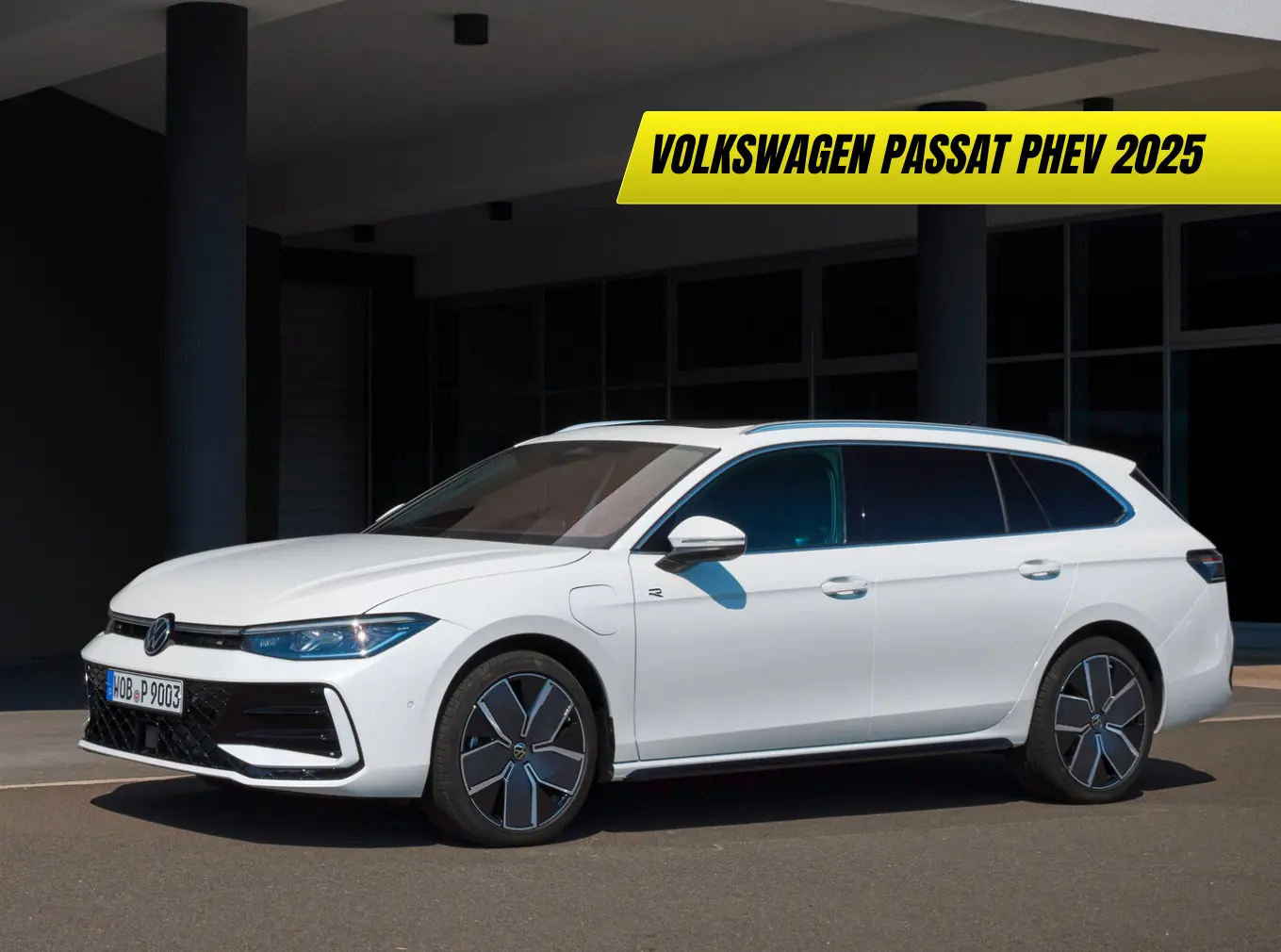
Volkswagen Passat PHEV 2025 UK review with 82-mile electric range, estate practicality, pricing, real-world fuel economy, and comparison with rivals.
The Volkswagen Passat PHEV 2025 proves that traditional estate cars remain relevant in an SUV-dominated marketplace, combining generous interior space with sophisticated plug-in hybrid technology. Available in the UK as the Passat Estate eHybrid, this ninth-generation model offers up to 82 miles of electric-only range from its 19.7 kWh battery, paired with a 1.5-litre TSI petrol engine for combined outputs of either 201 bhp or 268 bhp. Priced from approximately £43,900 for the lower-output version, the Passat Estate targets company car drivers and families seeking maximum practicality without graduating to bulkier SUV alternatives.
Plug-In Hybrid Powertrain Technology
The Passat eHybrid combines a 1.5-litre TSI turbocharged four-cylinder petrol engine with an electric motor integrated into the six-speed DSG automatic transmission. Two power outputs are available: the base eHybrid produces 201 bhp with 258 lb-ft of combined torque, whilst the more powerful version delivers 268 bhp for stronger performance. Front-wheel drive comes as standard across the range, with power distributed through Volkswagen’s DQ400e evo dual-clutch transmission.
The 19.7 kWh net capacity battery pack delivers an official WLTP electric-only range of 82 miles—among the longest in the plug-in hybrid estate segment. From my perspective, this genuine usability for daily commuting without consuming petrol represents the Passat PHEV’s strongest selling point, particularly for drivers with regular access to charging infrastructure at home or work.
Volkswagen Passat PHEV Performance Specifications
| Specification | Value |
|---|---|
| Petrol Engine | 1.5L TSI 4-Cylinder Turbo |
| Electric Motor | Integrated in DSG Transmission |
| Combined Output (Base) | 201 bhp / 258 lb-ft |
| Combined Output (High) | 268 bhp |
| Battery Capacity | 19.7 kWh (net) |
| Electric Range (WLTP) | Up to 82 miles |
| Real-World Electric Range | 65-75 miles |
| 0-62 mph (268 bhp) | 6.9 seconds |
| Top Speed | 143 mph |
| Transmission | 6-Speed DSG Automatic |
Real-world electric range testing achieved approximately 65-75 miles depending on driving conditions, temperature, and route profile—a respectable 80-90% of the official claim. When operating in hybrid mode with a depleted battery, fuel consumption averages around 45-50 mpg, significantly better than equivalent non-hybrid estates whilst carrying passengers and luggage.
Estate Practicality and Interior Space
At 4,920mm long, 1,850mm wide, and 1,510mm tall, the Passat Estate occupies traditional D-segment territory with dimensions that prioritize interior volume over external bulk. The 2,840mm wheelbase creates genuinely spacious accommodation for rear passengers, with ample knee and headroom for adults on longer journeys. Unlike many competitors, Volkswagen positions the Passat as a proper family estate rather than attempting dubious “coupe” styling that compromises practicality.
Boot capacity measures 510 litres with the rear seats upright in the PHEV version—reduced from the 690 litres offered by petrol and diesel variants to accommodate battery packaging beneath the load floor. With rear seats folded, maximum capacity reaches 1,770 litres compared to 1,920 litres in non-hybrid models. This represents the plug-in hybrid’s primary compromise, though the reduction affects absolute maximum capacity more than everyday usability for family holidays or trips to the recycling center.
The boot opening remains wide and low, with minimal lip to impede loading heavier items. Underfloor storage provides dedicated compartments for charging cables without encroaching on primary cargo space—a thoughtful detail missing from some rivals. For UK buyers comparing estate options, the Toyota Corolla Cross offers alternative packaging in a taller crossover format, whilst the Mercedes Electric GLC targets premium buyers seeking pure electric propulsion.
Aerodynamic Efficiency and Design
The Passat Estate achieves an impressive 0.25 drag coefficient through meticulous aerodynamic optimization including active grille shutters, sculpted door mirrors, and carefully managed underbody airflow. This slippery shape contributes directly to the extended electric range and improved hybrid fuel economy, proving that elegant design and functional efficiency can coexist without resorting to dramatic styling statements.
The exterior presents clean, understated lines that prioritize timeless elegance over fashionable excess. LED headlights feature distinctive daytime running light signatures, whilst the front grille adopts Volkswagen’s latest corporate identity with horizontal elements emphasizing width. Body-colored lower sections maintain visual cohesion, though R-Line specifications add sportier bumpers and larger alloy wheels for buyers seeking more presence.
I would recommend appreciating the Passat’s restrained aesthetic as a deliberate choice rather than lack of imagination—in a marketplace dominated by increasingly aggressive styling, the Volkswagen’s subtlety should age gracefully without appearing dated within typical three-year ownership cycles.
Interior Quality and Technology
The cabin presents high-quality materials and meticulous build quality that justify the Passat’s premium positioning. Soft-touch surfaces dominate upper dashboard areas, with optional massaging front seats providing exceptional long-distance comfort. The digital instrument cluster measures 12.3 inches with customizable displays, whilst the central infotainment touchscreen spans either 12.9 or 15 inches depending on specification.
Touch-sensitive climate controls beneath the main screen deliver modern aesthetics but sacrifice the intuitive usability of traditional physical buttons—a common criticism across Volkswagen’s current model range. The controls illuminate clearly and respond adequately once familiarized, though passengers adjusting temperature whilst driving occasionally require multiple attempts to achieve desired settings.
Rear passengers benefit from generous legroom, individual USB-C charging ports, and tri-zone climate control that maintains independent temperature preferences. The flat floor aids middle-seat comfort for occasional fifth occupants, whilst door pockets lined with felt-like material reduce noise from loose items—a detail that demonstrates Volkswagen’s attention to refinement.
Driving Dynamics and Refinement
The Passat Estate prioritizes comfort and refinement over sporty handling characteristics, employing suspension tuning that absorbs Britain’s deteriorating road surfaces capably. Optional adaptive dampers provide selectable firmness levels through the Individual drive mode, allowing drivers to balance comfort against reduced body roll depending on road conditions and loading.
From my driving experience, the Passat handles its 1,910 kg kerb weight competently through corners, maintaining composed body control without the wallowing sometimes associated with heavy plug-in hybrids. Steering weight feels appropriately calibrated for relaxed motorway cruising, lightening for parking maneuvers without becoming artificially heavy in sportier drive modes.
Refinement stands out as a particular strength, with exceptional sound insulation keeping wind noise, tyre roar, and mechanical vibration to a minimum at UK motorway speeds. The petrol engine remains impressively subdued during electric operation, only becoming noticeable during rapid acceleration or when charging the battery under sustained motorway cruising. For drivers concerned about compliance with speed limits, our guide on UK speed camera regulations 2025 provides comprehensive coverage of current enforcement practices.
Charging Capabilities and Electric Range
The 19.7 kWh battery accepts AC charging at up to 11 kW, enabling full replenishment in approximately 2.5 hours from home wallboxes or public destination chargers. DC fast charging capability reaches 50 kW maximum—not particularly rapid by modern standards, but sufficient for adding significant range during lunch stops on longer journeys. A 10-80% rapid charge takes approximately 30 minutes at compatible public chargers.
Real-world electric range varies predictably with temperature and driving style, achieving the upper end of the 65-75 mile bracket during temperate weather with moderate speeds. Winter conditions and motorway-heavy routes reduce this to the lower end, though the Passat still delivers genuine single-charge capability for typical UK commuting distances. For information about charging infrastructure access, our comprehensive guide to UK toll roads and charges 2025 covers motorway service station facilities.
When operating in hybrid mode, the powertrain management system intelligently depletes and replenishes battery charge to optimize efficiency, using predictive routing from the navigation system to reserve electric operation for urban sections whilst relying on petrol propulsion during motorway cruising where efficiency advantages diminish.
UK Pricing and Specification Levels
Volkswagen positions the Passat Estate eHybrid from approximately £43,900 for the base 201 bhp version, rising to around £48,500 for the more powerful 268 bhp variant in R-Line specification. Three trim levels span the range: standard Passat, Business-focused specification, and sportier R-Line adding visual enhancements and larger wheels.
Volkswagen Passat Estate eHybrid Range
| Trim Level | Power Output | Starting Price | Key Features |
|---|---|---|---|
| Passat eHybrid | 201 bhp | £43,900 | LED lights, 12.3-inch digital instruments, adaptive cruise, lane assist |
| Business eHybrid | 201 bhp | £46,200 | Upgraded upholstery, wireless charging, larger infotainment screen |
| R-Line eHybrid | 268 bhp | £48,500 | Sporty styling, 19-inch wheels, adaptive dampers, premium trim |
Company car drivers benefit from exceptionally low Benefit-in-Kind tax rates thanks to sub-50 g/km CO2 emissions and the extended electric range, making the Passat Estate particularly attractive for high-mileage business users who can charge regularly. First-year VED is minimal, dropping to the standard rate thereafter.
For UK buyers comparing plug-in hybrid estates, alternatives include the [BMW 3 Series Touring PHEV](limited competition in the traditional estate segment), whilst crossover alternatives like those featured in our best plug-in hybrid cars UK 2025 guide offer different packaging approaches to electrified family transport.
Running Costs and Ownership Considerations
With battery charged, official WLTP combined fuel consumption drops to 257.8 mpg—a figure reflecting the weighted test methodology rather than real-world expectation. More realistically, drivers charging daily and covering typical commuting distances can expect to use minimal petrol for weeks at a time, with hybrid-mode consumption settling around 45-50 mpg once battery charge depletes.
Home charging at typical UK domestic electricity rates of 24p per kWh costs approximately £4.73 for a complete battery replenishment, delivering 65-75 miles of electric-only driving—equivalent to 6-7p per mile. This compares favorably with petrol costs even accounting for the reduced hybrid-mode efficiency once battery charge depletes.
Servicing follows Volkswagen’s standard intervals, with the plug-in hybrid system requiring no additional maintenance beyond regular oil changes and brake inspections. The three-year/60,000-mile manufacturer warranty matches industry norms, with the battery covered separately for eight years or 100,000 miles maintaining at least 70% of original capacity—industry-standard protection reflecting battery technology maturity.
Safety and Driver Assistance Technology
Volkswagen equips the Passat Estate comprehensively with active safety systems including adaptive cruise control with stop-and-go functionality, lane-keeping assistance with active steering correction, and blind-spot monitoring with exit warning to prevent opening doors into oncoming cyclists or traffic. Front and rear parking sensors combine with a reversing camera to simplify maneuvering the nearly five-meter estate in tight spaces.
Travel Assist provides semi-autonomous capability on motorways, maintaining centered position within lane markings whilst managing speed and distance from traffic ahead. The system requires periodic steering wheel inputs to confirm driver attention, functioning smoothly during extended motorway cruising to reduce fatigue. Emergency braking assistance detects pedestrians and cyclists, intervening automatically when collision risk is detected.
Optional 360-degree camera systems display overhead views during parking, whilst the head-up display projects key information onto the windscreen to minimize distraction from the road ahead. UK drivers should familiarize themselves with the penalty point system outlined in our UK driving licence points guide to maintain clean records and avoid disqualification.
How It Compares to Rivals
The Passat Estate eHybrid faces limited direct competition in the traditional estate segment, with many manufacturers abandoning wagon bodystyles in favor of SUVs. The BMW 3 Series Touring offers plug-in hybrid power with sportier dynamics but reduced boot space, whilst the Mercedes C-Class Estate provides premium alternatives at higher pricing.
Against crossover alternatives like the Nissan X-Trail or [Audi Q5 PHEV](taller vehicles), the Passat counters with superior boot capacity, lower loading height, and more car-like driving dynamics that some buyers prefer over raised SUV seating positions. The Toyota Corolla Touring Sports Hybrid offers full-hybrid efficiency in a smaller package, whilst lacking the Passat’s pure electric capability and interior volume.
From my assessment, the Passat Estate eHybrid suits drivers who value traditional estate practicality, appreciate Volkswagen’s build quality and refinement, and can exploit the genuine electric-only range through regular charging. It sacrifices the commanding driving position that attracts many buyers to SUVs, but rewards with superior aerodynamic efficiency and more engaging road manners.
Frequently Asked Questions
What is the real-world electric range of the Passat PHEV?
Real-world testing achieved approximately 65-75 miles from the 19.7 kWh battery depending on temperature, driving style, and route profile—representing 80-90% of the official 82-mile WLTP claim. Urban driving and moderate speeds favor the upper end of this range, whilst motorway cruising and cold weather reduce it toward the lower figure.
How long does the Passat eHybrid take to charge?
A full charge from empty requires approximately 2.5 hours using an 11 kW home wallbox or public AC charger. DC fast charging at up to 50 kW enables 10-80% replenishment in around 30 minutes at compatible rapid chargers, though AC charging represents the typical solution for overnight home or workplace charging.
What fuel economy does the Passat achieve with depleted battery?
When operating in hybrid mode after battery charge depletes, real-world fuel consumption settles around 45-50 mpg across mixed driving conditions—significantly better than equivalent non-hybrid petrol estates. This reflects the mild hybrid functionality that continues assisting the petrol engine even without pure electric capability.
Is the Passat Estate suitable for long-distance family holidays?
The Passat Estate excels at long-distance touring, combining comfortable seating, generous boot capacity, and refined cruising manners with competitive hybrid fuel economy. The 510-litre boot accommodates family luggage adequately, though the reduction from 690 litres in non-hybrid versions may require more careful packing for four occupants on extended holidays.
How much does it cost to charge the Passat eHybrid at home?
Charging the 19.7 kWh battery at typical UK domestic electricity rates of 24p per kWh costs approximately £4.73 for complete replenishment, delivering 65-75 miles of electric-only driving. This translates to running costs of 6-7p per mile—substantially cheaper than petrol even accounting for reduced efficiency once battery charge depletes.
Does the Passat PHEV qualify for UK government grants?
The plug-in car grant scheme ended in June 2022, meaning the Passat eHybrid no longer qualifies for purchase incentives. However, company car drivers benefit from exceptionally low Benefit-in-Kind tax rates reflecting the sub-50 g/km CO2 emissions and extended electric range—often the primary financial incentive for business users.
What are common dashboard warning lights I should know about?
Like all modern vehicles, the Passat features comprehensive warning systems to alert drivers of maintenance needs or faults. UK motorists should familiarize themselves with indicators including the spanner warning light for service requirements and the handbrake warning light which may indicate brake system issues requiring immediate attention. For buyers exploring different powertrain options, our guides to diesel SUVs and best Chinese SUVs UK 2025 provide alternative perspectives.
The Volkswagen Passat PHEV 2025 delivers refined, practical family transport with genuine electric-only capability that suits regular commuting whilst maintaining versatility for longer journeys. It excels at effortless cruising with exceptional build quality and competitive company car taxation, though the premium pricing requires careful cost comparison against non-hybrid alternatives. For drivers who can charge regularly and value traditional estate practicality over fashionable SUV styling, the Passat eHybrid represents a compelling blend of efficiency and capability backed by Volkswagen’s reputation for quality and dealer network coverage across the UK.





