
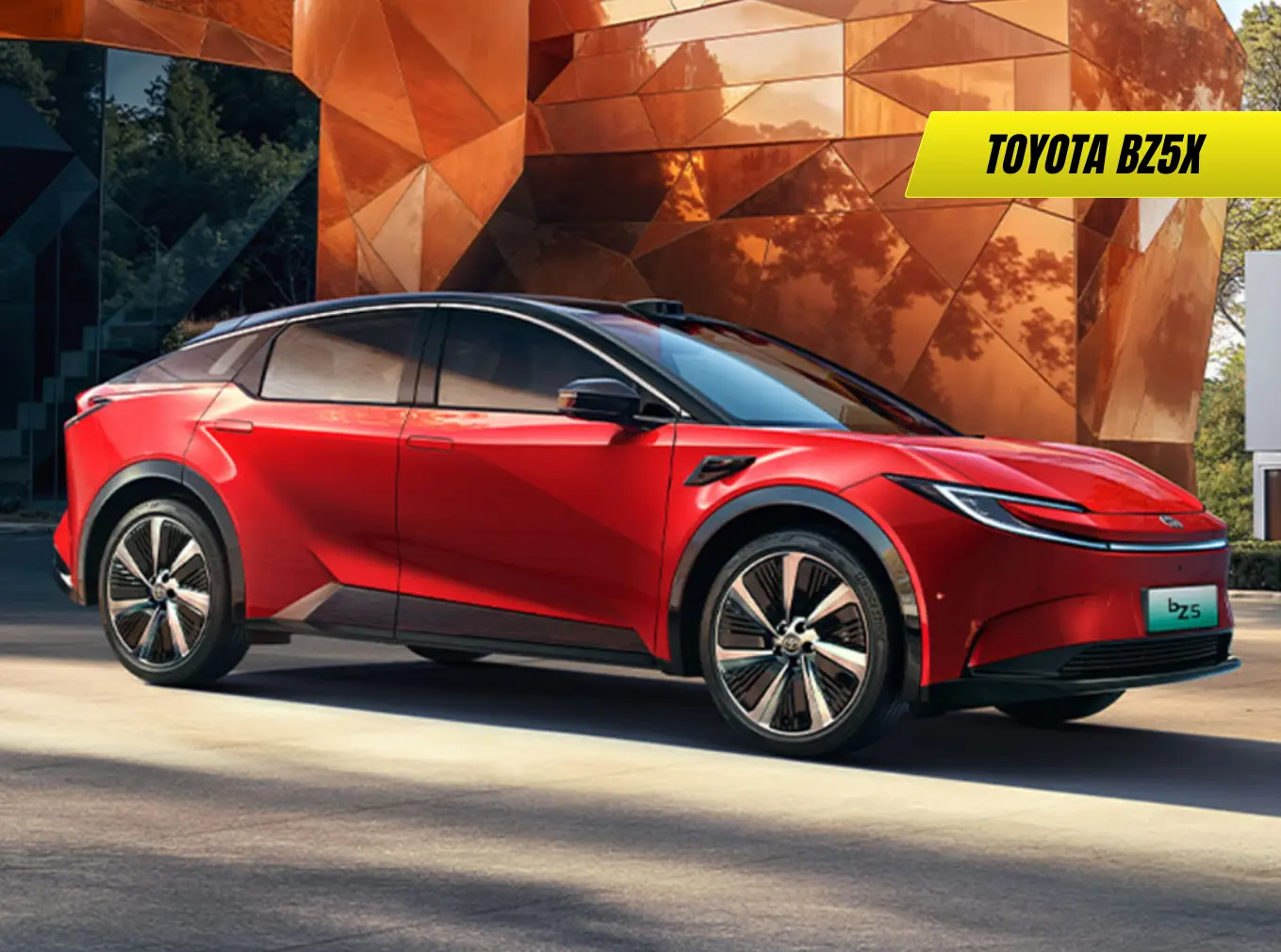
Toyota bZ5X 2026: three-row electric SUV, 100kWh battery, Kentucky production. California reveal February 2026, US launch H2 2026, £65,000+ UK estimated.
Toyota teases long-awaited three-row electric SUV ahead February 2026 California unveiling through “Something new is on the horizon” campaign revealing full-width LED rear light bar, upright SUV proportions, and roof rails matching 2021 bZ Large SUV Concept patent drawings confirming production version likely badged bZ5X (five-row designation following bZ4X mid-size). Built at Georgetown, Kentucky plant with batteries from Toyota North Carolina facility, the 100kWh battery electric family hauler targets Kia EV9 (£65,000) and Hyundai Ioniq 9 (£68,000) launching second half 2026 as seventh-generation Highlander electric alternative addressing US market’s insatiable three-row SUV demand. Production delayed from original 2025 timeline due “production preparation issues” not demand uncertainty, with naming strategy pivoting away from confusing bZ sub-brand toward potential “Highlander EV” or “bZ Highlander” leveraging familiar nameplate recognition following Ford Mustang Mach-E’s successful branding playbook applying established model names to new electric platforms.
Patent Drawings Confirm bZ Large Concept Production
Toyota’s teaser matches previously-unseen patent filings:
Design Comparison: 2021 Concept vs 2026 Teaser
| Element | bZ Large SUV Concept (2021) | 2026 Teaser Image | Match? |
|---|---|---|---|
| Rear light bar | Full-width LED strip | Full-width LED strip | ✓ Identical |
| Body proportions | Upright SUV stance, wide hips | Upright SUV stance, wide hips | ✓ Matches |
| Roof rails | Black longitudinal rails | Black longitudinal rails | ✓ Confirmed |
| Rear glass angle | Near-vertical tailgate | Near-vertical tailgate | ✓ Same |
| D-pillar treatment | Thick, SUV-style pillar | Thick, SUV-style pillar | ✓ Consistent |
Patent Revelations
The 2021 concept’s public images omitted rear views, but patent drawings filed USPTO (United States Patent and Trademark Office) revealed complete design including rear fascia now matching teaser photograph exactly. This confirms Toyota proceeding with substantially unchanged exterior from five-year-old concept versus typical production compromises diluting concept car designs.
What Changed From Concept?
Based on teaser analysis, minimal alterations:
- Mirrors: Production side mirrors replacing concept’s camera-based units (regulatory requirements)
- Door handles: Likely pop-out flush handles versus concept’s touch-sensitive panels
- Wheel design: Production-spec aerodynamic wheels replacing concept’s show-car designs
- Lighting details: Refined LED signatures within same overall light bar architecture
From my point of view, Toyota’s design discipline maintaining concept’s distinctive rear light bar and proportions demonstrates confidence in original styling versus typical automaker pattern significantly diluting concept car boldness through production engineering compromises—refreshing commitment suggesting bZ5X won’t suffer generic “electric blob” styling plaguing early EVs like Ford Mustang Mach-E’s controversial fastback roofline alienating traditional SUV buyers.
Naming Strategy: bZ5X vs Highlander EV Debate
Toyota faces critical branding decision:
Option 1: bZ5X (Sub-Brand Continuation)
Pros
- Maintains bZ naming consistency (bZ4X sibling positioning)
- “5X” clearly indicates three-row versus “4X” two-row differentiation
- EV-specific branding separates from combustion models
Cons
- bZ branding confused customers (poor bZ4X sales: 14,000 units US 2023 vs RAV4’s 434,000)
- Alphanumeric naming lacks emotional connection versus traditional nameplates
- Toyota already walking back bZ strategy (GR Yaris, Land Cruiser avoid bZ prefix)
Option 2: Highlander EV or bZ Highlander
Pros
- Leverages 23-year Highlander heritage and customer recognition
- Ford Mustang Mach-E proved familiar names work on EVs (94,000 US sales 2023)
- Grand Highlander success (136,801 units 2025) validates nameplate strength
Cons
- Standard Highlander sales declining 37% (56,208 units 2025) potentially taints EV association
- Confusion with existing ICE Highlander and Grand Highlander in showrooms
- May anger purists expecting Highlander remaining combustion-only
Option 3: Entirely New Nameplate
Pros
- Fresh start avoiding bZ baggage or Highlander decline associations
- Opportunity creating EV-specific identity (e.g., “Crown SUV” or “Grand Crown”)
- Appeals to early adopters seeking distinction from traditional models
Cons
- Requires massive marketing investment establishing brand awareness
- No existing customer loyalty to leverage
- Risky in competitive segment where recognition matters
Most Likely Outcome: “Highlander EV” or “bZ Highlander” combining familiar nameplate with EV designation, following industry trend (Chevrolet Blazer EV, Cadillac Escalade IQ) applying established names to electric variants rather than confusing alphanumeric sub-brands failing marketplace repeatedly (BMW iX, Mercedes EQE).
Kentucky Production: US Manufacturing Strategy
Georgetown Plant Details
- Location: Georgetown, Kentucky (Toyota’s largest North American facility)
- Capacity: 550,000 annual vehicles (Camry, RAV4, Lexus ES currently produced)
- EV investment: $1.3 billion dedicated electric vehicle production preparation
- Battery source: Toyota Battery Manufacturing North Carolina (80 miles away)
- Production start: Q2 2026 (April-June estimated)
- Initial volume: 50,000-75,000 annual units projected (ramping to 100,000+ by 2028)
Why Kentucky Manufacturing Matters UK Market
US-built EVs potentially impact UK availability:
- Tariff implications: US-EU trade agreements may affect import duties
- Production priority: American market prioritized over European deliveries initially
- Right-hand drive: UK/Japan conversions require separate production runs (potential delays)
- Volume constraints: Limited initial capacity favors left-hand drive markets
Toyota UK likely receives bZ5X 2027 earliest, potentially badged differently for European market (e.g., “bZ7X” indicating larger size versus bZ4X already sold UK).
Expected Specifications: 100kWh Battery Platform
Projected Technical Specifications
| Specification | Estimate | Basis |
|---|---|---|
| Platform | e-TNGA (evolved) | bZ4X architecture scaled up |
| Battery capacity | 95-100kWh | Industry reports, competitive parity |
| Battery chemistry | NMC or LFP options | Cost/range optimization |
| Motors | Dual permanent-magnet | Front + rear AWD standard |
| Total power | 350-400hp | Competitive with Kia EV9 (384hp) |
| Torque | 480-520 lb-ft | Electric instant torque delivery |
| 0-62mph | 5.5-6.5 seconds | Family SUV performance |
| Top speed | 112-124mph (limited) | Safety/range optimization |
| WLTP range | 340-380 miles | 100kWh / efficient aerodynamics |
| DC fast charging | 150-200kW peak | 800V architecture unlikely |
| 10-80% charge time | 30-35 minutes | Competitive with Hyundai/Kia |
| Towing capacity | 5,000 lbs (2,270kg) | US market requirement |
| Seating | 7 or 8 seats | 2nd-row bench or captain’s chairs |
Why Not 800V Like Hyundai/Kia?
Toyota likely sticks with 400-volt architecture:
- Cost advantage: 400V components 20-30% cheaper than 800V
- Supplier availability: Broader component sourcing reducing supply chain risk
- Proven technology: bZ4X’s 400V system refined through production experience
- Charging reality: Most US public chargers 150kW max (400V sufficient)
However, 150-200kW charging still competitive: 30-minute 10-80% charge acceptable family SUV buyers versus performance EV enthusiasts demanding sub-20-minute charging.
Competitor Context: Three-Row EV Segment 2026
US Three-Row Electric SUV Market
| Model | Price (US) | UK Price (est) | Battery | Range | Power | Seats |
|---|---|---|---|---|---|---|
| Kia EV9 | $54,900 | £65,000 | 99.8kWh | 304 miles | 384hp | 6/7 |
| Hyundai Ioniq 9 | $56,000 | £68,000 | 110.3kWh | 335 miles | 429hp | 6/7 |
| Toyota bZ5X | $55-60k | £65-70k | 95-100kWh | 340-380mi | 350-400hp | 7/8 |
| Rivian R1S | $75,900 | £95,000+ | 135kWh | 410 miles | 533hp | 7 |
| Tesla Model X | $79,990 | £90,000 | 100kWh | 348 miles | 670hp | 6/7 |
Toyota’s Competitive Advantages
- Brand reliability: Toyota reputation for quality/durability versus Korean upstarts
- Dealer network: 1,500+ US dealers (vs Kia 755, Hyundai 820) providing service access
- Resale value: Historical Toyota residuals 55-60% at 3 years (vs Kia 45-50%)
- Towing capability: Expected 5,000 lb capacity competitive with Rivian R1S
- Hybrid alternative: Grand Highlander Hybrid success proves brand’s electrification credibility
Challenges vs Competition
- Charging speed: 150-200kW vs Hyundai/Kia’s 350kW (800V advantage)
- Brand perception: Toyota viewed as EV laggard versus Korean leaders
- Technology: Hyundai/Kia’s superior infotainment and ADAS reputation
- Pricing: Must undercut to overcome brand disadvantage (tough given Toyota premium positioning)
UK Market: Estimated £65-75k Pricing
Projected UK Pricing Structure
- bZ5X Standard (RWD, 75kWh): £60,000-65,000 (if offered, unlikely)
- bZ5X AWD (100kWh, 350hp): £65,000-70,000 (volume model)
- bZ5X Premium (100kWh, 400hp): £72,000-75,000 (top specification)
UK Competitive Landscape
| Model | UK Price | Battery | Range | Seats | Market Position |
|---|---|---|---|---|---|
| Kia EV9 99.8kWh Air | £65,025 | 99.8kWh | 304 miles | 7 | Korean value leader |
| Hyundai Ioniq 9 | £68,000 (est) | 110.3kWh | 335 miles | 7 | Premium Korean |
| Toyota bZ5X | £65-70k (est) | 100kWh | 340-380mi | 7/8 | Japanese reliability |
| Tesla Model X Long Range | £89,990 | 100kWh | 348 miles | 7 | Premium performance |
| Mercedes EQB 350 | £60,000 | 70.5kWh | 260 miles | 7 | Compact premium |
UK-Specific Challenges
- Right-hand drive: Production investment required (potential 12-18 month UK delay)
- Company car tax: 2% BIK same as all BEVs (no advantage vs Kia/Hyundai)
- Charging infrastructure: UK’s Ionity/Gridserve network favors 350kW-capable cars (disadvantage vs Hyundai)
- Brand loyalty: UK buyers traditionally preferring European/German brands in £65k+ segment
California Reveal: February 2026 Timeline
Expected Unveiling Schedule
- Late January 2026: Teaser campaign (current phase)
- Mid-February 2026: California press event (likely Los Angeles or San Francisco)
- March 2026: Specifications and pricing announcement
- April-June 2026: Production commencement Kentucky plant
- Q3 2026: First US customer deliveries (September-October)
- Q4 2026: Dealer availability expands nationwide
- 2027: UK/Europe launch (if confirmed)
Why California Venue?
California represents 40%+ US EV sales:
- Largest EV market globally outside China
- Tech-savvy early adopters driving adoption trends
- Strong Toyota brand loyalty (Prius pioneered hybrid acceptance 1997-2010)
- Zero-emissions vehicle mandates requiring automaker participation
FAQ
When does Toyota bZ5X launch?
US launch Q3 2026 (September-October) following California reveal February 2026 and Kentucky production start April-June. UK availability 2027 earliest if confirmed for European market.
How much will bZ5X cost?
Estimated $55,000-60,000 US pricing, £65,000-75,000 UK equivalent positioning between Kia EV9 (£65,025) and Hyundai Ioniq 9 (£68,000 estimated).
What’s the range?
Expected 340-380 miles WLTP from 95-100kWh battery, competitive with Hyundai Ioniq 9 (335 miles) and exceeding Kia EV9 (304 miles).
How many seats?
Likely 7-seat standard with optional 8-seat configuration (2nd-row bench), competing against Kia EV9’s 6/7-seat layouts and Hyundai Ioniq 9’s 6/7 options.
Will it be called Highlander EV?
Unconfirmed. Strong possibility Toyota applies Highlander nameplate (with EV or bZ prefix) leveraging familiar branding versus confusing bZ5X alphanumeric designation.
Is it coming to UK?
Not confirmed. US production prioritizes American market; UK/Europe availability depends on demand, right-hand drive investment, and global allocation strategy.
How fast does it charge?
Expected 150-200kW DC fast charging (400-volt architecture) enabling 10-80% in 30-35 minutes, slower than Hyundai/Kia’s 350kW 800-volt systems (18-20 minutes).
Better than Kia EV9?
Different priorities: Toyota offers brand reliability, dealer network, likely superior resale value. Kia provides faster charging (350kW), proven EV technology, established three-row EV credibility.
The Toyota bZ5X represents Japanese giant’s delayed entry into booming three-row electric SUV segment dominated by Korean rivals Kia EV9 and Hyundai Ioniq 9, with February 2026 California reveal preceding second-half US launch from Kentucky production facility utilizing North Carolina-sourced batteries in 95-100kWh configurations delivering estimated 340-380 mile range. Critical naming decision between maintaining confusing bZ sub-brand (bZ5X) versus leveraging familiar Highlander nameplate (Highlander EV) determines market acceptance, with Ford Mustang Mach-E’s success validating established model names applied to new electric platforms versus alphanumeric designations consistently failing marketplace recognition. Estimated $55-60k US pricing (£65-70k UK equivalent if confirmed) positions competitively against Korean three-row EVs while leveraging Toyota’s reliability reputation and extensive dealer network offsetting likely disadvantages including slower 150-200kW charging versus competitors’ 350kW capability and brand perception as EV laggard following years of hybrid-focused strategy. Whether bZ5X successfully competes depends on overcoming Toyota’s recent EV missteps (poor bZ4X sales, battery recall, charging infrastructure confusion) through refined product execution and strategic naming recognizing luxury family buyers prioritizing familiar brands and proven quality over technological specifications and fast-charging bragging rights characterizing EV enthusiast community versus mainstream three-row SUV segment’s practical transportation priorities.





