
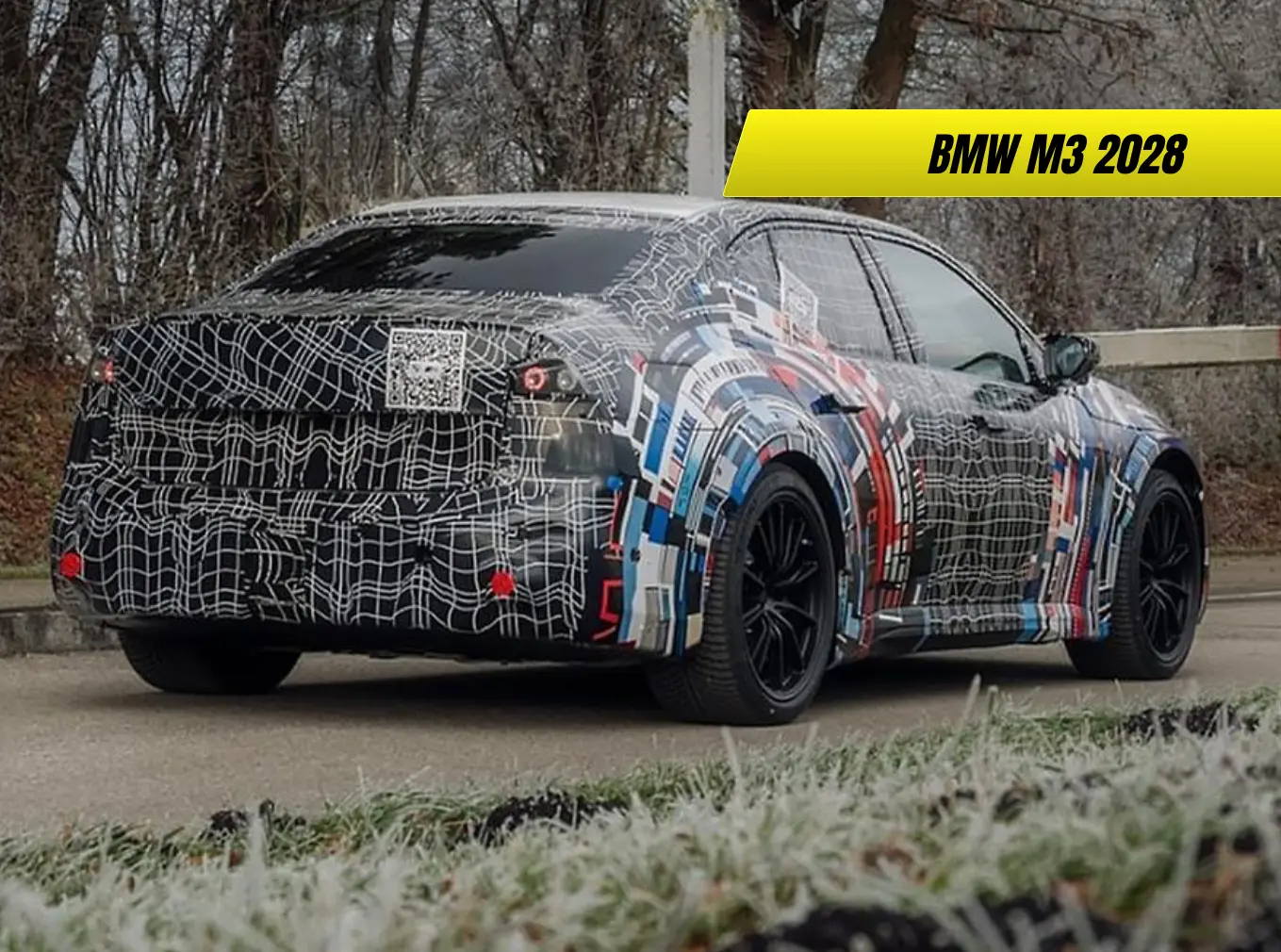
BMW M3 2028 (G84) spy photos show Neue Klasse styling, mild-hybrid S58 inline-six producing 523-560hp, xDrive AWD standard. No manual, RWD dropped. UK launch 2028, pricing £75,000+ estimated.
BMW M3 2028 G84: spy photos reveal Neue Klasse design, mild-hybrid S58 inline-six (523-560hp), xDrive AWD standard, manual transmission discontinued, UK launch 2028.
BMW’s next-generation M3 sports sedan (codename G84) photographed winter testing ahead 2028 launch, confirming combustion engine continuation alongside previously-announced electric iM3 variant through spy images revealing widened fenders, aggressive stance, quad exhaust outlets, and Neue Klasse-inspired front fascia adapted from upcoming eighth-generation 3 Series (G50) debuting late 2026. The performance flagship retains S58-derived 3.0-litre twin-turbocharged inline-six despite V6 speculation, with 48-volt mild-hybrid system integrationdelivering estimated 523hp base output (up from current 503hp) and 560hp+ performance variants (CS/CSL successors) meeting stringent Euro 7 emissions regulations while improving throttle response and efficiency. Controversially, BMW discontinues manual transmission and rear-wheel drive configurations entirely, making xDrive all-wheel drive and eight-speed automatic standard across the G84 M3 range – decision alienating purists who prioritize mechanical purity and driver engagement over objective performance metrics while acknowledging market realities where 95%+ current M3 buyers specify automatic/AWD combinations. UK pricing estimated £75,000-85,000base M3 Competition, £90,000-100,000 for higher-performance variants, positioning against Mercedes-AMG C 63 hybrid (2.0T four-cylinder + electric motor) and Audi RS 4 potentially receiving V6 electrification maintaining traditional combustion performance sedan segment before inevitable full electrification renders ICE variants extinct mid-2030s.
Neue Klasse Design Language Adaptation for M3 Performance Sedan
The 2028 M3’s most immediately apparent transformation involves adopting BMW’s Neue Klasse design philosophy – the radical styling direction debuting with iX2 and Vision Neue Klasse concepts emphasizing minimalism, illuminated surfaces, and geometric precision replacing the brand’s recent controversial styling excess epitomized by oversized kidney grilles and complex surfacing.
Front Fascia Evolution
Spy photographs reveal the G84 M3 test mule wearing heavy camouflage but displaying recognizable Neue Klasse characteristics:
Kidney Grille Refinement
- Reduced vertical dimension compared to current G80 M3’s massive upright kidneys
- Wider, flatter proportions creating horizontal emphasis versus vertical aggression
- Illuminated kidney outlines incorporating LED lighting technology (likely optional)
- Gloss black surround replacing chrome emphasizing contemporary aesthetic
Headlight Configuration
- Slimmer horizontal units abandoning current G80’s complex multi-element design
- Integrated LED daytime running lights with distinctive BMW signature
- Reduced overall headlight height contributing to lower, wider visual stance
- Advanced Matrix LED or Laser technology providing enhanced illumination
Lower Bumper Treatment
- Enlarged air intakes accommodating increased cooling requirements (mild-hybrid system, larger intercoolers)
- Vertical side intakes flanking central section (M-specific design element)
- Integrated splitter element enhancing front downforce while remaining road-legal
- Reduced decorative complexity versus current G80’s busy lower fascia
Side Profile Modifications
The widened fenders captured in spy images confirm M3’s traditional muscular stance surviving Neue Klasse’s minimalist philosophy:
| Dimension | Current G80 M3 | 2028 G84 M3 (Est) | Change |
|---|---|---|---|
| Front fender width | +70mm vs 3 Series | +75-80mm vs G50 3 Series | Slightly wider |
| Rear fender width | +80mm vs 3 Series | +85-90mm vs G50 3 Series | Wider for hybrid components |
| Front track | 1,627mm | ~1,650mm | +23mm |
| Rear track | 1,669mm | ~1,690mm | +21mm |
Design Elements
- Flush door handles reducing aerodynamic drag (Neue Klasse standard feature)
- Redesigned M-specific side mirrors with aerodynamic optimization
- Character lines running from front fenders to taillights creating visual length
- Black plastic fender extensions (functional: stone chip protection on wider bodywork)
- M-specific side skirts with subtle diffuser elements
Rear Design
The quad exhaust outlets visible in spy shots confirm combustion engine retention despite BMW’s aggressive electrification push:
Exhaust Configuration
- Four circular exhaust tips (traditional M3 signature since E46 generation)
- Center-exit placement through rear bumper diffuser
- Larger diameter than standard 3 Series (likely 90-100mm)
- Active exhaust flaps managing sound levels and backpressure (emissions compliance + driving modes)
Tail Section
- Slimmer horizontal taillights matching Neue Klasse’s graphic minimalism
- Integrated rear diffuser with vertical fins enhancing aerodynamic efficiency
- Subtle ducktail spoiler integrated into trunk lid (or available CSL-style carbon fiber lip)
- License plate position lowered versus current G80 enabling cleaner rear panel surfacing
The overall design represents careful balancing act: incorporating Neue Klasse’s contemporary minimalism attracting new customers while preserving M3’s aggressive performance aesthetic satisfying existing enthusiasts expecting visual drama matching the car’s capabilities.
For context on BMW design evolution, buyers familiar with Audi Q3 2025 see how German premium brands navigate styling transitions balancing heritage with contemporary expectations.
S58 Mild-Hybrid Powertrain: Evolution Not Revolution
Despite internet speculation suggesting V6 engine adoption following BMW executive comments about “new type of six-cylinder,” the G84 M3 continues with inline-six architecture – BMW’s signature configuration since the 1930s favored for inherent balance, smooth power delivery, and compact dimensions enabling optimal front-mid engine placement behind front axle.
Updated S58 Specifications
| Specification | Current G80 M3 Competition | 2028 G84 M3 Base (Est) | G84 M3 CS (Est) |
|---|---|---|---|
| Engine code | S58B30 | S58B30 Evo (mild-hybrid) | S58B30 Evo (enhanced) |
| Configuration | 3.0L inline-six twin-turbo | 3.0L inline-six twin-turbo + 48V | Same |
| Power (ICE only) | 503hp @ 6,250rpm | 510-515hp @ 6,500rpm | 540-550hp @ 6,500rpm |
| Mild-hybrid boost | N/A | +13hp (48V ISG) | +13hp |
| Total system output | 503hp | 523-528hp | 553-563hp |
| Torque | 650Nm (479 lb-ft) | 700Nm (516 lb-ft) | 750Nm+ (553+ lb-ft) |
| 0-62mph | 3.9s (Competition xDrive) | 3.6-3.8s (estimated) | 3.2-3.4s (estimated) |
| Top speed | 155mph (limited), 180mph (M Driver’s Pack) | Same limitations expected | Same |
| Emissions | Euro 6d-ISC | Euro 7 compliant | Euro 7 compliant |
48-Volt Mild-Hybrid System Integration
The updated S58 incorporates BMW’s latest 48-volt mild-hybrid technology similar to systems implemented across B58 (mainstream inline-six) and S68 (V8) engines:
Components
- Integrated Starter-Generator (ISG) replacing conventional alternator
- Belt-driven motor-generator unit producing 13hp (10kW) continuous, 20hp (15kW) brief bursts
- 48-volt lithium-ion battery (capacity approximately 0.8-1.0 kWh) located under rear seat or trunk
- 48-volt electrical architecture powering ancillaries (water pump, AC compressor) reducing mechanical losses
Benefits
- Reduced turbo lag: Electric motor fills torque gap before turbos spool, improving throttle response
- Enhanced efficiency: Engine-off coasting at highway speeds, start-stop system refinement, regenerative braking energy recovery
- Emissions compliance: Enables meeting Euro 7 standards without resorting to four-cylinder downsizing
- Performance boost: 13hp continuous assistance during acceleration, brief 20hp bursts during gear changes
- Ancillary optimization: Electric water pump and AC compressor operate independently of engine speed improving efficiency
Fuel Economy Improvements
The mild-hybrid system delivers estimated 10-15% real-world efficiency gains compared to non-hybrid S58:
- Current G80 M3 Competition: 25.0 mpg combined (WLTP), 256 g/km CO2
- 2028 G84 M3 (estimated): 28-30 mpg combined, 220-235 g/km CO2
- Annual fuel cost savings (12,000 miles @ £1.50/L): Approximately £300-400
While modest savings unlikely swaying purchase decisions in £75,000+ performance sedan segment, the improvements prove sufficient meeting regulatory requirements enabling S58’s survival into late-2020s when most competitors abandon combustion entirely.
Why No V6?
BMW executives’ cryptic “new type of six-cylinder” comments sparked V6 speculation, but multiple factors ensure inline-six continuation:
- Heritage and brand identity: Inline-six engines central to BMW’s “Ultimate Driving Machine” positioning since pre-war era
- NVH characteristics: Inline-six configuration inherently balanced without requiring balance shafts; V6 configurations exhibit secondary vibrations requiring management
- Packaging efficiency: Inline-six’s narrow width enables rearward engine placement behind front axle improving weight distribution
- Development costs: Evolving proven S58 architecture far cheaper than all-new V6 development for limited production volumes
- Market preference: BMW customers expect inline-six smoothness and character; V6 perceived as cost-cutting compromise
The “new type” reference likely indicates mild-hybrid integration and revised internal components rather than fundamental architecture change – evolutionary development maintaining BMW’s inline-six DNA while meeting contemporary requirements.
Manual Transmission Discontinued: Automatic and xDrive Now Standard
Perhaps most controversial aspect of G84 M3 development involves eliminating manual transmission and rear-wheel drive options entirely, making eight-speed automatic and xDrive all-wheel drive standard across the range – decision reflecting market realities while frustrating enthusiasts prioritizing mechanical engagement over objective performance.
Transmission Options
| Generation | Manual Availability | Automatic Option | AWD Availability |
|---|---|---|---|
| E90 M3 (2007-2013) | 6-speed manual standard | 7-speed DCT optional | RWD only |
| F80 M3 (2014-2020) | 6-speed manual standard (early), 7-speed DCT only (late) | 7-speed DCT from launch | RWD only (Competition added late) |
| G80 M3 (2021-2027) | 6-speed manual optional | 8-speed auto standard | RWD or xDrive (customer choice) |
| G84 M3 (2028+) | Discontinued | 8-speed auto only | xDrive only |
Rationale for Manual Elimination
BMW’s decision discontinuing manual M3 reflects sobering market data:
- Manual take rate: Less than 3% globally (approximately 5-7% US market, <1% Europe/Asia)
- Development costs: Engineering manual transmission meeting Euro 7 emissions (rev-matching, emissions during gear changes) proves expensive for minimal sales
- Performance disadvantage: 8-speed automatic delivers faster acceleration (0.2-0.3s quicker 0-62mph), better fuel economy, easier daily driving
- Complexity reduction: Single transmission option simplifies production, reduces inventory, minimizes warranty exposure
Enthusiast Backlash Predictable but Ignored
Online forums and social media erupted with criticism following manual/RWD discontinuation rumors, with purists arguing:
- Engagement priority: Manual transmission provides connection and involvement impossible with automatics regardless of performance metrics
- Driver skill celebration: Three-pedal driving rewards technique and practice versus automated efficiency
- Lightweight advantage: Manual saves 30-40kg improving power-to-weight ratio and handling balance
- Heritage abandonment: M Division built reputation on ultimate driver engagement; eliminating manual betrays brand’s founding principles
However, BMW recognizes these passionate enthusiasts represent tiny minority among actual buyers. The overwhelming majority – even self-described “car enthusiasts” – ultimately specify automatic transmission when configuring £75,000+ vehicles driven daily in traffic-congested urban environments where manual’s theoretical engagement benefits prove frustrating rather than enjoyable.
xDrive All-Wheel Drive Becomes Standard
Similarly, rear-wheel drive’s elimination reflects technical and market factors:
Technical Reasons
- Mild-hybrid packaging: 48V battery and electrical components occupy space previously available for propshaft and differential alternatives
- Traction capability: 523-560hp overwhelms rear tires alone in most conditions; AWD enables using available power more consistently
- Safety systems integration: Modern stability control, traction management, and driver aids optimized for AWD providing broader safety margins
- Winter capability: AWD transforms M3 from seasonal sports car to year-round transportation particularly crucial northern European markets
Market Demand
- Current G80 M3: 85%+ buyers specify xDrive over RWD despite price premium and slight weight penalty
- Customer priorities: Buyers prioritize usability, weather capability, and confident power delivery over purism
- Competition: Mercedes-AMG C 63 exclusively AWD (four-cylinder hybrid), Audi RS 4 Avant always Quattro AWD
For perspective on AWD performance cars, buyers researching best SUVs under £40k see how AWD became standard across multiple segments beyond traditional off-road applications.
Purist Alternative: Track-Focused CSL Variant?
BMW may placate hardcore enthusiasts through limited-edition CSL successor offering:
- Rear-wheel drive configuration (weight savings, purist appeal)
- Potential manual transmission (low-volume special edition justifying development costs)
- Stripped interior (carbon fiber, reduced sound deadening)
- Enhanced aerodynamics (adjustable wing, aggressive splitter/diffuser)
- Production limited to 1,000-2,000 units globally at £120,000-140,000 pricing
This strategy mirrors Porsche’s approach: mainstream 911 models now predominantly automatic/AWD, with GT3/GT3 RS offering manual/RWD options for enthusiasts willing paying substantial premiums. BMW’s CSL/CS variants could follow similar path, commercializing purism as luxury feature rather than standard offering.
UK Pricing and Competitive Positioning
Official pricing awaits announcement closer to 2028 UK launch, but current G80 M3 pricing combined with inflation, technology additions, and mild-hybrid premiums provides estimation framework:
Estimated UK Pricing Structure
| Model Variant | Estimated UK Price | Key Features |
|---|---|---|
| M3 Competition xDrive | £75,000-80,000 | 523hp, standard equipment, 8-speed auto, AWD |
| M3 Competition Plus | £82,000-87,000 | Enhanced specification, carbon exterior, premium audio |
| M3 CS | £95,000-105,000 | 560hp, weight reduction, track-focused suspension, carbon fiber |
| M3 CSL (if offered) | £120,000-140,000 | Ultimate performance, potential RWD/manual, extreme limited production |
Company Car Tax Implications
UK business users evaluating M3 ownership face substantial Benefit-in-Kind taxation given high P11D values and emissions:
| Tax Year | BIK Rate (Petrol) | Annual Tax (40% taxpayer, £77k P11D) | Monthly Cost |
|---|---|---|---|
| 2026-27 | 37% | £11,396 | £950 |
| 2027-28 | 38% | £11,704 | £975 |
| 2028-29 | 39% (projected) | £12,012 | £1,001 |
These substantial tax burdens push company car users toward plug-in hybrid alternatives or pure electric vehicles benefiting from ultra-low BIK rates (2-8% depending on electric range), potentially limiting M3’s UK corporate sales to business owners controlling company policy or ultra-high earners for whom £12,000 annual tax proves immaterial.
For reference understanding company car taxation, guides on UK toll roads and charges and driving licence points help fleet managers budget total motoring costs beyond purchase price.
Competitor Comparison
| Model | UK Price (Est) | Power | Drive | Transmission | Fuel Type |
|---|---|---|---|---|---|
| Mercedes-AMG C 63 | £75,000-85,000 | 671hp | AWD | 9-speed auto | 2.0T hybrid (4-cyl!) |
| Audi RS 4 Avant | £70,000-80,000 | TBC (450hp+ est) | Quattro AWD | Auto | Petrol or PHEV |
| BMW M3 G84 | £75-85k | 523-560hp | xDrive AWD | 8-speed auto | 3.0L I6 mild hybrid |
| Alfa Romeo Giulia Quadrifoglio | £72,000-77,000 | 520hp | RWD | 8-speed auto | 2.9L V6 (Ferrari-derived) |
| Tesla Model 3 Performance | £59,990 | 460hp | Dual AWD | Single-speed | Electric |
The M3’s estimated £75,000-85,000 positioning slots directly between mainstream electric performance (Tesla Model 3 Performance at £59,990) and exotic combustion alternatives (Alfa Romeo Giulia Quadrifoglio), with direct German rivals pricing similarly. The 3.0-litre inline-six mild-hybrid configuration offers middle-ground between Mercedes’ controversial four-cylinder hybrid (criticized despite 671hp output) and Alfa’s pure combustion V6, potentially appealing to customers seeking electrification benefits without abandoning traditional engine configurations.
Timeline and Launch Schedule
The G84 M3’s development follows BMW’s established product cadence with combustion variant launching after electric iM3 introduction:
Key Dates
| Milestone | Timing | Details |
|---|---|---|
| G50 3 Series reveal | Q4 2026 | Eighth-generation 3 Series debuts with Neue Klasse design |
| M350 launch | Q1 2027 | M Performance variant (not full M3) bridges gap with 400hp+ inline-six |
| iM3 electric reveal | Q2-Q3 2027 | Pure electric M3 debuts on Neue Klasse platform |
| G84 M3 ICE reveal | Q1 2028 | Combustion M3 officially unveiled |
| UK deliveries commence | Q2-Q3 2028 | First customer cars arrive spring/summer 2028 |
| CS variant launch | 2029 | Higher-performance model follows base M3 by 12-18 months |
Production Location
The G84 M3 will be manufactured at BMW’s Munich plant alongside standard G50 3 Series, maintaining traditional production arrangement where M3 variants are built on the same assembly lines as regular models with specialized M-specific components (engines, transmissions, suspension, braking) installed during production rather than separate M Division assembly facility.
This integrated production approach reduces costs and improves quality consistency but means M3 production volumes remain constrained by overall 3 Series facility capacity – typically 15,000-20,000 M3 units annually globally versus 300,000+ total 3 Series production.
Frequently Asked Questions
When does the BMW M3 2028 launch in the UK?
The G84 M3 officially debuts Q1 2028 with UK deliveries commencing spring/summer 2028 (April-July). Order books likely open late 2027 or early 2028, approximately 6-9 months before first deliveries. Higher-performance CS variants follow 12-18 months later in 2029.
Will the 2028 M3 have a manual transmission?
No. BMW discontinues manual transmission entirely on the G84 M3, making eight-speed automatic standard across all variants. This decision reflects market realities where less than 3% of buyers globally specified manual on current G80 M3, insufficient justifying development costs meeting Euro 7 emissions regulations. Potential CSL limited edition might offer manual as exclusive feature for enthusiasts willing paying substantial premiums.
Is rear-wheel drive available on the new M3?
No. The G84 M3 adopts xDrive all-wheel drive as standard configuration, eliminating rear-wheel drive options entirely. Current G80 M3 buyers overwhelmingly specify xDrive (85%+ take rate) for superior traction, weather capability, and confident power delivery. Potential limited-edition CSL variant might offer RWD configuration appealing purists prioritizing handling balance over straight-line performance.
How much power does the 2028 M3 produce?
Base M3 Competition produces estimated 523-528hp from revised S58 inline-six with 48-volt mild-hybrid system (510-515hp combustion engine + 13hp electric boost). Higher-performance CS successor delivers estimated 553-563hp. This represents meaningful increase over current G80 M3 Competition’s 503hp while remaining below AMG S 63 E Performance plug-in hybrid’s 791hp maintaining model hierarchy.
What’s the 0-62mph acceleration time?
Estimated 3.6-3.8 seconds for base M3 Competition xDrive (improvement from current 3.9s), with CS variant achieving approximately 3.2-3.4 seconds. These estimates assume xDrive AWD traction advantages and eight-speed automatic’s optimized shift patterns. Mild-hybrid system’s instant electric torque assists launches and gear changes improving performance despite modest 13hp contribution.
How much does the 2028 M3 cost in the UK?
Official pricing unconfirmed but estimated £75,000-80,000 for base M3 Competition xDrive, £82,000-87,000 for enhanced Plus specification, and £95,000-105,000 for CS performance variant. Potential limited-edition CSL could reach £120,000-140,000. Final UK pricing announced approximately 6-12 months before launch incorporating specification details and equipment levels.
Is the new M3 better than Mercedes-AMG C 63?
Subjective comparison depends on priorities. M3 advantages: traditional inline-six engine (versus controversial four-cylinder C 63), higher base power (523hp vs C 63’s 671hp system output but different character), Neue Klasse contemporary design. C 63 advantages: plug-in hybrid system (671hp, electric-only mode), more aggressive styling for some tastes, established AMG performance reputation. Test drive both determining personal preference as objective superiority claims prove meaningless at this performance level.
Will there be an M3 Touring (estate) version?
Unconfirmed but likely following current G81 M3 Touring’s success. BMW introduced first-ever M3 estate with current generation after decades of customer requests. Sales exceeded expectations particularly in Europe where estate body styles traditionally popular. Expect G84 M3 Touring announcement 6-12 months after sedan launch, likely 2029 arrival continuing successful formula.
Does the mild-hybrid system improve fuel economy significantly?
The 48-volt mild-hybrid system delivers estimated 10-15% real-world efficiency improvements compared to non-hybrid S58, translating to approximately 28-30 mpg combined (up from current 25.0 mpg). For 12,000 annual miles, this saves roughly £300-400 yearly at current UK fuel prices – modest savings unlikely influencing purchase decisions but sufficient meeting Euro 7 emissions regulations enabling S58’s continued production into late-2020s.
Conclusion
The 2028 BMW M3 (G84) represents careful evolutionary development balancing contemporary requirements with heritage preservation, introducing Neue Klasse-inspired design minimalism, mild-hybrid S58 inline-six producing 523-560hp meeting Euro 7 regulations, and standard xDrive all-wheel drive with automatic transmission reflecting market preferences while controversially eliminating manual gearbox and rear-wheel drive options cherished by purists prioritizing engagement over objective performance metrics. Spy photographs confirm widened fenders, aggressive stance, and quad exhaust outlets maintaining M3’s visual drama despite regulatory pressures forcing rivals toward four-cylinder hybridization (Mercedes-AMG C 63) or full electrification threatening traditional performance sedan segment’s extinction.
For UK enthusiasts, the G84 M3’s estimated £75,000-85,000 pricing positions competitively against German rivals while offering middle-ground between pure combustion nostalgia and aggressive electrification – the 3.0-litre turbocharged inline-six with mild-hybrid assistance providing familiar BMW character enhanced with contemporary efficiency rather than revolutionary powertrain transformation alienating traditional customers. The automatic/AWD-only specification will frustrate vocal minority demanding three-pedal purity, though market data vindicates BMW’s pragmatism given less than 3% manual take rates and 85%+ xDrive preference among actual buyers versus online commentators whose purchasing intentions rarely materialize into dealership transactions.
The fundamental question facing BMW involves combustion engine longevity: does developing refined G84 M3 for 2028 launch make strategic sense when electric iM3 debuts simultaneously and regulatory landscape increasingly hostile toward internal combustion regardless of emissions compliance? The answer likely recognizes that while automotive future undoubtedly electric, present remains firmly combustion-hybrid transition requiring manufacturers maintaining competitive offerings across powertrain types rather than prematurely abandoning profitable segments where demand persists. The G84 M3 represents BMW’s hedge – sophisticated combustion engineering demonstrating technical excellence while electric alternatives mature and charging infrastructure expands enabling mass-market EV adoption currently constrained by practical limitations affecting buyers beyond wealthy early adopters.
Whether enthusiasts celebrate or mourn the G84 M3’s specification depends on perspective: pragmatists recognize automatic/AWD delivers superior daily usability, all-weather capability, and objective performance metrics justifying compromises, while purists lament inevitable march toward homogenized competence eliminating mechanical engagement and driver skill celebration defining enthusiast motoring’s core appeal before electrification standardization renders such debates moot.





