
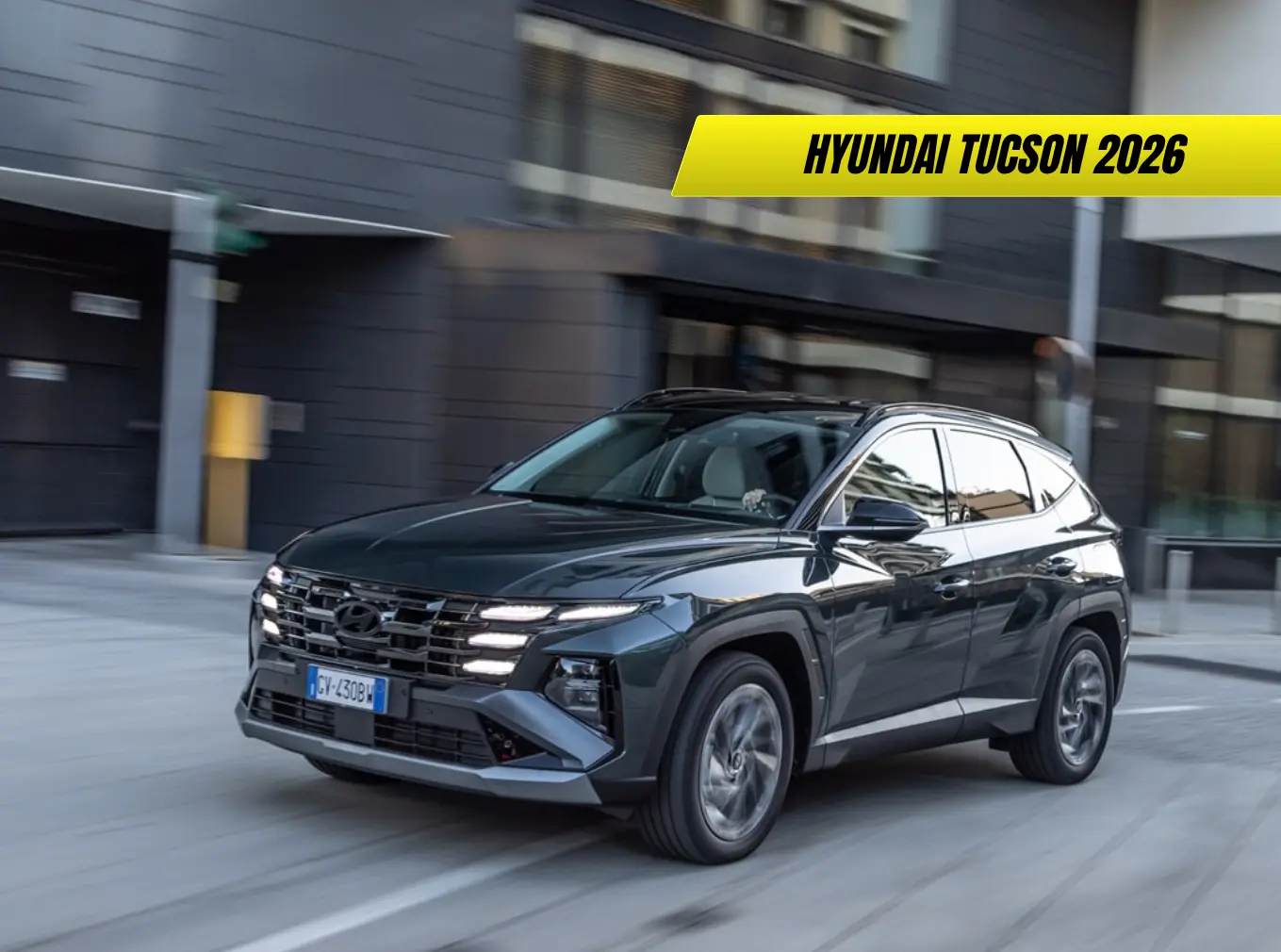
The next-generation Hyundai Tucson arrives in 2026 with a dramatic design overhaul, updated hybrid and plug-in hybrid powertrains, and a significantly upgraded technology package — reinforcing its position as one of the UK’s most complete family SUVs.
The Hyundai Tucson has consistently been one of the strongest performers in the competitive mid-size family SUV segment, offering genuine space, strong value and a wide choice of electrified powertrains. The 2026 generation takes that solid foundation and delivers a thorough redesign — both inside and out — alongside over-the-air update capability and a refined driving experience. For broader context on what’s available in the family SUV space, our guides to the 20 best SUVs under £40k and the Nissan Qashqai e-Power review are essential reading.
Hyundai Tucson 2026: Key Highlights
- Completely redesigned exterior with a sharper, more angular aesthetic
- UK prices span from approximately £34,805 to £46,010
- Three powertrain options: 1.6T petrol, 1.6T hybrid and 1.6T plug-in hybrid
- Hybrid variant starts from £36,220 in Advance trim
- Over-the-air (OTA) software updates standard across the range
- New interior with a redesigned digital cockpit and improved materials throughout
- Five-star Euro NCAP safety rating retained
Release Date: When Is the Hyundai Tucson 2026 Available in the UK?
The Hyundai Tucson 2026 is available now in the UK, with the full refreshed range on sale through Hyundai’s national dealer network. All three powertrain options — the petrol, hybrid and plug-in hybrid — are available to order immediately, with delivery times typically between four and eight weeks depending on trim and specification. You can configure and order directly through the Hyundai UK official website.
Price: How Much Does the Hyundai Tucson 2026 Cost in the UK?
The Tucson 2026 range is available across five trim levels — Advance, Premium, N Line, Ultimate and N Line S — with prices starting from £34,805 for the entry petrol and rising to £46,010 for the fully equipped hybrid and PHEV models.
| Variant | Trim | Power | UK Price (from) |
|---|---|---|---|
| 1.6T Petrol | Advance | 150 hp | £34,805 |
| 1.6T Hybrid | Advance | 230 hp combined | £36,220 |
| 1.6T Hybrid | Premium | 230 hp combined | £38,720 |
| 1.6T Hybrid | N Line S | 230 hp combined | £41,320 |
| 1.6T PHEV | Advance | 265 hp combined | £42,500 est. |
| 1.6T PHEV | Ultimate | 265 hp combined | £46,010 |
In my experience, the hybrid Advance at £36,220 represents the strongest value in the Tucson range for most UK families — the self-charging hybrid system significantly reduces fuel consumption on urban and suburban routes without the additional complexity or upfront cost of the PHEV variant.
Redesigned Exterior: A Bolder Direction
The 2026 Tucson adopts a significantly more assertive design language compared to its predecessor. The front end features a wider parametric grille with an illuminated horizontal blade running between the headlights — a distinctive lighting signature that makes the Tucson instantly identifiable at night. The headlight clusters are slimmer and more angular than before, while the bonnet line is sharper and more sculpted.
In profile, the 2026 Tucson retains the familiar five-door SUV proportions but gains more pronounced body creases and a slightly more raked roofline. At the rear, a full-width light bar connects the taillights in a clean, horizontal sweep — a design approach now common across Hyundai’s SUV family. 17-inch alloy wheels are standard on Advance trim, rising to 19-inch items on N Line specifications.
Powertrains: Electrified for UK Drivers
The 2026 Tucson range is built around three powertrain options, all based on a 1.6-litre turbocharged four-cylinder petrol engine in varying states of electrification:
1.6T Petrol (150 hp): The entry-level option, paired with a six-speed manual or seven-speed dual-clutch automatic, returning approximately 40 MPG in combined UK driving.
1.6T Hybrid (230 hp combined): Combines the 1.6T engine with a belt-integrated starter-generator and a small lithium-ion battery. The hybrid system adds torque fill at low speeds and enables the engine to shut off during light-load cruising, delivering approximately 50 MPG in real-world UK use. Available with six-speed automatic and optional HTRAC all-wheel drive.
1.6T PHEV (265 hp combined): Pairs the 1.6T engine with a more substantial electric motor and a 13.8 kWh battery, delivering a claimed electric-only range of approximately 38 miles — more than sufficient for most UK daily commutes. The PHEV qualifies for a reduced Benefit-in-Kind rate of 8% for company car users, making it particularly attractive for fleet buyers. For a broader comparison of plug-in hybrid options, our best PHEVs for UK drivers guide covers the segment in depth.
Interior: Redesigned and More Premium
The 2026 Tucson interior represents the most significant upgrade of this generation, with a redesigned dashboard centred on an integrated dual 12.3-inch curved display — combining the instrument cluster and infotainment screen into a single panoramic unit. Key standard features across the range include:
- Wireless Apple CarPlay and Android Auto as standard
- 64-colour ambient interior lighting
- Dual-zone automatic climate control on Advance, three-zone on Premium and above
- Wireless smartphone charging pad
- Reversing camera standard on all variants
- Heated front seats and steering wheel from Advance trim
- Bose premium sound system available on higher trims
- Second-row heated seats on Ultimate and N Line S
From my point of view, the Tucson’s interior now genuinely competes with premium SUVs costing considerably more. The dual curved display in particular brings the cabin up to the level expected from a 2026 family SUV.
Space and Practicality
The Tucson remains one of the most spacious vehicles in the family SUV class. Key dimensions include:
- Boot capacity: 620 litres (5-seat) / 535 litres (PHEV, due to battery under floor)
- Rear legroom: Among the best in class — genuinely comfortable for adult rear passengers
- Panoramic sunroof: Available from N Line trim upwards
- HTRAC AWD: Available on hybrid models — particularly relevant for UK buyers in rural areas or those who encounter difficult winter conditions regularly
Safety: Five Stars, Comprehensive Standard Kit
The Hyundai Tucson 2026 maintains its five-star Euro NCAP safety rating, with the following active safety systems standard across all UK variants:
- Forward collision avoidance assist — with junction, pedestrian and cyclist detection
- Lane keeping assist and lane departure warning
- Blind-spot collision warning
- Rear cross-traffic collision avoidance
- Driver attention warning
- Adaptive cruise control with stop-and-go function
- Safe exit warning — alerts occupants to passing cyclists or vehicles before opening doors
For UK drivers conscious of accumulating penalty points, the Tucson’s speed limit assist and intelligent speed recognition system can be configured to UK road speed limits. Our guide on UK driving licence points explains what happens as you approach the 12-point threshold.
Hyundai Tucson 2026 vs. Key Rivals
| Model | Hybrid Option | Boot (L) | PHEV Range | UK Price (from) |
|---|---|---|---|---|
| Hyundai Tucson 2026 | Yes (50 MPG) | 620 | ~38 miles | £36,220 |
| Kia Sportage 2026 | Yes (50 MPG) | 587 | ~43 miles | £34,465 |
| Toyota Corolla Cross 2025 | Yes (56 MPG) | 477 | N/A | £34,925 |
| Nissan Qashqai e-Power | Yes (45 MPG) | 504 | N/A | £32,395 |
| Volkswagen Tiguan 2026 | Yes | 652 | ~62 miles | £38,870 |
FAQ
Is the Hyundai Tucson 2026 available in the UK now?
Yes. The full 2026 Tucson range is available through Hyundai UK dealerships. Visit the Hyundai UK website to configure and order.
What is the most fuel-efficient Hyundai Tucson 2026?
The 1.6T Hybrid returns approximately 50 MPG in real-world UK driving — the best fuel economy in the range for buyers who do not regularly charge the PHEV.
How far can the Hyundai Tucson PHEV go on electric power?
The PHEV offers a claimed electric range of approximately 38 miles from its 13.8 kWh battery — sufficient for most UK daily commutes on electricity alone.
Is the Hyundai Tucson 2026 ULEZ compliant?
All 2026 Tucson petrol, hybrid and PHEV variants meet Euro 6d emission standards, making them fully ULEZ compliant in London and all UK clean air zones.
What is the road tax (VED) for the Hyundai Tucson 2026?
Petrol and hybrid variants are subject to standard UK VED rates based on CO₂ emissions. The PHEV benefits from lower first-year VED due to its reduced CO₂ output. Full current rates are available on the official DVLA vehicle tax page.
Does the Hyundai Tucson 2026 support over-the-air updates?
Yes. OTA software update capability is standard across the 2026 Tucson range — allowing Hyundai to improve vehicle software, add features and fix issues remotely without a dealer visit.
How does the Tucson compare to the Kia Sportage?
Both share the same 1.6T hybrid platform and are closely matched on space and efficiency. The Tucson edges ahead on interior design and the dual curved display, while the Sportage undercuts it slightly on price. The Sportage PHEV also offers a slightly longer electric range of approximately 43 miles.
Conclusion
The Hyundai Tucson 2026 is the most complete version of this consistently strong family SUV yet. The bolder exterior design, redesigned dual curved display interior, comprehensive electrification options and strong standard safety equipment make it a genuinely compelling choice in one of the UK’s most competitive car segments. For drivers who cover a mixture of urban, suburban and motorway miles, the hybrid Advance offers outstanding real-world value. I would recommend the Tucson 2026 unreservedly to any family in the market for a practical, well-equipped and attractively priced SUV.





