
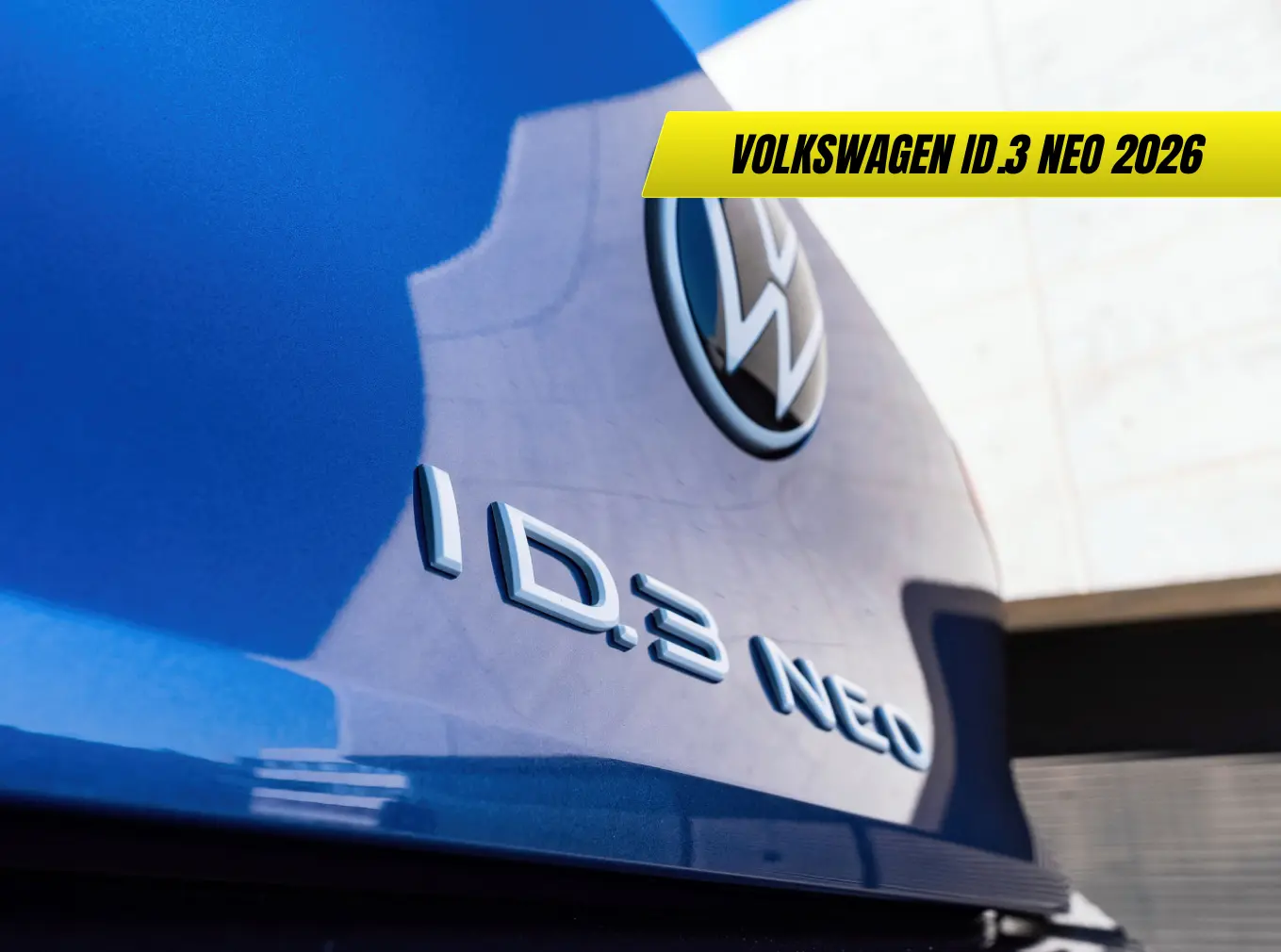
The Volkswagen ID.3 receives its most significant update since launch — now branded the ID.3 Neo, with a comprehensively refreshed interior, vehicle-to-load technology, updated charging and a deeper range of batteries — available in the UK from April 2026.
The Volkswagen ID.3 was the car that launched Volkswagen’s mass-market electric era — a Golf-sized hatchback with zero-emission credentials, a practical 385-litre boot and a price that made EV ownership genuinely accessible. After four years on sale, the ID.3 receives its most comprehensive update yet — now carrying the Neo suffix that signals a deeper generational shift rather than a routine annual update. The ID.3 Neo arrives in UK showrooms from April 2026, with upgrades that address the original car’s main criticisms and introduce genuinely new technology to the segment. For buyers comparing compact EVs, our coverage of the Renault Clio 6 2026 and Dacia Sandero 2026 provides context on the wider affordable EV and near-EV landscape.
Volkswagen ID.3 Neo 2026: Key Highlights
- New Neo suffix — marking the most significant update since the ID.3’s 2020 launch
- UK on sale: April 2026 — from approximately £30,860
- Vehicle-to-Load (V2L) technology added — the ID.3 can now power external devices and appliances
- Revised front bumper and headlight graphics — more assertive visual identity
- New darker blue metallic paint — added to the colour range
- Updated infotainment software — faster processing, improved voice recognition
- Battery options: 52 kWh, 59 kWh and 79 kWh — range from 240 to 369 miles WLTP
- 130 kW DC rapid charging retained — 10–80% in approximately 25–28 minutes
Release Date: April 2026 in the UK
The ID.3 Neo goes on sale in the UK in April 2026, with order books now open through Volkswagen UK’s dealer network. The full visual and specification details will be confirmed at the official April reveal event — pre-production renders released by Volkswagen confirm updated front and rear styling. Configure and order via the Volkswagen UK official website.
Price: From £30,860 — Still the Most Competitive Volume EV
The ID.3 Neo retains the current car’s pricing structure, starting from £30,860 for the base Pure Essential 52 kWh model after the £1,500 Electric Car Grant is applied. The full UK range:
| Variant | Battery | Range (WLTP) | Price (after grant) |
|---|---|---|---|
| Pure Essential | 52 kWh | 240 miles | £30,860 |
| Pure Match | 52 kWh | 240 miles | £32,960 |
| Pro Essential | 59 kWh | 280 miles | £35,360 |
| Pro Match | 59 kWh | 280 miles | £37,460 |
| Pro S Essential | 79 kWh | 369 miles | £42,860 |
| GTX Performance | 79 kWh | 340 miles | £46,860 |
From my point of view, the Pro Match at £37,460 with the 59 kWh battery represents the sweet spot of the ID.3 Neo range — sufficient range for any UK daily commute and most longer journeys, with a specification level that includes the most desirable technology features.
The Neo Suffix: What Has Actually Changed?
Vehicle-to-Load (V2L) — The Headline Feature
The most significant new capability of the ID.3 Neo is Vehicle-to-Load (V2L) technology. This allows the ID.3 Neo to act as a mobile power bank — exporting power from its high-voltage battery through a dedicated outlet to power external electrical devices. Practical applications for UK drivers include:
- Powering electric tools on a building site or outdoor event
- Running camping equipment — electric cool boxes, lighting, cooking appliances
- Providing emergency power to a home or critical appliances during a grid outage
- Charging other electric vehicles or e-bikes via a standard adapter
The V2L system supports up to 3.6 kW of continuous output — sufficient for most domestic appliances simultaneously. This brings the ID.3 Neo in line with the Hyundai Ioniq 5 and Kia EV6, which have offered V2L since their launch.
Revised Exterior Design
Pre-production images confirm:
- Reprofiled front bumper — wider lower intake, more angular lower graphic, closer in character to the ID.7 saloon
- Updated headlight graphics — revised LED daytime running light signature
- New wheel designs across the range — lighter and more visually refined
- New darker blue metallic paint — complementing the existing colour palette
Updated Infotainment and Software
The ID.3 Neo receives the latest iteration of Volkswagen’s infotainment software — addressing the speed and responsiveness criticisms of the original car’s interface. Key improvements:
- Faster system processing — reduced touchscreen lag that was a common complaint on early ID.3 models
- Improved voice recognition — natural language processing update
- OTA software update capability — all future feature updates delivered wirelessly, without dealer visits required
- Updated navigation with predictive charging stop planning based on real-time battery state and charge point availability
Charging: 130 kW Retained, V2L Added
The ID.3 Neo retains the current car’s DC rapid charging capability at 130 kW — one of the fastest in the compact EV segment, enabling 10–80% in approximately 25–28 minutes at a compatible ultra-rapid charger. Home AC charging at 11 kW remains standard across the range.
The addition of V2L export capability is the most meaningful charging-related change — expanding the ID.3 Neo’s energy management role from a pure consumer to a bidirectional participant in the UK’s energy ecosystem.
ID.3 Neo vs. Key Rivals
| Model | Range (WLTP) | Boot (L) | DC Charging | V2L | UK Price (from) |
|---|---|---|---|---|---|
| VW ID.3 Neo | 240–369 miles | 385 | 130 kW | Yes | £30,860 |
| Ford Puma Gen-E 2026 | 250 miles | 574 | 100 kW | No | £26,245 |
| Hyundai Ioniq 5 | 316 miles | 531 | 230 kW | Yes | £40,845 |
| Renault Scenic E-Tech | 379 miles | 545 | 150 kW | No | £36,995 |
| BMW iX1 | 272 miles | 490 | 130 kW | No | £43,445 |
FAQ
When is the Volkswagen ID.3 Neo on sale in the UK?
The ID.3 Neo goes on sale in April 2026 — order books are open now.
What is new on the Volkswagen ID.3 Neo?
Key additions include Vehicle-to-Load (V2L) technology, updated exterior styling, revised headlight graphics, faster infotainment software and OTA update capability.
How much does the Volkswagen ID.3 Neo cost in the UK?
Prices start from £30,860 for the Pure Essential 52 kWh model after the Electric Car Grant.
What is V2L on the Volkswagen ID.3 Neo?
Vehicle-to-Load allows the ID.3 Neo to export up to 3.6 kW of power to external devices — effectively turning the car into a mobile generator for tools, camping equipment or emergency home power.
What is the range of the Volkswagen ID.3 Neo?
Between 240 miles (52 kWh) and 369 miles (79 kWh) WLTP — depending on battery specification.
Does the ID.3 Neo have fast charging?
Yes — 130 kW DC rapid charging achieves 10–80% in approximately 25–28 minutes.
Why is it called the ID.3 Neo?
The Neo suffix signals a more significant generational update than a routine annual refresh — a deliberate branding choice by Volkswagen to communicate the depth of the changes.
Conclusion
The Volkswagen ID.3 Neo is a meaningfully improved car that addresses the key criticisms of the original — the sluggish infotainment, the lack of bidirectional charging capability and the need for a visual refresh. The addition of V2L technology, in particular, transforms the ID.3 Neo from a good compact EV into a genuinely versatile energy tool for UK households. From my point of view, the Pro Match at £37,460 remains one of the best-value propositions in the compact EV segment — and the Neo update makes that case stronger than ever.





