
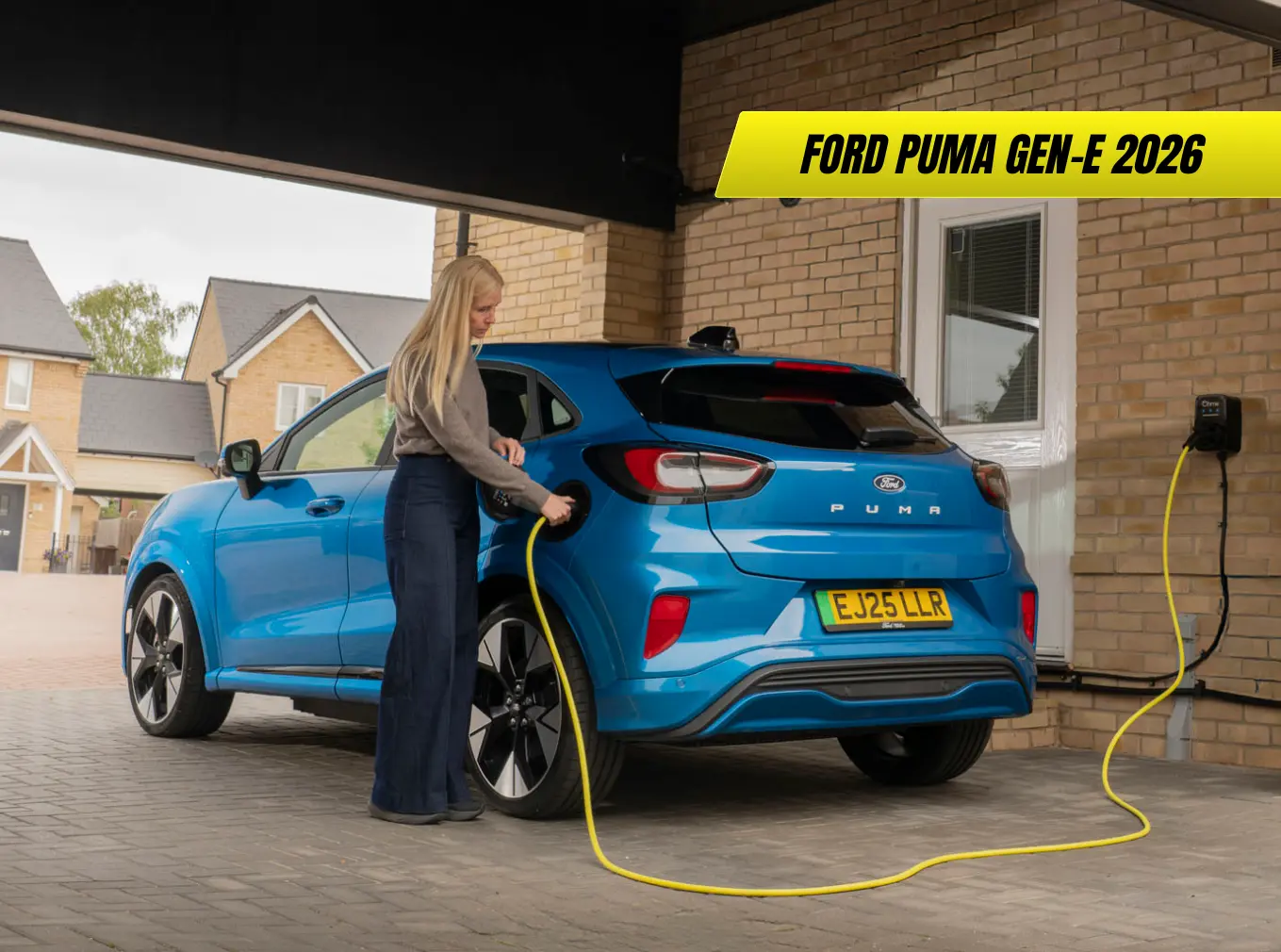
The Ford Puma Gen-E 2026 gains 17 additional miles of WLTP range and becomes the first affordable UK electric car to feature a legally approved hands-off semi-autonomous highway driving system — all at an unchanged starting price of £26,245.
The Ford Puma Gen-E has been one of the UK’s most popular small electric cars since its launch, combining the familiar and well-loved Puma exterior with a practical electric drivetrain. For 2026, Ford has delivered two significant improvements: a range increase from 233 to 250 miles through an optimised battery design, and the addition of BlueCruise— the first hands-off, eyes-on autonomous driving system to receive legal approval for use on UK roads. Both updates arrive without a price increase — a welcome development in a segment where value is paramount. For buyers comparing compact EVs, our guides to the CUPRA Raval 2026 and Renault Clio 6 2026 offer useful comparisons.
Ford Puma Gen-E 2026: Key Highlights
- UK starting price: £26,245 — unchanged from the 2025 model after the £3,750 Electric Car Grant
- WLTP range increased from 233 to 250 miles — via optimised battery design, not a larger battery
- 43 kWh battery retained — same capacity, improved efficiency
- BlueCruise hands-off highway driving standard on the new ST-Line Vignale special edition
- BlueCruise legal for hands-off use on 95% of the UK motorway network
- UK deliveries begin: May 2026
- Claimed urban range of up to 341 miles — best-in-class for a 43 kWh battery
Release Date: When Is the 2026 Puma Gen-E Available?
The updated 2026 Ford Puma Gen-E is available to order now through Ford UK dealerships, with deliveries beginning in May 2026. The BlueCruise-equipped ST-Line Vignale special edition is available alongside the standard range from the same date. Order directly through the Ford UK official website.
Price: Unchanged Despite the Upgrades
Ford has confirmed that the 2026 Puma Gen-E range starts at £26,245 after the government’s £3,750 Electric Car Grant is applied — identical to the 2025 model. This represents an exceptionally strong value position in the compact EV market, where most competitors are priced above £27,000 for equivalent range.
| Variant | Range (WLTP) | Price (after grant) |
|---|---|---|
| Puma Gen-E Trend | 250 miles | £26,245 |
| Puma Gen-E ST-Line | 250 miles | £28,495 |
| Puma Gen-E ST-Line Vignale | 250 miles | £30,745 |
| Puma Gen-E ST-Line Vignale (BlueCruise) | 250 miles | £31,995 |
In my experience, the ST-Line at £28,495 represents the best balance of specification and value in the Puma Gen-E range — the sportier exterior detailing, larger alloy wheels and enhanced interior finish are worth the premium over the base Trend without the significant uplift to Vignale.
The Range Increase: 250 Miles From the Same Battery
The 2026 Puma Gen-E’s range increase from 233 to 250 miles is achieved without adding battery capacity — a technically elegant solution that Ford describes as an “enhanced battery design”. The key improvements include:
- Optimised cell chemistry — revised electrolyte formulation reducing internal resistance and improving energy delivery at varying temperatures
- Improved thermal management — more precise battery temperature regulation reduces energy lost to heating and cooling the pack in typical UK ambient conditions
- Software optimisation — updated battery management software reduces parasitic energy consumption and improves regenerative braking energy recovery
The practical result is an additional 17 miles of WLTP range and a particularly impressive claimed urban range of 341 miles — reflecting the hybrid system’s effectiveness in stop-start city driving where regenerative braking is most active. For UK drivers primarily using the Puma Gen-E for urban and suburban commuting, this urban figure is the most relevant real-world indicator.
BlueCruise: The UK’s First Legal Hands-Off Highway System
The headline technology addition to the 2026 Puma Gen-E is Ford BlueCruise — the most significant driver assistance advancement in the compact EV segment this year, and the first hands-off autonomous driving system to receive legal approval for use on UK roads.
How BlueCruise Works
BlueCruise is classified as a Level 2+ semi-autonomous system — meaning it handles both steering and speed control simultaneously on pre-mapped roads, allowing the driver to remove their hands from the steering wheel while keeping their eyes on the road ahead. It uses:
- A combination of cameras and radar sensors to monitor lane markings, road signs and surrounding traffic
- Driver monitoring cameras to confirm the driver is attentive (eyes-on requirement)
- A continuously updated database of pre-mapped “Blue Zone” roads — currently covering 95% of the UK motorway network and over 84,000 miles of road across 16 European countries
Unlike other systems such as Tesla Autopilot or Volvo Pilot Assist — which require hands on the wheel at all times — BlueCruise genuinely allows hands-off operation within its approved zones. This makes it the most advanced consumer driver assistance system currently legally available on UK roads.
“BlueCruise is the only hands-off, eyes-on driver assistance system with legal approval for use on public roads in the UK.” — Ford Motor Company
Why It Matters for UK Motorway Driving
For UK drivers who regularly use motorways — the M25, M6, M1 or M40, all fully mapped in the Blue Zone — BlueCruise can handle lane centering, speed management and safe following distance continuously and without driver input, significantly reducing fatigue on long journeys. Ford drivers have already accumulated over 522 million miles using BlueCruise globally since its launch on the Mustang Mach-E in 2023. For guidance on UK motorway regulations applicable when using driver assistance systems, our UK speed camera regulations guide covers current enforcement rules in detail.
Charging and Practicality: Unchanged but Competitive
The 2026 update does not alter the Puma Gen-E’s charging hardware:
- 11 kW AC home charging — a full charge from empty overnight in approximately 4.5 hours
- 100 kW DC rapid charging — 10–80% in approximately 25 minutes
- Boot: 574 litres — best in class for a compact electric crossover, thanks to the front motor freeing up the underfloor space
- Frunk (front storage) — a useful additional compartment under the bonnet
The 574-litre boot remains one of the most compelling practical arguments for the Puma Gen-E over rivals — significantly larger than the Renault 5 E-Tech (326 litres), CUPRA Raval (est. 310 litres) and even some larger EVs.
Ford Puma Gen-E 2026 vs. Key Competitors
| Model | Range (WLTP) | Boot (L) | DC Charging | UK Price (from) |
|---|---|---|---|---|
| Ford Puma Gen-E 2026 | 250 miles | 574 | 100 kW | £26,245 |
| Renault 5 E-Tech Extended | 249 miles | 326 | 100 kW | £25,995 |
| CUPRA Raval (est.) | 248 miles | ~310 | 130 kW | ~£22,000 |
| Peugeot e-208 | 248 miles | 311 | 100 kW | £28,250 |
| VW ID.3 Standard | 251 miles | 385 | 130 kW | £32,995 |
FAQ
How much does the Ford Puma Gen-E 2026 cost in the UK?
Prices start from £26,245 after the £3,750 Electric Car Grant — unchanged from the 2025 model despite the added range and BlueCruise technology.
What is the range of the Ford Puma Gen-E 2026?
250 miles WLTP — up from 233 miles in the 2025 model. The urban range is claimed at up to 341 miles.
What is BlueCruise and is it legal in the UK?
BlueCruise is a hands-off, eyes-on highway driving system that is the first of its kind to receive legal approval for use on UK roads. It is available on the Puma Gen-E ST-Line Vignale special edition and covers 95% of the UK motorway network.
When do 2026 Ford Puma Gen-E deliveries start in the UK?
UK deliveries begin in May 2026.
Has the battery size increased on the 2026 Puma Gen-E?
No. The battery remains at 43 kWh. The range increase comes from an optimised battery design and improved efficiency — not additional capacity.
Is the Ford Puma Gen-E ULEZ compliant?
Yes. As a zero-emission vehicle, the Puma Gen-E is exempt from London ULEZ and Congestion Charge fees.
What is the boot size of the Ford Puma Gen-E?
574 litres — the largest boot of any compact electric crossover in its class, enabled by the front-mounted electric motor freeing up underfloor storage space.
Conclusion
The Ford Puma Gen-E 2026 is a genuinely better car than its predecessor without costing a penny more — the 250-mile range, the industry-leading 574-litre boot and now the addition of BlueCruise make it one of the most well-rounded compact EVs available in the UK market. The addition of the UK’s first legal hands-off highway driving system is a milestone moment for British motoring. I would recommend the 2026 Puma Gen-E confidently to any UK driver seeking a practical, technology-rich compact EV with excellent real-world usability.





