
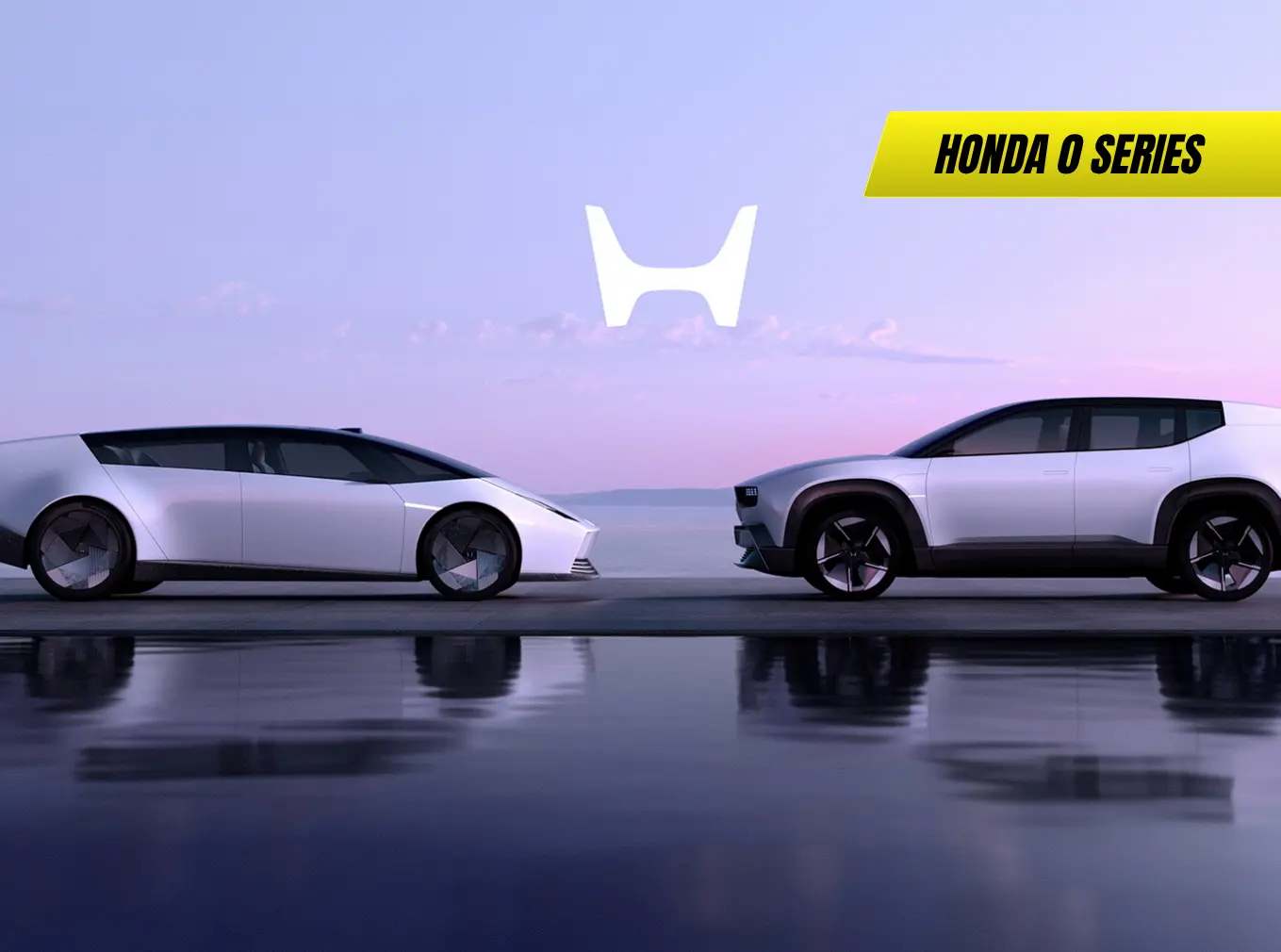
Honda has cancelled the Honda 0 SUV, Honda 0 Saloon and Acura RSX electric models that were due to launch in North America in 2026, citing a strategic reassessment of its electrification roadmap and expected losses of up to ¥2.5 trillion (approximately £12.5 billion) for the fiscal year ending March 2026.
Honda announced on 12 March 2026 one of the most significant strategic retreats in the Japanese automotive industry’s recent history — the cancellation of three flagship electric models that were intended to launch Honda’s dedicated EV era in North America. The Honda 0 SUV, the Honda 0 Saloon and the Acura RSX were not peripheral models — they were the centrepiece of Honda’s electrification strategy, each previewed at the Consumer Electronics Show and presented as Honda’s definitive answer to Tesla, Hyundai and the broader EV revolution. Their cancellation, at costs that could reach ¥2.5 trillion (approximately £12.5 billion), represents a fundamental reassessment of Honda’s electric vehicle direction. For UK buyers currently considering Honda’s existing EV products, the Volkswagen ID.3 Neo 2026 and best Chinese SUVs UK 2025 provide context on the competitive EV landscape.
Honda 0 Series Cancellation: Key Highlights
- Three models cancelled: Honda 0 SUV, Honda 0 Saloon, Acura RSX
- Expected financial losses: up to ¥2.5 trillion (~£12.5 billion) for FY2026
- Honda stated the decision was made to “improve the current earnings situation as early as possible”
- The 0 Series was supposed to introduce Honda’s own dedicated EV platform — now abandoned
- Two projects remain active: Honda 0 Series models for the Chinese market and a separate European EV project
- Honda is not abandoning EVs entirely — but its North American electric identity is now “on hold”
- The cancellations follow similar retreats by General Motors (Ultium Cruise robotaxi) and Ford (reduced EV investment)
- UK implications: no confirmed replacement for the Honda e Advance, which was discontinued in 2024
What the 0 Series Was Supposed to Be
The Honda 0 Series was unveiled to extraordinary fanfare at the Consumer Electronics Show (CES) in January 2024 — a moment when Honda’s leadership confidently presented the brand’s electric future to a global audience.
The three cancelled models each represented a distinct ambition:
Honda 0 SUV
A mid-size, practical SUV designed to compete with the Tesla Model Y and Hyundai Ioniq 5in the most competitive segment of the global EV market. The 0 SUV was built on a new in-house EV platform developed entirely by Honda — a significant engineering investment representing the brand’s desire to own its electric architecture rather than licensing technology from partners. It featured Honda’s distinctive “Thin, Light and Wise” design philosophy — a commitment to a lower coefficient of drag and lighter construction than conventional electric SUVs.
Honda 0 Saloon
A sleek coupé-saloon in the mould of the original Honda Accord — a car that combined a fastback silhouette with four-door practicality and a range target of over 300 miles WLTP. The 0 Saloon was presented as Honda’s statement of premium EV intent, competing with the Tesla Model 3, BMW i3 and forthcoming Volkswagen ID.7 Tourer.
Acura RSX Electric
The premium-brand expression of the 0 Series architecture — a performance-oriented EV that would have reactivated the beloved Acura RSX nameplate (last used on a sporty coupé in 2006) for the electric era, targeting BMW M3 electric and Mercedes-AMG C-Class EVrivals in North America.
Why Honda Cancelled: The Financial Reality
Honda’s official statement cited the need to “improve the current earnings situation as early as possible” — a remarkably candid acknowledgement of financial pressure. The deeper causes are multiple:
EV profitability crisis: Honda’s EV operations have been loss-making — a problem shared with virtually every established manufacturer attempting to transition to electric vehicles. The investment required to develop a proprietary EV platform (the new Honda 0 architecture) runs into several billion dollars, with no guarantee of profitability at launch volumes.
North American market dynamics: The US EV market has grown more slowly than Honda’s planning assumptions anticipated. Weaker-than-expected consumer demand for EVs — particularly at the price points Honda needed to achieve profitability — made the business case for three simultaneous North American EV launches increasingly difficult to justify.
Trump administration tariff uncertainty: The US tariff environment in early 2026 has created significant uncertainty for any manufacturer planning North American EV production. Honda’s 0 Series was planned for production at Honda’s Ohio manufacturing facilities — but the broader tariff landscape affected component sourcing economics.
Sony Honda Mobility prioritisation: Honda’s joint venture with Sony — producing the Afeela premium electric saloon — has required significant engineering resource. Internal competition for development capacity may have contributed to the 0 Series cancellation.
What Remains: Honda’s Surviving EV Strategy
The cancellation of the 0 Series is not a complete EV retreat. Two active programmes survive:
Honda 0 Series for China: Honda’s EV models for the Chinese market — developed in partnership with its Chinese joint venture partners — remain active. These models are designed specifically for Chinese consumer preferences and production economics, and are entirely separate from the cancelled North American 0 Series.
European EV programme: Honda has confirmed that a separate European electric vehicle project is proceeding. Details are limited, but it is understood to target the compact and small SUV segments that Honda currently serves with the Jazz and HR-V in the UK — suggesting an electric HR-V or Jazz successor may still reach UK showrooms.
Afeela (Sony Honda Mobility): The Afeela premium electric saloon — developed jointly with Sony — is proceeding towards production and is expected to launch in the US market in 2026. It does not use the cancelled 0 Series platform.
UK Implications: Honda’s EV Gap
For UK buyers, the Honda 0 Series cancellation deepens an existing problem — Honda’s electric product lineup in Britain is effectively absent. The Honda e Advance — the brand’s beloved urban EV — was discontinued in 2024 due to profitability challenges and its limited 130-mile range. No confirmed replacement has been announced for the UK market.
Honda’s UK range is currently entirely combustion and hybrid — the Jazz, HR-V, ZR-V, Civic and CR-V are all petrol or self-charging hybrid only. For UK buyers who specifically want Honda’s build quality, reliability and ownership experience in an electric car, there is currently no Honda EV available in UK showrooms.
The surviving European EV programme offers the best prospect of a UK-market Honda electric car — but no timeline has been confirmed.
FAQ
Which Honda electric cars have been cancelled?
The Honda 0 SUV, Honda 0 Saloon and Acura RSX electric models — all planned for North American launch in 2026 — have been cancelled.
Why did Honda cancel its 0 Series EVs?
Honda cited the need to “improve the current earnings situation” — reflecting wider EV profitability challenges, slower-than-expected US EV demand and the significant cost of developing a proprietary EV platform.
How much money is Honda losing?
Honda expects financial losses of up to ¥2.5 trillion (approximately £12.5 billion) for the fiscal year ending March 2026.
Is Honda abandoning electric vehicles entirely?
No — Honda’s EV models for the Chinese market continue, the Afeela joint venture with Sony proceeds, and a European EV programme is confirmed as active.
Is there a Honda electric car available in the UK now?
No — the Honda e Advance was discontinued in 2024 and no replacement has been announced for the UK market. Honda’s current UK range is entirely petrol or hybrid.
Does this affect the Honda e:Ny1 SUV?
The Honda e:Ny1 — sold in the European market — is unaffected by the 0 Series cancellation. It uses a different platform and is part of a separate European product strategy.
When will Honda launch a new EV in the UK?
No confirmed date. Honda’s surviving European EV programme is the most likely source of a future UK-market electric Honda, but no timeline has been announced.
Conclusion
Honda’s cancellation of the 0 Series is one of the most striking indicators yet that the global EV transition is proceeding more slowly, and at greater financial cost, than major manufacturers planned. The loss of three flagship electric models — including a dedicated EV platform that represented years of engineering investment — is a serious setback for a brand that built its reputation on engineering excellence and forward-thinking design. From my point of view, the most urgent consequence for Honda is its UK EV vacuum — a market that increasingly demands zero-emission options, and where Honda currently has nothing to offer. The surviving European EV programme must be accelerated if Honda is to remain relevant to UK buyers in the post-2030 combustion car ban era.





