
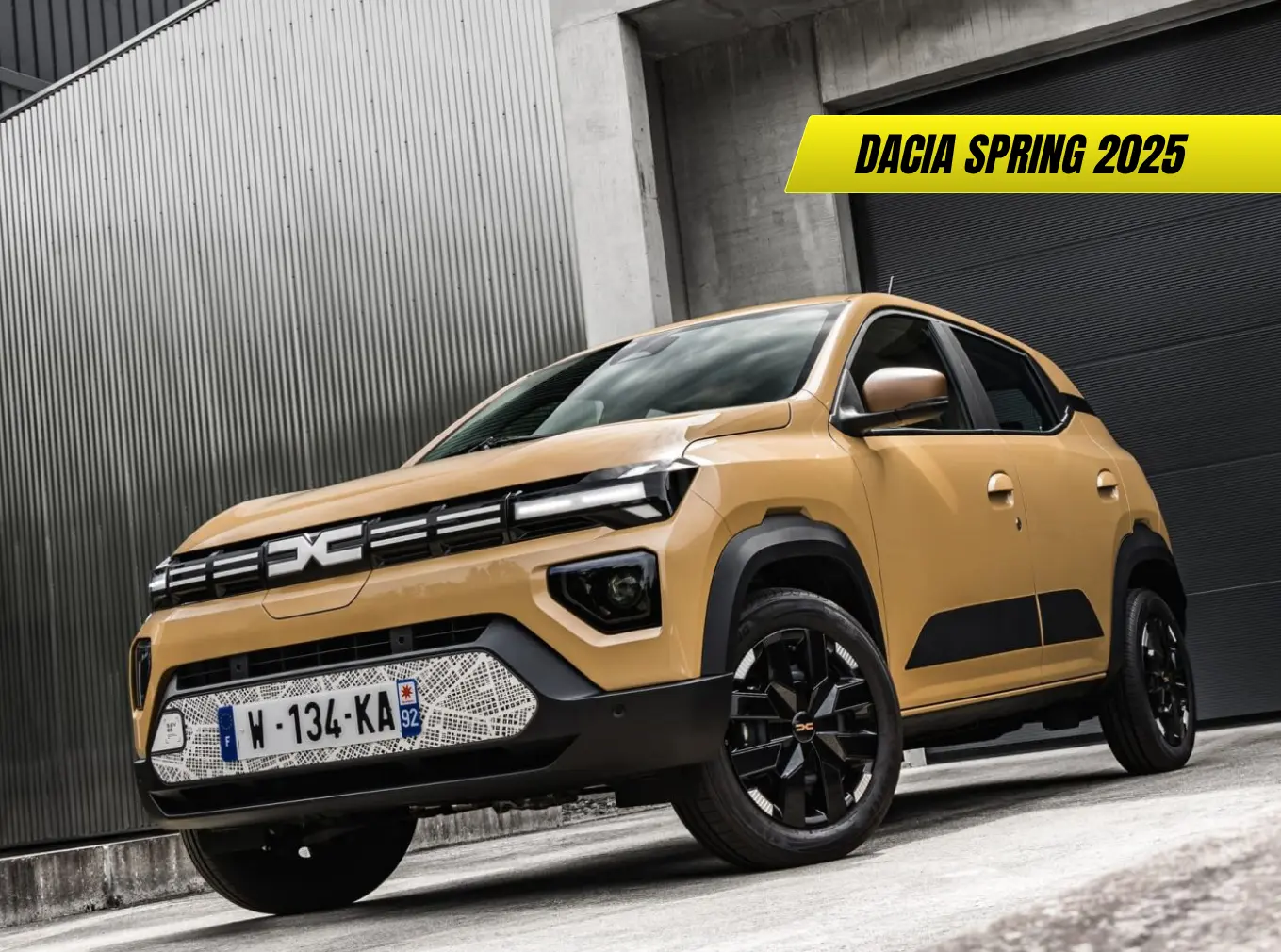
The Dacia Spring 2025 is a compact electric crossover starting from just €17,900 — refreshed with improved safety systems, a new digital cockpit and a 308-litre boot — making it the most accessible route to zero-emission urban driving available in the UK market today.
Dacia Spring 2025: Key Highlights
- 65 hp (48 kW) electric motor with 113 Nm of torque; entry 45 hp variant also available
- Declared WLTP range of 228 km — confirmed as realistic in real-world testing
- DC fast charging at up to 30 kW: 0–100% in approximately 90 minutes
- Boot capacity from 308 to 1,004 litres with rear seats folded
- Full automatic emergency braking now standard across the entire range
- Continental pricing from €17,900 (Expression 45) to €19,900 (Extreme 65)
Design and Exterior: Compact, Practical and Updated
At just 3.70 metres long, 1.58 metres wide and 1.52 metres tall with a 2.42-metre wheelbase, the Dacia Spring is one of the most compact cars on sale in Europe today — and deliberately so. Its crossover-inspired proportions, with squared-off body panels, pronounced black plastic cladding along the wheel arches and sills, and a raised ride height of 151 mm, give it a more robust appearance than a conventional city car, while keeping the overall footprint small enough for effortless urban parking.
The 2025 update has brought a meaningful visual refresh: the front bumper and grille have been redesigned for a more assertive appearance, and the headlight graphic has been sharpened. The black cladding serves a genuinely practical purpose beyond aesthetics — it limits cosmetic damage from the minor car park scrapes and low-speed kerb contacts that are an unavoidable reality of city driving. Wheel options include alloy wheels across all trim levels as standard, and a selection of two-tone colour schemes adds visual variety. The overall impression is of a car that has grown up without losing the honest, no-frills character that has always defined the Dacia brand identity.
Interior and Technology: Significantly Improved
Step inside the Spring 2025 and the improvement over the previous generation is immediately apparent. The cabin has been thoroughly revised — the austere, purely functional interior of the original has been replaced by a more cheerful, well-resolved space featuring bicolour detailing, improved material textures and a noticeably more considered dashboard layout. A deep central storage pocket in the lower dash is flanked by practical accessory hooks — sized to accommodate a smartphone, a drinks bottle or a small torch — reflecting the sort of thoughtful practicality that Dacia executes better than almost any other brand.
The instrument cluster is now a 7-inch digital display, a significant step up from the analogue unit of the outgoing car. The central infotainment screen measures 10 inches on the Extreme 65 top trim, with the system offering navigation (Extreme only), Bluetooth connectivity and multimedia management. Apple CarPlay and Android Auto are not supported on the Spring’s infotainment — a notable omission at this price point that buyers should factor into their assessment. The steering wheel is adjustable for height but not reach, and the driver’s seat slides fore and aft but lacks lumbar adjustment — limitations that are entirely consistent with the car’s price positioning.
Rear Space and Boot: Better Than You Would Expect
Four-seat homologation is the one firm limitation of the Dacia Spring: regardless of trim level, it is a four-passenger vehicle. Within that constraint, however, rear space is genuinely acceptable. Passengers up to approximately 185 cm tall will find adequate headroom, and the rear door aperture is wide enough for straightforward access. A total of 23 litres of internal storage is distributed across door pockets, the central tray and a glovebox — well above average for a car of this size.
The boot’s 308 litres in standard configuration is competitive for the segment and expands to a useful 1,004 litres with the rear seats folded flat. The rear seat back cannot be split-folded — a practical shortcoming noted in our test — meaning the choice between full boot access and rear passenger use is binary rather than flexible. An optional front storage box mounts under the bonnet and can house the charging cables, freeing the boot entirely for luggage — a practical accessory worth including at the point of order.
Powertrain and Driving Experience: City-Focused and Honest
The Dacia Spring 2025 is available in two power outputs: the 45 hp (33 kW) Expression, and the 65 hp (48 kW) Expression and Extreme variants. Both share the same 26 kWh lithium-ion battery, with the higher-powered version returning a marginally longer declared range of 228 km versus 225 km. Maximum torque is 125 Nm on the 45 hp version and 113 Nm on the 65 hp — a slightly counter-intuitive figure that reflects the different motor configurations. Top speed is limited to 125 km/h on both.
On the road, the Spring is clearly and unapologetically a city car. The 0–100 km/h time of 19.1 seconds is slow by any measure — but in urban use, the relevant benchmark is 0–50 km/h, and here the instant torque of the electric motor means the Spring responds briskly to traffic light starts and short acceleration bursts. The steering is light and precise, the turning circle of just 4.8 metres is exceptional for urban manoeuvring, and the low body weight of approximately 970 kg means the car changes direction with an agility that belies its unhurried straight-line performance.
Ride quality on urban surfaces is genuinely good. The suspension absorbs pronounced potholes and speed humps with composure, and the car feels planted and stable through corners for its class, with limited body roll. Above 70–80 km/h, road and wind noise become more intrusive — a characteristic shared with most city cars — and the Spring is not the most comfortable motorway vehicle in consequence. For its intended brief of urban and suburban use, however, the Spring performs with quiet confidence.
| Specification | Detail |
|---|---|
| Motor | Electric, 65 hp (48 kW) / 113 Nm |
| Battery | 26 kWh lithium-ion |
| Drivetrain | Front-wheel drive |
| 0–100 km/h | 19.1 seconds |
| Top speed | 125 km/h |
| WLTP range (declared) | 228 km |
| Real-world range | ~220–230 km (city conditions) |
| AC charging (max) | 7.4 kW (4h 50min, 0–100%) |
| DC fast charging (optional) | 30 kW (90 min, 0–100%) — €600 option |
| Boot volume | 308–1,004 litres |
| Length | 3.70 m |
| Seats | 4 |
| Continental price (from) | €17,900 |
Charging: Affordable but Limited
Charging the Spring 2025 is straightforward, if not rapid. The standard AC charging capability is 7.4 kW (6.6 kW effective), meaning a full charge from empty takes approximately 4 hours 50 minutes on a home wallbox — perfectly acceptable for overnight charging. On a standard domestic 3-pin socket at 2.3 kW, charging takes approximately 13.5 hours. DC fast charging at up to 30 kW is available as a €600 optional extra — a meaningful capability upgrade that reduces the 0–100% charge time to approximately 90 minutes at a compatible rapid charger.
It is worth noting that 30 kW DC maximum is among the slowest DC charging rates in the current electric vehicle market — models like the Hyundai Inster (120 kW) and Citroën ë-C3 (100 kW) are significantly faster at public chargers. For buyers who rarely use public rapid charging and primarily charge at home overnight, this limitation is inconsequential. For those who depend on en-route rapid charging for regular longer journeys, it is a material constraint. UK drivers should also note that the Spring’s zero-emission status exempts it from all ULEZ and Clean Air Zone charges — a genuine running cost benefit explored in our UK toll roads and charges 2025 guide.
Dacia Spring 2025 vs. Key Rivals
| Model | Range (WLTP) | Boot | DC Charging | Seats | Price (from) |
|---|---|---|---|---|---|
| Dacia Spring 65 Extreme | 228 km | 308–1,004 l | 30 kW (opt.) | 4 | €19,900 |
| Renault Twingo Electric 2026 | 263 km | 260–1,010 l | 50 kW | 4/5 | €19,500 |
| Hyundai Inster 42 kWh | 300 km | 238–1,059 l | 120 kW | 4/5 | €24,900 |
| Citroën ë-C3 | 326 km | 310 l | 100 kW | 5 | €23,300 |
| Leapmotor B10 | 375 km | 380 l | 80 kW | 5 | ~€25,000 |
The Spring’s competitive position rests almost entirely on price: at €17,900, it undercuts every rival in this table by a meaningful margin. Where it concedes ground is in range, charging speed and seating capacity — all relevant factors for buyers whose requirements extend beyond pure urban commuting. For those considering an affordable hybrid alternative instead, the Dacia Sandero 2026 is worth considering alongside the Spring.
Is the Dacia Spring 2025 Available in the UK?
Yes. The Dacia Spring is available through Dacia’s UK dealer network, with pricing starting from £14,995 for the Expression 45 — making it the most affordable new electric car on sale in Britain. The Extreme 65 with DC charging option is priced at approximately £17,495. Full UK pricing, specifications and dealer contact details are available at dacia.co.uk. Buyers interested in a comparison with Dacia’s wider range should also read our detailed review of the Dacia Duster 2025.
FAQ
Is the Dacia Spring 2025 worth buying in the UK?
For urban drivers who charge at home and cover predominantly city mileage, the Dacia Spring 2025 represents exceptional value. Its 228 km WLTP range is sufficient for most weekly commuting needs, and at under £15,000 it is the cheapest new electric car available in Britain. Buyers with regular longer journey requirements or a need for five seats should consider the Hyundai Inster or Citroën ë-C3.
What is the real-world range of the Dacia Spring 2025?
In predominantly urban and suburban conditions, our test confirmed that the declared WLTP range of 228 km is a realistic figure. City driving benefits the Spring most, as the low speeds and frequent braking that characterise urban commuting maximise regenerative efficiency. Motorway driving at sustained high speeds will reduce range to approximately 160–180 km.
Does the Dacia Spring support rapid charging?
DC fast charging at up to 30 kW is available as a €600 optional extra on all trim levels. This enables a full charge in approximately 90 minutes at a compatible rapid charger. Without the option, charging is limited to 7.4 kW AC — approximately 4 hours 50 minutes on a wallbox.
How many people does the Dacia Spring seat?
The Dacia Spring is homologated for four passengers only — there is no five-seat option. This is a genuine limitation for families or those who regularly carry four adults plus luggage.
Is the Dacia Spring safe?
The 2025 update introduced automatic emergency braking as standard across the entire range — a significant improvement over the previous generation. The safety suite also includes involuntary lane departure warning and driver fatigue alert. For independent safety ratings, check Thatcham Research for the latest assessments.
Does the Dacia Spring have Apple CarPlay?
No. The Spring’s infotainment system does not support Apple CarPlay or Android Auto. Smartphone connectivity is limited to Bluetooth audio and media streaming. This is the most significant technology limitation of the car relative to similarly priced rivals.
What is the boot size of the Dacia Spring 2025?
The Spring offers 308 litres of boot space in standard configuration, expanding to 1,004 litres with the rear seats folded. The rear seat back is a single-piece fold rather than a split-fold, meaning the full 1,004-litre capacity is only accessible when all rear seating is removed.
The Dacia Spring 2025 is exactly what it sets out to be: the most affordable path to electric car ownership available in the UK, delivered with a level of honesty and pragmatism that is entirely consistent with the Dacia brand philosophy. Its limitations — four seats, 30 kW maximum charging, no smartphone integration — are real and worth acknowledging. But within the brief of daily urban commuting with overnight home charging, the Spring performs with quiet competence and considerable cost efficiency. From my point of view, it remains the most rational first electric car purchase for budget-conscious UK city drivers who prioritise low running costs and ease of ownership above all else.





