
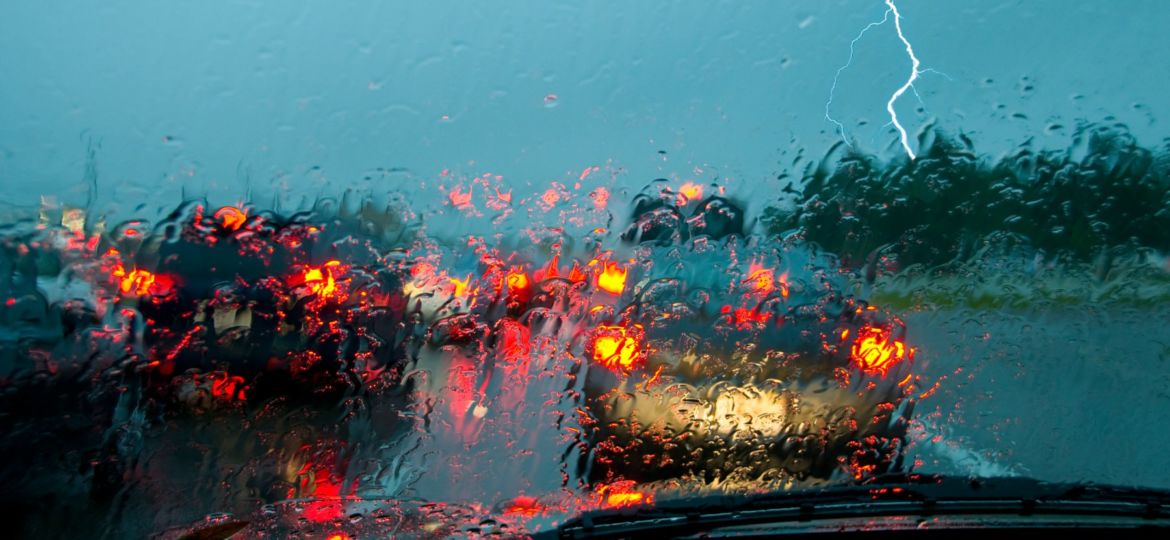
Heavy rain is one of the most common causes of road accidents in the UK, yet many drivers underestimate how dramatically it changes stopping distances, visibility, and vehicle behaviour. This guide covers what the law requires, the techniques that keep you safe, and the visibility essentials every UK driver should know.
Key Points
- Stopping distances at least double in wet weather, according to the Highway Code
- Using rear fog lights in rain is actively dangerous and potentially an offence
- The four-second following distance rule replaces the standard two-second rule in heavy rain
- Splashing a pedestrian deliberately can result in a fine under the Road Traffic Act
- Cruise control should always be disabled in wet conditions
- Air conditioning helps prevent windscreen fogging and should remain on in rain
What UK Law Requires in Heavy Rain
There is no single law that says “slow down in rain,” but several provisions of the Highway Codeand the Road Traffic Act 1988 combine to create clear legal obligations. Rule 126 of the Highway Code requires drivers to allow safe stopping distances — in wet weather, this means at least double the distances required on dry roads. Failure to maintain adequate stopping distances and causing an accident can lead to charges of careless or dangerous driving.
Using dipped headlights when visibility is seriously reduced is a legal requirement under Rule 226 of the Highway Code. Rear fog lights, however, should only be used when visibility drops below 100 metres — using them in ordinary rain (not fog) can mask your brake lights and dazzle following drivers, which is both dangerous and potentially an offence under the Road Vehicles Lighting Regulations.
For a broader understanding of camera enforcement on wet roads, see our guide to UK speed camera regulations 2025.
Safe Driving Techniques in Heavy Rain
Adapting your driving style in heavy rain is not just about going slowly — it requires a complete recalibration of how you interact with the car and the road.
Essential techniques:
- Increase your following distance to four seconds — the Highway Code’s two-second rule doubles in wet weather
- Use dipped headlights throughout heavy rain, even in daylight, so other drivers can see you
- Do not use rear fog lights unless visibility falls below 100 metres
- Disable cruise control — it cannot react appropriately to aquaplaning or sudden changes in grip
- Brake progressively — avoid sharp inputs; press the brake pedal smoothly and earlier than you normally would
- Slow down before bends and junctions — wet road markings and manhole covers are particularly slippery
- Avoid large puddles — they may conceal potholes (see our Pothole Damage UK guide) and can cause brake fade if water enters the discs
Visibility: The Most Overlooked Risk
Reduced visibility in heavy rain is a cascade problem: your vision is restricted, other drivers’ vision of you is restricted, and spray from large vehicles — particularly HGVs on motorways — can reduce visibility to near-zero in seconds.
Practical visibility steps:
- Keep windscreen washer fluid topped up and wipers in good condition — worn blades smear rather than clear
- Keep air conditioning on to prevent the windscreen fogging from the inside — this is particularly important when carrying passengers
- Do not rely solely on your sat-nav — road markings become difficult to read in heavy rain, and lane discipline is harder to maintain
- Slow down when overtaking HGVs — the spray from a lorry at motorway speeds can be as blinding as heavy fog
National Highways advises: “If it’s time for your wipers, it’s time to slow down.” This simple rule of thumb applies on all road types.
Driving Through Flood Water
Standing water and flooded roads present a specific additional hazard. The advice from all major UK road safety organisations is consistent: if in doubt, don’t. Just 30cm of moving water is enough to move a car. Even shallow flood water can cause:
- Brake fade — water on brake discs temporarily reduces braking efficiency; drive slowly after any water crossing and apply light brake pressure to dry them out
- Engine hydrolocking — if water enters the air intake, internal engine damage can be catastrophic and is almost never covered by standard insurance
- Electrical faults — particularly in modern vehicles with low-mounted ECUs or hybrid components
If you must pass through standing water, enter slowly in first gear (or the lowest drive mode in an automatic), maintain a steady speed, and do not attempt to accelerate through.
Penalties for Bad Wet-Weather Driving
Several specific driving behaviours in rain carry legal penalties worth knowing:
| Behaviour | Potential Penalty |
|---|---|
| Splashing a pedestrian deliberately | Fixed Penalty Notice; up to £5,000 fine |
| Careless driving (inadequate stopping distance) | Up to £2,500 fine; 3–9 penalty points |
| Driving without due care in poor visibility | Fixed Penalty Notice; points on licence |
| Using fog lights unnecessarily | Fixed Penalty Notice |
FAQ
Is it illegal to use rear fog lights in heavy rain?
It is not explicitly illegal unless it causes a hazard, but road safety organisations strongly advise against it. Fog lights in rain mask your brake lights and dazzle drivers behind you.
Do I have to use headlights in heavy rain?
The Highway Code requires dipped headlights when visibility is seriously reduced. In practice, turning headlights on whenever you use your wipers is the safest approach.
What counts as a safe following distance in heavy rain?
The four-second rule — double the standard two-second rule — applies in wet conditions. Increase this further in heavy traffic or on roads with poor drainage.
Can I be fined for driving through a puddle?
Yes. If a court determines the act was careless or deliberate — particularly if pedestrians were splashed — you can be prosecuted under the Road Traffic Act 1988 for driving without reasonable consideration.
What should I do if my wipers cannot keep up with the rain?
Pull off the road safely and wait. No appointment or journey is worth the risk of driving with near-zero forward visibility.
In my experience, the biggest mistake drivers make in heavy rain is failing to adjust early enough. Slowing down before the road becomes dangerously wet — not after — is what separates safe driving from reactive driving. The Highway Code gives you the framework; good judgement fills the gaps.
Car Tyre Wear Patterns Explained: What Your Tyres Are Telling You
Your tyres wear in patterns that reveal far more than simple age or mileage. Understanding what different wear patterns mean can help you diagnose alignment problems, incorrect pressures, and suspension faults before they become safety issues — or cause an MOT failure.
Key Points
- Uneven tyre wear is one of the most commonly failed items at MOT in 2026
- Centre wear typically indicates overinflation; edge wear suggests underinflation
- One-sided wear is almost always caused by wheel misalignment
- Patchy or cupped wear may signal a worn shock absorber or wheel balance issue
- The legal minimum tread depth in the UK is 1.6mm — fines of up to £2,500 per tyre apply
- MOT inspectors in 2026 are scrutinising tyre wear more closely than in previous years
Why Tyre Wear Patterns Matter
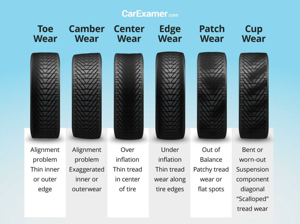
A tyre does not wear evenly by accident — every pattern of wear corresponds to a specific condition affecting the vehicle. Catching unusual wear early saves money, improves safety, and prevents MOT failures. New tyres start with approximately 8mm of tread depth; at 3mm, wet-weather performance deteriorates significantly; at the legal minimum of 1.6mm, the risk of aquaplaning and blowouts increases sharply. In 2026, stricter MOT tyre inspections mean that patterns once noted as advisories are more likely to result in immediate failure.
The Six Main Tyre Wear Patterns
1. Centre wear (wear in the middle of the tread)
The tyre contacts the road primarily on its central section, leaving the edges relatively unworn. This is the classic sign of overinflation — when a tyre is inflated above the manufacturer’s recommended pressure, it bulges at the centre, concentrating contact there.
- Cause: Tyre pressure too high
- Fix: Reduce to the manufacturer’s specified pressure, found in the door jamb or owner’s manual
2. Edge wear (wear on both outer shoulders)
Both edges of the tyre wear faster than the centre. This is the opposite problem — underinflation — causing the tyre to sag and contact the road at its edges. Underinflation also increases rolling resistance and fuel consumption.
- Cause: Tyre pressure too low
- Fix: Inflate to the correct pressure; check for slow punctures
3. One-sided wear (inner or outer edge only)
Only one edge of the tyre wears excessively. This indicates a camber alignment problem — the wheel is tilting either inward (negative camber) or outward (positive camber), placing unequal load across the tyre. In some cases, worn ball joints or a damaged suspension component is the root cause.
- Cause: Wheel misalignment; worn suspension components
- Fix: Wheel alignment check; inspect suspension and ball joints
4. Feathered or sawtooth wear
The tread blocks appear worn on one side and sharp on the other when you run your hand across them, creating a feathered texture. This typically indicates a toe alignment problem — the wheels are angled inward or outward relative to the direction of travel.
- Cause: Incorrect toe setting; worn tie rod ends
- Fix: Four-wheel alignment; inspect steering components
5. Patchy or flat-spot wear
Irregular patches of wear appearing around the tyre’s circumference. This can result from wheel imbalance, harsh braking that causes tyre flat-spotting, or worn shock absorbers that allow the wheel to bounce excessively.
- Cause: Wheel imbalance; worn shock absorbers; emergency braking without ABS
- Fix: Wheel balancing; shock absorber inspection
6. Cupping or scalloping
The tyre tread has a wavy, scalloped appearance — high and low spots alternate around the circumference. This is strongly associated with worn or damaged shock absorbers, which allow the wheel to bounce rhythmically at speed.
- Cause: Worn shock absorbers; suspension issues
- Fix: Shock absorber replacement; full suspension inspection
Tyre Wear Pattern Diagnosis Table
| Wear Pattern | Likely Cause | Urgency |
|---|---|---|
| Centre wear | Overinflation | Medium — check pressure |
| Both-edge wear | Underinflation | Medium — check pressure |
| Inner-edge only | Negative camber / alignment | High — alignment needed |
| Outer-edge only | Positive camber / alignment | High — alignment needed |
| Feathered/sawtooth | Toe misalignment | High — alignment needed |
| Patchy / flat spots | Imbalance / worn dampers | High — balancing / inspection |
| Cupping / scalloping | Worn shock absorbers | Urgent — suspension check |
Tyre Wear and UK Law in 2026
The legal position in the UK is clear: 1.6mm of tread depth across the central three-quarters of the tyre, around the entire circumference. Driving on illegal tyres carries a penalty of up to £2,500 per tyre and 3 penalty points per tyre — meaning four illegal tyres could theoretically result in 12 points and disqualification. In 2026, MOT inspectors are applying more rigorous standards, and issues such as uneven wear that previously generated advisory notices are increasingly resulting in immediate failure. For what happens when you accumulate 12 points, see our guide to UK driving licence points.
It is worth noting that the handbrake warning light illuminating while driving can sometimes indicate a brake force distribution issue, which over time can contribute to uneven tyre wear on individual wheels.
External Resources
FAQ
How often should I check my tyre tread depth?
Check monthly, and before every long journey. Once tread reaches 4–5mm, switch to monthly checks; replace at or before 3mm for optimal wet-weather safety.
Can I get an MOT advisory for tyre wear patterns?
Yes — and in 2026, advisories for certain patterns are increasingly being upgraded to failures. Uneven wear, sidewall cracks, and tread below 1.6mm will all fail an MOT.
Does tyre rotation help prevent uneven wear?
Yes. Rotating front and rear tyres every 6,000–8,000 miles evens out wear rates, particularly on front-wheel drive cars where the front tyres do most of the work.
How do I know if my shock absorbers are worn?
Classic signs include cupped tyre wear, excessive body bounce when you press down on a corner of the car, and a wallowing sensation over bumps at speed.
Can wheel alignment be checked without visiting a garage?
A rough check involves observing whether the car drifts to one side on a level road. However, professional four-wheel alignment equipment is required for an accurate adjustment.
From my point of view, reading your tyre wear patterns is one of the most underrated maintenance habits a driver can develop. Fifteen minutes with a tread depth gauge and a visual inspection every month can prevent an MOT failure, a dangerous blowout, and a very expensive repair bill — often all at once. I would recommend making it part of every routine fuel stop.





