
All-season tyres are increasingly popular with UK drivers who want year-round convenience without the cost and hassle of swapping between two sets. But how many miles do they genuinely last — and is the convenience worth the trade-off in longevity? The honest answer depends heavily on brand, driving style, and maintenance.
Key Points
- All-season tyres typically last between 25,000 and 50,000 miles depending on quality
- Premium brands can exceed 50,000 miles; budget all-season tyres often wear out below 30,000 miles
- Front tyres wear faster than rears — typically around 20,000 miles vs up to 40,000 miles
- Tyre age matters as much as tread depth: replace any tyre older than six years regardless of mileage
- The UK legal minimum tread depth is 1.6mm — fines of up to £2,500 and three penalty points per tyre apply
- Regular tyre rotation every 8,000–10,000 miles significantly extends all-season tyre life
What the Mileage Figures Actually Mean
On average, car tyres last between 30,000 and 60,000 miles, or roughly three to five years for a typical UK driver covering around 7,000–8,000 miles annually. All-season tyres sit at the lower end of that range compared to dedicated seasonal alternatives — because their compound is a compromise between summer and winter performance, it tends to wear slightly faster under the sustained heat of summer motorway driving.
In practical terms, a UK driver covering average mileage might expect a quality set of all-season tyres to last four to five years before tread depth becomes the deciding factor. A higher-mileage driver covering 15,000+ miles per year could see those same tyres worn out in two to three years. A low-mileage driver, conversely, may find their tyres reach the recommended six-year age limit before the tread actually wears down.
The difference between budget and premium is significant. Entry-level all-season tyres from lesser-known brands often show heavy wear before 25,000 miles, particularly on front-wheel drive vehicles where the front axle carries both driving and steering loads. Premium all-season tyres — such as the Michelin CrossClimate range or Continental AllSeasonContact — are engineered with more durable compounds and can realistically exceed 50,000 miles with proper care.
All-Season vs Seasonal Tyres: The Mileage Trade-Off
| Tyre Type | Typical Lifespan | Notes |
|---|---|---|
| All-season budget | 20,000–30,000 miles | Faster wear in summer heat |
| All-season mid-range | 30,000–40,000 miles | Balanced performance |
| All-season premium | 45,000–55,000+ miles | Best compound durability |
| Summer (mid-range) | 30,000–50,000 miles | Only used half the year |
| Winter (mid-range) | 25,000–40,000 miles | Softer compound, quicker wear on warm roads |
The argument for all-season tyres is not purely about mileage — it is about total cost of ownership when you factor in fitment costs, storage fees, and the convenience of never booking a tyre swap. According to Michelin UK, all-season tyres with the 3PMSF certificationcan deliver long-term savings for drivers who do not regularly face extreme winter conditions.
The Biggest Factors Affecting Tyre Lifespan
Driving behaviour has the single greatest influence on how long your all-season tyres last. Hard acceleration from standstill, late braking, and fast cornering all generate heat and friction that accelerate tread wear. Motorway cruising at consistent speeds is far kinder to rubber than stop-start urban driving.
Vehicle type and traction matter considerably. Front-wheel drive cars concentrate all braking, steering, and acceleration forces on the front axle, meaning front tyres typically last around 20,000 miles while rears can last up to 40,000 miles. This imbalance makes tyre rotation particularly valuable on FWD vehicles.
Wheel alignment and balancing are the most overlooked mechanical factors. A misaligned wheel can halve the life of a perfectly good tyre within months, generating the kind of uneven wear patterns that lead to MOT failure and dangerous handling. Have your alignment checked whenever you notice the car pulling to one side, after any significant kerb strike, or at every annual service. For guidance on reading those wear patterns, our guide to Car Tyre Wear Patterns Explained covers every scenario in detail.
Tyre Age: The Factor Most Drivers Ignore
Mileage is only half the story. Rubber degrades chemically over time — UV exposure, ozone, and temperature cycling cause the compound to harden and crack, reducing grip and increasing blowout risk even when the tread appears perfectly adequate. Most tyre manufacturers and road safety organisations recommend not using tyres older than six years, and replacing them by ten years at the absolute maximum regardless of appearance.
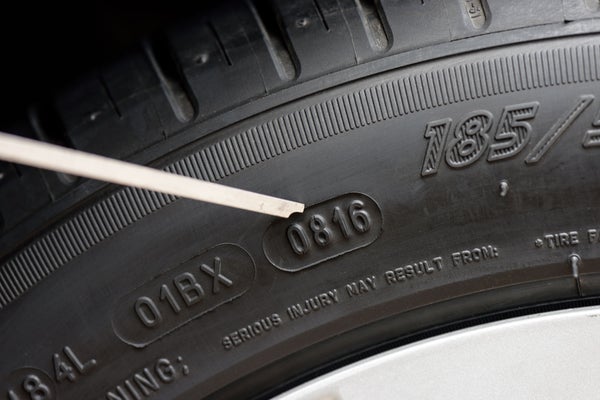
The manufacture date is encoded in the DOT code on the tyre’s sidewall. The last four digits represent the week and year of production — for example, 1823 means the tyre was made in the 18th week of 2023. If you are buying a used car or second-hand tyres, always check this code before trusting the tread depth reading alone.
In 2026, MOT enforcement of tyre condition has become more rigorous. Cracked sidewalls, perished rubber, and visible age-related deterioration are increasingly resulting in MOT failuresrather than advisory notes, even when tread depth remains above the legal limit. The DVSA MOT inspection standards provide a full breakdown of what inspectors assess.
How to Extend the Life of Your All-Season Tyres
- Check tyre pressure monthly — both over- and under-inflation accelerate wear; a tyre 0.3 bar below the correct pressure can lose up to 25% of its lifespan
- Rotate tyres every 8,000–10,000 miles — particularly important on front-wheel drive cars to even out wear between axles
- Have wheel alignment checked annually — a properly aligned car wears tyres evenly and predictably
- Avoid kerbing — even low-speed kerb strikes can damage the internal structure of a tyre, causing bulges that are invisible until the tyre fails
- Drive smoothly — progressive braking and gentle acceleration make a measurable difference to wear rate over tens of thousands of miles
For context on how tyre condition affects your legal standing on UK roads, our guide to UK driving licence points explains the penalty point implications of being caught on illegal tyres.
FAQ
How long do all-season tyres last in the UK?
Typically between 25,000 and 50,000 miles, depending on the brand, your driving style, and how well the tyres are maintained. Premium brands consistently outperform budget alternatives.
Do all-season tyres wear out faster than summer tyres?
In summer conditions, yes — the softer all-season compound wears more quickly on hot, dry asphalt than a dedicated summer tyre. Over the full year, the difference is less pronounced.
When should I replace all-season tyres regardless of tread?
At six years old as a precaution, and by ten years as an absolute maximum. Check the DOT code on the sidewall to confirm the manufacture date.
In most cases, yes. Premium all-season tyres can last more than double the mileage of budget alternatives, meaning the higher purchase price often works out cheaper per mile over the tyre’s lifetime.
Do I still need to check tread depth on all-season tyres?
Absolutely. The UK legal minimum of 1.6mm applies to all tyres regardless of type. Most experts recommend replacing at 3mm to maintain adequate wet-weather performance.
Can all-season tyres fail an MOT?
Yes — if tread depth is below 1.6mm, if there is uneven or abnormal wear, visible cracking, bulging, or any sign of structural damage. In 2026, MOT standards for tyre assessment have become stricter.
From my point of view, all-season tyres represent the most sensible choice for the majority of UK drivers — particularly those in cities and lowland areas who rarely encounter snow. I would recommend spending on a mid-range or premium product rather than chasing the cheapest option: the difference in longevity, safety, and wet-weather grip is substantial and, over the life of the tyre, the cost per mile often makes premium the more economical choice anyway.





