
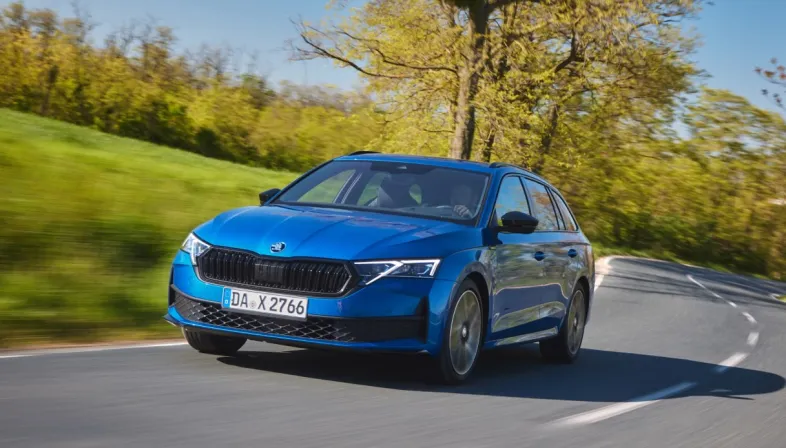
The 2026 Skoda Octavia remains one of the most rational choices for UK drivers who want huge space, comfort and value without paying premium‑brand money. Available as a hatchback and the even roomier estate (Combi), it blends a gigantic boot, excellent rear legroom, comfortable ride and a grown‑up driving feel. It shares its engineering roots with the Volkswagen Golf but stretches everything – from dimensions to practicality – into a different league, while still staying affordable.
Key points (summary)
- Hatch and estate (Combi) versions with class‑leading boot space and excellent rear room.
- Engine range centred around efficient 1.5 TSI petrol (often mild‑hybrid) and 2.0 TDI diesel, plus plug‑in hybrid in some markets.
- Facelift brings sharper styling, bigger screens and higher perceived quality in the cabin.
- Driving experience is relaxed, secure and comfortable – ideal for long UK journeys.
- Outstanding value for families, high‑mileage drivers and anyone who prioritises space over badge snobbery.
Skoda Octavia 2026: space and practicality
Space is where the Octavia humiliates most “normal” family hatchbacks.
Approximate boot capacities:
- Octavia hatchback: around 600 litres seats up, over 1,550 litres seats down.
- Octavia Combi estate: around 640 litres seats up, over 1,700 litres seats down.
For comparison, many typical C‑segment hatchbacks sit closer to 380–400 litres. In real UK life, that means an Octavia can easily handle:
- Two large suitcases, a pushchair and shopping in the boot with room to spare.
- Dogs, bikes (with seats folded), DIY materials or work kit in the estate variant.
Rear-seat space is similarly generous: adults sit comfortably behind tall drivers, with plenty of legroom and decent headroom. For families, taxi/private‑hire use or car‑sharing, this makes the Octavia feel like “half a class up” from its rivals.
A simple table to illustrate:
| Car | Boot (seats up) | Comment |
|---|---|---|
| Skoda Octavia hatch | ~600 L | Enormous for a hatchback |
| Skoda Octavia Combi estate | ~640 L | One of the biggest in the class |
| Typical family hatch | ~380–400 L | Much smaller |
Engines, performance and efficiency
The 2026 Octavia range typically revolves around a familiar set of engines:
- 1.5 TSI petrol (often mild‑hybrid)
- Around 150 PS.
- Available with manual or DSG automatic.
- Smooth, quiet and efficient for mixed town/motorway driving.
- 2.0 TDI diesel
- Around 150 PS in mainstream trims.
- Strong torque and excellent motorway economy.
- Ideal for very high annual mileages.
- Plug‑in hybrid (iV) – available on some markets/trims
- Combines a petrol engine with an electric motor and usable EV range.
- Allows shorter commutes to be done largely on electric power if charged regularly.
Skoda also offers more powerful variants (including sporty vRS models) in some configurations, but most UK buyers will focus on the 1.5 TSI and 2.0 TDI.
On the road:
- The 1.5 TSI is the best “all‑rounder” for most UK driving – refined, good on fuel and with enough power for fully‑loaded motorway trips.
- The 2.0 TDI is still the king for people doing lots of long runs, especially on motorways or dual carriageways.
- The plug‑in hybrid suits drivers who can charge at home and do regular short or medium trips, using petrol only for occasional long journeys.
From my point of view, the Octavia does not try to be sporty; it aims to be quietly competent, easy and comfortable to drive every day.
Interior, tech and comfort
The facelifted Octavia’s interior has moved closer to premium territory:
- Digital instrument cluster in front of the driver.
- Large central touchscreen for infotainment, navigation and connectivity.
- Softer materials and better design details, giving a more upmarket impression than older Skodas.
You also get classic Skoda “Simply Clever” touches:
- Hooks and nets in the boot.
- Under‑floor storage in many versions.
- Plenty of cubbies and large door bins.
Seats are supportive and comfortable on long journeys, with higher trims offering electric adjustment, lumbar support, heating and sometimes even massage functions. Ride comfort is a strong point: the suspension soaks up typically poor UK surfaces well, especially if you avoid the very largest wheel sizes.
The only real minus is that more functions now live inside the touchscreen than before, which can make some adjustments a bit less intuitive than in older Octavias with more physical buttons. However, the system is still manageable once learned, and the car’s general ergonomics remain good.
Running costs and value
The Octavia’s appeal has always been about value per pound and per litre of space, and that hasn’t changed:
- Purchase prices are usually lower than comparably‑equipped mid‑size rivals, despite the space advantage.
- Fuel economy is strong, especially with the 1.5 TSI and 2.0 TDI; plug‑in hybrid versions can be very cheap to run if charged often.
- Insurance and servicing costs are reasonable for the segment.
Depreciation is moderate – not as strong as some pure premium brands, but helped by the car’s practicality and VW‑group engineering reputation. For company‑car users, plug‑in hybrid versions can be particularly interesting thanks to lower Benefit‑in‑Kind rates.
Overall, for a UK driver who needs a genuinely big, capable car but doesn’t want to overspend on an SUV or a premium badge, the Octavia is one of the best value propositions on the market.
Skoda Octavia Combi vs Toyota Corolla Touring Sports
Estate buyers in the UK often end up comparing the Skoda Octavia Combi and Toyota Corolla Touring Sports (TS). Both are practical, family‑oriented estates, but they take very different paths.
Space and practicality
- Octavia Combi
- Boot around 640 L seats up, over 1,700 L seats down.
- Extremely spacious cabin, especially in rear legroom.
- Corolla TS
- Boot typically just under or around 600 L seats up, about 1,600 L seats down.
- Very usable, but slightly smaller overall than the Octavia.
Result: if maximum space is your top priority, the Octavia Combi wins.
Powertrains and efficiency
- Octavia
- Petrol, diesel and (in some line‑ups) plug‑in hybrid.
- Higher power options available, better for towing and performance.
- Can be very efficient, but depends heavily on engine choice and driving style.
- Corolla TS
- Full‑hybrid powertrains (1.8 or 2.0).
- Self‑charging hybrids that don’t need plugging in.
- Excellent real‑world fuel economy, especially in city and mixed driving.
Result: for sheer fuel efficiency and hybrid simplicity, Corolla TS is superior; for engine choice, power and flexibility, Octavia has the edge.
Driving experience
- Octavia Combi
- Comfortable, stable and quiet on motorways.
- Feels like a larger, more relaxed car – ideal for long trips with family and luggage.
- Corolla TS
- Smooth and calm, thanks to the hybrid drivetrain.
- Less powerful in most trims than the stronger Octavias, but very easy to drive and manoeuvre.
Both are comfortable; the key difference is character: the Octavia feels like a refined big estate, the Corolla TS feels like a super‑efficient hybrid family car.
Cost and long‑term ownership
- Octavia often undercuts the Corolla TS on purchase price for a similarly‑equipped car.
- Corolla TS may offer lower fuel costs and, statistically, an exceptional reliability reputation over many years.
A comparison snapshot:
| Aspect | Skoda Octavia Combi | Toyota Corolla TS |
|---|---|---|
| Boot space | Larger | Slightly smaller |
| Engine options | Petrol, diesel, PHEV (market‑dependent) | Full‑hybrid only |
| Fuel efficiency | Very good | Excellent |
| Power/performance choice | More powerful variants available | Generally lower, focused on economy |
| Purchase price | Often lower at like‑for‑like spec | Often a bit higher |
| Long‑term simplicity | Good | Superb (simple hybrid system) |
FAQs
Is the Skoda Octavia a good family car for UK roads?
Yes. It is one of the best options if you need serious space, comfort and practicality. Both hatch and estate versions comfortably handle family life, long holidays and daily commuting.
Which engine should I choose in the Octavia?
For most drivers, the 1.5 TSI petrol (ideally with DSG and mild‑hybrid) is the best all‑rounder. High‑mileage motorway drivers should look at the 2.0 TDI, while those able to charge at home might find a plug‑in hybrid version the most economical.
Is the Octavia comfortable on long journeys?
Very. The Octavia’s ride, seats and noise insulation are designed for long‑distance comfort, making it an excellent car for frequent motorway or A‑road use.
How does the Octavia compare with an SUV for space?
An Octavia estate often offers similar or better boot space than many mid‑size SUVs, while being more efficient, lower, and usually cheaper to buy and run.
Octavia Combi or Corolla Touring Sports for a UK family?
Choose the Octavia Combi if you want maximum space, power options and a very relaxed big‑car feel. Choose the Corolla TS if your top priorities are fuel economy, hybrid simplicity and Toyota’s outstanding long‑term reliability.
Conclusion
The 2026 Skoda Octavia remains a benchmark for space, comfort and sensible value in the UK market. It offers more room and load capacity than almost any regular hatchback, with a driving experience tuned for long‑distance ease and day‑to‑day comfort. Against rivals like the Toyota Corolla TS, it trades a little hybrid efficiency and brand reputation for pure practicality and flexibility. For British drivers who want one car that can truly do it all – family hauler, long‑distance cruiser and everyday workhorse – the Octavia, especially as an estate, is still one of the smartest and most rational choices available.





