An MOT emissions failure does not, by itself, identify one broken part. In Great Britain, the check can involve measured petrol exhaust gases, a diesel smoke test and visual checks for smoke or emissions equipment. That matters to UK drivers because the result is an assessment against vehicle-specific rules, not a diagnosis.
The limits and procedure depend on fuel type, date of first use, engine design and, for a diesel, whether a diesel particulate filter (DPF) is fitted. The useful question after a failure is therefore not simply which part to buy, but what the test actually found.
What the MOT emissions test checks
The GOV.UK MOT inspection manual says the emissions test is normally carried out with the engine at operating temperature.
For petrol cars, the basic test checks the engine at fast idle and normal idle. The readings include carbon monoxide (CO), hydrocarbons (HC) and lambda. The manual gives limits of up to 0.2% CO and 200 ppm HC at fast idle, a lambda reading between 0.97 and 1.03, and up to 0.3% CO at idle.
Those figures should not be treated as a universal pass-or-fail rule for every petrol car. The applicable standard depends on the vehicle and its test category, so comparing one car’s result with an online figure for another model can be misleading.
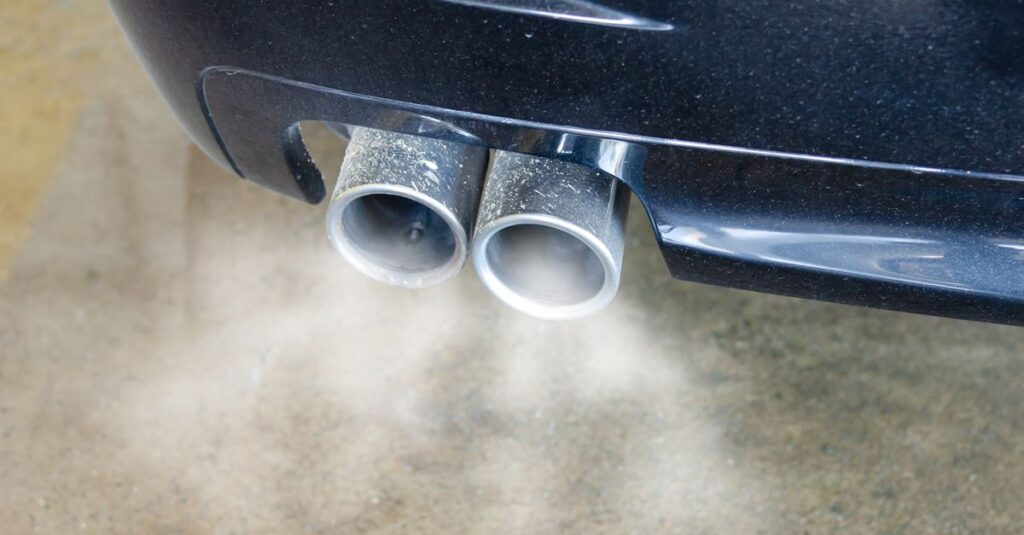
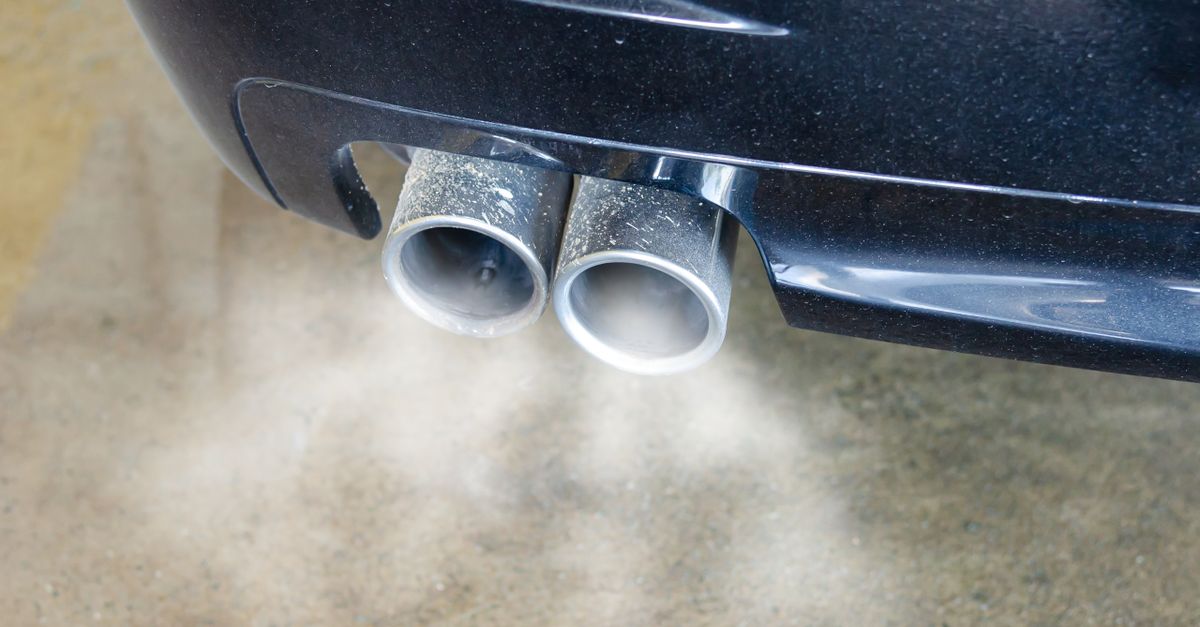
Diesel cars are tested for smoke emissions rather than the same petrol gas readings. A separate visual inspection also matters: a petrol or diesel car can fail if it produces dense blue or clearly visible black smoke. The GOV.UK guidance sets out these inspection requirements.
What can cause a petrol emissions failure?
Possible underlying causes reported in emissions-failure guidance include:
- a fuelling or ignition fault;
- worn spark plugs;
- a faulty sensor;
- a dirty air filter;
- an exhaust leak; or
- a catalytic converter that is not working effectively.
These possibilities are discussed by Black Circles and Banks of the Tyne, but they are not a diagnosis of an individual car. The same failed reading can have more than one possible cause, so replacing a catalytic converter, sensor or other part based only on a general list is not a reliable repair strategy.
Visible smoke is a separate warning sign. Dense blue or clearly visible black smoke during the visual inspection can lead to a failure even if the driver has not noticed an obvious change in how the car runs.
Diesel failures: smoke, DPFs and other possible faults
Reported causes of diesel emissions failures include DPF problems, EGR or injector faults, turbocharger issues, a restricted air intake and excessive smoke. Banks of the Tyne and Black Circles both identify these as possible areas for investigation, rather than proof that a particular component has failed.
A diesel fitted with a DPF has an additional emissions requirement. Under the GOV.UK MOT inspection guidance, visible smoke of any colour can constitute a major defect. Evidence that the DPF is missing, clearly tampered with or improperly modified can also result in a failure, as explained in the government’s car-parts MOT guidance.
Removing or altering a DPF is therefore not a route to passing the MOT. A garage should investigate why the emissions system is not working correctly instead of trying to hide the symptom before the test.
What happens if the emissions test cannot be completed?
The emissions test is not always completed if doing so could damage the engine or cannot be carried out safely. The GOV.UK inspection manual includes a major-defect category for an emissions test that cannot be completed, while the government’s MOT parts guidance also covers this situation.
If a tester raises that concern, the sensible response is to have the vehicle assessed by a qualified garage rather than asking for the test to be forced through. An emissions failure or incomplete test should be treated as evidence that further diagnosis is needed.
What to do after an emissions failure
- Read the exact MOT defect wording. Establish whether the issue was a measured petrol reading, visible smoke, a diesel smoke result, DPF condition or an incomplete test.
- Ask for a vehicle-specific diagnosis. The likely cause depends on the car’s age, engine and emissions system; a general internet checklist cannot identify the faulty part.
- Have the underlying fault repaired. For a diesel, this may involve investigating the DPF, EGR system, injectors, turbocharger or air intake, but none should be assumed to be defective without appropriate checks.
- Do not tamper with emissions equipment. A missing or clearly modified DPF can itself produce a major defect.
- Take safety concerns seriously. If the tester believes the emissions procedure could damage the engine or cannot be completed safely, obtain professional advice before presenting the vehicle again.
The key point for drivers
A petrol emissions failure may involve CO, HC, lambda or visible smoke. A diesel failure may involve smoke, a DPF problem or another fault affecting the air, fuel or exhaust system. The exact limits vary between vehicles, and the MOT result is a starting point for diagnosis—not proof that one particular part needs replacing.