
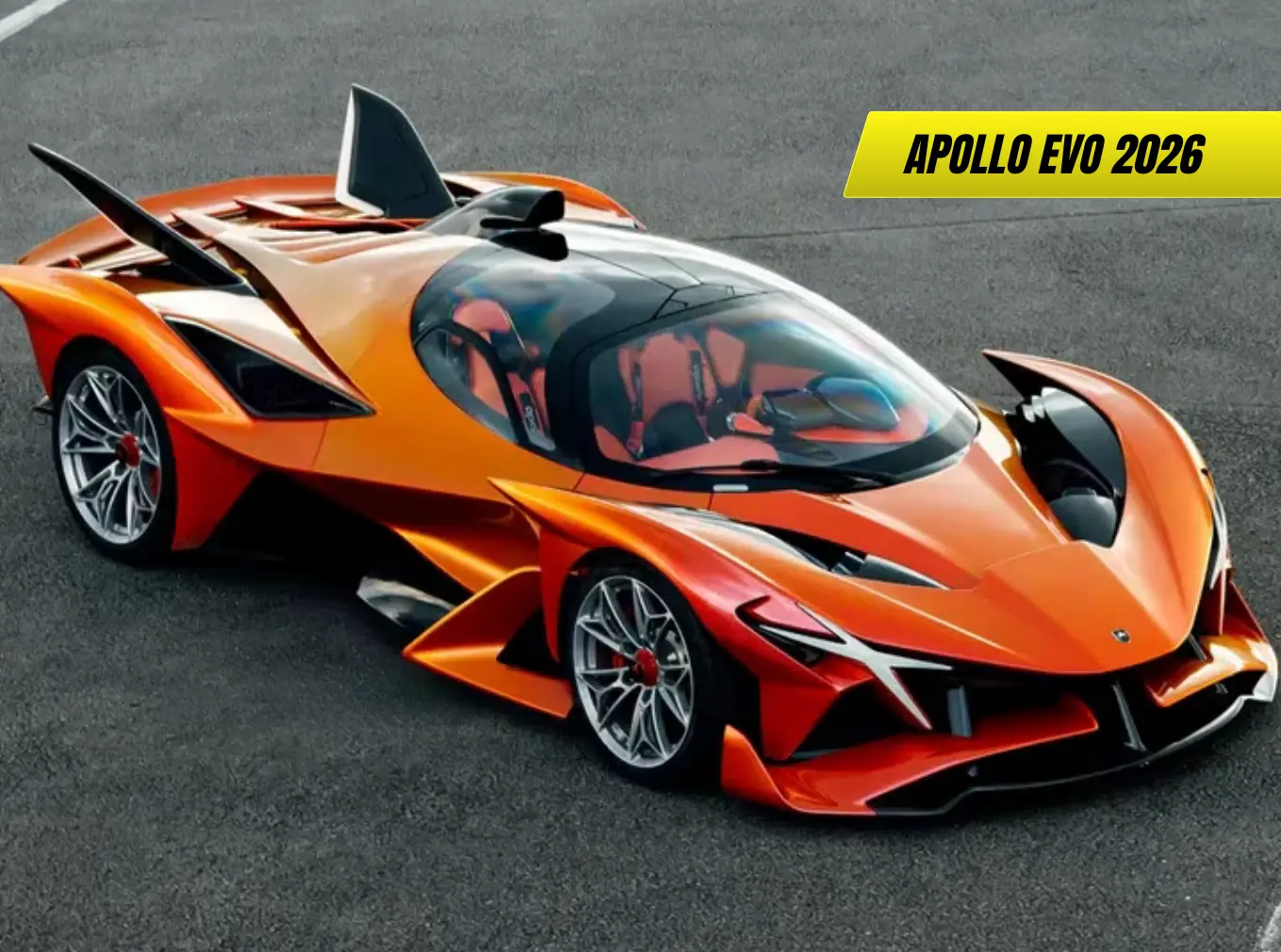
Apollo Automobil unveils EVO track-only hypercar featuring naturally-aspirated 6.3-litre V12 producing 800hp, carbon fiber monocoque achieving 1,300kg weight, and extreme aerodynamics generating 1,350kg+ downforce with first deliveries beginning early 2026 at €3 million pricing.
Germany’s sole hypercar manufacturer Apollo Automobil celebrates 20th anniversary (founded 2004 as Gumpert Sportwagenmanufaktur) revealing EVO track-only hypercar succeeding 2017’s Intensa Emozione through limited 10-unit production run targeting ultimate circuit performance unencumbered by road legality constraints enabling extreme aerodynamics, minimal weight, and pure driving experience. The 6.3-litre naturally-aspirated V12 revving 8,500rpm delivers 800hp (597kW) and 564 lb-ft (765Nm) through Hewland six-speed sequential transmissiondriving rear wheels exclusively, launching 1,300kg (2,866 lbs) carbon-fiber-intensive machine 0-62mph in 2.7 secondstoward 208mph (335km/h) top speed wearing Michelin Pilot Sport Cup 2 rubber wrapping forged aluminum wheels and carbon-ceramic brakes managing extreme thermal loads. The carbon fiber monocoque weighing merely 165kg (364 lbs) proves 15% stiffer than Intensa Emozione despite reduced mass, forming foundation for carbon fiber front and rear subframes supporting aggressive active aerodynamics generating 1,350kg+ downforce enabling 2.0+ lateral g-forces through corners while dramatic spaceship-meets-dragon styling featuring jutting aero fins, 3D-printed titanium exhaust, and skeletonized interior emphasizes Apollo’s “rebellious engineering” philosophy. First deliveries commence early 2026 at estimated €3 million (approximately £2.55 million) positioning EVO among ultra-exclusive track weapons competing against Aston Martin Valkyrie AMR Pro, McLaren Solus GT, and Porsche 935 while maintaining naturally-aspirated combustion purity increasingly rare as hybridization and turbocharging dominate hypercar segment.
Apollo Heritage: From Gumpert to Global Hypercar Brand
Understanding the EVO requires examining Apollo’s turbulent two-decade journey from obscure German startup through bankruptcy and revival toward current hypercar manufacturer status.
Company Timeline and Evolution
| Period | Name | Key Developments | Products |
|---|---|---|---|
| 2004-2012 | Gumpert Sportwagenmanufaktur | Founded by Roland Gumpert (ex-Audi Sport director), developed radical Apollo supercar | Gumpert Apollo (various editions) |
| 2012-2016 | Bankruptcy and reorganization | Original Gumpert company declared bankruptcy 2012, acquired by Hong Kong investors | Limited production continuation |
| 2016-present | Apollo Automobil GmbH | Rebranded under Apollo name, relocated operations, developed Intensa Emozione | Intensa Emozione (2017), Arrow (2020), EVO (2026) |
Roland Gumpert’s Vision
Company founder Roland Gumpert brought extensive motorsport pedigree from Audi Sport (quattro rally program director) envisioning road-legal supercar delivering genuine racing car experience through:
- Extreme downforce at all speeds (not just high velocity)
- Minimal weight through extensive carbon fiber
- Mid-engine layout with optimal weight distribution
- Naturally-aspirated engines prioritizing response over peak power
- Track capability first, road legality secondary consideration
The original Gumpert Apollo (2005-2012) embodied this philosophy, gaining cult following among hardcore enthusiasts appreciating uncompromising engineering despite polarizing insect-inspired styling and commercial struggles culminating in 2012 bankruptcy.
Resurrection Under Hong Kong Ownership
Hong Kong-based Ideal TeamVenture acquired bankrupt Gumpert assets 2016, rebranding as Apollo Automobil and relocating headquarters while maintaining German engineering center. The investment enabled developing Intensa Emozione (Intense Emotion in Italian) – far more visually dramatic successor to original Apollo incorporating lessons learned while amplifying extreme design language.
Production Numbers Context
Apollo remains ultra-low-volume manufacturer even by hypercar standards:
- Original Gumpert Apollo (2005-2012): ~45 units total across all variants
- Apollo Intensa Emozione (2017-2022): 10 units produced (all sold)
- Apollo Arrow (2020+): Street-legal variant, limited production ongoing
- Apollo EVO (2026+): 10 units planned
These microscopic production figures position Apollo among world’s most exclusive automotive brands, with total company output across 20 years likely below 75 vehicles – fewer than Ferrari produces weekly or Lamborghini manufactures daily, similar to extreme rarity discussed in BYD Yangwang U9 2026 though at opposite end of market spectrum.
Technical Specifications: Engineering for Ultimate Track Performance
The EVO represents Apollo’s most extreme vehicle, freed from road homologation constraints enabling optimization purely for circuit performance through weight reduction, aerodynamic aggression, and mechanical purity.
Powertrain Architecture
6.3-Litre Naturally-Aspirated V12
- Configuration: 60-degree V12, naturally aspirated (no turbocharging or supercharging)
- Displacement: 6,262cc (6.3 litres)
- Power output: 800 hp (597 kW) @ 8,000+ rpm
- Torque: 564 lb-ft (765 Nm) @ 6,000+ rpm
- Redline: 8,500 rpm
- Origin: Enhanced version of Intensa Emozione’s Ferrari-derived V12
- Sound: Unmuffled titanium exhaust delivering visceral aural experience
The V12’s naturally-aspirated configuration proves increasingly rare in contemporary hypercar landscape dominated by turbocharged and hybrid powertrains. Apollo deliberately maintains atmospheric purity prioritizing:
- Instant throttle response: Zero turbo lag, immediate power delivery
- Linear power delivery: Predictable characteristics crucial for track precision
- Acoustic experience: Spine-tingling sound impossible with forced induction or electric motors
- Mechanical purity: Traditional engineering philosophy resisting electrification trends
Transmission and Drivetrain
- Gearbox: Hewland six-speed sequential transmission (motorsport-proven brand)
- Control: Electropneumatic paddle shifters behind steering wheel
- Drive configuration: Rear-wheel drive only (no AWD for weight and complexity reasons)
- Differential: Limited-slip unit optimizing traction and cornering characteristics
The Hewland transmission represents professional motorsport hardware appearing in Formula Ford, GT racing, and historic Formula 1 cars – far more robust and responsive than dual-clutch automatics found in road-going supercars but requiring aggressive driving technique and clutchless sequential operation unsuitable for street traffic.
Performance Metrics
| Specification | Apollo EVO | Competitors Context |
|---|---|---|
| 0-62 mph | 2.7 seconds | Similar: McLaren Solus GT, Aston Martin Valkyrie AMR Pro |
| Top speed | 208 mph (335 km/h) | Limited by extreme downforce sacrificing ultimate velocity |
| Power-to-weight | 615 hp/ton | Exceptional even by hypercar standards |
| Lateral acceleration | 2.0+ g | Rivaling dedicated racing prototypes |
| Downforce | 1,350kg+ | Exceeds vehicle weight at speed |
The 2.0+ lateral g capability positions EVO among world’s most capable cornering machines, matching or exceeding dedicated racing cars through combination of extreme aerodynamics, lightweight construction, sticky tires, and sophisticated suspension geometry.
Carbon Fiber Construction and Weight Optimization
The EVO’s performance foundation rests on obsessive weight reduction achieving 1,300kg (2,866 lbs) through extensive carbon fiber composite application and minimalist approach eliminating non-essential features.
Carbon Fiber Monocoque
The central passenger cell monocoque constructed entirely from carbon fiber composite weighs merely 165kg (364 lbs) while providing:
- 15% greater stiffness than Intensa Emozione predecessor
- Crash protection meeting FIA safety standards (track-use requirements)
- Mounting points for suspension, drivetrain, aerodynamic elements
- Integrated roll cage protecting occupants during accidents
This extraordinarily light yet stiff structure forms perfect foundation for track hypercar, enabling suspension working optimally without flexing chassis distorting geometry and ensuring occupant safety despite minimal weight.
Additional Carbon Fiber Components
- Front subframe: Carbon composite structure supporting suspension, steering
- Rear subframe: Carbon assembly carrying engine, transmission, rear suspension
- Body panels: All external surfaces carbon fiber (no metal panels)
- Aerodynamic elements: Wings, splitters, diffusers carbon construction
- Interior components: Seats, dashboard, trim pieces minimalist carbon
Weight Distribution
- Front: ~42-43% (aggressive for mid-engine configuration)
- Rear: ~57-58%
- Balance: Optimized for high-speed cornering stability and traction
The slightly rear-biased distribution typical mid-engine racing cars ensures rear tires adequately loaded for traction while maintaining sufficient front grip for turn-in responsiveness and high-speed stability.
Skeletonized Interior Philosophy
The EVO’s cabin exemplifies “skeletonized” design approach exposing structural elements and eliminating superfluous comfort features:
- Exposed carbon monocoque: Visible tub construction throughout interior
- Minimalist dashboard: Essential gauges only, no infotainment or navigation
- Racing seats: Fixed-back carbon fiber buckets with six-point harnesses
- 3D-printed components: Titanium and aluminum pieces reducing weight while maintaining strength
- No sound deadening: Acoustic insulation eliminated for weight savings (and V12 symphony)
- No climate control: Weight and complexity eliminated (driver wears race suit)
- No power accessories: Manual window nets, basic switches for essentials only
This ruthless approach prioritizes performance over comfort, appropriate for track-only vehicle where occupants wear full racing equipment and focus entirely on driving experience rather than entertainment or convenience, similar to philosophy behind UK speed camera regulations emphasizing safety over convenience.
Aerodynamics: Generating 1,350kg+ Downforce
The EVO’s most visually dramatic element – its extreme aerodynamic bodywork – serves functional purpose generating massive downforce enabling otherwise-impossible cornering forces.
Active Aerodynamic Systems
Front Splitter and Dive Planes
- Underbody splitter: Aggressive front element channeling air beneath vehicle
- Dive planes: Wing-like elements at front corners increasing front downforce
- Active adjustment: Computer-controlled angle optimization based on speed, braking, cornering
Rear Wing and Diffuser
- Multi-element rear wing: Massive adjustable wing dominating rear visual profile
- Active adjustment: DRS-style (Drag Reduction System) for straights, maximum angle for corners
- Vertical fins: Jutting aero stabilizers improving high-speed directional stability
- Rear diffuser: Aggressive underbody element accelerating air from beneath vehicle
Underbody Management
- Flat floor: Smooth underbody creating venturi effect
- Vortex generators: Small elements managing airflow preventing separation
- Brake cooling ducts: Integrated aerodynamic elements channeling cooling air
Downforce Production by Speed
| Speed | Estimated Downforce | Effect |
|---|---|---|
| 50 mph | ~200-300 kg | Meaningful grip enhancement even low speeds |
| 100 mph | ~600-800 kg | Substantial increase in cornering capability |
| 150 mph | ~1,100-1,300 kg | Approaching vehicle weight in downforce |
| 200 mph | ~1,350+ kg | Exceeding vehicle weight, theoretical ceiling driving capability |
At maximum velocity, the EVO generates more downforce than it weighs – enabling theoretical ceiling or inverted driving if suitable surface available, though no sane person would attempt this. Practically, the massive downforce enables cornering speeds impossible without aerodynamic assistance, loading tires far beyond their own weight would permit.
Ownership Experience and Track-Only Reality
Unlike most “track-focused” hypercars offering road legality option, the EVO commits entirely to circuit use through features incompatible with street driving.
Track-Only Implications
Cannot Be Driven on Public Roads
- No homologation: Doesn’t meet safety or emissions regulations any jurisdiction
- No license plate provisions: No mounting points or lighting for registration
- No insurance: Standard road policies won’t cover track-only vehicle
- Transport required: Must be trailered to/from circuits
Requires Specialized Track Support
- Tire warmers: Michelin Cup 2 tires require pre-heating for optimal grip
- Fuel: High-octane racing fuel recommended (98+ RON minimum)
- Technical support: Specialized mechanics familiar with Apollo systems
- Spare parts: Limited availability given extreme low production volumes
- Track days: Not all circuits permit unlimited-downforce vehicles (safety concerns)
Operating Costs Estimates
Beyond €3 million purchase price, EVO ownership involves substantial ongoing expenses:
| Expense Category | Annual Cost Estimate |
|---|---|
| Track days (10-15 annually) | €50,000-75,000 (circuit rental, insurance, officials) |
| Tires (multiple sets annually) | €15,000-25,000 (Michelin Cup 2 sets ~€5,000 each) |
| Fuel (racing spec) | €8,000-12,000 |
| Maintenance (engine services, inspections) | €30,000-50,000 |
| Transport (dedicated trailer and towing) | €10,000-20,000 |
| Storage (climate-controlled facility) | €5,000-10,000 |
| Insurance (track coverage, transport) | €15,000-25,000 |
| Technical support (mechanics, engineers) | €25,000-40,000 |
| Total annual operating cost | €158,000-257,000 |
These substantial ongoing costs position EVO ownership exclusively among ultra-wealthy car collectors and racing enthusiasts for whom €250,000 annual expenditure represents negligible portion of overall automotive budgets typically spanning multiple hypercars, classic collections, and professional racing programs.
Comparable Track-Only Hypercars
| Model | Price | Power | Weight | Production | Status |
|---|---|---|---|---|---|
| Apollo EVO | ~€3.0M | 800 hp V12 | 1,300 kg | 10 units | Deliveries 2026 |
| Aston Martin Valkyrie AMR Pro | £3.0M+ | 1,000+ hp hybrid | 1,000 kg | 40 units | Delivered 2023-2024 |
| McLaren Solus GT | £3.5M | 840 hp V10 | 1,000 kg | 25 units | Delivered 2024-2025 |
| Porsche 935 | €701,948 | 700 hp turbo flat-6 | 1,380 kg | 77 units | Delivered 2019-2020 |
| Ferrari FXX-K Evo | €2.6M+ | 1,050 hp hybrid V12 | 1,165 kg | Limited | Invitation only |
The EVO’s naturally-aspirated V12 distinguishes it from turbocharged and hybrid competitors, appealing to purists valuing acoustic experience and mechanical simplicity over absolute performance numbers.
Frequently Asked Questions
How much does the Apollo EVO cost?
Estimated €3 million (approximately £2.55 million or $3.3 million USD) though Apollo hasn’t confirmed exact pricing publicly. This positions EVO among ultra-exclusive track hypercars like Aston Martin Valkyrie AMR Pro (£3 million+) and McLaren Solus GT (£3.5 million) while remaining below seven-figure Bugatti Bolide territory.
Can the Apollo EVO be driven on public roads?
No. The EVO is track-only vehicle lacking road homologation in any jurisdiction. It doesn’t meet safety standards, emissions regulations, or lighting requirements for street legality. Owners must transport EVO on trailer to/from race circuits, similar to dedicated racing cars or vehicles discussed in UK toll roads and charges guide.
How many Apollo EVOs will be produced?
Apollo limits production to exactly 10 units worldwide. This extreme scarcity exceeds even most exclusive hypercars (Valkyrie AMR Pro: 40 units, Solus GT: 25 units) positioning EVO among rarest modern performance cars alongside invitation-only Ferrari XX program vehicles.
What engine does the Apollo EVO use?
Naturally-aspirated 6.3-litre V12 producing 800hp and 564 lb-ft torque with 8,500rpm redline. The V12 represents enhanced version of Intensa Emozione’s Ferrari-derived engine featuring upgraded internals, revised engine management, and 3D-printed titanium exhaust. No turbocharging, supercharging, or hybrid assistance maintains purist naturally-aspirated experience increasingly rare contemporary hypercar segment.
When do Apollo EVO deliveries begin?
First customer deliveries scheduled early 2026 (January-March) coinciding with Apollo Automobil’s 20th anniversary. Production occurs at Apollo’s German facility with each vehicle requiring extensive hand-assembly over several months. Final deliveries likely extend through late 2026 or early 2027 given ultra-low production volume and bespoke nature.
How does the EVO compare to Intensa Emozione?
EVO represents evolution rather than revolution: enhanced V12 (+~20hp), lighter and stiffer carbon monocoque (+15% stiffness, reduced weight), more aggressive aerodynamics generating greater downforce, refined suspension geometry, updated electronics. Both share fundamental mid-engine V12 track-focused philosophy but EVO pushes every parameter further based on IE lessons learned and customer feedback.
Is the Apollo EVO faster than Formula 1 cars?
No, though cornering speeds likely competitive with older F1 generations. Current F1 cars achieve ~5g lateral acceleration versus EVO’s 2g+ capability, while F1 straight-line speed reaches 230+ mph versus EVO’s 208 mph. However, EVO likely outperforms most GT3 and GT4 racing cars while remaining more accessible than full racing prototypes requiring factory support teams.
Who can buy an Apollo EVO?
Apollo selects buyers through application process favoring existing hypercar collectors, professional racers, and automotive enthusiasts demonstrating genuine appreciation for vehicle versus investment speculators. Preference given buyers with appropriate track experience safely extracting EVO’s performance and access to circuits permitting unlimited-downforce vehicles. All 10 build slots likely allocated though Apollo hasn’t confirmed final sales status.
Conclusion
The Apollo EVO represents German hypercar manufacturer’s ultimate expression celebrating 20-year journey from obscure Gumpert startup through bankruptcy and revival toward current niche player among world’s most exclusive performance brands, distilling philosophy into track-only machine generating 1,350kg+ downforce from naturally-aspirated 6.3-litre V12 producing 800hp within 1,300kg carbon-intensive structure achieving 2.7-second 0-62mph acceleration and 2.0+ lateral g cornering capability rivaling dedicated racing prototypes. The €3 million pricing and 10-unit production limit position EVO among automotive world’s rarest objects alongside invitation-only Ferrari XX program and ultra-limited Aston Martin, McLaren track specials attracting collectors prioritizing exclusivity, acoustic purity, and uncompromising performance over road practicality or investment considerations.
For potential buyers among ultra-wealthy car collecting community, the EVO offers distinctive alternative to hybrid and turbocharged competitors through naturally-aspirated V12 purity, German engineering heritage, and extreme exclusivity ensuring owners never encountering another example at any track day or collector gathering worldwide. The track-only commitment eliminates compromises inherent road-legal hypercars attempting serving dual purposes, enabling Apollo optimizing purely for circuit performance through features impossible on street-legal vehicles regardless of price point.
Whether EVO represents swan song for naturally-aspirated hypercar segment or demonstration that combustion purity retains appeal despite hybridization trends depends on customer reception and Apollo’s ability executing flawless deliveries maintaining brand credibility. However, the existence of €3 million V12 track weapons limited to 10 examples demonstrates that even as automotive industry transitions toward electrification, niche remains for uncompromising mechanical experiences appealing to purists valuing sound, response, and tradition over ultimate lap times or environmental credentials – philosophy increasingly rare but not yet extinct among world’s most passionate automotive enthusiasts.





