
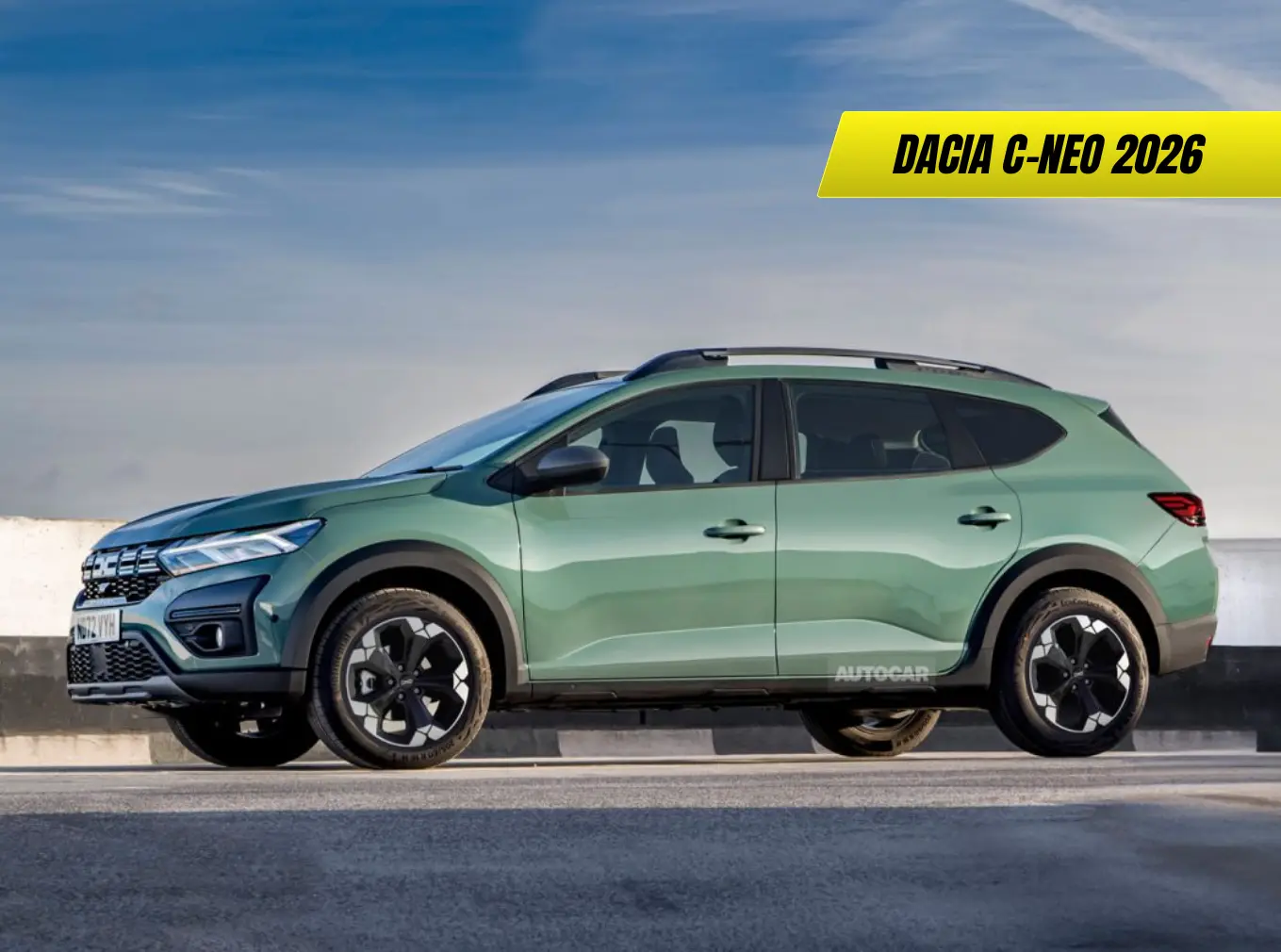
Dacia launches C-Neo compact estate spring 2026 with station wagon and fastback crossover variants offering full hybrid, mild hybrid, and LPG powertrains starting around £20,000, positioning budget brand directly against mainstream European C-segment leaders through value-focused practicality.
Romanian budget brand Dacia expands beyond SUV-focused lineup introducing C-Neo compact estate (provisional name) debuting spring 2026 with UK sales commencing autumn 2026, representing strategic move into mainstream C-segment currently dominated by Skoda Octavia, Volkswagen Golf, and Opel Astra through radical value proposition targeting £20,000 starting price undercutting established rivals by £6,000-10,000. The model arrives as station wagon primarily featuring approximately 4.6-meter length creating substantial cargo capacity and rear passenger space competitive with premium offerings, with potential fastback crossover variant combining coupe-SUV styling with slightly elevated ride height appealing to buyers seeking adventurous aesthetics without full SUV dimensions. Built on versatile Renault CMF-B platform shared across Sandero, Jogger, and upcoming Bigster, the C-Neo offers comprehensive powertrain lineup including 1.2-liter TCe mild hybrid (48V system), 1.8-liter full hybrid(155hp combining gasoline engine with electric motor), LPG bi-fuel variants, and potential 4WD option maintaining Dacia’s philosophy offering practical solutions addressing diverse customer needs through cost-effective engineering. Interior follows “Smart-Value Luxury” principle featuring 10.1-inch touchscreen with Apple CarPlay/Android Auto, 7-inch digital instrument cluster, and improved materials quality versus previous Dacia generations while avoiding premium pricing through strategic equipment rationalization. The rugged minimalism design language incorporates Y-shaped LED headlights, Dacia Link signature grille, sculpted fenders, and slightly raised ground clearancecreating crossover-inspired aesthetic distinguishing C-Neo from conventional estates while maintaining wagon practicality through substantial boot capacity estimated 600+ liters rivaling Octavia Combi’s segment-leading 640 liters.
Design Philosophy: Rugged Estate Meets Crossover Aesthetics
The C-Neo represents Dacia’s interpretation of modern family transportation, blending traditional estate wagon practicality with contemporary crossover styling cues appealing to buyers seeking adventurous appearance without SUV compromises.
Exterior Design Elements
Front Fascia
- Y-shaped LED headlights: Dacia’s new signature lighting extending from current Duster and Bigster
- Dacia Link grille: Horizontal design element creating brand recognition across lineup
- High hood line: SUV-inspired elevated nose suggesting robustness and capability
- Sculpted fenders: Muscular wheel arches creating planted, aggressive stance
- Lower protective cladding: Unpainted plastic trim suggesting light off-road capability
Side Profile
- Station wagon proportions: Extended roofline maximizing cargo volume and rear headroom
- Elevated ground clearance: Slightly raised versus conventional estates (~20-30mm estimated)
- Strong shoulder line: Character line connecting headlights to taillights creating visual tension
- Blacked-out C-pillars: Creating “floating roof” effect popularized by contemporary crossovers
- Roof rails: Functional luggage carrying capability reinforcing practical family positioning
Rear Design
- Horizontal Y-shaped taillights: Matching front lighting signature for visual consistency
- Wide, stable stance: Emphasized through horizontal light bar and broad tailgate
- Substantial cargo opening: Large tailgate enabling easy loading of bulky items
- Protective rear bumper: Unpainted lower section suggesting rugged capability
The overall aesthetic channels “Robust Minimalism” – Dacia’s evolving design language combining toughness with refined simplicity, avoiding excessive ornamentation while creating distinctive, modern appearance competitive with mainstream European brands typically costing 30-50% more.
Body Style Variants
Station Wagon (Primary Version)
- Traditional elongated roofline maximizing cargo capacity
- Vertical tailgate optimizing loading height and volume
- Estimated 600-650 liter boot capacity (seats up)
- 1,500-1,600 liter capacity with rear seats folded
- Target customers: families prioritizing maximum practicality
Fastback Crossover (Potential Variant)
- Sloping roofline from B-pillar creating coupe-SUV silhouette
- Slightly reduced cargo capacity versus wagon (~550 liters estimated)
- Enhanced aerodynamics improving fuel economy and highway refinement
- More dynamic styling appealing to style-conscious buyers
- Higher ground clearance versus wagon (additional 10-20mm)
The dual-body strategy mirrors approaches from Skoda (Octavia wagon vs Scala hatchback), SEAT (Leon estate vs Formentor), and Peugeot (308 SW vs 408 fastback), enabling Dacia addressing diverse customer preferences through single platform investment, similar to versatility discussed in Dacia Sandero 2026.
Platform and Dimensions: CMF-B Versatility
The C-Neo utilizes Renault-Nissan-Mitsubishi Alliance’s CMF-B platform – versatile modular architecture underpinning numerous European mainstream models enabling cost-effective production and diverse powertrain integration.
Platform Specifications
| Specification | Dacia C-Neo (Estimated) | Comparative Context |
|---|---|---|
| Platform | Renault CMF-B (Common Module Family) | Shared: Sandero, Jogger, Clio, Captur, Arkana |
| Length | ~4,600 mm (181 inches) | Similar: Skoda Octavia (4,689mm), VW Golf Estate (4,633mm) |
| Wheelbase | ~2,700 mm (106 inches) | Extended versus Sandero (2,604mm) for rear space |
| Width | ~1,800 mm (71 inches) | Competitive C-segment standard |
| Height | ~1,500-1,520 mm (wagon/crossover) | Elevated versus conventional estates (~1,450-1,480mm) |
| Ground clearance | ~160-180 mm | Higher than typical estates (~140-150mm), below SUVs (~200mm) |
| Boot capacity | ~600-650 liters (wagon) | Competitive: Octavia 640L, Golf Estate 605L |
| Boot (seats folded) | ~1,500-1,600 liters | Maximum cargo capability rivaling premium wagons |
The 4.6-meter length positions C-Neo as genuine C-segment competitor rather than stretched B-segment vehicle, ensuring adequate rear passenger space and cargo capacity competing against established European leaders without size compromises often limiting budget alternatives.
CMF-B Platform Benefits
Cost Efficiency
- Shared components across multiple Renault/Nissan/Dacia models reducing per-unit costs
- Economies of scale enabling competitive pricing despite comprehensive equipment
- Proven reliability through millions of units produced globally since 2012
Powertrain Flexibility
- Accommodates gasoline, diesel, hybrid, and electric powertrains without major modifications
- Supports front-wheel drive and all-wheel drive configurations
- Enables mild hybrid (48V), full hybrid, and plug-in hybrid integration
Safety Standards
- Euro NCAP five-star crash test ratings achieved by numerous CMF-B vehicles
- Modern driver assistance systems integration (ADAS hardware/software)
- Meets current and upcoming European safety regulations through 2028+
Manufacturing Efficiency
- Produced at multiple Alliance factories enabling flexible production allocation
- Standardized manufacturing processes reducing complexity and quality variations
- Rapid tooling changes enabling multiple body styles from single platform
Powertrain Lineup: Hybrid Leadership and LPG Value
Dacia’s C-Neo powertrain strategy emphasizes electrified efficiency through full hybrid technology while maintaining affordability through LPG bi-fuel and mild hybrid variants addressing diverse customer priorities.
Expected Powertrain Options
1.8-Liter Full Hybrid 155 (Flagship)
- Engine: 1.8L naturally-aspirated 4-cylinder gasoline
- Electric motor: Integrated within automatic transmission
- System output: 155 hp (115 kW) combined
- Transmission: Specialized hybrid automatic (clutchless multi-mode)
- Fuel economy: 60-65 mpg combined (estimated)
- CO2 emissions: ~100-110 g/km
- Electric-only capability: Low-speed urban driving (up to ~30-40 mph for short distances)
- Target customers: Efficiency-focused buyers wanting maximum fuel economy
This system represents Renault Group’s proven E-Tech full hybrid architecture appearing in Clio, Captur, Arkana, and Austral delivering genuine fuel economy benefits versus conventional gasoline through extensive electric operation in urban conditions and regenerative braking energy recovery.
1.2-Liter TCe Mild Hybrid 48V
- Engine: 1.2L turbocharged 3-cylinder gasoline
- Output: 100-130 hp depending on tune
- 48V system: Belt-integrated starter generator (BISG)
- Transmission: Manual 6-speed or dual-clutch automatic
- Fuel economy: 50-55 mpg combined (estimated)
- CO2 emissions: ~115-125 g/km
- Benefits: Improved start-stop, modest fuel economy gains, reduced cost versus full hybrid
- Target customers: Value-conscious buyers wanting electrified benefits without full hybrid cost
The 48V mild hybrid system provides affordable electrification benefits including smoother start-stop operation, modest electric boost during acceleration, and regenerative braking energy recovery at fraction of full hybrid’s cost and complexity.
LPG Bi-Fuel Variants
- Base engine: 1.0L or 1.2L TCe turbocharged gasoline
- Fuel system: Dual tanks (gasoline + LPG) with seamless switching
- Range: 800-1,000+ km combined on both fuels
- Running costs: LPG typically 40-50% cheaper than gasoline per liter
- CO2 emissions: ~10-15% lower than gasoline-only due to LPG’s cleaner combustion
- Target markets: Eastern Europe (Poland, Romania, Italy) where LPG infrastructure extensive
Dacia maintains LPG commitment serving markets where bi-fuel vehicles deliver substantial cost advantages through cheaper fuel pricing and government incentives encouraging cleaner-burning alternatives to conventional gasoline.
Potential 4WD Option
- Likely available on selected mild hybrid or full hybrid variants
- Enhanced traction for poor weather conditions or light off-road use
- Reinforces crossover-inspired positioning and “adventurous” marketing
- Premium positioning justifying higher pricing tier
UK Pricing Estimates by Powertrain
| Variant | Estimated UK Price | Key Positioning |
|---|---|---|
| TCe 100 Mild Hybrid (base) | £20,000-22,000 | Value entry, adequate performance |
| TCe 130 Mild Hybrid | £22,000-24,000 | Better performance, still affordable |
| LPG Bi-Fuel | £22,500-24,500 | Eastern Europe focus, niche UK appeal |
| Full Hybrid 155 | £24,000-26,000 | Best fuel economy, mainstream positioning |
| Full Hybrid 155 4WD | £26,000-28,000 | Top specification, all-weather capability |
Even top-specification Full Hybrid 4WD at £26,000-28,000 undercuts mainstream rivals substantially:
- Skoda Octavia Estate: £30,000-37,000
- VW Golf Estate: £27,000-35,000
- SEAT Leon Estate: £26,000-32,000
- Peugeot 308 SW: £27,000-35,000
The £4,000-9,000 price advantage enables Dacia competing on value while offering comparable practicality and increasingly competitive equipment levels, similar to strategies employed in SEAT Ibiza 2026.
Interior Design: Smart-Value Luxury Philosophy
Dacia’s interior approach balances cost consciousness with improved quality and technology integration addressing previous generation criticism regarding cabin finish while avoiding premium pricing through strategic material selection and equipment rationalization.
Cabin Layout and Technology
Digital Interface
- 10.1-inch central touchscreen: Angled toward driver for ergonomic access
- Wireless smartphone integration: Apple CarPlay and Android Auto without cables
- 7-inch digital instrument cluster: Customizable displays showing driving information
- Voice control: Basic commands for navigation, phone, media (avoiding complex AI assistants)
- Physical controls retained: HVAC controls and key functions remain button/dial operated
The balance between digital and physical controls reflects customer feedback that excessive touchscreen integration sacrifices usability for perceived modernity – Dacia pragmatically maintains buttons/dials for functions requiring quick access while driving.
Materials and Quality
Improvements Over Previous Dacia Generations
- Increased soft-touch surfaces on upper dashboard and door tops
- Improved hard plastic quality with better textures and visual finish
- Enhanced upholstery fabrics with more premium appearance
- Better assembly quality with tighter panel gaps and reduced rattles
- Simplified design avoiding cheap-looking faux chrome trim
Practical Family Features
- Multiple USB-C charging ports (front and rear)
- Large door pockets accommodating water bottles
- Practical storage cubbies throughout cabin
- Easy-clean materials suitable for family use with children
- Simple, intuitive controls requiring minimal learning curve
Seating and Space
Front Seats
- Comfortable cloth upholstery (synthetic leather on top trims)
- Manual adjustment standard (electric optional on top trims)
- Adequate support for long-distance comfort
- Height-adjustable driver’s seat across range
Rear Seats
- Generous legroom from extended wheelbase (~2,700mm)
- 60/40 split-folding standard (40/20/40 potentially on higher trims)
- Flat load floor when folded maximizing cargo versatility
- ISOFIX child seat mounting points on outer positions
- Adequate headroom even for taller passengers
Boot/Cargo Capacity
- 600-650 liters estimated (wagon, seats up)
- 1,500-1,600 liters with seats folded
- Practical square shape without intrusions
- Low loading lip for easy lifting heavy items
- Underfloor storage for charging cables and tools
- Roof rails enabling additional cargo capacity (roof boxes, bikes)
Market Strategy: Disrupting C-Segment Through Value
Dacia’s C-Neo launch represents calculated assault on European C-segment – highest-volume passenger car category accounting for millions annual sales dominated by established players facing pressure from above (premium SUVs) and below (budget brands).
Target Customer Profile
Primary Demographics
- Young families: First-time buyers needing space but constrained by budgets
- Value-conscious professionals: Pragmatic buyers prioritizing practicality over badge prestige
- Fleet buyers: Rental companies and businesses seeking cost-effective fleet vehicles
- Downsizers: Older buyers leaving larger vehicles for practical, affordable estates
- Eastern European markets: Price-sensitive buyers where Dacia achieves strong penetration
Customer Priorities
- Value: Maximum space and equipment per pound spent
- Practicality: Genuine family capability with generous cargo capacity
- Running costs: Fuel economy and maintenance affordability
- Simplicity: Uncomplicated ownership without complex technology requiring expensive servicing
- Reliability: Proven mechanicals prioritizing durability over cutting-edge features
Competitive Positioning Matrix
Direct Competitors (Estate Segment)
| Model | Starting Price | Boot Capacity | Hybrid Available | Key Advantage |
|---|---|---|---|---|
| Dacia C-Neo | £20,000 (est) | 600-650L | Yes | Unbeatable value |
| Skoda Octavia Estate | £30,000 | 640L | Yes (mild/PHEV) | Premium quality, VW engineering |
| VW Golf Estate | £27,000 | 605L | Mild hybrid | German brand prestige |
| SEAT Leon Estate | £26,000 | 620L | Mild hybrid | Sporty styling, VW platform |
| Peugeot 308 SW | £27,000 | 608L | Plug-in hybrid | French style, comfortable |
| Ford Focus Estate | £25,000 | 575L | No | Dynamic handling, Ford brand |
Indirect Competitors (Compact SUVs)
C-Neo also competes against compact SUVs where buyers prioritize elevated seating over maximum cargo capacity:
- Dacia Duster: £18,000-25,000 (brand cannibaliza potential)
- Nissan Qashqai: £28,000-37,000
- Kia Sportage: £29,000-43,000
- Hyundai Tucson: £30,000-42,000
The C-Neo’s estate bodystyle differentiates from Dacia’s SUV-heavy lineup (Duster, Jogger, Bigster) while offering superior cargo capacity and potentially better fuel economy through improved aerodynamics versus SUVs’ bluff frontage.
Frequently Asked Questions
When does the Dacia C-Neo launch?
Spring 2026 public debut (likely Geneva Motor Show March or Paris in April) with UK sales beginning autumn 2026 (September-November). Production ramps through late 2026 with full availability early 2027. Initial launches prioritize Western European markets (UK, France, Germany, Spain) before expanding Eastern Europe where Dacia achieves highest market penetration.
How much will the C-Neo cost in the UK?
Estimated £20,000-28,000 spanning base mild hybrid through top-specification full hybrid 4WD. Entry TCe mild hybrid likely £20,000-22,000 while flagship full hybrid 155 4WD peaks around £26,000-28,000. This substantially undercuts established C-segment rivals (Skoda Octavia from £30,000, VW Golf Estate from £27,000) by £4,000-10,000.
What’s the difference between wagon and fastback versions?
Station wagon features traditional vertical tailgate maximizing cargo capacity (~650 liters), targeting families prioritizing maximum practicality. Fastback crossover variant adds sloping roofline creating coupe-SUV styling with slightly elevated ride height, sacrificing ~50-100 liters cargo capacity for more dynamic appearance and improved aerodynamics. Both share mechanical specifications and wheelbase.
Is the C-Neo available with hybrid power?
Yes. Full hybrid 155 system combines 1.8L gasoline engine with electric motor producing 155hp total, delivering 60-65 mpg estimated fuel economy. Additionally, mild hybrid versions feature 48V system with 1.2L TCe turbocharged engine providing modest efficiency gains at lower cost. LPG bi-fuel variants also available primarily targeting Eastern European markets where autogas infrastructure extensive.
How big is the boot compared to rivals?
Estimated 600-650 liters seats-up capacity rivals best-in-class Skoda Octavia Estate (640L) while substantially exceeding VW Golf Estate (605L), SEAT Leon Estate (620L), and Peugeot 308 SW (608L). With rear seats folded, capacity reaches approximately 1,500-1,600 liters – genuine family-hauling capability competitive with vehicles costing £10,000 more.
Will the C-Neo replace the Jogger?
No. Jogger continues as seven-seat MPV-style offering targeting large families requiring third-row seating. C-Neo positions as five-seat estate/crossover filling gap between Sandero hatchback and Jogger MPV, appealing to smaller families prioritizing cargo capacity over maximum passenger count. Expanded lineup enables Dacia addressing diverse customer needs without model overlap confusion.
Is 4WD available on the C-Neo?
Likely yes on selected variants, probably limited to full hybrid 155 versions. The all-wheel drive system enhances poor-weather traction and light off-road capability reinforcing crossover-inspired positioning. However, FWD remains standard across most range maintaining affordability and fuel efficiency advantages – 4WD adds weight and complexity increasing purchase prices £2,000-3,000 typically.
What warranty does Dacia provide?
Dacia offers 3-year/60,000-mile vehicle warranty plus 8-year/100,000-mile battery warranty on hybrid variants (where applicable). This matches mainstream European manufacturers though falls short of Hyundai/Kia’s industry-leading 5-7 year coverage. However, Dacia’s simplified mechanical approach typically ensures fewer warranty claims and lower long-term maintenance costs compensating for shorter coverage period.
Conclusion
The Dacia C-Neo’s spring 2026 launch represents Romanian budget brand’s ambitious expansion beyond SUV-focused lineup into European C-segment’s heartland targeting mainstream families through radical value proposition delivering Skoda Octavia-rivaling practicality at £20,000-28,000 pricing undercutting established competitors by £4,000-10,000 while offering comprehensive hybrid powertrain lineup, improved interior quality, and distinctive rugged-estate styling differentiating from conventional wagons through crossover-inspired aesthetic cues. The 4.6-meter length and estimated 600-650 liter boot capacity positions C-Neo as genuine family hauler rather than compromised budget alternative, while full hybrid 155 system delivering projected 60-65 mpg addresses fuel economy priorities increasingly important amid high European fuel prices and emissions regulations tightening through remainder of decade.
For UK buyers, the C-Neo delivers compelling alternative to conventional C-segment estates and compact SUVs through unmatched value-per-pound proposition, though success depends on execution quality matching improved specifications and avoiding previous Dacia generations’ criticism regarding interior finish and perceived cheapness potentially deterring mainstream buyers accustomed to Volkswagen Group’s refinement standards. The availability of both wagon and fastback crossover variants enables Dacia addressing diverse styling preferences while maintaining single-platform cost efficiency, potentially capturing customers otherwise defaulting toward more expensive SUVs purely for adventurous aesthetics rather than genuine off-road capability requirements.
Whether C-Neo achieves projected success disrupting established C-segment hierarchy depends fundamentally on product quality meeting elevated expectations, pricing remaining genuinely competitive post-launch, and marketing effectively communicating genuine improvements over previous budget-brand perceptions. However, the strategic positioning targeting families prioritizing practicality and value over badge prestige suggests substantial potential in European markets where economic pressures increasingly favor rational purchasing decisions versus premium positioning historically dominating passenger car segments, potentially accelerating Dacia’s transformation from niche budget brand toward mainstream volume manufacturer rivaling established European players through superior value proposition unencumbered by legacy cost structures and premium brand positioning commitments.





