
Understanding UK driving licence categories and renewal rules in 2025 is essential for anyone learning to drive, changing vehicle types, or managing professional driver qualifications. This guide explains the structure of licence categories, new DVLA updates, medical and age limits, and how the coming digital licence reform will affect all UK motorists.
Key Points
- UK licences are managed by the DVLA (Driver and Vehicle Licensing Agency).
- Categories determine which vehicles you can legally drive.
- Photocard licences are valid for 10 years; provisional licences last until you pass your test.
- From 2025, digital licences via the GOV.UK IT Wallet are being introduced.
- Driving with the wrong category or expired licence can lead to £1,000 fines and penalty points.
Driving Licence Structure in the UK
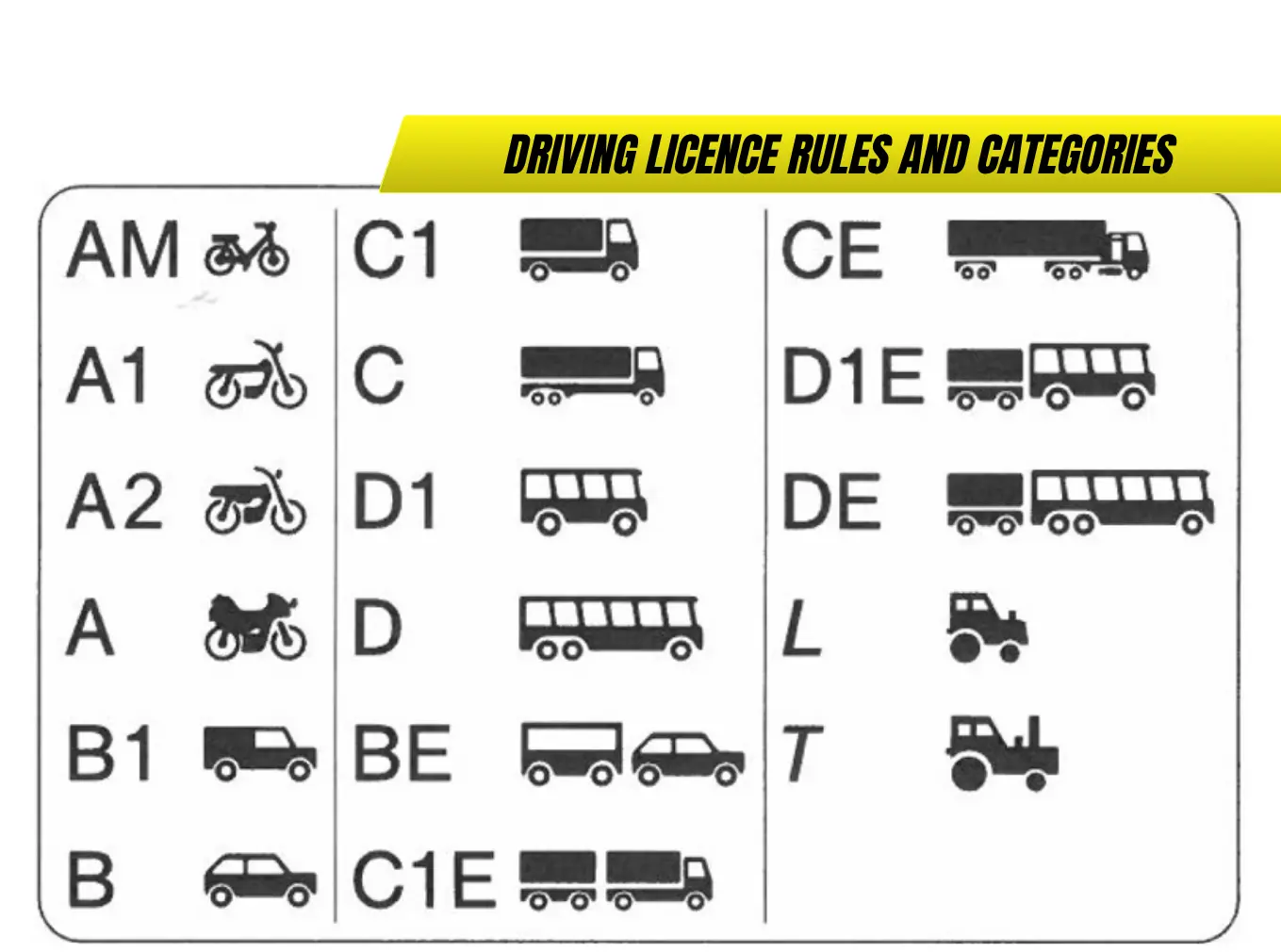
Every UK licence displays one or more vehicle categories printed on the back, each representing a different class of vehicle.
These categories specify the vehicle type, engine size, and weight limits that you are legally permitted to drive.
| Category | Vehicle Type | Minimum Age | Notes |
|---|---|---|---|
| B | Cars up to 3,500 kg | 17 | May tow up to 750 kg |
| B Auto | Automatic cars only | 17 | No manual vehicles |
| BE | Cars with trailer (up to 3,500 kg) | 17 | Must hold full B licence |
| C1 | Medium goods vehicle (3.5–7.5 tonnes) | 18 | Often for small trucks |
| C | Large goods vehicle (7.5+ tonnes) | 21 | Requires medical check |
| D1 | Minibuses (8–16 passengers) | 21 | PCV qualification required |
| D | Bus/coach (16+ passengers) | 24 | CPC certificate mandatory |
| A1 / A2 / A | Motorcycles | 17–24 | Graduated licence system |
| AM | Mopeds (≤50cc) | 16 | Max speed 45 km/h |
| F / G / H / K | Agricultural & special vehicles | 16 | Specific usage only |
This classification aligns with EU Directive 2006/126/EC, ensuring consistency across European and UK licences.
Licence Types
Provisional Licence
Issued to learners, allowing supervised driving with “L” plates.
Applicants must be at least 17 (16 for mopeds) and meet eyesight standards.
Full Licence
Granted after passing the practical and theory tests.
Valid for 10 years and renewable online through the DVLA.
Vocational Licence
For professional drivers of HGVs, buses, or coaches.
Requires additional tests and Driver CPC training (Certificate of Professional Competence).
2025 Updates from the DVLA
The DVLA introduced several modernisation measures:
- Digital licence pilot via GOV.UK IT Wallet (optional in 2025).
- Enhanced online renewal process with faster ID verification.
- Simplified medical reporting system for fitness-to-drive conditions.
- Updated points and endorsement system integrated digitally with police databases.
For details, see UK Digital Driving Licence 2025 – How the IT Wallet Will Work.
Medical and Vision Requirements
To hold a valid licence, you must:
- Read a number plate from 20 metres away.
- Disclose conditions such as diabetes, epilepsy, or vision impairment.
- Undergo medical checks for commercial categories (C, D, D1, C1).
Drivers over 70 must renew every three years and confirm continued fitness.
Failure to declare relevant health issues may result in fines or revocation.
Endorsements and Penalty Points
Driving offences can lead to endorsements on your licence for 4–11 years.
These include speeding, careless driving, or insurance offences.
| Offence | Points | Duration on Record |
|---|---|---|
| Speeding (SP30) | 3–6 | 4 years |
| No insurance (IN10) | 6–8 | 4 years |
| Dangerous driving (DD40) | 3–11 | 11 years |
| Drink-driving (DR10) | 3–11 | 11 years |
| Using mobile while driving | 6 | 4 years |
New drivers face licence revocation if they reach 6 points within 2 years of passing their test.
For more details, check UK Driving Licence Points – What Happens at 12 Points and How to Check Your Total.
Licence Renewal and Validity
- Photocard renewal every 10 years (£14 online or £17 by post).
- Address changes must be updated immediately (free of charge).
- Over-70 renewals every 3 years (no fee).
- Renewals can be done via the DVLA portal.
A licence that’s expired or invalid for your vehicle category can result in fines up to £1,000 and potential insurance voidance.
Driving Abroad with a UK Licence
- UK licences are recognised across the EU, EEA, and Switzerland.
- For non-EU destinations, an International Driving Permit (IDP) may be required.
- IDPs are issued by select Post Offices for £5.50 and valid for 12 months.
If you’re moving abroad, you may need to exchange your UK licence within a specified period depending on the country.
Lost, Stolen, or Damaged Licence
Replacement can be requested online for £20 at GOV.UK replace driving licence.
Stolen licences should be reported to the police before applying for a new one.
The digital licence system being introduced in 2025 will allow instant reissue via biometric verification through the IT Wallet app.
Provisional Drivers and Learning Rules
Learner drivers must:
- Display L plates (or D plates in Wales).
- Be supervised by a driver over 21 with 3+ years’ experience.
- Have valid insurance coverage while practising.
Provisional licence holders are not allowed to drive on motorways unless accompanied by an approved instructor in a dual-control vehicle.
See New Rules for Learner Drivers in the UK 2025 – Passenger Restrictions and Safety Updates for updated learner regulations.
Category Additions and Upgrades
You can expand your licence categories by taking additional tests:
| Category | Vehicle Type | Additional Requirement |
|---|---|---|
| B to BE | Towing heavier trailers | Practical test |
| B to C1 | Small lorries | Medical + test |
| C to C+E | Articulated lorries | Additional training |
| D1 to D | Full-size buses | CPC + test |
Training schools across the UK offer modular upgrade courses, often eligible for tax deductions for professional drivers.
Digital Licence Integration (2025–2026)
The coming digital licence system will connect to DVLA databases in real time.
Drivers will be able to:
- Display their licence digitally during police checks.
- Update address and medical details instantly.
- Verify categories and endorsements within seconds.
Physical cards remain valid, but the IT Wallet aims to make driving records paperless by 2030.
Common Offences and Licence Suspension
Your licence can be suspended or revoked for:
- Exceeding 12 points in 3 years (6 for new drivers).
- Serious offences like drink or drug driving.
- Failing to disclose medical conditions.
Reinstatement requires application to DVLA and may involve re-taking tests or medical assessments.
For context on new driver penalties, see Licence Suspension Rules for New Drivers UK 2025 – What You Need to Know.
Expert Opinion
From my point of view, the UK licensing system in 2025 offers one of the most structured and transparent frameworks in Europe.
The addition of digital verification and online renewals simplifies administration, while stricter penalty integration ensures safer roads.
As the IT Wallet expands, British motorists will experience faster renewals, fewer documents, and stronger fraud protection.
FAQs
How long is a UK driving licence valid?
10 years for standard cards; 3 years for over-70s.
Can I drive abroad with a UK licence?
Yes, across the EU and most countries recognising the IDP system.
What happens if I lose my licence?
You can order a replacement online for £20.
Is a digital licence available yet?
Pilot rollout begins in 2025; full access expected by 2026.
Do I need a medical for car licences?
Only for categories C, D, or certain medical conditions.
By 2025, the UK driving licence ecosystem is moving rapidly toward digital integration and transparency.
In my experience, understanding your licence category, renewal rules, and upcoming IT Wallet transition is the key to avoiding penalties and staying compliant on British roads.





