
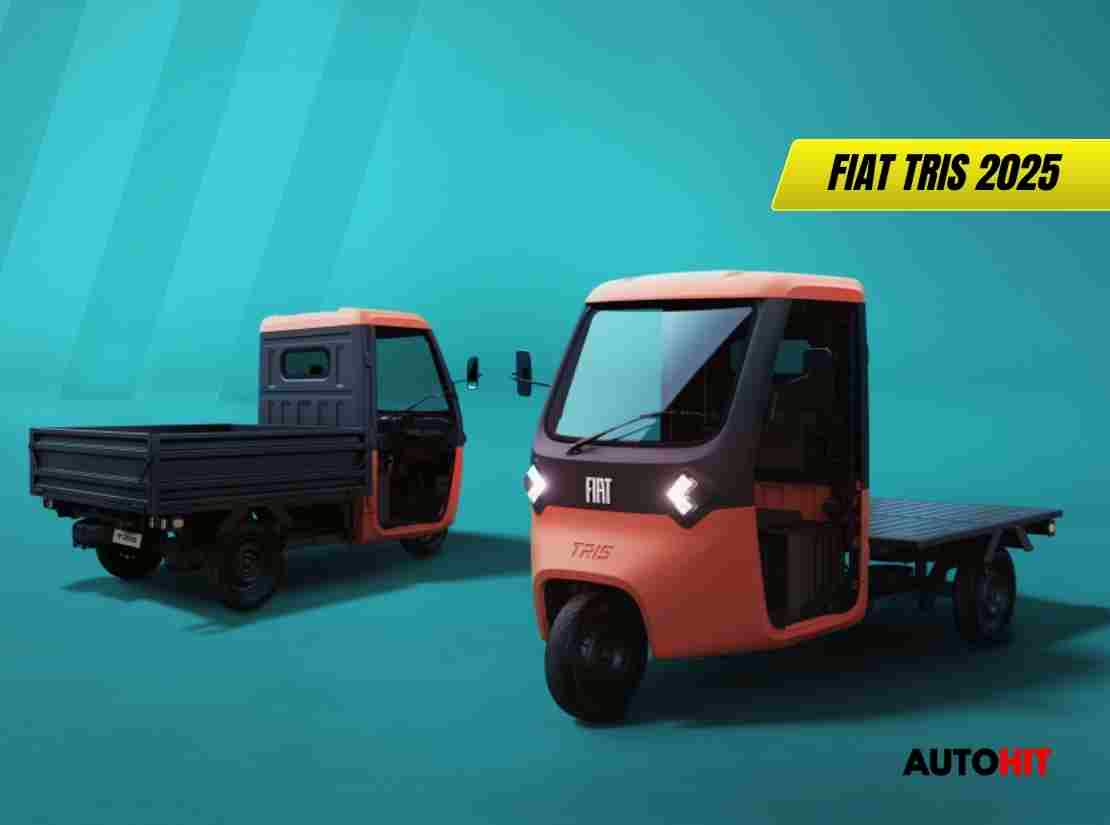
Fiat Tris 2025 electric three-wheeler delivers 56-mile range, 28mph top speed, and innovative urban delivery solutions. Could this cute cargo hauler reach UK shores?
In a world obsessed with ever-larger SUVs and electric saloons, Fiat has just unveiled something refreshingly different: a pint-sized, three-wheeled electric commercial vehicle that looks more like a cheerful cartoon character than a serious delivery truck. The Fiat Tris, launched initially for Middle East and African markets, represents a fascinating return to automotive fundamentals – and according to our analysis at AutoHit, it could be exactly what UK urban logistics desperately needs.
This isn’t just another electric vehicle launch. The Tris marks Fiat’s first-ever three-wheeled vehicle, channelling the spirit of Italy’s legendary Piaggio Ape while embracing 21st-century electric technology. With its adorable “emoticon eyes,” integrated domestic charging, and ability to carry a Euro pallet despite measuring just 3.17 metres long, the Tris challenges everything we think we know about commercial vehicles.
More intriguingly, Fiat CEO Olivier Francois has hinted that “Europe may be next” for the Tris launch, suggesting this charming little workhorse could soon be navigating UK city centres. In an era where last-mile delivery costs are spiralling and urban congestion chokes traditional vans, could a 28mph three-wheeler actually make commercial sense?
Key Highlights: Why the Tris Matters for Urban Delivery
• Compact Urban Champion: Just 3.17m long with 3.05m turning radius – perfect for narrow UK streets and tight parking • Euro Pallet Capable: 2.25 square metres of load space accommodating standard Euro pallets despite tiny footprint • Integrated Charging: Built-in 220V domestic charger eliminates need for specialist charging equipment • Three Configurations: Available as pickup, flatbed, or chassis-cab for maximum versatility • Piaggio Ape Heritage: Modern interpretation of Italy’s beloved three-wheeler delivery tradition • Potential UK Arrival: CEO hints at European expansion following Middle East/Africa launch
Design Philosophy: Function Meets Italian Flair
Having examined the specifications and press imagery, the Fiat Tris represents a masterclass in purposeful design. This isn’t just a shrunk-down van – it’s a completely reimagined approach to urban logistics that prioritises accessibility, efficiency, and yes, charm.
Exterior Character
The Tris immediately distinguishes itself through what can only be described as automotive personality. The LED front face features three distinctive lights (hence “Tris”) that create an almost anthropomorphic expression – friendly rather than intimidating, approachable rather than aggressive.
Available in vibrant two-tone colour schemes including orange-and-black (which genuinely resembles a cheerful clownfish), the Tris brings joy to utilitarian functionality. This matters more than you might think – in dense urban environments where delivery vehicles often represent noise and pollution, a smiling electric three-wheeler sends entirely different signals to pedestrians and residents.
The proportions are utterly distinctive. Despite measuring only 10.4 feet long (five feet shorter than a Honda Civic), the upright stance and purposeful rear section create surprising visual presence. It’s recognisably commercial without being intimidating – crucial for last-mile delivery in residential areas.
Interior Practicality
Inside, the Tris embraces minimalism without sacrificing functionality. The single-seat cabin (no doors for frequent entry/exit) features a 5.7-inch digital instrument cluster displaying essential information including range, battery level, and speed.
Multiple storage solutions include a closed 3-litre glove compartment, additional storage nets, and practical touches like USB-C charging and a 12V socket. Everything focuses on the driver’s immediate needs rather than passenger comfort – this is a working vehicle designed by people who understand commercial operations.
The handlebars steering might seem unconventional, but it directly connects to the Tris’s three-wheeler heritage while offering excellent manoeuvrability in tight spaces.
Revolutionary Electric Powertrain
The Tris’s electric drivetrain represents thoughtful engineering rather than headline-grabbing performance. Every component serves the vehicle’s urban logistics mission with impressive efficiency.
Motor and Performance
The 48V electric motor produces 9kW (12bhp) peak power and 45Nm torque – modest figures that translate into perfectly adequate urban performance. The 28mph (45km/h) top speed might seem limiting, but it’s ideal for city centre delivery routes where traffic rarely exceeds 30mph anyway.
More importantly, electric motors deliver maximum torque from standstill, providing surprising responsiveness for loading/unloading operations and traffic light starts. The instant throttle response makes the Tris feel lively despite its modest power output.
Battery and Charging Innovation
The 6.9kWh lithium battery (shared with the Fiat Topolino) provides 56 miles (90km) WMTC range – perfectly adequate for urban delivery rounds. However, the real innovation lies in the charging system.
Unlike most commercial EVs requiring expensive charging infrastructure, the Tris features an integrated 220V charger with standard domestic plug. Simply connect an extension lead to any household socket for overnight charging. A complete charge takes 4 hours 40 minutes, while 80% charging requires just 3.5 hours.
For small businesses operating from domestic premises, this represents a genuine breakthrough. No specialist charging equipment, no electrician visits, no expensive infrastructure investment – just plug in overnight like charging a mobile phone.
Real-World Range Considerations
The 56-mile official range should translate to 40-50 miles in typical UK urban delivery use. This comfortably covers most city centre delivery routes, particularly when combined with opportunity charging during lunch breaks or between shifts.
For comparison, traditional delivery vans rarely achieve more than 100-150 miles per day in dense urban environments due to traffic, parking restrictions, and frequent stops. The Tris’s range limitation becomes less relevant when operational patterns match the vehicle’s capabilities.
UK Market Analysis: Commercial Viability and Regulations
Current UK Three-Wheeler Market
The UK currently allows three-wheelers under specific licensing categories. The Tris would likely qualify as a Light Quadricycle (L6e category) or potentially a Motor Tricycle, depending on final homologation decisions.
This regulatory framework already accommodates vehicles like the Aixam range and various imported Asian three-wheelers. The Tris’s European design standards and safety equipment (three-point seatbelt, LED lighting, reverse buzzer) suggest straightforward UK approval.
Target UK Applications
Detailed Market Opportunity Analysis
| Application | Current Solution | Tris Advantage | Market Size (Est.) |
|---|---|---|---|
| Last-Mile Delivery | Transit vans | Lower costs, better access | £2.8 billion/year |
| Local Food Delivery | Motorcycles/cars | Weather protection, cargo space | £8.9 billion/year |
| Maintenance Services | Small vans | Easier parking, lower costs | £1.2 billion/year |
| Local Authority | Electric vans | Reduced infrastructure needs | £450 million/year |
| Campus/Site Logistics | Utility vehicles | Quiet operation, low impact | £340 million/year |
| Urban Construction | Pick-up trucks | Access to restricted areas | £890 million/year |
| Mobile Services | Converted vans | Lower barrier to entry | £2.1 billion/year |
Our Take: The Tris could capture 2-5% market share in specific niches, particularly where access restrictions or cost pressures favour smaller vehicles. The key is identifying applications where its limitations become advantages.
Pricing Projections for UK Market
While official UK pricing remains unconfirmed, we can estimate based on similar vehicles and European positioning. The Tris would likely retail between £18,000-£25,000 depending on configuration and local incentives.
This compares favourably to electric vans (£35,000+) while offering legitimate commercial capability. For small businesses currently using cars or motorcycles for deliveries, the step-up cost to proper commercial capability becomes manageable.
Competitive Landscape: David Among Goliaths
The Tris enters a crowded but segmented market. While no direct UK competitors exist, various vehicles compete for similar applications.
Traditional Alternatives
Electric vans like the Nissan e-NV200 (£31,000+) offer more space and weather protection but struggle with parking restrictions and operating costs. The Tris trades capacity for accessibility and affordability.
Cargo bikes and e-bikes provide similar manoeuvrability but lack weather protection and professional appearance. The Tris offers enclosed operation while maintaining much of the access advantage.
European Three-Wheeler Competition
Various European manufacturers produce similar vehicles, though most target different market segments. The Tris’s Italian design heritage and Stellantis backing provide credibility that smaller manufacturers struggle to match.
Piaggio, ironically Fiat’s historical inspiration, continues producing modern Ape variants but hasn’t embraced full electrification with the same enthusiasm. The Tris could capture buyers seeking proven reliability with cutting-edge electric technology.
UK Urban Logistics Revolution
Congestion Charge Benefits
In London and other UK cities implementing clean air zones, the Tris’s zero emissions provide unrestricted access. This operational advantage could prove decisive for delivery businesses facing increasing urban restrictions.
The vehicle’s tiny footprint also minimises parking challenges while the domestic charging eliminates range anxiety for operators working from home bases.
Last-Mile Delivery Crisis
UK delivery costs have increased 40% since 2020, driven by fuel prices, congestion, and regulatory restrictions. The Tris addresses multiple pressure points simultaneously: lower purchase costs, minimal operating expenses, and superior urban access.
For independent delivery operators or small businesses, the Tris could democratise commercial vehicle ownership. The domestic charging capability particularly benefits operators without commercial premises or expensive charging infrastructure.
Climate and Regulatory Alignment
The UK’s commitment to net-zero by 2050 increasingly pressures commercial vehicle operators toward electrification. The Tris provides a credible electric solution for applications where full-size vans represent over-specification.
Government incentives for commercial EV adoption could significantly reduce Tris purchase costs, improving the business case for early adopters.
Real-World Considerations for UK Operations
Weather and Seasonal Use
The Tris’s open design raises obvious questions about UK weather compatibility. However, many current delivery solutions (motorcycles, cargo bikes) operate year-round in British conditions.
The enclosed cab provides significantly better weather protection than two-wheelers while maintaining much of their access advantage. For operators currently using motorcycles or e-bikes, the Tris represents a substantial upgrade in comfort.
Infrastructure Requirements
The domestic charging capability represents a genuine game-changer for small operators. Many potential Tris users currently lack access to commercial charging infrastructure, making traditional electric vans impractical.
The ability to charge from domestic premises – garages, driveways, even extension leads to street-side properties – dramatically expands the potential user base for electric commercial vehicles.
Operational Economics
Running Cost Comparison (Per Mile)
| Vehicle Type | Fuel/Energy | Maintenance | Insurance | Total Cost |
|---|---|---|---|---|
| Fiat Tris | 4-6p | 8-12p | 15-20p | 27-38p |
| Small Petrol Van | 18-25p | 15-20p | 25-35p | 58-80p |
| Electric Van | 8-12p | 10-15p | 30-40p | 48-67p |
| Cargo E-bike | 2-4p | 5-8p | 8-12p | 15-24p |
| Motorcycle | 12-18p | 12-18p | 20-30p | 44-66p |
Our Take: The Tris occupies a sweet spot between cargo bikes and full vans, offering weather protection and professional appearance while maintaining cost advantages over traditional commercial vehicles.
Frequently Asked Questions
Q: Could the Fiat Tris legally operate on UK roads and what licence would be required?
A: The Tris would likely qualify as either a Light Quadricycle (L6e) requiring a car licence or potentially a Motor Tricycle depending on final homologation. Its European safety standards including three-point seatbelt, LED lighting, and reverse buzzer suggest straightforward UK approval. The 28mph top speed and 12bhp power output place it well within existing three-wheeler categories that already operate legally on UK roads. However, final categorisation would depend on DVSA assessment and specific weight/power ratios.
Q: How does the 56-mile range work for typical UK delivery routes?
A: The 56-mile official range should provide 40-50 miles real-world operation – adequate for most urban delivery rounds. UK city centre delivery typically involves 20-40 miles per day due to traffic and frequent stops. The domestic charging capability allows overnight charging plus opportunity charging during breaks. For longer routes, operators would need route planning or multiple vehicles, but most last-mile delivery applications work within these limitations.
Q: What would insurance and road tax costs be for the Tris in the UK?
A: Insurance would likely fall into specialist commercial vehicle categories, potentially similar to small vans or three-wheelers. The low value, modest performance, and commercial use should keep premiums reasonable – estimated £800-1,500 annually depending on operator experience and location. Road tax would depend on final vehicle categorisation but could qualify for reduced rates as an electric commercial vehicle. Some categories pay as little as £165 annually, making it very cost-effective for small businesses.
Q: How does the load capacity compare to alternatives like cargo bikes or small vans?
A: The Tris offers 2.25 square metres of load space with 540kg payload capacity – significantly more than cargo bikes (typically 100-200kg) but less than small vans (800-1,000kg). However, it can accommodate Euro pallets and provides weather protection that cargo bikes lack. For many urban delivery applications, the capacity proves adequate while offering cost and access advantages. The key is matching vehicle capability to actual operational requirements rather than over-specifying.
Q: Would the open cabin design work in UK weather conditions?
A: The Tris provides significantly better weather protection than motorcycles or cargo bikes while maintaining their manoeuvrability advantages. The enclosed cab with windscreen and roof protects against rain and wind, though it’s not fully enclosed like a van. Many UK delivery operators currently use motorcycles or e-bikes year-round, so the Tris represents a substantial comfort upgrade. Optional weather protection accessories could further improve all-season usability.
Q: What charging infrastructure would be needed for UK operations?
A: This is the Tris’s greatest advantage – it requires no specialist charging infrastructure. The integrated 220V charger works with standard domestic sockets, requiring only an extension lead for overnight charging. This eliminates the major barrier preventing small businesses from adopting electric commercial vehicles. Operators can charge at home, customer premises, or any location with domestic power supply. The 3.5-hour charge time easily fits into overnight periods or lunch breaks.
Q: How would the Tris handle UK urban challenges like speed bumps and narrow streets?
A: The Tris’s 3.17m length and 3.05m turning radius make it exceptionally manoeuvrable in tight urban spaces. The three-wheel configuration and 12-inch tyres should handle speed bumps adequately, while the galvanised chassis is designed for urban durability. The 28mph top speed limitation actually becomes an advantage in congested city centres where average speeds rarely exceed 15-20mph. For accessing restricted areas, pedestrian zones, or narrow residential streets, the Tris offers significant advantages over traditional vans.
Final Verdict: Small Vehicle, Big Potential
After analysing the Fiat Tris’s specifications, market positioning, and potential UK applications, we believe this charming three-wheeler represents something genuinely significant: a electric commercial vehicle that democratises access to professional logistics capability.
The Tris succeeds by not trying to be everything to everyone. Instead, it excels within specific parameters: urban delivery routes under 50 miles, operations requiring frequent access to restricted areas, and businesses seeking electric commercial capability without infrastructure investment.
What Excites Us:
- Domestic charging eliminates the biggest EV adoption barrier for small businesses
- Genuine commercial capability (Euro pallet capacity) in an ultra-compact package
- Italian design flair bringing personality to utilitarian applications
- Cost structure enabling profitable operations for independent delivery services
- Zero emissions with unrestricted urban access in clean air zones
- Potential to transform last-mile logistics economics
What Concerns Us:
- Limited range restricts operational flexibility
- Open cabin design challenges in severe weather
- Modest payload capacity compared to traditional vans
- Uncertain UK regulatory approval and dealer support
- Limited service network if European launch proceeds slowly
The Reality: The Fiat Tris could revolutionise specific segments of UK commercial vehicle operations, particularly for independent operators and small businesses currently using inappropriate vehicles for delivery work. Success depends on identifying applications where its limitations become advantages rather than trying to replace full-sized commercial vehicles.
For UK urban logistics, the Tris represents exactly the kind of innovative thinking needed to address rising costs, environmental pressures, and access restrictions. Whether it can overcome regulatory hurdles and establish dealer networks remains uncertain, but the fundamental proposition – affordable, accessible electric commercial capability – addresses genuine market needs.
In a world increasingly dominated by oversized, over-complicated vehicles, the Tris’s radical simplicity feels refreshingly honest. Sometimes the best solutions aren’t bigger or more powerful – they’re smarter and more appropriate. The Fiat Tris might just prove that point beautifully.
If Fiat does bring the Tris to Europe, UK commercial vehicle operators should pay serious attention. This adorable little workhorse could transform how we think about urban logistics – one charming, efficient delivery at a time.





