
The commercial vehicle landscape is about to welcome a genuinely disruptive force. Flexis, the ambitious joint venture between Renault, Volvo Group, and French logistics giant CMA CGM, has finally unveiled its distinctive new logo – an angular ‘F’ resembling a building plan that symbolises its commitment to “city-positive logistics”. This isn’t just corporate branding; it represents a £293 million investment in reimagining how electric commercial vehicles should be conceived, built, and operated in urban environments.
Having observed enough commercial vehicle launches to distinguish between genuine innovation and marketing hyperbole, we at AutoHit find ourselves genuinely intrigued by Flexis’s approach. Unlike traditional manufacturers adapting combustion platforms for electric use, this joint venture has developed an entirely native electric architecture from the ground up. The result promises to be something fundamentally different – lighter, more efficient, and considerably more intelligent than current electric van offerings.
The timing feels particularly significant for UK operators. With London’s ULEZ expansion, increasing urban delivery demands driven by e-commerce growth, and the government’s commitment to banning new petrol and diesel van sales from 2030, Flexis arrives precisely when fleet managers need credible electric solutions that don’t compromise operational efficiency for environmental compliance.
Key Highlights
• Native Electric Platform: Built on dedicated EV-native skateboard architecture with 800-volt electrical system, not a converted combustion platform • Impressive Range Claims: Up to 280 miles (450km) WLTP range with rapid charging capability – 80% charge in under 20 minutes • Three Distinct Models: Panel Van, Step-In Van, and Cargo Van variants designed specifically for urban logistics requirements • Advanced Software Integration: Software Defined Vehicle (SDV) architecture enabling over-the-air updates and fleet management integration • Competitive Weight Advantage: 300kg lighter than equivalent electric vans converted from combustion platforms • UK Market Launch: 2026 debut with established partnerships including London-based delivery specialist HIVED
Revolutionary Platform Architecture
The foundation of Flexis’s ambitious proposition lies in its EV-native skateboard platform, developed specifically for commercial vehicle applications rather than adapted from passenger car technology. This dedicated approach allows for optimisations impossible when retrofitting electric powertrains into existing combustion architectures.
The 800-volt electrical system represents a significant competitive advantage over most current electric vans operating on 400-volt architectures. In practical terms, this translates to rapid charging capabilities that could transform operational patterns for UK fleet managers. The promise of reaching 80% charge in under 20 minutes makes multiple daily charging cycles viable – crucial for high-utilisation urban delivery operations where vehicle downtime directly impacts profitability.
Weight and Efficiency Benefits
Perhaps most significantly for UK operators concerned about payload capacity, Flexis claims its vans are “300kg lighter” than similar vehicles electrified from existing combustion platforms. This weight saving addresses one of the primary concerns fleet managers express about electric commercial vehicles – the tendency for battery weight to compromise payload capacity compared to diesel equivalents.
The skateboard platform’s flat battery integration eliminates the need for separate battery housing structures, contributing to both weight savings and interior space optimisation. For UK delivery operations where every kilogram of payload matters, this could represent a significant operational advantage over competitors like Ford’s E-Transit Custom or the electric Stellantis van range.
Model Range Strategy
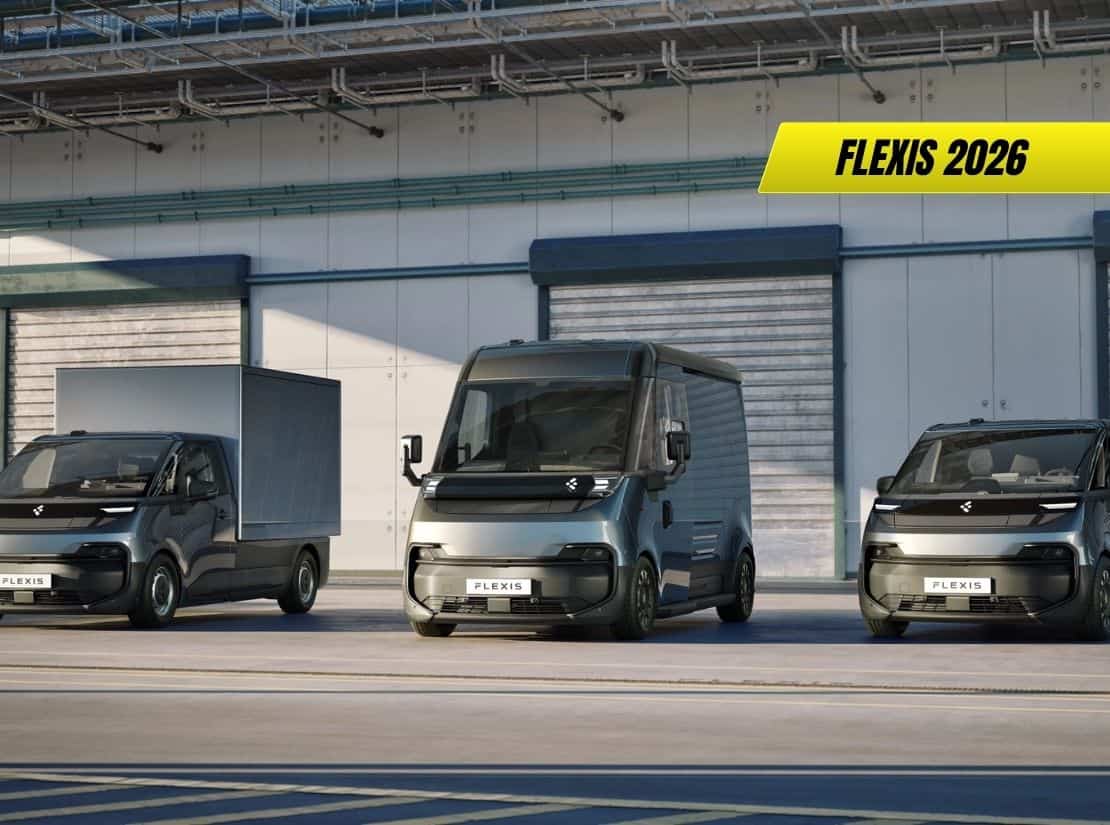
Flexis has developed three distinct models targeting different aspects of the urban logistics market, each optimised for specific operational requirements whilst sharing the common platform architecture.
Panel Van: Traditional Commercial Excellence
The Panel Van represents Flexis’s answer to established models like the Ford Transit Custom and Vauxhall Vivaro, featuring a 1.9-metre height that enables access to underground car parks whilst maintaining substantial cargo capacity. This height specification proves particularly relevant for UK operations, where urban delivery often involves navigating height-restricted environments.
The model will be available in two wheelbase lengths, with the longer variant measuring 400mm more than the standard version. Despite its compact external dimensions, the van is “25 centimetres shorter than traditional light commercial vehicles” whilst maintaining equivalent cargo space – a direct result of the electric platform’s packaging advantages.
Step-In Van: Urban Innovation
The Step-In Van represents perhaps the most innovative approach to urban delivery vehicle design. Featuring front sliding doors and a rear shutter door – claimed as “a first for the European market” – the vehicle offers 1.9-metre internal height clearance allowing drivers to walk upright throughout the vehicle.
This design philosophy addresses genuine operational challenges faced by UK delivery drivers. The ability to move between cab and cargo areas without exiting the vehicle could prove particularly valuable during British weather conditions, whilst the upright working environment should reduce driver fatigue during long delivery shifts.
Cargo Van: Maximum Flexibility
The Cargo Van takes a different approach, focusing on adaptability rather than fixed configuration. Designed for urban last-mile delivery with “an easily convertible box capable of integrating different widths, heights, and beds, as well as modular solutions including refrigerated boxes”, this variant promises maximum operational flexibility.
For UK operators serving diverse customer requirements – from standard parcel delivery to temperature-controlled goods – this modularity could eliminate the need for multiple specialist vehicles, potentially improving fleet utilisation rates whilst reducing capital investment.
Advanced Technology Integration
Beyond the fundamental platform advantages, Flexis has developed what it terms Software Defined Vehicle (SDV) architecture, promising capabilities that extend far beyond traditional commercial vehicles.
Fleet Management Innovation
The SDV architecture “supports fleet management connectivity to maximise uptime through features such as predictive maintenance” and “enables over-the-air updates to the vans’ embedded software, as happens with smartphones”. For UK fleet managers, this connectivity could transform maintenance scheduling from reactive to predictive, potentially reducing unexpected downtime costs.
The FlexE Connect platform promises integration with existing fleet management systems, addressing a common concern about electric vehicle adoption – the need to replace established operational software alongside vehicle fleets.
Operational Efficiency Claims
Flexis claims it can “offer total cost of ownership savings of 20% compared to fleets using diesel vans” through “boosting operational efficiency, offering charging infrastructure management and protecting residual values with regular software upgrades”.
Whilst such claims require real-world validation, the combination of reduced fuel costs, lower maintenance requirements, and software-enabled efficiency improvements could deliver significant operational savings for UK businesses operating substantial van fleets.
UK Market Positioning and Competition
The UK commercial vehicle market presents both opportunities and challenges for Flexis. The company has already announced partnerships with logistics providers including London-based electric delivery specialist HIVED, demonstrating early market validation for its urban-focused approach.
However, established competitors aren’t standing still. Ford’s E-Transit Custom, Mercedes eVito, and Vauxhall Vivaro Electric have gained market traction, whilst new entrants like Chinese manufacturer Farizon are preparing UK market entry. Flexis must prove its technological advantages translate into operational benefits that justify potential price premiums.
Distribution Strategy
Flexis plans to sell vehicles directly to logistics providers and fleet managers whilst also supplying vehicles to Renault Group and Renault Trucks, “who will distribute them under their own brands in their sales networks”. This dual approach provides multiple route-to-market options for UK customers whilst leveraging established dealer networks for service and maintenance.
The direct sales strategy particularly suits large fleet operators seeking customised solutions, whilst the Renault dealer network serves smaller operators requiring traditional purchasing and service arrangements.
Competitive Analysis
| Specification | Flexis Panel Van (est.) | Ford E-Transit Custom | Mercedes eVito | Vauxhall Vivaro Electric | Our Take |
|---|---|---|---|---|---|
| Range (WLTP) | 280 miles | 233 miles | 174 miles | 205 miles | Flexis leads significantly if claims prove accurate |
| Payload | TBC (300kg advantage claimed) | 951kg | 888kg | 1,226kg | Weight advantage should benefit payload capacity |
| Charging Speed | 80% in 20 mins (800V) | 80% in 41 mins (400V) | 80% in 35 mins (400V) | 80% in 30 mins (400V) | 800V architecture provides clear advantage |
| Height | 1.9m | 1.97m | 1.91m | 1.9m | Optimised for urban access restrictions |
| Turning Circle | 10.3m | 11.8m | 11.9m | 11.2m | Excellent manoeuvrability for urban delivery |
| Launch Date | 2026 | Available now | Available now | Available now | Late to market but potentially superior technology |
Production and Investment Strategy
Flexis represents a €350 million investment from its founding partners, with production scheduled to begin mid-2026 at Renault Group’s Sandouville plant in France. This substantial financial commitment demonstrates confidence in the project’s commercial viability whilst the established production facility reduces typical start-up risks.
The joint venture has already built and tested twenty representative prototypes, accumulating more than 9,000 hours of driving since March 2024. This extensive testing programme suggests genuine commitment to product development rather than rushed market entry.
Employment and Economic Impact
The creation of Flexis is estimated to create as many as 550 jobs in the next four years, contributing to European electric vehicle manufacturing capacity. For UK operations, this European production base ensures proximity to key markets whilst avoiding potential post-Brexit complications affecting some global manufacturers.
Financial Models and Accessibility
Flexis plans to release pricing towards the end of 2025 but has indicated it will offer vans on a pay-per-use basis alongside traditional outright purchase. This flexible approach could prove particularly attractive for UK businesses hesitant about electric vehicle adoption due to higher initial purchase costs.
The pay-per-use model addresses a common barrier to commercial electric vehicle adoption – the higher capital investment required compared to diesel alternatives. By linking payments to actual usage, Flexis could make electric transition more accessible for smaller operators whilst potentially improving vehicle utilisation rates.
Total Cost of Ownership Proposition
Luca de Meo, Renault Group CEO, explained the financial proposition: “if you imagine that in the life cycle of such a product people spend between €100,000 and €120,000 to pay for the gasoline, to [operate the vehicle], we can probably save 30% of that”.
For UK operators, this cost reduction potential becomes particularly compelling when combined with benefits like exemption from London’s Congestion Charge, reduced road tax, and potential government incentives for commercial electric vehicle adoption.
Environmental and Regulatory Compliance
Flexis’s timing aligns perfectly with increasing environmental regulations affecting UK commercial vehicle operations. The 1.9-metre height specification for both Panel and Step-In models ensures compliance with Low Emission Zone requirements whilst maintaining operational capability.
The 280-mile range claim addresses range anxiety concerns that have historically deterred fleet managers from electric adoption. For most UK urban delivery operations, this range provides substantial operational margin whilst rapid charging capabilities enable multiple daily top-ups if required.
Future-Proofing Strategy
The Software Defined Vehicle architecture enables “over-the-air updates” and constant improvement of vehicle capabilities throughout operational life. This approach addresses depreciation concerns by ensuring vehicles remain technologically current rather than becoming obsolete as software develops.
For UK fleet managers concerned about residual values, this continuous update capability could maintain vehicle relevance and value throughout operational life – a significant consideration for lease and finance arrangements.
Frequently Asked Questions
When will Flexis electric vans be available to UK customers, and how can they be purchased?
Flexis electric vans will begin production mid-2026, with UK availability expected shortly thereafter through direct sales to fleet operators and via Renault dealer networks. The company plans a dual distribution strategy – selling directly to large logistics providers whilst utilising established Renault and Renault Trucks dealerships for smaller operators and service requirements. This approach ensures both specialised fleet support and conventional dealer accessibility for UK businesses.
How does the 280-mile range claim compare to real-world UK driving conditions?
The 280-mile WLTP range represents laboratory testing under ideal conditions. UK operators should expect real-world range of approximately 220-250 miles depending on weather, load, and driving patterns. However, this still exceeds most current electric van competitors and should comfortably cover typical urban delivery routes. The rapid charging capability (80% in 20 minutes) provides practical solutions for extending daily range when required, making the vehicles suitable for intensive urban operations.
What makes Flexis vans different from electric versions of traditional vans like the Ford E-Transit Custom?
Flexis vans are built on dedicated electric platforms rather than converting existing combustion vehicles, resulting in a claimed 300kg weight advantage and 25cm shorter overall length whilst maintaining equivalent cargo space. The 800-volt electrical architecture enables significantly faster charging than most competitors, whilst the software-defined vehicle approach provides capabilities like over-the-air updates and advanced fleet integration that traditional manufacturers struggle to match.
How will servicing and maintenance work for Flexis vehicles in the UK?
Customers can access servicing through existing Renault and Volvo dealer networks across the UK, alongside mobile service units. The software-defined architecture enables predictive maintenance capabilities that should reduce unexpected breakdowns whilst over-the-air diagnostics can identify issues before they cause operational disruption. This combination of established service networks and advanced monitoring should provide reliable support for UK fleet operations.
What charging infrastructure requirements do Flexis vans have, and are they compatible with UK networks?
The 800-volt architecture can utilise the latest rapid charging infrastructure whilst maintaining compatibility with standard charging networks. UK operators can expect charging speeds up to 270kW at compatible stations, though the vehicles will charge at appropriate rates across all public networks. The advanced fleet management system includes charging infrastructure management to optimise charging schedules and costs – particularly valuable for UK operators managing multiple vehicles across different charging networks.
How do the payload and cargo capacities compare to diesel equivalents?
Flexis claims its platform provides 300kg weight advantage over electric conversions of traditional vans, which should translate to improved payload capacity compared to competitors. However, specific payload figures haven’t been released yet. The company promises cargo volumes equivalent to diesel vans despite the shorter overall length, achieved through optimised packaging of the electric drivetrain and battery integration within the skateboard platform.
What financial support or incentives are available for UK businesses purchasing Flexis vans?
Flexis plans to offer both traditional purchase options and innovative pay-per-use models, potentially reducing initial capital requirements. UK businesses can also benefit from government grants for commercial electric vehicles, exemption from Congestion Charges in applicable areas, reduced road tax, and potential corporation tax benefits. The claimed 20% total cost of ownership reduction compared to diesel vans could provide significant operational savings for high-mileage operators.
Conclusion: Promising Innovation with Proven Backing
Our assessment of Flexis reveals a genuinely promising proposition that addresses many traditional barriers to commercial electric vehicle adoption. The combination of native electric architecture, substantial financial backing from established manufacturers, and focus on operational efficiency rather than just environmental compliance creates compelling foundations for success.
The 280-mile range claim, if achieved in real-world conditions, would represent a significant advance over current electric van offerings. More importantly, the 300kg weight advantage and rapid charging capabilities address practical concerns that have limited electric commercial vehicle adoption among UK fleet managers.
However, success depends on translating promising specifications into reliable operational performance. The commercial vehicle market punishes unreliability severely, and Flexis must prove its innovative approach delivers consistent uptime and predictable operating costs that justify potential price premiums over established alternatives.
Our verdict: Flexis represents the most comprehensive rethinking of electric commercial vehicle design we’ve encountered. The combination of proven manufacturing partners, substantial investment, and genuine technological innovation creates optimism for a product that could finally deliver electric vans that enhance rather than compromise operational capability.
For UK fleet managers, Flexis offers the potential to address electric transition requirements without sacrificing operational efficiency. The 2026 launch timeline allows for infrastructure development and competitor evaluation, whilst early partnerships with logistics specialists like HIVED suggest market validation beyond manufacturer claims.
The success of Flexis could accelerate electric adoption across UK commercial vehicle fleets whilst demonstrating that environmental compliance and operational excellence aren’t mutually exclusive. For British businesses seeking electric solutions that enhance rather than compromise their capabilities, Flexis deserves serious consideration when it arrives in 2026.
Meta Description: Flexis unveils new logo and electric van strategy for 2026 UK launch. Revolutionary native electric platform promises 280-mile range, 800V rapid charging, and 300kg weight advantage over competitors.





