
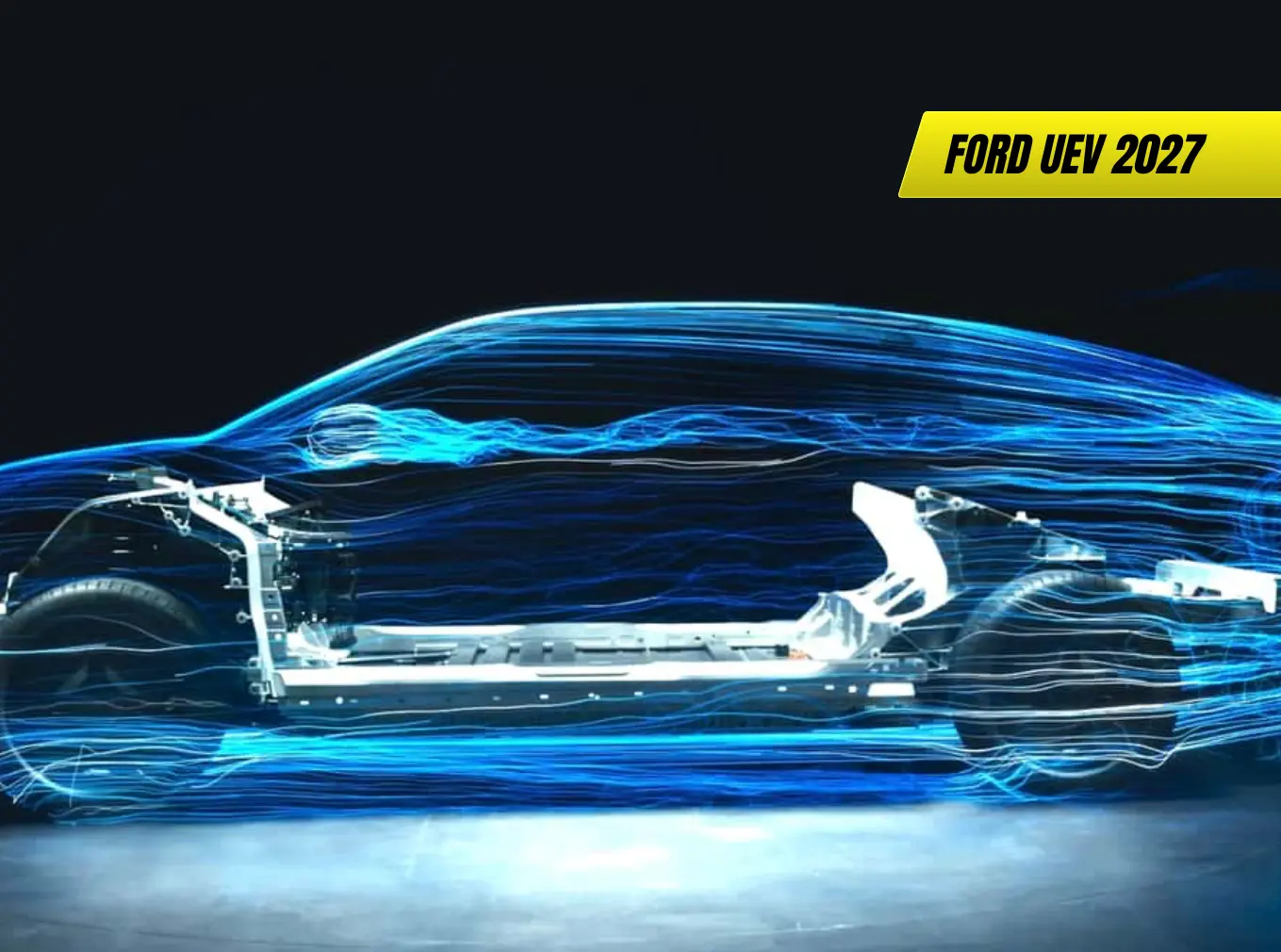
Ford’s most ambitious electric vehicle project in decades, the UEV platform underpins a new mid-size electric pick-up truck starting from approximately £22,000 — positioning it as one of the most affordable electric trucks ever sold in the UK.
Ford has described its new Universal Electric Vehicle (UEV) platform as a “Model T moment” — a once-in-a-generation shift in how it designs, engineers and manufactures cars. The first vehicle to emerge from this entirely new architecture will be a mid-size electric pick-up truck, priced from approximately $30,000 in the United States — roughly £22,000 for UK buyers — and scheduled for production in 2027. For context on what else is arriving in the UK electric market, our best PHEVs for UK drivers guide and the Nissan Qashqai e-Power review are worth reading alongside this.
Ford UEV Electric Pick-Up 2027: Key Highlights
- Starting price of approximately $30,000 in the US — around £22,000 at current exchange rates
- Mid-size four-door pick-up, similar in footprint to the existing Ford Ranger
- Built on the all-new UEV (Universal Electric Vehicle) platform — sharing nothing with existing Ford models
- LFP (lithium iron phosphate) batteries integrated into the vehicle structure as a structural floor
- Wiring harness 1.3 km shorter and 10 kg lighter than Ford’s current electric SUV
- Platform designed to underpin SUVs, crossovers, vans and sedans in future years
- V2H (vehicle-to-home) capability — can power your home for up to six days during a power outage
- Production begins at Ford’s Louisville, Kentucky plant in 2027
Release Date: When Will the Ford UEV Pick-Up Arrive in the UK?
Ford has confirmed 2027 as the production start date for the first UEV platform vehicle in the United States. UK and European availability has not been officially confirmed at the time of writing, but Ford has made clear that the UEV architecture is designed to support global markets, including right-hand drive configurations.
“The numbers tell the story. Take for instance the wiring harness in our new midsize truck — it will be more than 1.3 kilometres shorter and 10 kilograms lighter than the one used in our first-gen electric SUV.” — Jim Farley, Ford CEO
Given Ford’s strong commercial vehicle presence in the UK — the Ranger and Transit remain consistently among the best-selling commercial vehicles in Britain — a UK launch of the UEV pick-up in late 2027 or early 2028 seems commercially logical, though not yet officially confirmed. Keep an eye on the Ford UK official website for confirmed launch timelines.
Price: How Much Will the Ford UEV Pick-Up Cost in the UK?
The $30,000 US base price is the headline figure, and Ford CEO Jim Farley has explicitly referenced the original Ford Model T as the benchmark — a car that democratised personal transport through radical cost reduction. Adjusted for inflation, $30,000 today is approximately equivalent to what the Model T cost when it was introduced over a century ago.
For UK buyers, the price will inevitably be higher once VAT (20%), shipping, homologation costs and right-hand drive conversion are factored in. A realistic UK starting price is estimated at £22,000–£26,000, though this remains speculative until Ford makes an official UK announcement.
| Specification | Detail |
|---|---|
| US Base Price | $30,000 |
| Estimated UK Price | ~£22,000–£26,000 |
| Body Style | Mid-size 4-door pick-up |
| Platform | UEV (Universal Electric Vehicle) |
| Battery Type | LFP (structural integration) |
| Production Start | 2027 (Louisville, Kentucky) |
| UK Availability | TBC — likely late 2027/2028 |
In my experience, American base prices rarely translate directly to UK retail prices without meaningful additions. However, even at £26,000, this would represent the most affordable electric pick-up available in the UK by a considerable margin — the nearest current rival, the BYD Shark PHEV, starts above £50,000.
The UEV Platform: Ford’s Manufacturing Revolution
The UEV platform is not simply a new car — it is a fundamental reimagining of how Ford builds vehicles. Several key innovations distinguish it from anything the brand has produced before:
Unicasting technology: Ford is investing in large-format aluminium casting, reducing the number of separate chassis components by 75% and cutting fasteners and welds by 50%. This is the same technique pioneered by Tesla (the Gigacast process) and subsequently adopted by BMW, and it dramatically reduces manufacturing time, cost and complexity.
Structural battery integration: The LFP battery pack is built directly into the vehicle’s floor structure, performing a dual role as both energy storage and structural chassis member. Ford claims it can achieve the same range with one-third less battery capacity compared to conventional pack designs — a significant reduction in weight and materials cost.
Reduced wiring complexity: The entire electrical architecture has been redesigned from scratch. The wiring harness is 1.3 km shorter and 10 kg lighter than that of the Mustang Mach-E, reducing both manufacturing cost and potential points of failure.
Performance: Faster Than a Turbocharged Mustang
Ford has confirmed that the UEV pick-up will be “faster than a turbocharged Mustang” — a bold claim that positions this affordable truck as a genuine performance vehicle, not merely a utilitarian workhorse. Specific power output and 0–62 mph figures have not yet been published, but the structural battery integration and LFP chemistry suggest a system capable of delivering both strong acceleration and competitive range simultaneously.
For UK drivers used to the performance of current electric pick-ups such as the Ford F-150 Lightning (the closest equivalent), the UEV truck is expected to offer comparable straight-line pace in a significantly smaller, lighter and more affordable package.
Practicality: Built for UK Use
The mid-size footprint — broadly comparable to the existing Ford Ranger — is well suited to UK roads, where full-size American trucks like the F-150 Lightning are impractical for daily use. UK buyers would benefit from:
- Double cab configuration with five full seats
- Flat load bed for commercial and leisure use
- V2H (vehicle-to-home) technology — the ability to power your home from the truck’s battery for up to six days during a power cut, an increasingly relevant feature in the context of UK grid resilience
- Towing and payload capability consistent with the Ranger class, though specific figures have not yet been confirmed
The V2H capability deserves particular attention for UK buyers. As a structural LFP battery of meaningful capacity, the UEV pick-up could serve as a home energy storage device during peak-rate periods or grid outages — a practical benefit that goes well beyond conventional motoring.
Autonomous Driving: Eyes-Off Technology by 2028
Ford has confirmed that the UEV platform will also support eyes-off autonomous driving capability, targeted for introduction from 2028 — placing Ford in direct competition with Tesla’s Full Self-Driving system, General Motors’ Super Cruise and Rivian’s active safety suite. This technology would allow the driver to remove their hands from the wheel and eyes from the road on approved motorway sections — a significant development for long-distance UK motorway users.
Is the Ford UEV Pick-Up ULEZ Compliant?
As a fully electric vehicle, the Ford UEV pick-up would be exempt from ULEZ charges and the London Congestion Charge — important considerations for tradespeople and commercial users operating in urban areas. It would also attract the lowest rate of UK VED road tax applicable to zero-emission vehicles, representing a meaningful saving over equivalent diesel pick-ups. For guidance on UK road charges more broadly, our UK toll roads and charges guide covers everything you need to know.
Ford UEV vs. Current UK Electric Pick-Ups
| Model | Type | Power | Range | UK Price (from) |
|---|---|---|---|---|
| Ford UEV Pick-Up (2027) | Full EV | TBC | TBC | ~£22,000–£26,000 est. |
| Ford Ranger PHEV | Plug-in Hybrid | 326 hp | ~30 miles EV | ~£47,500 |
| BYD Shark | PHEV | 433 hp | ~62 miles EV | ~£50,000 |
| Ford F-150 Lightning | Full EV | 452 hp | ~240 miles | ~£70,000 (import) |
FAQ
When is the Ford UEV electric pick-up coming to the UK?
Ford has confirmed a 2027 US production start. UK availability has not been officially announced, but a late 2027 or 2028 launch seems likely given Ford’s commercial vehicle presence in Britain.
How much will the Ford UEV pick-up cost in the UK?
The US base price is $30,000. UK pricing is estimated at approximately £22,000–£26,000once taxes and market adjustments are included, though no official UK price has been confirmed.
What battery does the Ford UEV pick-up use?
It uses lithium iron phosphate (LFP) batteries, integrated structurally into the vehicle floor. Ford claims this achieves the same range with one-third less capacity than conventional packs.
Can the Ford UEV power my home?
Yes. The pick-up features V2H (vehicle-to-home) technology, capable of powering a typical home for up to six days from a full battery charge.
Is the Ford UEV pick-up faster than a Mustang?
Ford has confirmed it will be “faster than a turbocharged Mustang”, though specific 0–62 mph figures have not yet been published.
What size is the Ford UEV pick-up?
It is classified as a mid-size four-door pick-up, comparable in footprint to the current Ford Ranger — considerably more practical for UK roads than full-size American trucks.
Will the Ford UEV platform underpin other models?
Yes. Ford has confirmed the UEV architecture will eventually support SUVs, crossovers, commercial vans and sedans — making this truck the first of a substantial new family of affordable electric vehicles.
Conclusion
The Ford UEV electric pick-up represents one of the most disruptive product announcements in the UK automotive market in years. If Ford can deliver a genuinely capable, practical mid-size electric pick-up at £22,000–£26,000, it will fundamentally change the accessible EV landscape in Britain — not just for private buyers but for tradespeople, small businesses and fleet operators. The manufacturing innovations underpinning the UEV platform are credible and well-evidenced, and the V2H capability adds a layer of practical utility that no current pick-up in the UK can match. I would strongly recommend keeping this model on your radar — it could prove to be one of the defining cars of the decade.





