
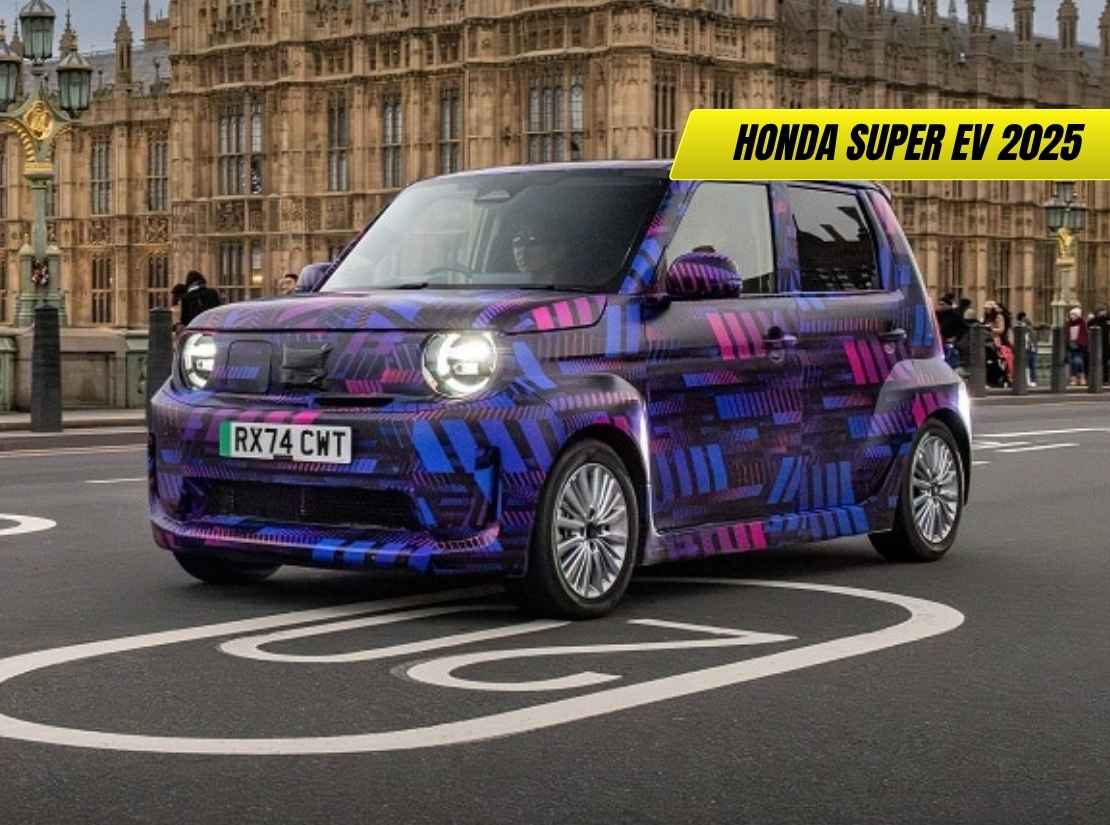
Honda surprises with the Super EV concept, a small electric city car set to rival the upcoming Renault Twingo electric. First glimpse at Goodwood Festival of Speed July 2025.
According to our analysis at AutoHit, the revelation of Honda’s Super EV concept represents one of the most unexpected developments in the small electric car segment that UK buyers could witness in 2025. Having closely followed Honda’s pivot away from small cars after the discontinuation of the Jazz, we never anticipated the Japanese manufacturer would return to the city car market with such apparent determination.
We’ve long advocated that the UK desperately needs affordable, practical electric city cars to accelerate mainstream EV adoption, and Honda’s surprise entry into this segment could fundamentally reshape competition in what’s becoming the industry’s most crucial battleground. With the Renault Twingo electric scheduled for 2026 and Nissan planning its own small EV based on the same platform, Honda’s timing suggests serious intent rather than mere concept car posturing.
The Super EV’s debut at the Goodwood Festival of Speed from July 10-13, 2025, positions Honda perfectly to gauge British market reaction before finalising production plans. For UK buyers seeking affordable electric mobility without compromising on build quality and reliability, Honda’s entry could provide exactly the alternative needed to challenge European dominance in this emerging segment.
Key Highlights of the Honda Super EV Concept
• Segment A positioning: Direct competitor to the upcoming Renault Twingo electric and VW ID.1 • Production reality: Lightly camouflaged prototype suggests near-production readiness • UK debut: First public showing at Goodwood Festival of Speed, July 10-13, 2025 • Improved range: Expected 300-400km capability, significantly better than Honda e’s disappointing 220km • Design evolution: Clear inspiration from Honda e but with more conventional practicality • Strategic importance: Honda’s return to affordable electric vehicles after focusing on hybrids
Honda’s Strategic Surprise: Why Now?
Honda’s decision to develop a small electric city car seems particularly significant given the company’s recent strategic pivot. Having scaled back EV investment from ¥10 trillion to ¥7 trillion by 2031 and openly acknowledged that EVs will comprise less than 30% of global sales by 2030, Honda appeared to be retreating from aggressive electrification.
However, CEO Toshihiro Mibe’s emphasis on needing “more affordable EVs” to increase volumes suggests Honda recognises that expensive electric vehicles won’t drive mainstream adoption. The Super EV concept appears to be Honda’s answer to this challenge – a genuinely affordable electric car that could succeed where the premium-priced Honda e failed dramatically.
Learning from the Honda e Debacle
The Honda e’s failure in European markets provides crucial context for the Super EV’s development. Despite widespread praise for its design and technology, the Honda e’s combination of limited range (220km) and high pricing (£26,160-£28,660) made it commercially unviable for most UK buyers.
The Super EV’s projected 300-400km range represents a substantial improvement that addresses the primary criticism of its predecessor. More importantly, positioning in the affordable city car segment suggests Honda has learned that electric vehicles must offer compelling value propositions rather than relying solely on technological novelty.
Design Evolution: Practical Honda e Heritage
Early images of the Super EV prototype reveal clear design DNA from the beloved Honda e whilst addressing its practical limitations. The oblong front panel incorporating round headlights and charging port maintains the e’s distinctive character, whilst conventional door handles suggest prioritising functionality over futuristic aesthetics.
The wraparound windscreen design and upward-sweeping shoulder line that flows into thick C-pillars create a distinctive silhouette that should appeal to UK buyers seeking characterful city transport. Unlike the Honda e’s rear-wheel-drive exoticism, the Super EV appears designed for mainstream acceptance rather than niche appeal.
Interior and Practicality Focus
While Honda hasn’t revealed interior details, the Super EV’s positioning suggests pragmatic approaches to space utilisation and technology integration. The Honda e’s impressive interior design was undermined by limited rear seat space and minimal luggage capacity – issues that a successful city car must address.
For UK buyers, practical concerns like rear passenger accommodation and shopping capacity will prove crucial. The Super EV’s slightly larger dimensions compared to the Honda e should enable more sensible interior packaging whilst maintaining the distinctive design character that made its predecessor so visually appealing.
Market Positioning: Challenging European Assumptions
The Super EV’s development represents Honda’s direct challenge to European manufacturers’ assumptions about small electric car leadership. With Renault preparing the Twingo electric, Nissan planning its platform-sharing variant, and Volkswagen developing the ID.1, the segment is becoming increasingly competitive.
Honda’s entry brings Japanese reliability reputation to a segment dominated by European brands with historically mixed reliability records in small cars. For UK buyers, this represents potentially significant differentation in build quality, long-term durability, and dealer service standards.
Pricing Strategy: The Crucial Unknown
Success in the small electric car segment depends entirely on competitive pricing. The Renault Twingo electric targets sub-€20,000 (approximately £17,000) pricing, whilst various competitors aim for similar accessibility. Honda must match or undercut these prices whilst maintaining profit margins – a challenge that requires careful cost engineering.
The Honda e’s pricing failure demonstrates that premium positioning doesn’t work in this segment. UK buyers expect small cars to offer exceptional value, and Honda’s reputation for reliability could justify modest premiums only if overall pricing remains competitive with European alternatives.
UK Market Context: Small Car Revival
The Super EV’s potential UK launch coincides with renewed interest in small cars driven by urban emission regulations, parking challenges, and economic uncertainty. London’s expanded ULEZ, similar schemes in other cities, and increasing urban density make compact electric vehicles increasingly attractive for city dwellers.
However, the UK small car market has contracted significantly as manufacturers focused on higher-margin SUVs. The Honda Jazz’s discontinuation, Fiesta’s demise, and limited small car options create opportunities for manufacturers willing to serve this segment properly.
Competition Analysis
The Super EV would compete against established players like the Fiat 500e, Mini Cooper Electric, and upcoming models including the Renault 5 and Twingo electric. Each offers different value propositions: the Fiat emphasises style, Mini focuses on premium appeal, whilst Renault targets affordability.
Honda’s entry could occupy the reliability-focused middle ground, appealing to UK buyers seeking dependable electric transport without premium pricing or style-over-substance compromises. Models we’ve recently tested in the best hybrid cars for city driving demonstrate strong appetite for practical Honda solutions in urban applications.
Technology Expectations: Beyond the Honda e
The Super EV must deliver technology appropriate for its market positioning whilst avoiding the Honda e’s over-specification that inflated costs. Essential features include smartphone integration, basic driver assistance systems, and efficient charging capabilities without unnecessary complexity.
Range charging infrastructure compatibility will prove crucial for UK buyers. The Honda e’s CHAdeMO charging limitation created practical difficulties, so CCS Combo 2 compatibility and reasonable charging speeds (50kW minimum) are essential for mainstream acceptance.
Battery Technology and Range
The projected 300-400km range suggests Honda is targeting real-world capability of 250-300km under typical UK driving conditions. This addresses range anxiety concerns whilst avoiding the cost implications of larger batteries that would compromise affordability.
Honda’s partnership with LG Energy Solution for its 0 Series vehicles could provide technology transfer opportunities for the Super EV’s battery systems, ensuring competitive energy density whilst maintaining cost effectiveness crucial for segment success.
Manufacturing and Launch Timeline
The Super EV’s relatively light camouflage during testing suggests development is well advanced, potentially enabling production launch within 18-24 months of the Goodwood debut. However, Honda’s recent strategy revision and focus on hybrid technology might delay commitments to additional EV models.
UK production seems unlikely given Honda’s limited European manufacturing presence, but Japanese production could enable competitive pricing if currency exchange rates remain favourable. Assembly location will significantly impact final UK pricing and availability timing.
Right-Hand Drive Considerations
Unlike many European competitors, Honda has extensive right-hand drive experience, potentially simplifying UK market entry compared to manufacturers primarily focused on left-hand drive markets. This could provide competitive advantages in launch timing and dealer network preparation.
The Goodwood debut suggests Honda is specifically evaluating UK market reception, indicating serious consideration of right-hand drive production rather than mere concept car exhibition.
Environmental Credentials: More Than Just Electric
Small electric cars offer disproportionate environmental benefits due to reduced material usage, lower energy consumption, and urban emission reduction where air quality matters most. The Super EV’s city car positioning maximises these benefits whilst minimising the resource intensity of larger EVs.
For environmentally conscious UK buyers, small electric cars represent more sustainable transport choices than larger EVs that require substantial battery capacities for highway range. Urban-focused electric vehicles align better with actual usage patterns whilst reducing environmental impact.
Strategic Implications: Honda’s EV Future
The Super EV represents Honda’s recognition that successful EV strategies require diverse model portfolios rather than focusing solely on premium offerings. The company’s stated goal of increasing volumes through affordable EVs suggests the Super EV could become strategically important for European market success.
Honda’s 0 Series represents the premium end of its EV strategy, whilst the Super EV would anchor the affordable segment. This two-pronged approach mirrors successful market strategies from manufacturers who’ve maintained broad model portfolios rather than niche positioning.
Global Platform Potential
The Super EV’s platform could support multiple variants and markets, spreading development costs across higher volumes. Honda’s global presence enables platform sharing opportunities that purely European manufacturers cannot match, potentially providing cost advantages crucial for competitive pricing.
Success in Europe could justify expansion to other markets seeking affordable electric transport, particularly in Asia where Honda maintains strong positions and small cars remain popular.
UK Infrastructure Readiness
The UK’s expanding charging infrastructure makes small electric cars increasingly viable for buyers previously concerned about range limitations. Urban charging network growth particularly benefits city car users who lack home charging capabilities.
The Super EV’s expected range should comfortably handle typical UK urban driving whilst providing sufficient buffer for occasional longer journeys. This addresses the primary practical concern about small electric cars whilst maintaining cost advantages over larger, longer-range alternatives.
Industry Context: Small Car Renaissance
The Super EV’s development reflects broader industry recognition that small electric cars represent crucial volume opportunities rather than niche products. Chinese manufacturers’ success with affordable EVs has demonstrated market appetite for practical electric transport without premium pricing.
European manufacturers’ renewed focus on small electric cars, exemplified by the Renault 5 and upcoming Twingo, creates competitive pressure that benefits UK buyers through improved choice and pricing. Honda’s entry intensifies this competition whilst adding reliability reputation to the mix.
Frequently Asked Questions
When will the Honda Super EV be available to buy in the UK?
Honda hasn’t confirmed production plans for the Super EV, though the lightly camouflaged prototype suggests near-production readiness. The concept debuts at Goodwood Festival of Speed from July 10-13, 2025, where Honda will likely gauge UK market reaction. If production proceeds, expect a 2026-2027 UK launch to compete with the Renault Twingo electric and other small EVs. Honda’s decision will depend on market research and the company’s broader EV strategy revision following recent investment scaling back.
How much will the Honda Super EV cost compared to competitors?
While Honda hasn’t announced pricing, successful city cars must compete with the Renault Twingo electric’s sub-€20,000 (£17,000) target price. The Honda e’s failure at £26,160-£28,660 demonstrates that premium pricing doesn’t work in this segment. Honda must balance its reputation for quality with competitive pricing, likely targeting £18,000-£22,000 to justify modest premiums over European rivals whilst remaining accessible to urban buyers seeking affordable electric transport.
What range will the Honda Super EV offer in real-world UK driving?
Honda expects 300-400km range, representing substantial improvement over the Honda e’s disappointing 220km capability. In real-world UK conditions, this translates to approximately 250-320km depending on weather, driving style, and terrain. This range comfortably handles urban commuting and local journeys whilst providing adequate buffer for occasional longer trips. The projected capability addresses range anxiety concerns that affected Honda e sales whilst avoiding the larger batteries that would compromise affordability.
How does the Super EV differ from the failed Honda e?
The Super EV appears designed to address every Honda e weakness: improved range (300-400km vs 220km), conventional door handles for practicality, likely lower pricing targeting affordability rather than premium positioning, and positioning as a mainstream city car rather than niche lifestyle vehicle. While maintaining Honda e design DNA through round headlights and distinctive styling, the Super EV prioritises practical usability over futuristic novelty that limited Honda e’s market appeal.
Will the Honda Super EV be reliable compared to European rivals?
Honda’s reputation for reliability and build quality could provide significant advantages over European small car manufacturers who’ve historically struggled with long-term durability in this segment. Japanese manufacturing standards and Honda’s extensive small car experience suggest potentially superior ownership experience compared to newer electric vehicle manufacturers. However, EV reliability depends heavily on battery technology and software integration, areas where Honda must prove competency after the Honda e’s mixed technological reception.
What charging capabilities will the Honda Super EV offer?
Learning from Honda e’s CHAdeMO charging limitations, the Super EV likely features CCS Combo 2 compatibility standard across Europe. Expect 50kW+ DC fast charging for reasonable top-up times and 7-11kW AC charging for home and workplace use. The smaller battery required for city car range enables faster charging times relative to capacity, making the Super EV practical for urban drivers who rely on public charging infrastructure rather than home installations.
How will the Honda Super EV compete against the Renault Twingo electric?
The Super EV targets similar buyers but emphasises Honda’s reliability reputation versus Renault’s design flair and affordability focus. Both target urban drivers seeking practical electric transport, but Honda could appeal to buyers prioritising long-term durability and dealer service quality over absolute lowest pricing. Success depends on Honda matching Renault’s pricing competitiveness whilst delivering tangible quality advantages that justify any premium. The competition benefits UK buyers through improved choice and innovation in affordable electric vehicle segments.
Our Verdict: Promising Surprise with Execution Questions
The Honda Super EV concept represents exactly the sort of practical electric vehicle that the UK market needs – affordable, reliable, and properly engineered for real-world city use. Honda’s decision to return to small cars after the Jazz discontinuation signals recognition that successful EV strategies require broad model portfolios rather than niche premium positioning.
The concept addresses virtually every criticism of the Honda e: improved range, conventional practicality, and apparent focus on affordability over technological showboating. If Honda can deliver competitive pricing whilst maintaining its reputation for reliability and build quality, the Super EV could establish a compelling niche in the expanding small electric car segment.
However, significant questions remain about Honda’s commitment to production and UK availability. The company’s recent EV strategy scaling back and hybrid focus suggest internal uncertainty about electric vehicle priorities. The Goodwood debut represents market research rather than production confirmation, and Honda’s final decision will depend on European market reception and broader strategic considerations.
For UK buyers, the Super EV’s potential represents welcome competition in a segment currently dominated by European manufacturers with mixed reliability records. Honda’s entry could drive innovation and competitive pricing whilst offering the dependability that many buyers prioritise over cutting-edge technology or fashionable design.
The small electric car segment is experiencing unprecedented competition as manufacturers recognise its volume potential and regulatory necessity. Honda’s surprise entry with the Super EV intensifies this competition whilst bringing Japanese engineering standards to a market segment that could benefit enormously from improved reliability and practical design. Whether Honda commits to production will determine if UK buyers gain access to this potentially compelling alternative to European city car offerings.
Most importantly, the Super EV demonstrates that successful electric vehicles don’t require radical departures from conventional automotive wisdom – they need practical solutions to real-world transport requirements at accessible prices. If Honda executes this vision successfully, the Super EV could achieve the mainstream electric vehicle acceptance that the premium-positioned Honda e notably failed to deliver.





