
A step-by-step guide to fuel pump replacement for UK drivers — covering symptoms, safety precautions, costs and when to call a professional.
A failing fuel pump is one of those faults that can leave you stranded without warning — yet it almost always gives clear warning signs in the days or weeks before it fails completely. Understanding what a fuel pump does, recognising the symptoms of imminent failure, and knowing how to replace it safely can save you the cost of a breakdown recovery call and a significant garage bill. This guide covers everything UK drivers need to know about fuel pump diagnosis and replacement on modern petrol and diesel vehicles.
Key Points
- The fuel pump delivers pressurised fuel from the tank to the engine — a failing pump causes hard starting, power loss and stalling
- Most modern UK cars use an in-tank electric fuel pump — replacement requires accessing the fuel tank
- Working on fuel systems involves serious fire and health hazards — correct safety precautions are non-negotiable
- Replacement costs range from approximately £80 DIY (parts only) to £400 at a UK garage
- Always replace the fuel filter at the same time — a blocked filter is often the cause of premature pump failure
- Diesel high-pressure injection pumps are a separate, specialist component — this guide covers the low-pressure lift pump only
How the Fuel Pump Works
On virtually all modern UK petrol cars and most diesels, the electric fuel pump is located inside the fuel tank — an arrangement known as an in-tank pump. The pump is submerged in fuel, which keeps it cool and lubricated during operation. It draws fuel from the tank and delivers it at a regulated pressure — typically 3–5 bar on petrol injection systems — to the fuel rail and injectors via a fuel filter.
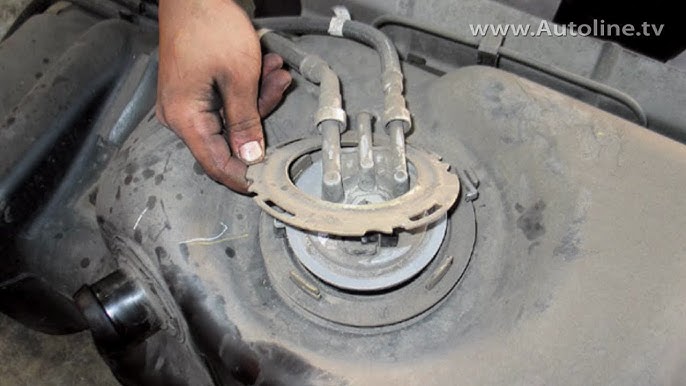
The pump unit on most UK cars is part of a fuel sender assembly that also incorporates the fuel level float and sender, the strainer (pre-filter), and the pump itself — all mounted on a single plastic carrier that fits into the top of the tank through a large threaded or twist-lock ring. On some vehicles, the pump is a separate component inside the tank, but the sender assembly replacement approach remains the same.
Symptoms of a Failing Fuel Pump
A fuel pump rarely fails without warning. Recognising these signs early means the difference between a planned repair and an unexpected breakdown:
- Hard or extended cranking before the engine starts — particularly noticeable on first start of the day as the system struggles to build pressure
- Engine hesitation or stumbling under load — when accelerating or climbing hills, insufficient fuel pressure causes a lean misfire
- Loss of power at high speed or under hard acceleration — the pump cannot sustain adequate flow at maximum demand
- Engine cutting out at speed — the pump fails intermittently under heat or load before failing completely
- Engine stalling and failing to restart when hot — heat causes a failing pump to lose efficiency temporarily
- Whining or buzzing noise from the rear of the car (where the tank is located), especially when the fuel level is low
- Engine management warning light — a fuel system fault code may be stored if the ECU detects incorrect fuel pressure
From my experience, the most reliable early warning sign is an unusual whining noise from the rear of the car combined with slightly extended cranking times. These two symptoms together almost always point to a fuel pump approaching end of life — and acting on them before a complete failure avoids the cost and inconvenience of a breakdown. If your warning light is also on, our guide to the spanner warning light and what it means for UK drivers explains how fuel system fault codes are logged and interpreted.
Safety First: Working With Fuel Systems
Working on a fuel system carries genuine fire and health risks that must be taken seriously. Petrol vapour is heavier than air, highly flammable and toxic. Before starting any fuel pump work:
- Work outdoors or in a very well-ventilated area — never in an enclosed garage with power tools running
- Disconnect the negative battery terminal before starting
- No smoking, no naked flames, no sparks in the work area — this includes power tools with brushed motors
- Have a dry powder or CO₂ fire extinguisher within reach
- Run the engine until it stalls (with fuel pump fuse removed) before starting work, to depressurise the fuel system
- Wear nitrile gloves — prolonged skin contact with petrol is a known carcinogen
- Have absorbent rags ready for fuel spillageIn the UK, petrol is classified as a Category 1 Flammable Liquid under the Dangerous Substances and Explosive Atmospheres Regulations (DSEAR). Treating it with appropriate respect is a legal and practical obligation.
Tools and Parts You Will Need
| Item | Notes |
|---|---|
| Replacement fuel pump / sender assembly | Match to exact vehicle — fuel level sender must match instrument cluster calibration |
| New fuel filter | Replace simultaneously — a blocked filter causes premature pump failure |
| Fuel pump lock ring tool or spanner wrench | Specific to the tank lock ring diameter — available from motor factors |
| Torque wrench | Lock ring must be torqued correctly to prevent fuel leaks |
| Fuel line disconnect tools | Plastic quick-release clips on fuel lines require specific push-fit tools |
| Large flat container or tray | To catch residual fuel from the tank neck |
| Absorbent rags and disposal bags | For safe fuel handling |
| Penetrating spray | For corroded lock ring threads — common on UK cars |
| Masking tape and marker | To mark fuel line orientations before disconnection |
Step-by-Step: Replacing an In-Tank Fuel Pump
Access routes to the fuel pump vary between vehicles. On most UK hatchbacks and saloons, the pump is accessed by lifting the rear seat cushion or removing a trim panel in the boot floor. On some vehicles, the fuel tank must be partially or fully lowered.
- Run the fuel level as low as practical before starting — a nearly empty tank significantly reduces the weight and volume of fuel to handle
- Disconnect the negative battery terminal and remove the fuel pump fuse from the fusebox as an additional precaution
- Depressurise the fuel system — on vehicles without a Schrader valve, start the engine with the fuel pump fuse removed and allow it to stall, then crank briefly to clear residual pressure
- Access the pump — lift the rear seat base or remove the boot floor trim panel to expose the pump access cover. Remove the cover retaining screws
- Disconnect the electrical connector from the pump sender unit — press the retaining tab and pull firmly
- Disconnect the fuel lines — use the correct push-fit disconnect tools and have rags ready. Mark each line’s position before removal (feed and return lines must not be swapped)
- Remove the lock ring using the correct spanner wrench, turning anticlockwise. Apply penetrating fluid if corroded — a seized lock ring is one of the most common complications of this job on older UK cars
- Carefully lift the pump/sender assembly straight upward — tilt it as required to clear the tank opening without bending the float arm. Have a tray ready for residual fuel
- Note the orientation arrow on the pump flange — the new unit must be installed at exactly the same rotational position for the float arm to read correctly
- Lower the new pump assembly into the tank carefully, aligning the arrow with the mark on the tank
- Refit the lock ring and torque to the manufacturer’s specification — typically 65–90 Nm. Use a new sealing ring — never reuse the old one
- Reconnect the fuel lines (confirming correct feed and return positions) and the electrical connector
- Refit the access cover, reconnect the battery and refit the fuel pump fuse
- Turn the ignition to position 2 (without starting) for 5–10 seconds to allow the pump to prime the system, then start the engine. Check immediately for fuel leaks at the tank connection
In-Tank vs External Fuel Pump: Key Differences
| In-Tank Fuel Pump | External (Inline) Fuel Pump | |
|---|---|---|
| Location | Inside the fuel tank | Along the fuel line, under the car |
| Common on | Most post-1990 UK petrol and diesel cars | Older vehicles, some performance cars |
| Cooling method | Cooled by surrounding fuel | Air cooled |
| DIY access | Via seat or boot floor (usually) | Along underbody fuel line |
| Failure risk from low fuel | High — running on empty overheats the pump | Lower |
| Replacement complexity | Moderate | Moderate |
One of the most important pieces of advice for UK drivers is to avoid running the fuel tank below a quarter full as a habit. In-tank pumps rely on surrounding fuel for cooling — running the tank dry repeatedly is one of the most common causes of premature pump failure, as the pump overheats and degrades the internal brushes and impeller far faster than normal.
Fuel Pump Replacement Costs in the UK
| Vehicle Type | Typical Garage Cost | DIY Parts Cost |
|---|---|---|
| Small petrol hatchback | £150–£280 | £40–£90 |
| Family hatchback / saloon | £180–£320 | £50–£110 |
| Premium brand (BMW, Audi, Mercedes) | £250–£450 | £80–£180 |
| Diesel (lift pump only) | £150–£300 | £40–£100 |
| High-pressure diesel injection pump | £600–£2,000+ | Not DIY recommended |
Prices are approximate 2026 UK market estimates. Always request a written itemised quote and confirm whether the fuel filter is included.
If your vehicle is also showing symptoms related to fuel quality or injector condition alongside pump faults, our guide on EGR valve replacement covers related diesel fuel system maintenance in detail. For diesel vehicles affected by DPF issues linked to fuel system performance, our DPF cleaning guide is also relevant.
DIY or Professional Replacement?
In-tank fuel pump replacement is an intermediate DIY job that is achievable for a mechanically confident home mechanic, provided the safety precautions above are strictly followed. The main complications are a seized lock ring (extremely common on older UK cars), incorrect orientation of the new pump unit causing inaccurate fuel gauge readings, and swapped fuel lines.
I would recommend this as a DIY job for mechanics who have previous experience with fuel system work, have the correct lock ring tool for their vehicle, and are comfortable working safely with petrol vapour. Anyone unsure about fuel system safety should have this work carried out professionally — the consequences of a fuel leak near an ignition source are severe. The UK government’s DSEAR guidance provides clear information on safe handling of flammable liquids in practical settings.
How do I know if my fuel pump has failed completely?
A completely failed pump presents as an engine that cranks normally but will not fire. You can confirm a failed pump by listening for the brief priming hum from the rear of the car when you turn the ignition to position 2 — if there is no sound, the pump has likely failed. Check the fuel pump fuse and relay first before condemning the pump.
Can I drive with a failing fuel pump?
Not reliably. A failing pump may allow the car to start and run intermittently but will stall without warning — particularly at speed or under load. This is dangerous in traffic or on a motorway. Have the vehicle repaired promptly once symptoms are confirmed.
How long does a fuel pump last on a UK car?
Most in-tank fuel pumps last between 100,000 and 150,000 miles under normal conditions. Regularly running the tank below a quarter full, using contaminated fuel, or running the tank completely dry all reduce pump lifespan significantly.
Should I replace the fuel filter at the same time?
Yes, always. A blocked or restricted fuel filter forces the pump to work harder, generating more heat and accelerating wear. On many modern UK cars, the filter is integrated into the pump sender assembly and is replaced as part of the same unit. On vehicles with a separate inline filter, it should always be replaced simultaneously.
Is fuel pump replacement covered under a used car warranty?
Most used car warranties cover the fuel pump as a mechanical component. Check the policy wording for exclusions — some policies exclude wear items or have a single-claim limit that may not cover the full cost of a pump and filter replacement. For UK consumer rights on used vehicle warranties, Citizens Advice provides useful guidance.
What causes a fuel pump to fail prematurely?
The most common causes are running the tank on low fuel repeatedly (overheating the pump), using contaminated or water-affected fuel, a blocked fuel filter increasing pump strain, and normal wear on high-mileage vehicles. On some vehicles, age-related degradation of the pump’s internal plastic components is also a factor.
Will a faulty fuel pump cause an MOT failure?
Not directly — fuel pumps are not tested at MOT. However, an engine that will not start or runs poorly due to fuel pressure issues will prevent the emissions test from being completed, which results in an MOT failure. An illuminated engine management warning light caused by a fuel system fault code is also an automatic failure.
Conclusion
Fuel pump replacement is a repair that rewards early action — catching the early symptoms of a failing pump and replacing it before a complete failure avoids breakdown costs and the added stress of being stranded. For most UK petrol cars, in-tank pump replacement is a manageable intermediate DIY job with the right tools and strict adherence to fuel safety procedures. The golden rules are straightforward: always depressurise the system before opening any fuel connections, never reuse the tank sealing ring, note the pump orientation before removal, and replace the fuel filter simultaneously. In my experience, drivers who combine pump replacement with a full fuel system inspection — including filter condition and injector cleanliness — get significantly better post-repair performance and reliability than those who address only the pump in isolation. For related engine maintenance, our guides on ignition coil replacement and water pump replacement cover the other high-priority components on high-mileage UK engines.





