
A step-by-step guide to wheel bearing replacement for UK drivers — covering symptoms, costs, tools and when to seek professional help.
A worn wheel bearing is one of those faults that starts as a minor annoyance and quickly becomes a serious safety hazard. The characteristic humming or rumbling noise that grows with speed is one of the most common reasons UK drivers visit a garage unplanned — yet with the right knowledge and tools, the replacement is well within reach of a confident home mechanic. This guide covers everything you need to know about identifying, replacing and correctly torquing a wheel bearing on a modern UK car.
Key Points
- Wheel bearings allow your wheels to rotate smoothly on the axle — a worn bearing causes noise, vibration and instability
- The most common symptom is a low, rumbling hum that changes pitch or intensity when you change lane or corner
- Most modern UK cars use a sealed hub bearing assembly (HBA) — no repacking or adjustment required
- Replacement costs range from approximately £80 to £300 per corner depending on vehicle and garage
- Always replace bearings one side at a time to maintain a reference point — never both simultaneously
- A failed wheel bearing is an MOT failure and, in severe cases, can cause wheel separation at speed
What Is a Wheel Bearing and How Does It Work?
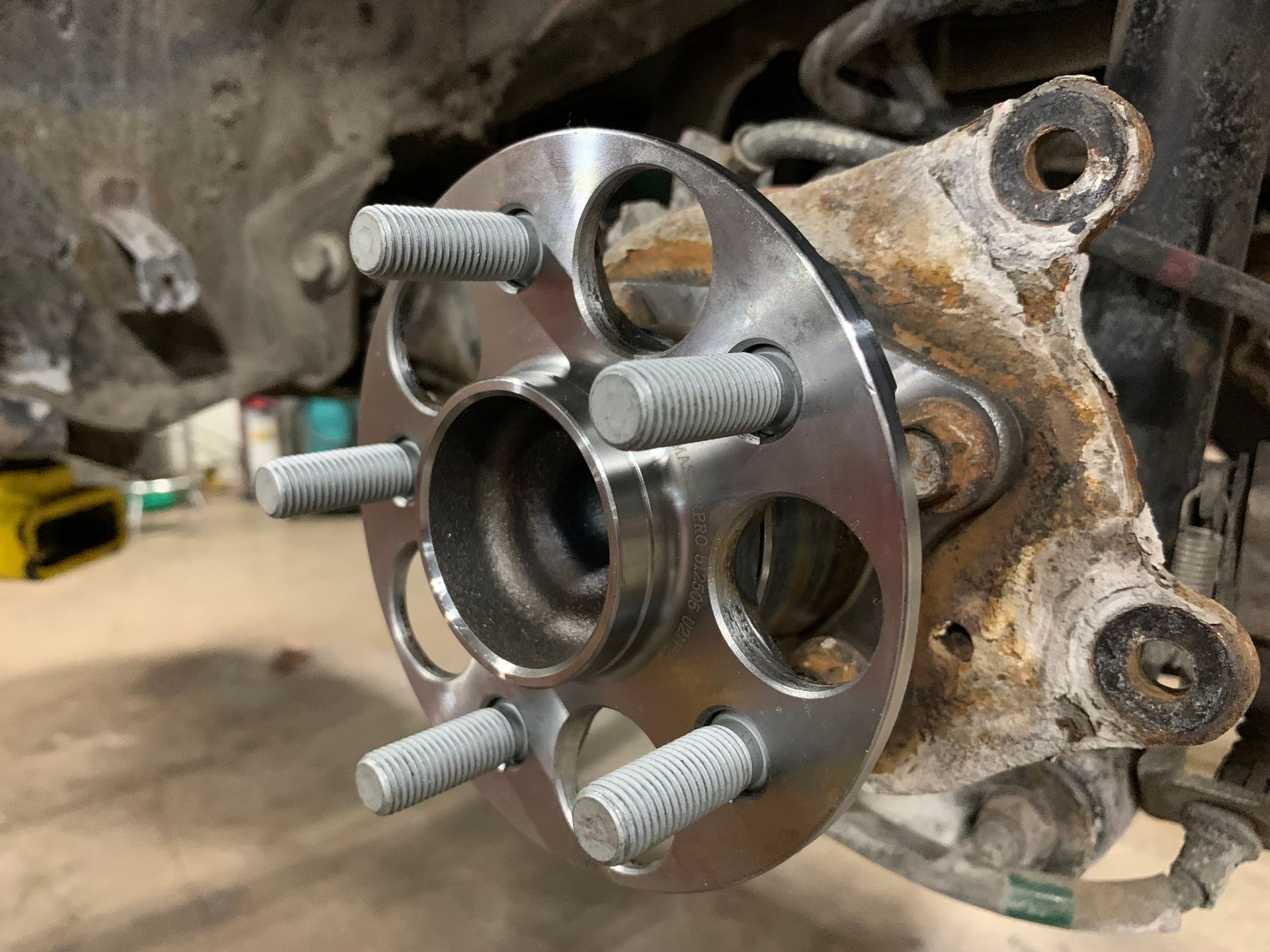
A wheel bearing is a set of precision steel balls or rollers housed within a sealed ring assembly, mounted between the wheel hub and the axle stub. Its function is to allow the wheel to rotate freely with minimal friction while carrying the full weight of the vehicle and withstanding the lateral forces generated during cornering. On most modern UK passenger cars, the bearing is integrated into a hub bearing assembly (HBA) — a sealed, pre-greased unit that bolts directly to the upright and requires no maintenance until it fails.
Older vehicles — and some commercial or performance cars — use tapered roller bearings that can be removed, cleaned, repacked with grease, and adjusted for preload. These are increasingly rare on new UK-registered passenger cars. If you are unsure which type your car uses, check the vehicle’s service manual or consult the parts catalogue for your specific make and model.
Symptoms of a Failing Wheel Bearing
Recognising the early signs of wheel bearing wear can prevent the fault from progressing to a dangerous or very costly failure. Watch for these indicators:
- Humming, rumbling or growling noise — the most distinctive symptom, typically loudest between 40–70 mph and varying with speed
- Noise changes when cornering — the sound increases when load shifts onto the worn bearing (e.g. humming louder when turning right usually indicates a worn left-front bearing)
- Vibration through the steering wheel or floor — felt at motorway speeds, often dismissed as a tyre imbalance issue
- Wheel play or looseness — rocking the jacked-up wheel at the 12 and 6 o’clock positions reveals vertical play in a worn bearing
- ABS or traction control warning light — many modern sealed hub assemblies incorporate the ABS wheel speed sensor; a failed bearing can corrupt the sensor signal and trigger dashboard warnings
- Uneven tyre wear — a loose bearing allows the wheel to run at a slight angle, causing edge wear
In my experience, the cornering test is the most reliable quick diagnosis tool available without specialist equipment. If the hum noticeably increases when you gently swerve to the left on a clear road, the right-side bearing is suspect — and vice versa.
Types of Wheel Bearing: Which Does Your Car Use?
| Type | Description | Common On |
|---|---|---|
| Hub Bearing Assembly (HBA) | Sealed, pre-greased unit — replace as a whole | Most post-2000 UK passenger cars |
| Tapered Roller Bearing | Serviceable, adjustable — requires repacking | Older vehicles, some commercials |
| Ball Bearing (press-fit) | Pressed into hub carrier — requires puller to remove | Some European models (VW Group, etc.) |
The HBA type is by far the most common on UK roads today and the simplest to replace — it bolts off and bolts on. Press-fit bearings require a hydraulic press or bearing puller and are better suited to a professional workshop unless you have access to the correct equipment.
Tools and Parts You Will Need
| Item | Notes |
|---|---|
| Replacement hub bearing assembly | Confirm front or rear, and driver’s or passenger’s side |
| Torque wrench and socket set | Hub nut torque is critical — typically 150–250 Nm |
| Large socket or hub nut socket | Hub nuts are large (often 32–36 mm) and very tight |
| Breaker bar | Essential for releasing the hub nut |
| Ball joint separator | Required if the lower ball joint or track rod end must be disconnected |
| Rubber mallet | For persuading stubborn hub assemblies |
| Penetrating spray (WD-40 or equivalent) | For corroded bolts — common on UK cars |
| Copper grease | Apply to mating surfaces and threads only |
| Jack, axle stands, wheel brace | Always work on axle stands — never a trolley jack alone |
The hub nut on most UK cars is a single-use, staked nut — it must always be replaced with a new one. Reusing a staked or deformed hub nut risks it loosening in service, which can cause wheel separation.
Step-by-Step: Replacing a Front Hub Bearing Assembly
This guide covers the standard front HBA replacement — the most common procedure on modern UK cars. Rear bearing replacement follows a similar process but may require disconnecting the driveshaft on driven rear axles.
- Loosen the wheel nuts and the hub nut (centre of the wheel) slightly while the car is still on the ground — the hub nut is very tight and the wheel needs to be grounded to resist rotation. Use a breaker bar with the correct socket size
- Jack the vehicle and place it on axle stands. Remove the wheel
- Fully remove the hub nut — this is the large central nut retaining the driveshaft. Set it aside but note it must be replaced with a new nut
- Remove the brake calliper (two guide pin bolts) and hang it safely from the spring using a wire hook — do not allow it to hang by the brake hose. Remove the brake disc
- Disconnect the ABS sensor connector from the hub assembly if present — unclip carefully to avoid damage to the wiring loom
- Remove the hub bearing assembly bolts — typically three or four bolts at the rear of the upright. Apply penetrating fluid if corroded
- Pull the hub assembly off the driveshaft splines — this may require gentle taps with a rubber mallet. If it is firmly seized, use a hub puller rather than excessive force
- Clean the upright mating surface thoroughly with a wire brush and brake cleaner before fitting the new unit
- Slide the new hub bearing assembly onto the driveshaft splines, aligning the bolt holes with the upright
- Fit and torque the mounting bolts to the manufacturer’s specification — typically 60–80 Nm for hub carrier bolts
- Reconnect the ABS sensor, refit the brake disc and calliper
- Fit a new hub nut and torque to specification — typically 150–250 Nm depending on vehicle. Stake or lock as required
- Refit the wheel, lower the car and perform a final torque check on the wheel nuts
Front vs Rear Bearing Replacement: Key Differences
| Front Wheel Bearing | Rear Wheel Bearing | |
|---|---|---|
| Driveshaft present? | Yes (on FWD/AWD) | Yes (on RWD/AWD); No on FWD rear |
| Brake calliper removal required? | Usually yes | Usually yes |
| ABS sensor integrated? | Commonly yes | Commonly yes |
| Additional disconnections? | Sometimes track rod end | Sometimes suspension arm |
| DIY difficulty | Intermediate | Intermediate to Advanced |
Rear wheel bearings on a front-wheel-drive car (such as a Ford Focus or Vauxhall Astra) are often simpler to replace because there is no driveshaft to contend with. Rear bearings on rear-wheel-drive or all-wheel-drive vehicles add the complication of a driven rear axle and, in some cases, require disconnecting the rear suspension geometry — which then requires a full alignment check afterwards.
If you are also carrying out suspension work at the same time, it is worth inspecting your strut top bearings and track rod ends simultaneously to reduce total labour time and avoid disturbing components twice.
Wheel Bearing Replacement Costs in the UK
| Vehicle Type | Average Garage Cost (per corner) | Parts Only |
|---|---|---|
| Small hatchback (e.g. Ford Fiesta, VW Polo) | £80–£150 | £25–£60 |
| Family hatchback (e.g. Golf, Astra, Focus) | £100–£180 | £30–£80 |
| Premium brand (BMW, Audi, Mercedes) | £150–£300 | £50–£130 |
| SUV or 4×4 | £130–£250 | £40–£100 |
| Press-fit bearing (specialist required) | £150–£350 | £20–£50 |
Prices are approximate 2026 UK market estimates and include parts and labour. Always request a written quote.
For reference, the UK government’s MOT testing standards assess wheel bearing play as part of the standard suspension and steering check — excessive free movement at the wheel is an automatic failure.
DIY or Professional Replacement?
Front hub bearing assembly replacement on most modern UK cars is a realistic intermediate DIY job. The main requirements are: a good torque wrench, a breaker bar capable of releasing a very tight hub nut, and the patience to deal with corrosion that is almost inevitable on UK cars exposed to road salt and wet conditions. Press-fit bearings are a different matter — without a hydraulic press, they cannot be safely installed to the correct fit.
I would recommend this as a DIY job for mechanics who have previously tackled brake calliper or suspension work, provided the bearing type is an HBA bolt-on unit. Always replace hub nuts with new ones and torque everything to specification — an undertorqued hub nut can back off in service with catastrophic consequences. For authoritative guidance on vehicle safety standards in the UK, Thatcham Research provides useful context on how mechanical failures are assessed in safety testing.
How do I know which wheel bearing has failed?
The cornering test is the most reliable method without equipment. If the humming noise increases when you swerve gently to the right, weight transfers to the left and loads the left bearing — meaning the right bearing is more likely the problem, and vice versa. A garage can confirm using a stethoscope or by monitoring ABS sensor data.
Can I drive with a worn wheel bearing?
Briefly and at low speed to reach a garage — but not further. A severely worn bearing can overheat, seize, or cause the wheel hub to separate from the upright. At motorway speeds, this is potentially fatal. The vehicle should be repaired as a matter of urgency.
Do wheel bearings need to be replaced in pairs?
Unlike brake components, wheel bearings do not strictly need to be replaced in pairs — they can fail independently. However, if both bearings are high mileage, replacing both at the same visit makes economic sense as the labour cost per side is reduced significantly.
How long does a wheel bearing last?
Most sealed hub bearing assemblies on UK cars last between 80,000 and 150,000 miles under normal conditions. Road salt, pothole impacts, incorrect tyre pressures and overloading all accelerate wear significantly.
Will a noisy wheel bearing fail an MOT?
A humming noise alone may not cause a failure, but the play it produces in the wheel hub will. MOT inspectors rock each wheel to check for bearing play — any detectable looseness results in a failure. A severely worn bearing may also trigger an ABS warning light, which is a separate MOT failure point.
Is a wheel bearing the same as a hub bearing assembly?
They refer to the same component on most modern cars. The hub bearing assembly is a sealed unit that integrates the bearing, hub flange and (often) the ABS sensor ring into one pre-assembled component. On older vehicles, the bearing and hub were separate components that could be individually replaced.
What happens if I ignore a worn wheel bearing?
Progressive wear causes the bearing to develop more play, generating heat and further accelerating deterioration. In the worst case, the bearing can seize or the hub can crack, causing wheel detachment at speed. Well before that point, the fault will cause an MOT failure and the associated tyre wear will cost more than the bearing replacement itself.
Conclusion
A wheel bearing is a small and inexpensive component whose failure carries disproportionately large consequences for safety, tyre wear, and MOT compliance. Catching the characteristic hum early — and acting on it before the play becomes severe — is always the most cost-effective approach. For most modern UK cars, the sealed hub bearing assembly is a straightforward bolt-on replacement that a competent home mechanic can complete in a couple of hours with basic tools. The critical steps are sourcing the correct unit for your specific vehicle, torquing everything to specification, and always fitting a new hub nut. Combined with a broader suspension check — including brake callipers and track rod ends — a wheel bearing replacement is an excellent opportunity to restore your car’s overall safety and refinement in a single workshop session.





